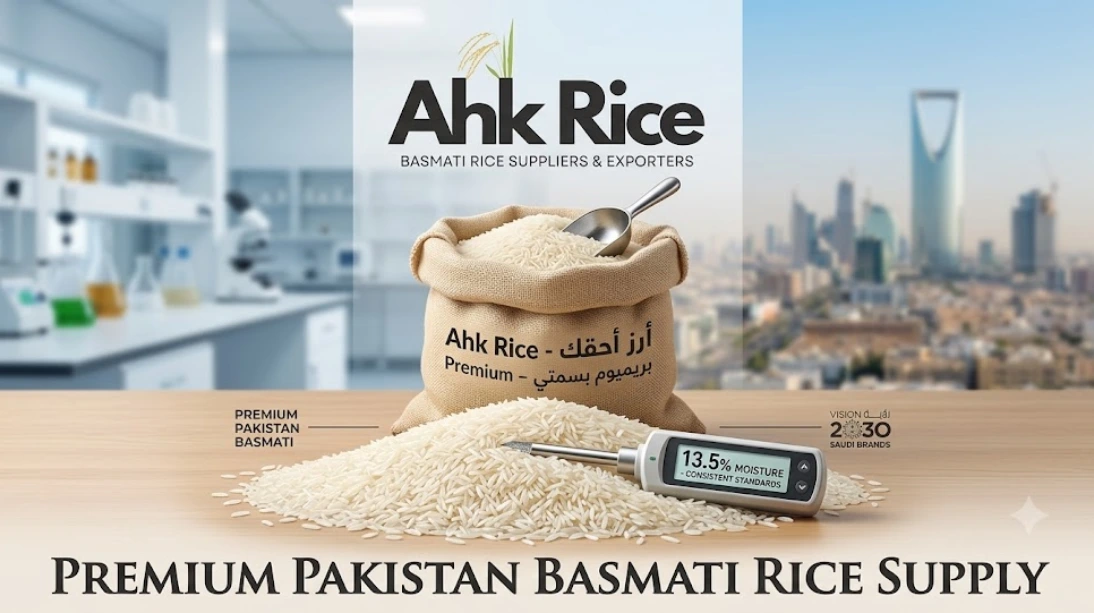
Premium Pakistan Basmati Rice Supply with Consistent Moisture Standards for Saudi Brands
Saudi rice brands that want stable product quality should first understand why lower and controlled moisture matters during export by reading our guide on:
Why premium Saudi brands choose Pakistani Basmati with optimised moisture levels. Buyers comparing different export grades can also explore our detailed comparison of:
1121, 1509, and Super Kernel moisture performance for the Saudi market. When your purchasing decision is ready, AHK Rice provides premium Pakistan Basmati rice through its Saudi Arabia export service with documented moisture standards, quality inspections, and shipment planning designed for commercial importers.
Saudi Arabia remains one of the world’s largest import markets for premium Pakistan Basmati rice in 2026. Retail brands, food distributors, private-label companies, wholesalers, and hospitality suppliers expect every shipment to deliver identical cooking performance. Moisture consistency directly affects shelf life, grain appearance, aroma retention, breakage rates, and customer satisfaction. A supplier capable of maintaining controlled moisture throughout procurement, processing, packaging, storage, and shipping reduces commercial risk while improving product consistency. AHK Rice follows export procedures designed to meet these expectations with documented quality control at every stage.
What is the best solution for maintaining consistent moisture standards in Pakistan Basmati rice for Saudi brands?
The most reliable solution is partnering with an exporter that controls moisture from paddy procurement through processing, laboratory testing, packaging, storage, and container loading. Consistent moisture reduces quality variations, protects grain integrity during shipping, supports longer shelf life, and improves cooking performance across every commercial shipment delivered to Saudi Arabia.
Many import problems begin long before a container reaches Saudi Arabia. Moisture variation often occurs because different batches are mixed without proper testing, rice is stored under uncontrolled warehouse conditions, or packaging takes place before moisture stabilization. Even small inconsistencies can create different cooking characteristics between production lots.
AHK Rice applies moisture verification throughout the production cycle instead of relying on a single inspection before export. Each production stage is monitored to reduce fluctuations between batches. This approach supports commercial buyers who need uniform products across multiple container orders.
The process normally includes:
- Paddy inspection after procurement.
- Controlled drying before milling.
- Moisture testing after milling.
- Quality grading and sorting.
- Final moisture verification before packing.
- Warehouse monitoring before shipment.
- Container inspection before loading.
Saudi supermarket brands often require products that perform consistently regardless of shipment date. When moisture remains within the required export specification, rice maintains its appearance, aroma, texture, and cooking characteristics more effectively throughout transportation.
For private-label brands, consistent moisture also helps maintain customer confidence because repeat purchases depend heavily on identical cooking results.
Why should Saudi buyers choose the Saudi Arabia export service from AHK Rice?
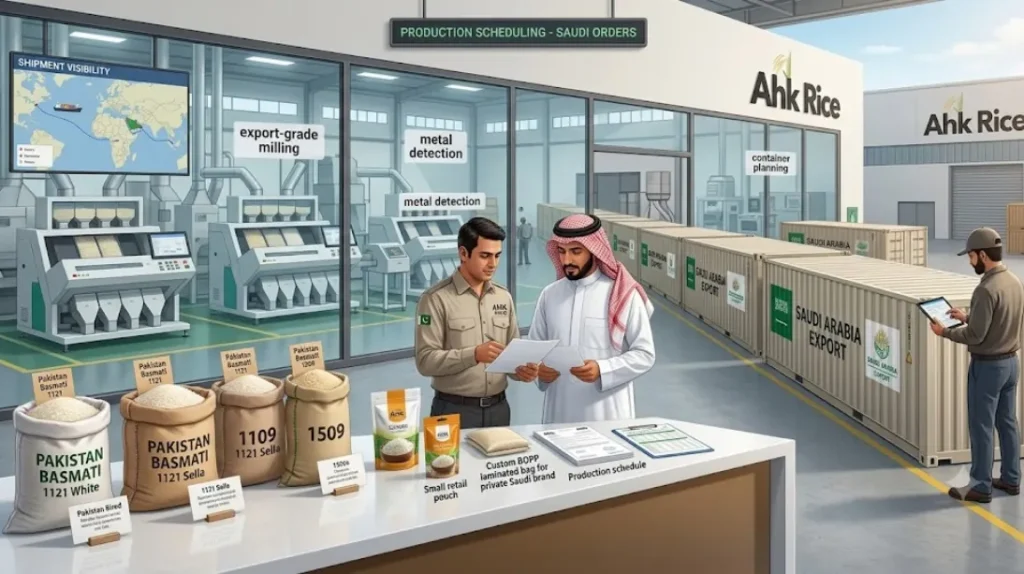
Saudi importers benefit from an exporter that combines quality control, documented inspections, flexible packaging, production planning, reliable logistics, and shipment visibility. A structured export process lowers commercial risk, simplifies procurement, supports private branding, and delivers consistent Pakistan Basmati rice specifications throughout long-term supply relationships.
Selecting an exporter involves much more than comparing quotations. Commercial buyers evaluate manufacturing capability, documentation, production capacity, shipment reliability, communication, certifications, packaging flexibility, and consistency.
The Saudi Arabia export service offered by AHK Rice is designed specifically for businesses importing premium Pakistan Basmati rice into Saudi distribution channels.
The service includes:
- Export-grade milling.
- Moisture-controlled processing.
- Color sorting.
- Length grading.
- Metal detection.
- Packaging customization.
- Private labeling.
- Bulk loading options.
- Documentation support.
- Export certification.
- Container planning.
Saudi brands frequently purchase multiple varieties including:
- 1121 Basmati White Rice
- 1121 Steam Basmati Rice
- 1121 Sella Rice
- Super Kernel Basmati Rice
- 1509 Basmati Rice
Each variety requires different production planning, but moisture consistency remains essential across every specification.
AHK Rice also supports custom packaging for wholesalers, supermarkets, distributors, restaurant suppliers, and institutional buyers. Packaging options commonly include retail packs, woven PP bags, BOPP laminated bags, paper bags, and bulk export packaging.
Commercial buyers also benefit from production scheduling before shipment confirmation, allowing more predictable delivery planning.
What results can Saudi brands expect from consistent moisture-controlled Basmati rice?
Controlled moisture produces more stable cooking performance, reduced grain breakage, improved aroma preservation, longer storage stability, stronger retail presentation, fewer customer complaints, and better inventory management. These measurable business outcomes help Saudi brands strengthen consumer trust while reducing operational and financial risks throughout their supply chain.
Rice quality is measured by more than laboratory reports. It is measured by customer satisfaction after cooking.
When moisture remains consistent, Saudi buyers generally experience:
- Better grain separation.
- Longer cooked grain length.
- Reduced broken rice.
- Improved texture.
- Stable aroma.
- Better visual appearance.
- Lower storage losses.
Consider a supermarket chain importing private-label Pakistan Basmati rice every month.
If moisture varies between shipments, consumers may notice differences in cooking time, softness, aroma, or grain expansion. Even if the rice technically meets import standards, inconsistency can affect brand reputation.
By maintaining controlled specifications across repeated shipments, AHK Rice helps reduce these quality variations.
Commercial distributors also benefit from improved warehouse performance. Stable moisture supports better storage conditions during distribution across different regions of Saudi Arabia, especially where temperatures remain high throughout much of the year.
For restaurant suppliers, consistent cooking performance reduces preparation adjustments in commercial kitchens.
For wholesalers, consistent product quality improves confidence when negotiating repeat contracts with retailers.
How many shipping days are required for Saudi Arabia and other export markets?
Shipping schedules depend on destination, vessel availability, customs procedures, and production planning. Most export orders require manufacturing before container loading, followed by international sea freight. Early scheduling helps buyers secure preferred shipping windows while maintaining production consistency and documentation accuracy.
Production usually begins after confirming specifications, packaging artwork, advance payment, and order approval.
Typical production timeline:
- Production planning: 1–2 days
- Milling and processing: 3–5 days
- Quality inspection: 1 day
- Packaging: 1–2 days
- Container loading: 1 day
Production is commonly completed within approximately 8–10 working days, depending on order volume.
Estimated sea freight transit in 2026:
| Destination Market | Typical Transit Time |
|---|---|
| Saudi Arabia (Jeddah Islamic Port) | 15–22 days |
| Saudi Arabia (Dammam) | 18–25 days |
| Saudi Arabia (Riyadh via inland transport) | 22–30 days |
| UAE | 7–12 days |
| Oman | 10–15 days |
| Kuwait | 12–18 days |
| Bahrain | 12–18 days |
| Qatar | 12–18 days |
Actual schedules depend on shipping line availability, seasonal demand, customs clearance, and port congestion.
AHK Rice coordinates production according to confirmed sailing schedules whenever possible to minimize unnecessary warehouse storage before export.
How does the sample process work, and what does it cost?
Professional sampling allows buyers to evaluate grain quality before placing bulk orders. Samples include product specifications, moisture verification, grain characteristics, and packaging information. Testing before commercial production reduces purchasing uncertainty and supports more confident procurement decisions for Saudi importers and private-label brands.
Most commercial buyers request samples before confirming container orders.
A standard sample process includes:
Step 1: Buyer specifies rice variety.
Step 2: Product specifications are confirmed.
Step 3: Samples are prepared.
Step 4: Moisture and quality inspections are completed.
Step 5: Samples are packed securely.
Step 6: Courier shipment is arranged.
Sample sizes commonly range from:
- 500 grams
- 1 kilogram
- 2 kilograms
- 5 kilograms
Typical sample costs in 2026:
| Item | Estimated Cost |
|---|---|
| Rice sample | Usually complimentary |
| Packaging | Included |
| Laboratory documentation (if requested) | May incur additional charges |
| International courier | Approximately USD 40–90 depending on destination and weight |
Many commercial buyers prefer laboratory reports alongside physical samples because they provide additional confidence before approving production.
After sample approval, production specifications are finalized before manufacturing begins.
AHK Rice encourages buyers to complete sample approval before confirming commercial quantities because approved specifications become the production reference for future shipments.
What factors affect the price of premium Pakistan Basmati rice?
Export pricing depends on rice variety, crop quality, processing method, grain length, packaging requirements, certifications, order volume, freight conditions, currency movements, and seasonal availability. Understanding these variables helps Saudi buyers compare quotations accurately rather than selecting suppliers based only on the lowest offered price.
International rice pricing changes throughout the year.
The largest pricing factors include:
- Rice variety.
- Crop season.
- Moisture specification.
- Broken percentage.
- Grain length.
- Color sorting level.
- Packaging material.
- Bag size.
- Printing requirements.
- Quantity ordered.
- Container utilization.
- Freight rates.
- Insurance.
- Exchange rates.
For example, private-label retail packaging generally costs more than bulk packaging because additional materials, printing, design approval, and packaging operations are required.
Similarly, stricter moisture requirements require additional production control, laboratory verification, and quality monitoring.
Commercial buyers should compare quotations using complete technical specifications instead of price alone.
A lower quotation without documented quality controls may result in inconsistent shipments, increasing long-term operational costs.
How can Saudi brands get started with AHK Rice?
The purchasing process begins by defining technical specifications, approving samples, confirming packaging, finalizing commercial terms, and scheduling production. Following a structured procurement process reduces misunderstandings, accelerates manufacturing, and helps Saudi buyers receive consistent Pakistan Basmati rice that matches approved commercial specifications.
A straightforward purchasing workflow improves efficiency for both importer and exporter.
The process typically includes:
- Submit your product requirements.
- Select the preferred rice variety.
- Confirm specifications.
- Review available packaging.
- Receive a commercial quotation.
- Approve product samples.
- Confirm artwork.
- Finalize production schedule.
- Begin manufacturing.
- Complete inspections.
- Load containers.
- Ship according to the agreed schedule.
Throughout this process, AHK Rice maintains communication regarding production progress, documentation, inspection status, and shipment preparation. This structured workflow helps Saudi importers plan inventory more accurately while reducing uncertainty during procurement.
Whether supplying supermarket brands, wholesale distributors, foodservice companies, or private-label importers, AHK Rice focuses on delivering consistent moisture-controlled Pakistan Basmati rice that aligns with commercial specifications and long-term supply expectations.
Frequently Asked Questions
How important is moisture consistency for Saudi rice brands?
Moisture consistency helps maintain grain quality, shelf life, aroma, cooking performance, and customer satisfaction. It also reduces the risk of spoilage and quality variations during storage and transportation.
Which Pakistan Basmati rice varieties are suitable for the Saudi market?
The most commonly imported varieties are 1121 Basmati White Rice, 1121 Steam Basmati Rice, 1121 Sella Rice, 1509 Basmati Rice, and Super Kernel Basmati Rice, depending on retail and foodservice requirements.
How long does it take to ship Pakistan Basmati rice to Saudi Arabia?
Production generally takes around 8–10 working days after order confirmation, while sea freight to Saudi ports typically requires 15–25 days, depending on the destination and shipping schedule.
Can buyers request rice samples before placing a bulk order?
Yes. Commercial buyers can request product samples to evaluate grain quality, moisture level, cooking performance, packaging, and overall specifications before confirming a container order.
What factors influence the export price of Pakistan Basmati rice?
Pricing depends on the rice variety, crop quality, processing method, moisture specification, packaging type, order quantity, certifications, freight charges, and market conditions.
Why should Saudi importers choose an exporter with moisture-controlled processing?
A supplier with controlled moisture management helps deliver consistent product quality, reduces storage risks, improves cooking performance, and supports long-term brand reliability in the Saudi market.
Does AHK Rice offer customized packaging for Saudi brands?
Yes. AHK Rice provides customized retail and bulk packaging options, including private-label solutions, to meet the branding and distribution requirements of Saudi importers.
What documents are typically provided with export shipments?
Export shipments generally include the commercial invoice, packing list, certificate of origin, phytosanitary certificate, bill of lading, and any additional quality or laboratory reports requested by the buyer.
How can a Saudi buyer start importing from AHK Rice?
The process starts by sharing product requirements, reviewing specifications and quotations, approving samples, confirming packaging, and then scheduling production before shipment.
How does consistent moisture improve shelf life?
Rice with controlled moisture is less susceptible to mould growth, quality deterioration, and storage-related issues, helping preserve freshness and market value during international transportation and warehousing.