What Makes 1121 White Basmati Rice Popular in American Kitchens?
American households choose 1121 White Basmati Rice because it combines extra-long grains, a naturally aromatic profile, soft yet separate cooked texture, and compatibility with a wide range of international and everyday meals. In 2026, it remains one of the most recognized premium Basmati rice categories in the United States due to consistent quality standards and reliable global supply.
Rice has become a staple in millions of American homes. Consumers prepare it for South Asian dishes, Middle Eastern recipes, healthy meal preparation, restaurant-quality dinners, and fusion cooking. Among premium rice varieties, 1121 White Basmati stands out because of its exceptional grain length, fragrance, and cooking performance.
Understanding why this variety performs differently requires examining its genetics, cultivation, processing methods, grading system, quality specifications, and international trade standards.
What Is 1121 White Basmati Rice?
1121 White Basmati Rice is a premium long-grain aromatic rice variety developed through traditional plant breeding, cultivated mainly in the Punjab region of Pakistan and northern India, then milled to remove the husk and bran layers while preserving its characteristic aroma, slender grain shape, and cooking quality.
1121 White Basmati belongs to the Basmati family, a group of aromatic rice varieties known for elongated grains and distinctive fragrance. The term 1121 identifies a specific cultivar that produces one of the world’s longest rice grains.
Unlike brown rice, White Basmati undergoes complete milling. During milling, processors remove:
- Outer husk
- Bran layer
- Rice germ
The remaining polished kernel becomes white rice.
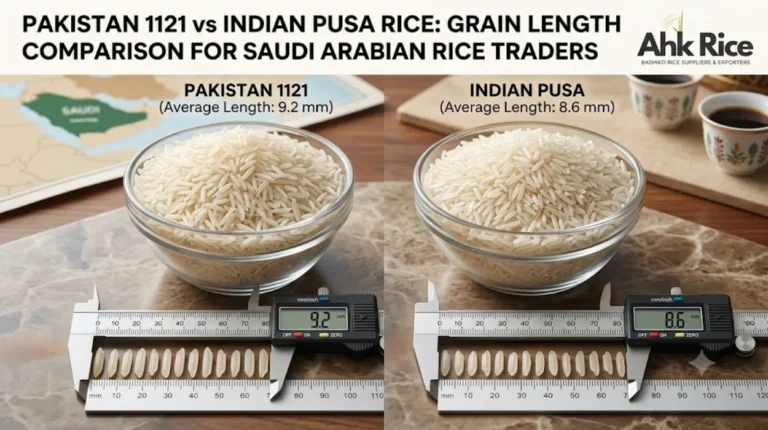
The average uncooked grain length ranges from 8.2 mm to 8.5 mm, depending on grade and crop quality. After cooking, quality kernels commonly elongate to nearly twice their original length while remaining separate.
This elongation distinguishes 1121 White Basmati from ordinary long-grain rice.
Where Is 1121 White Basmati Rice Grown?
1121 White Basmati Rice grows primarily in the fertile alluvial plains of Punjab, where mineral-rich soil, controlled irrigation, warm growing seasons, and cooler maturation periods create the environmental conditions required for premium grain development, aroma formation, and uniform kernel size.
Punjab produces the majority of export-quality 1121 White Basmati.
The crop follows a structured agricultural cycle.
Land Preparation
Farmers level fields using laser-guided equipment. Uniform fields improve irrigation efficiency and seedling establishment.
Organic matter is incorporated into the soil before planting.
Nursery Development
Seeds are sown in nursery beds.
Healthy seedlings develop for approximately 25 to 30 days before transplantation.
Transplanting
Workers or mechanized equipment transfer seedlings into flooded production fields.
Proper spacing allows better sunlight penetration and stronger plant growth.
Crop Management
Farmers monitor:
- Water levels
- Nutrient balance
- Weed control
- Pest management
- Disease prevention
Modern farms increasingly apply Integrated Pest Management (IPM) practices to reduce unnecessary pesticide use.
Harvest
Harvest normally begins when grain moisture reaches suitable harvesting levels.
Mechanical combines reduce grain damage and improve harvesting efficiency.
How Is 1121 White Basmati Rice Processed?
Processing transforms harvested paddy into export-quality White Basmati through cleaning, drying, dehusking, polishing, grading, optical sorting, quality inspection, packaging, and storage while preserving grain integrity, aroma, appearance, and internationally accepted food safety standards.
Each processing stage affects final quality.
Paddy Reception
Freshly harvested rice enters processing facilities.
Each batch receives identification for traceability.
Cleaning
Machines remove:
- Stones
- Dust
- Straw
- Metal fragments
- Foreign seeds
Cleaner raw material improves milling efficiency.
Drying
Processors reduce moisture to suitable storage levels.
Controlled drying minimizes grain cracking.
Dehusking
Rubber rollers remove the outer husk.
Brown rice remains after this stage.
Whitening and Polishing
Specialized milling equipment removes bran layers.
The result is polished White Basmati Rice with a bright appearance.
Length Grading
Length graders separate kernels according to size.
Uniform grain length improves product consistency.
Optical Color Sorting
Electronic cameras detect:
- Discolored kernels
- Chalky grains
- Damaged rice
- Foreign particles
Rejected kernels leave the production line automatically.
Quality Inspection
Laboratories evaluate:
- Grain length
- Broken percentage
- Moisture
- Purity
- Whiteness
- Foreign matter
Only compliant lots proceed to packaging.
Packaging
Rice is packed into:
- 1 kg retail bags
- 2 kg bags
- 5 kg bags
- 10 kg bags
- 20 kg sacks
- 25 kg sacks
- 40 kg bags
- 50 kg export bags
Packaging materials vary according to destination market requirements.
What Makes 1121 White Basmati Rice Different from Other Rice Varieties?
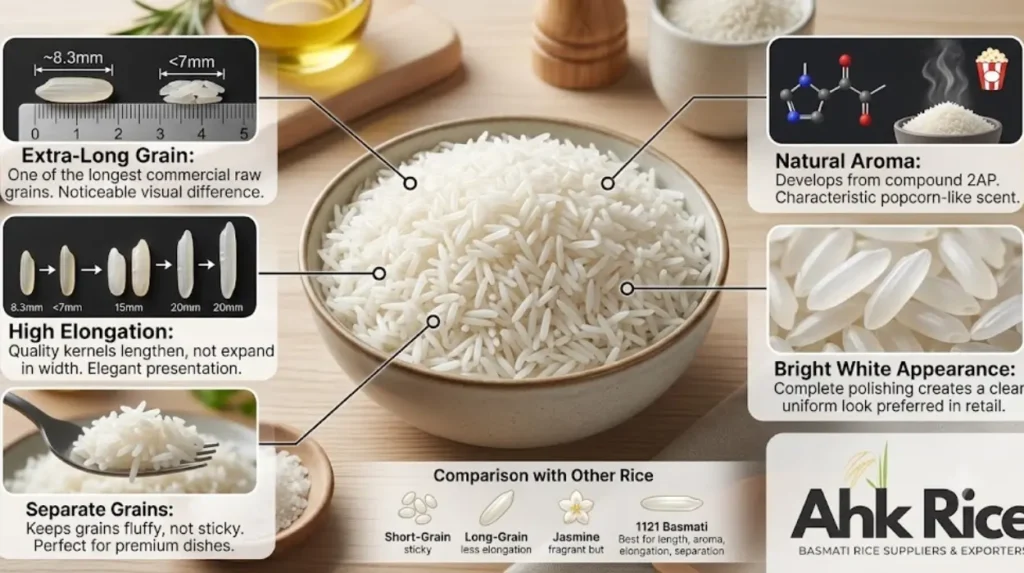
Its exceptional grain length, natural aromatic compounds, high elongation ratio, fluffy texture after cooking, and premium appearance distinguish 1121 White Basmati Rice from conventional long-grain, medium-grain, jasmine, and short-grain rice varieties available in global food markets.
Several characteristics explain its popularity.
Extra-Long Grain
1121 White Basmati produces one of the longest grains among commercial rice varieties.
Consumers notice the visual difference immediately after cooking.
Natural Aroma
The fragrance develops naturally due to the compound 2-acetyl-1-pyrroline (2AP).
This aromatic compound gives cooked rice its characteristic popcorn-like scent.
High Elongation
Quality kernels lengthen significantly during cooking instead of expanding in width.
The result is elegant presentation.
Separate Grains
Proper cooking keeps grains fluffy instead of sticky.
Restaurants value this characteristic for premium rice dishes.
Bright White Appearance
Complete polishing creates a clean, uniform visual appearance preferred in many retail markets.
What Grades of 1121 White Basmati Rice Are Available?
Export markets classify 1121 White Basmati Rice into several commercial grades based on grain length, percentage of broken kernels, purity, and milling quality so buyers can select products matching retail, foodservice, or industrial requirements.
Common commercial grades include:
1121 White Basmati Premium
- Maximum grain length
- Very low broken percentage
- High uniformity
- Premium retail packaging
1121 White Basmati Extra Fancy
- Excellent grain consistency
- Strong visual appearance
- Suitable for supermarkets
1121 White Basmati Standard
- Good grain quality
- Moderate broken percentage
- Foodservice applications
Broken Rice Grades
Broken kernels serve different industries including:
- Rice flour production
- Processed foods
- Snacks
- Brewing ingredients
Each importing market specifies acceptable quality limits before shipment.
Why Is 1121 White Basmati Rice Popular in American Kitchens?
American consumers value 1121 White Basmati Rice because it delivers consistent cooking results, attractive presentation, versatile meal applications, pleasant aroma, and compatibility with diverse cuisines including South Asian, Middle Eastern, Mediterranean, Mexican, and modern American recipes.
Several food trends support demand.
Meal preparation has become increasingly common.
Consumers prepare larger portions and refrigerate cooked rice for later meals.
Home cooks also prefer ingredients that pair with multiple proteins.
Examples include:
- Chicken
- Beef
- Seafood
- Lentils
- Vegetables
- Tofu
Restaurants appreciate long grains because plated meals appear more refined.
Retail buyers also recognize premium Basmati as a higher-value specialty rice category compared with ordinary white rice.
If you want to understand why visual appeal and fragrance strongly influence consumer purchasing decisions, the companion article on:
How aroma and grain length affect retail demand fits naturally after this discussion.
What Certifications Apply to Export-Quality 1121 White Basmati Rice?
International rice exports follow recognized food safety, quality management, and regulatory certification systems that verify production consistency, processing hygiene, traceability, and compliance with importing country requirements during international trade.
Certification requirements differ between importing countries.
Frequently recognized certifications include:
ISO 22000
Food Safety Management System certification covering food production processes.
HACCP
Hazard Analysis and Critical Control Points.
The system identifies and controls food safety risks.
FSSC 22000
An advanced food safety certification widely accepted by international retailers.
BRCGS Food Safety
Commonly requested by supermarket supply chains.
FDA Registration
Facilities exporting food to the United States register with the U.S. Food and Drug Administration where applicable under applicable regulations.
Phytosanitary Certificate
Government authorities verify that exported agricultural products meet plant health requirements.
Certificate of Origin
Confirms the producing country for international customs procedures.
What Are the Main Uses of 1121 White Basmati Rice?
Its long grains, aromatic profile, and fluffy texture make 1121 White Basmati Rice suitable for home cooking, restaurants, catering services, packaged food manufacturing, frozen meals, meal preparation, and premium hospitality applications across international markets.
Popular culinary applications include:
- Biryani
- Pilaf
- Fried rice
- Rice bowls
- Curry meals
- Stuffed vegetables
- Mediterranean platters
- Rice salads
Its neutral flavor also complements grilled meats, roasted vegetables, seafood, and vegetarian recipes.
The same cooked rice performs well in both traditional and contemporary cuisines.
What Misconceptions Exist About 1121 White Basmati Rice?
Several common beliefs about White Basmati Rice conflict with established agricultural and food science knowledge because grain length, polishing, aroma, and cooking performance depend on genetics, processing quality, and proper preparation rather than marketing claims alone.
One misconception states that longer grains contain artificial additives.
The aroma develops naturally through genetic characteristics.
Another misconception assumes all White Basmati products deliver identical quality.
Commercial grades differ significantly in:
- Grain length
- Broken percentage
- Purity
- Milling quality
- Color uniformity
Some consumers also believe polished rice cannot remain fluffy.
Cooking technique determines texture more than appearance.
Correct water ratio, soaking time, and resting period help maintain separate grains.
Another misunderstanding suggests all aromatic rice varieties belong to the Basmati family.
Jasmine rice, for example, belongs to a different botanical group with distinct aroma, texture, and cooking characteristics.
Why Does 1121 White Basmati Rice Continue to Lead Premium Rice Markets?
Its combination of exceptional grain length, reliable cooking quality, natural fragrance, internationally recognized grading standards, advanced processing methods, and broad culinary versatility explains why 1121 White Basmati Rice remains one of the world’s leading premium rice varieties in 2026.
Consumers increasingly evaluate food based on consistency, quality, and versatility.
1121 White Basmati satisfies these expectations through measurable characteristics rather than marketing language. From cultivation in Punjab to modern processing facilities, every production stage contributes to the finished product. Standardized grading systems, internationally accepted certifications, and strict quality inspections further support its position in global food markets, including the United States, where premium aromatic rice continues to gain popularity among households, restaurants, and specialty food retailers.
Frequently Asked Questions
What is 1121 White Basmati Rice?
1121 White Basmati Rice is a premium aromatic long-grain rice variety grown mainly in Punjab, known for its extra-long kernels, natural fragrance, and excellent grain elongation after cooking.
Why is 1121 White Basmati Rice popular in American kitchens?
American consumers prefer 1121 White Basmati Rice because of its fluffy texture, long cooked grains, pleasant aroma, versatility across many cuisines, and consistent cooking performance.
Where is 1121 White Basmati Rice cultivated?
The variety is primarily cultivated in the fertile plains of Punjab, where favorable climate, irrigation systems, and rich alluvial soil support high-quality grain production.
How is 1121 White Basmati Rice processed?
The rice is cleaned, dried, dehusked, polished, graded, color sorted, quality tested, and packaged under controlled conditions before being supplied to domestic and international markets.
What are the main grades of 1121 White Basmati Rice?
Common commercial grades include Premium, Extra Fancy, Standard, and Broken grades, each classified according to grain length, purity, and the percentage of broken kernels.
What makes 1121 White Basmati Rice different from ordinary long-grain rice?
Its naturally aromatic profile, extra-long grain length, excellent cooking elongation, and non-sticky texture distinguish it from conventional long-grain white rice.
Which certifications are commonly associated with export-quality 1121 White Basmati Rice?
Export-quality rice is commonly processed under standards such as ISO 22000, HACCP, FSSC 22000, BRCGS Food Safety, FDA registration where applicable, and official phytosanitary certification.
What dishes can be prepared with 1121 White Basmati Rice?
It is widely used for biryani, pilaf, fried rice, curry meals, rice bowls, Mediterranean dishes, grilled meat platters, and everyday family meals.
Does 1121 White Basmati Rice become sticky after cooking?
No. When cooked with the correct water ratio and proper resting time, the grains remain separate, fluffy, and well elongated.
Why does 1121 White Basmati Rice remain one of the leading premium rice varieties in 2026?
Its consistent quality, superior grain length, natural aroma, standardized grading, advanced processing, and broad culinary applications continue to make it one of the most preferred premium Basmati rice varieties worldwide.