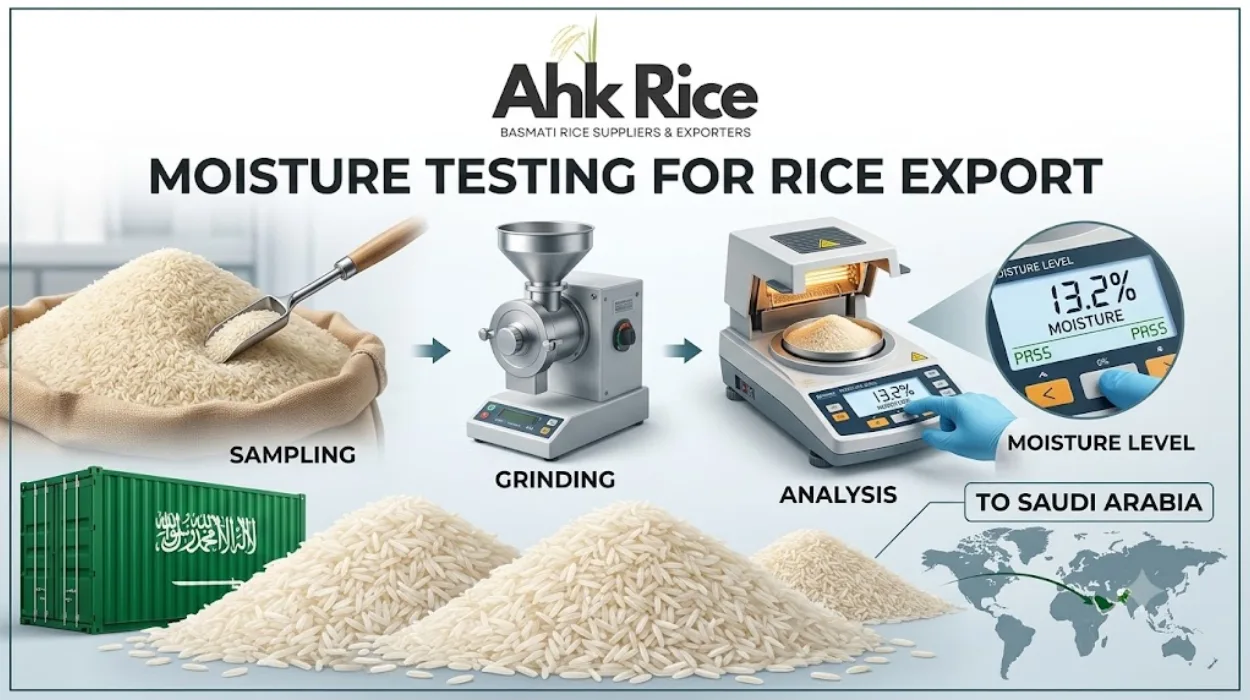
How Is Moisture Content Tested in Pakistan Basmati Rice Before Export to Saudi Arabia?
Moisture content testing measures the percentage of water present inside Basmati rice kernels before export. Pakistan exporters test every production batch to verify compliance with importing country requirements, maintain grain quality during storage, reduce spoilage risk, and ensure stable cooking performance after shipment to Saudi Arabia.
Moisture content is the amount of water contained inside a rice grain, expressed as a percentage of total weight. Every rice-exporting country measures this value before loading cargo because excessive moisture changes the physical and chemical stability of grain.
Pakistan produces premium Basmati rice in Punjab, where districts including Hafizabad, Gujranwala, Sheikhupura, Narowal, Okara, and Sialkot provide ideal growing conditions. The combination of fertile alluvial soil, canal irrigation, and seasonal temperature variation produces long-grain aromatic Basmati varieties that require controlled drying before export.
Saudi Arabia imports significant quantities of Pakistani Basmati rice for households, restaurants, catering companies, hotels, and food distributors. Every shipment undergoes quality verification before container loading. Moisture testing forms one of the primary quality control procedures because water content directly affects storage life, grain appearance, milling quality, and cooking consistency.
Instead of relying on visual inspection, exporters perform laboratory measurements using calibrated instruments that produce numerical readings suitable for quality documentation.
Why Does Moisture Content Matter Before Export to Saudi Arabia?
Moisture content determines storage stability, shipping safety, milling quality, cooking consistency, aroma preservation, and shelf life. Maintaining the specified moisture range prevents fungal development, insect activity, discoloration, grain breakage, and quality deterioration throughout the export journey from Pakistan to Saudi Arabia.
Rice remains inside containers for several weeks before reaching Saudi Arabian ports. During this period, temperature changes create condensation inside containers if grain moisture exceeds acceptable levels.
Higher moisture accelerates biological activity inside kernels. This process increases respiration, generates heat, and encourages mold growth. Lower moisture improves storage stability while preserving the natural aroma associated with Pakistani Basmati rice.
Quality testing also protects the milling value of rice. Excess moisture increases kernel damage during polishing and packaging. Controlled moisture preserves grain length and minimizes broken rice percentages.
For example, exporters monitor:
- Head rice recovery
- Broken kernels
- Color retention
- Aroma preservation
- Cooking elongation
- Storage stability
Each quality characteristic depends partly on maintaining proper moisture before packaging.
How Is Moisture Content Tested Before Rice Is Exported?
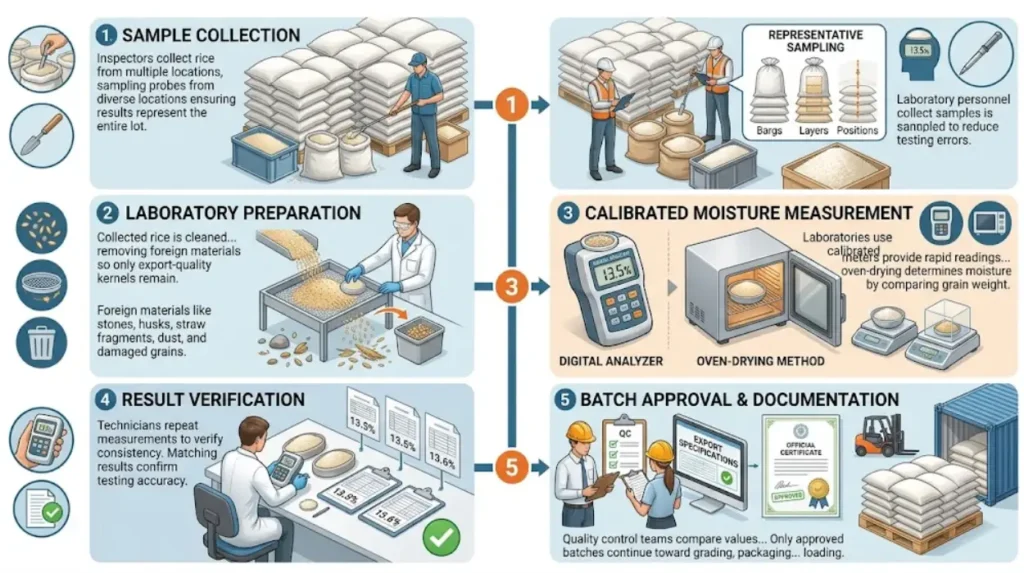
Moisture testing follows a standardized quality control process beginning with representative sampling, laboratory preparation, calibrated moisture measurement, result verification, record documentation, and final approval before packaging and container loading for international export.
Testing begins with representative sampling. Inspectors collect rice from multiple locations within a production batch instead of taking grain from only one bag. This approach produces results representing the complete lot.
Sample Collection
Laboratory personnel collect samples from different bags, layers, and storage positions.
A representative sample reduces testing errors because moisture varies slightly between different portions of large production lots.
Sample Preparation
Collected rice is cleaned before testing.
Foreign materials including stones, husks, dust, straw fragments, and damaged grains are removed so only export-quality kernels remain in the laboratory sample.
Moisture Measurement
Laboratories use calibrated digital moisture analyzers or oven-drying methods.
Digital moisture meters provide rapid numerical readings within minutes. Oven-drying methods determine moisture by comparing grain weight before and after controlled heating. The percentage difference represents water content.
Result Verification
Technicians repeat measurements to verify consistency.
Matching results confirm testing accuracy before reports are finalized.
Batch Approval
Quality control teams compare laboratory values with export specifications.
Only approved batches continue toward grading, packaging, palletization, and container loading.
What Equipment Is Used to Measure Moisture Content?
Modern rice laboratories use calibrated digital moisture meters, laboratory drying ovens, precision balances, sample grinders, thermometers, calibration standards, and computerized recording systems to produce accurate and repeatable moisture measurements for export documentation.
Digital moisture analyzers are the most common testing equipment in export processing facilities.
These instruments estimate moisture by measuring electrical or dielectric properties within rice kernels.
Laboratory ovens remain the international reference method for verification. Rice samples remain inside controlled-temperature ovens until water evaporates completely. Analysts compare initial weight with final dry weight to calculate moisture percentage.
Additional laboratory equipment includes:
- Precision weighing balances
- Sample grinders
- Stainless steel sample trays
- Calibration reference materials
- Temperature monitoring devices
- Digital record management systems
Each instrument contributes to accurate testing and traceable quality records.
What Processing Steps Help Control Moisture Before Testing?
Moisture control begins immediately after harvesting through cleaning, drying, tempering, storage, milling, grading, polishing, and packaging. Every processing stage contributes to maintaining uniform moisture levels before laboratory verification and export approval.
Rice moisture is managed long before laboratory testing.
Freshly harvested paddy contains higher moisture than export-ready rice. Processing gradually reduces water content under controlled conditions.
The complete processing sequence includes:
Harvesting
Farmers harvest mature paddy at the appropriate crop maturity stage.
Cleaning
Machines remove straw, stones, dust, and foreign material.
Drying
Mechanical dryers or controlled drying yards reduce moisture evenly throughout the grain.
Tempering
Rice rests between drying cycles.
This equalizes internal moisture across individual kernels.
Milling
The husk and bran layers are removed carefully.
Grading
Machines separate grains according to size, length, and quality.
Examples include extra-long grains, whole grains, and broken rice.
Polishing
Surface polishing improves appearance while maintaining grain integrity.
Laboratory Testing
Quality inspectors verify moisture along with other export specifications.
Packaging
Rice is packed into export bags after quality approval.
Which Grades of Pakistani Basmati Rice Undergo Moisture Testing?
Every export grade undergoes moisture testing regardless of grain length or processing type. Testing applies equally to premium whole grains, steamed rice, white rice, parboiled rice, broken rice, and specialty export grades.
Moisture testing is not limited to premium products.
Every commercial export grade requires laboratory verification before shipment.
Common Pakistani Basmati export grades include:
- 1121 White Basmati Rice
- 1121 Steam Basmati Rice
- 1121 Sella Basmati Rice
- 1121 Golden Sella Basmati Rice
- Super Kernel White Rice
- Super Kernel Steam Rice
- Super Kernel Sella Rice
- 1509 White Rice
- 1509 Steam Rice
- 1509 Sella Rice
- Brown Basmati Rice
- Broken Basmati Rice
Each grade follows the same quality control principle even though processing methods differ.
Which Markets Import Pakistani Basmati Rice Tested for Moisture?
Pakistani Basmati rice reaches numerous international markets where moisture verification supports import quality standards. Saudi Arabia represents one of the largest destinations alongside Gulf countries, Europe, North America, Africa, and Asia.
Saudi Arabia remains one of Pakistan’s major Basmati import destinations because of consistent consumer demand.
Other importing regions include:
- United Arab Emirates
- Qatar
- Kuwait
- Oman
- Bahrain
- Iraq
- United Kingdom
- Germany
- Netherlands
- Canada
- United States
- Australia
- Malaysia
- Singapore
- South Africa
Each importing region evaluates rice quality according to applicable import regulations and commercial specifications.
Which Certifications Support Moisture Testing During Export?
Export quality management combines moisture testing with internationally recognized certification systems covering food safety, processing controls, laboratory procedures, hygiene management, traceability, and phytosanitary compliance before shipment.
Moisture testing forms only one part of export quality assurance.
Exporters also operate within recognized certification systems that document production and food safety controls.
Common certifications and official documents include:
ISO 22000
Food safety management throughout processing.
HACCP
Hazard Analysis and Critical Control Points for identifying food safety risks.
GMP
Good Manufacturing Practices governing processing hygiene.
Phytosanitary Certificate
Confirms compliance with plant health requirements.
Certificate of Origin
Identifies the exporting country.
Fumigation Certificate
Documents approved pest-control treatment where required.
These documents complement laboratory quality reports and support international trade documentation.
What Benefits Does Accurate Moisture Testing Provide?
Accurate moisture testing protects grain quality, extends storage life, preserves aroma, reduces waste, supports consistent cooking performance, minimizes transport losses, improves documentation accuracy, and strengthens international quality assurance throughout the export supply chain.
Quality testing benefits every stage of the export process.
Uniform moisture preserves the long grain structure characteristic of Pakistani Basmati rice.
Controlled moisture also improves cooking performance by supporting predictable grain elongation and texture.
Other measurable benefits include:
- Lower spoilage rates
- Better storage stability
- Reduced insect activity
- Improved milling performance
- Consistent export quality
- Reliable laboratory records
- Better inventory management
Each benefit originates from controlling water content before shipment.
What Common Misconceptions Exist About Moisture Testing?
Several misunderstandings surround moisture testing. Scientific laboratory measurement, standardized sampling, calibrated equipment, and documented procedures determine export quality instead of visual appearance, grain color, or packaging style alone.
One common misconception is that experienced inspectors determine moisture simply by touching rice.
Laboratory instruments provide numerical measurements. Visual inspection cannot replace scientific testing.
Another misconception assumes white rice and steamed rice require different testing methods.
The testing principles remain the same. Only the processed grain differs.
Some people also believe packaging determines moisture quality.
Packaging protects rice after testing. It does not change the moisture already present inside kernels.
Others assume every harvest produces identical moisture values.
Harvest timing, drying efficiency, storage conditions, and processing influence final laboratory results, making testing necessary for every production batch.
Readers who want to understand the documentation used after laboratory testing can continue with the companion on:
Moisture test reports requested by Saudi Arabian rice importers from Pakistani suppliers, which explains how laboratory findings become part of export quality documentation.
Frequently Asked Questions
How is moisture content measured in Pakistan Basmati rice?
Moisture content is measured using calibrated digital moisture meters and verified with the oven-drying method in quality control laboratories before export.
Why is moisture testing important before exporting rice to Saudi Arabia?
It prevents spoilage, mold growth, insect infestation, grain damage, and quality loss during transportation and storage.
What is the ideal moisture content for export-quality Basmati rice?
Most export-quality Pakistani Basmati rice is maintained within the buyer’s agreed specification, commonly around 12% to 14%, depending on contract requirements.
Which equipment is used to test rice moisture?
Laboratories use digital moisture analyzers, drying ovens, precision balances, calibration standards, and temperature-controlled testing equipment.
When is moisture content tested during rice processing?
Testing is performed after drying, before packaging, and again before container loading to ensure export specifications are met.
Do all Pakistani Basmati rice varieties undergo moisture testing?
Yes. Varieties including 1121 White, 1121 Steam, 1121 Sella, Super Kernel, 1509, Brown Basmati, and Broken Basmati are all tested.
Can moisture content affect cooking quality?
Yes. Proper moisture levels help preserve grain texture, elongation, aroma, and consistent cooking performance.
Which certifications support moisture-controlled rice exports?
Common certifications include ISO 22000, HACCP, GMP, Phytosanitary Certificate, Certificate of Origin, and Fumigation Certificate.
Does visual inspection replace laboratory moisture testing?
No. Visual inspection cannot accurately determine moisture content. Exporters rely on calibrated laboratory equipment for precise measurements.
Which countries import moisture-tested Pakistani Basmati rice?
Major importing markets include Saudi Arabia, the UAE, Qatar, Kuwait, Oman, Bahrain, the United Kingdom, Canada, the United States, Germany, and Australia.