How Aroma and Grain Length Influence Retail Basmati Rice Sales
Retail Basmati rice sales increase when the product consistently delivers a strong natural aroma and long, uniform grain length because these two quality indicators shape customer perception, repeat purchases, shelf positioning, and retailer profitability more than price alone.
Retail buyers evaluate Basmati rice differently from wholesale importers. They focus on what consumers notice first after opening the pack and cooking the rice. Natural fragrance, grain appearance, elongation after cooking, and consistency across batches directly influence customer satisfaction. Understanding these quality factors also helps retailers identify suitable sourcing partners and premium product categories. For readers who want to understand why premium long-grain rice has become increasingly popular among American households, our guide on:
What makes premium long-grain Basmati preferred in modern American kitchens provides useful background before comparing retail buying decisions.
Retail markets in 2026 remain highly competitive. Consumers compare products visually before purchasing, while online buyers depend on product descriptions, reviews, and cooking results. This has increased the commercial value of authentic Pakistani Basmati varieties, particularly 1121 White Basmati Rice, because they combine visual appeal with reliable cooking performance.
What makes aroma and grain length important in retail Basmati rice sales?
Aroma and grain length directly influence purchasing decisions because consumers associate both characteristics with authenticity, premium quality, superior cooking performance, and higher value. Retail brands that consistently deliver these traits achieve stronger customer loyalty, better reviews, improved shelf performance, and increased repeat purchase rates across domestic and international markets.
Aroma is the naturally occurring fragrance present in authentic Basmati rice. The characteristic scent comes primarily from the compound 2-acetyl-1-pyrroline, which develops during cultivation, proper harvesting, and controlled ageing. Consumers often identify genuine Basmati by its distinctive fragrance before tasting it.
Grain length refers to the physical size of uncooked rice kernels and the elongation achieved after cooking. Premium Basmati varieties maintain separation while becoming significantly longer during cooking instead of expanding mainly in width.
Retail customers evaluate products visually before making purchase decisions. Long, slender grains create a premium appearance on shelves, packaging, and digital product listings. After cooking, the elongated grains improve food presentation, making the rice suitable for restaurants and home cooking alike.
Market research across North America and the Middle East during 2026 continues to show that appearance and aroma remain the two strongest quality indicators consumers use when comparing premium Basmati brands.
How do aroma and grain length compare when influencing consumer buying behaviour?
Aroma creates the initial emotional connection, while grain length provides visible evidence of premium quality. Together they reinforce consumer confidence. Products offering both characteristics outperform rice that excels in only one attribute because buyers expect a complete premium experience from authentic Basmati rice.
Consumers experience aroma immediately after opening the package and again during cooking. This creates anticipation before the meal is served.
Grain length becomes visible before purchase through transparent packaging or product photography. After cooking, long grains confirm product quality and justify the premium price.
Although both attributes influence purchasing behaviour, they affect different stages of the customer journey.
| Specification | Aroma | Grain Length |
|---|---|---|
| First customer impression | Strong fragrance | Long visual appearance |
| Purchase motivation | Authenticity | Premium appearance |
| Cooking experience | Pleasant kitchen aroma | Attractive presentation |
| Consumer perception | Traditional quality | High-grade product |
| Repeat purchase influence | High | High |
| Restaurant presentation | Moderate | Very High |
| Premium pricing support | Strong | Strong |
Retailers who source products with consistent aroma and grain length experience fewer customer complaints and higher repeat sales because consumers receive predictable cooking results.
What quality solutions are available for retailers seeking premium Basmati rice?
Retailers can improve product quality through better variety selection, controlled ageing, reliable processing, consistent grading, protective packaging, and trusted exporters. Combining these quality management practices produces more consistent retail performance than relying on a single quality factor alone.
Several practical solutions exist for improving retail Basmati quality.
The first solution is selecting the correct rice variety. Pakistani 1121 White Basmati remains one of the longest grain varieties available commercially. Its cooking performance and visual appeal make it suitable for premium retail shelves.
The second solution is controlled ageing. Rice aged for approximately 12 to 18 months develops improved cooking behaviour and enhanced aroma compared with freshly harvested rice.
The third solution involves modern processing facilities. Optical sorting, colour sorting, metal detection, polishing, and moisture control improve consistency while reducing defects.
The fourth solution is accurate grading. Uniform grain size reduces broken kernels and creates an attractive retail appearance.
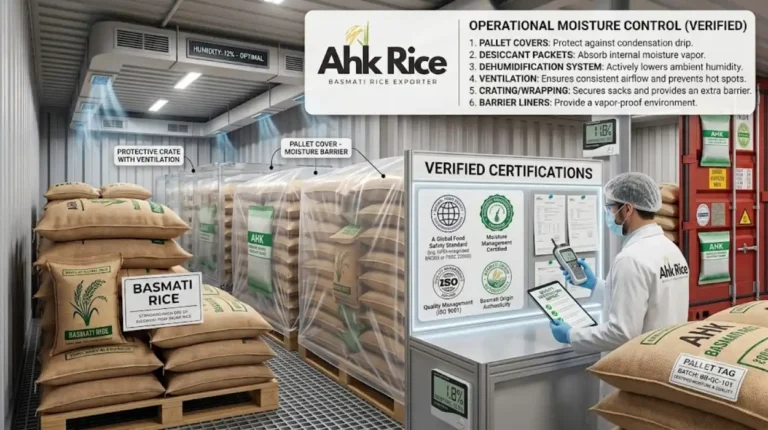
The fifth solution is protective packaging. Multi-layer food-grade packaging preserves aroma by limiting moisture absorption and external contamination during transportation and storage.
Exporters such as AHK Rice implement these processing stages from procurement through packaging to maintain consistent export quality across international shipments.
How do different sourcing approaches compare?
Retail sourcing methods differ significantly in consistency, traceability, pricing stability, and quality assurance. Direct sourcing from experienced exporters generally provides stronger control over aroma retention, grain grading, packaging quality, and shipment consistency than purchasing through multiple intermediaries.
Retail businesses usually source rice using one of three approaches.
The first approach involves buying through domestic distributors. This simplifies logistics but limits control over origin and processing.
The second approach uses international trading companies that consolidate products from multiple suppliers. While convenient, product consistency may vary between shipments.
The third approach involves working directly with experienced exporters such as AHK Rice, which oversee sourcing, milling, grading, packaging, documentation, and export processes from Punjab to international markets.
Direct sourcing generally improves traceability because retailers know the production origin and quality specifications before shipment.
Which Basmati grade works best for different retail markets?
Different retail regions prioritise different quality characteristics. North American buyers generally prefer extra-long premium grains with consistent appearance, while Gulf markets place additional emphasis on strong aroma and traditional cooking performance alongside grain length and whiteness.
Consumer expectations differ across international markets.
Retail preferences by market
| Market Region | Preferred Grade | Primary Buying Factors | Typical Retail Position |
|---|---|---|---|
| USA & Canada | Premium 1121 White Basmati | Extra-long grains, whiteness, elongation, uniform grading | Premium supermarket segment |
| GCC & Middle East | Premium 1121 White and Super Kernel | Strong aroma, long grains, ageing quality, flavour | Premium household and hospitality segment |
North American consumers increasingly compare cooking performance through online reviews and recipe content.
Middle Eastern consumers place greater emphasis on aroma because traditional rice dishes depend heavily on fragrance and grain separation.
Retailers benefit from matching product specifications to regional consumer preferences instead of offering identical specifications across every export destination.
How do prices and shelf life compare between quality grades?
Higher-grade Basmati commands premium pricing because improved grain length, lower breakage, better ageing, and stronger aroma increase consumer value. Proper storage preserves these advantages for extended periods, improving inventory management and reducing retail losses.
Price differences largely reflect processing quality rather than production cost alone.
Indicative 2026 Export Comparison
| Factor | Standard Grade | Premium 1121 White Basmati |
|---|---|---|
| Average Export Price | US$900–1,050 per MT | US$1,150–1,350 per MT |
| Average Broken Percentage | Higher | Lower |
| Grain Uniformity | Moderate | Excellent |
| Cooking Elongation | Moderate | Excellent |
| Aroma Retention | Moderate | High |
| Shelf Life (Proper Storage) | Up to 18 months | Up to 24 months |
Actual pricing varies according to crop quality, packaging specifications, freight costs, destination market, and contract volume.
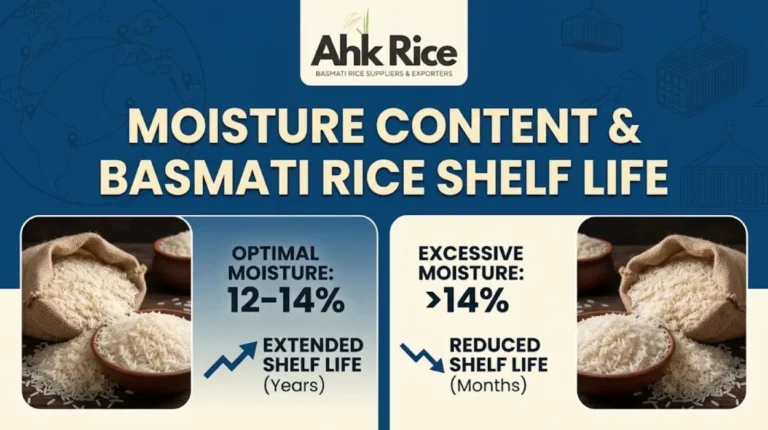
Proper storage remains essential regardless of grade. Temperature control, low humidity, and sealed packaging preserve aroma and cooking quality throughout the product lifecycle.
What are the advantages and disadvantages of prioritising aroma and grain length?
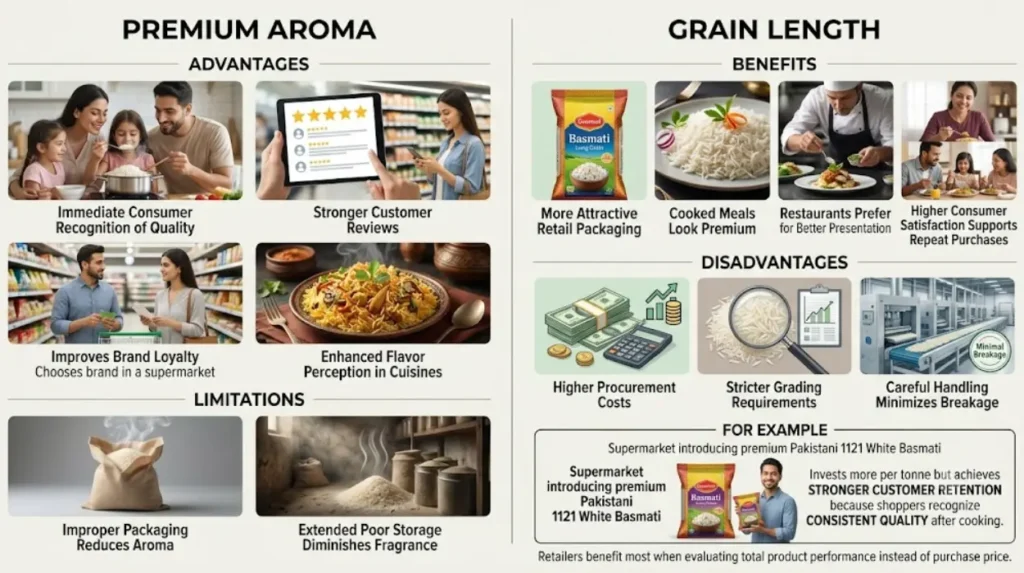
Premium aroma and long grain provide substantial retail advantages, but achieving consistent quality requires careful sourcing, grading, ageing, and storage. Retailers benefit most when they evaluate total product performance instead of focusing exclusively on purchase price.
Premium aroma offers several advantages.
Consumers immediately recognise authentic quality.
Products receive stronger customer reviews.
Brand loyalty improves after positive cooking experiences.
Traditional cuisines benefit from enhanced flavour perception.
There are also limitations.
Improper packaging reduces aroma during storage.
Extended storage under poor conditions diminishes fragrance.
Grain length also provides significant benefits.
Retail packaging appears more attractive.
Cooked meals look premium.
Restaurants prefer longer grains because presentation improves.
Higher consumer satisfaction supports repeat purchases.
Potential disadvantages include higher procurement costs and stricter grading requirements. Long-grain premium rice also requires careful handling during processing to minimise breakage.
For example, a supermarket introducing premium Pakistani 1121 White Basmati may initially invest more per tonne but often achieves stronger customer retention because shoppers recognise consistent quality after cooking.
Which decision factors should retailers evaluate before selecting Basmati rice?
Retail buyers should evaluate variety, processing quality, grading consistency, ageing, packaging, exporter capability, and regional consumer preferences together because successful retail performance depends on the combined effect of every quality factor rather than any single characteristic.
A structured evaluation process improves purchasing decisions.
| Decision Factor | Why It Matters | Retail Impact |
|---|---|---|
| Rice Variety | Determines natural grain length | Product positioning |
| Aroma Quality | Influences authenticity perception | Customer satisfaction |
| Ageing Period | Improves cooking quality | Premium value |
| Processing Standards | Reduces defects | Consistency |
| Packaging Quality | Protects freshness | Longer shelf life |
Retail buyers should also request detailed product specifications before confirming supply agreements.
These typically include grain length, moisture percentage, broken percentage, purity level, crop year, packaging options, and export certifications.
Experienced exporters provide this information before shipment, allowing retailers to compare suppliers objectively rather than relying solely on marketing claims.
How can retailers maximise long-term Basmati rice sales?
Long-term retail success comes from consistently delivering authentic quality rather than competing primarily on price. Reliable sourcing, premium specifications, accurate product information, and consistent consumer experience generate stronger repeat purchases and sustainable brand growth over time.
Consumers purchasing premium Basmati expect consistent results every time they cook.
When aroma changes between batches or grain length becomes inconsistent, customer confidence declines quickly.
Retailers therefore benefit from selecting exporters capable of maintaining identical specifications across multiple shipments.
This consistency strengthens retailer reputation while reducing product returns and customer complaints.
For businesses evaluating international sourcing options, our detailed guide explaining:
How to source premium Pakistani 1121 White Basmati for the American retail market provides the next stage of the buying process, including supplier evaluation and procurement considerations.
Authentic Pakistani Basmati continues to perform strongly in premium retail channels during 2026 because consumers increasingly value quality, transparency, and reliable cooking performance over simply purchasing the lowest-priced product.
Frequently Asked Questions
What makes aroma the most important quality factor in Basmati rice?
Aroma is one of the first characteristics consumers notice after opening and cooking Basmati rice. A natural fragrance enhances the eating experience, increases customer satisfaction, and encourages repeat purchases, making it a key factor in retail sales.
How does grain length affect retail Basmati rice sales?
Long, uniform grains create a premium appearance before and after cooking. Consumers often associate extra-long grains with authentic, high-quality Basmati rice, which increases product appeal and supports premium pricing.
Which Basmati rice variety is best for premium retail markets?
1121 White Basmati Rice is widely preferred in premium retail markets because of its extra-long grains, excellent cooking elongation, attractive appearance, and naturally pleasant aroma.
Why is aged Basmati rice preferred by retailers?
Properly aged Basmati rice develops a stronger aroma, improved texture, and better grain separation during cooking. These qualities enhance customer satisfaction and reduce complaints about product performance.
How do USA and GCC retail markets differ in their Basmati rice preferences?
Retail buyers in the USA generally prioritise extra-long grain length and visual quality, while GCC markets place equal importance on strong natural aroma, grain elongation, and traditional cooking performance.
Does premium Basmati rice have a longer shelf life?
Yes. When stored in cool, dry conditions using high-quality packaging, premium Basmati rice can maintain its quality and aroma for up to 24 months, depending on storage practices.
What factors should retailers consider when selecting a Basmati rice supplier?
Retailers should evaluate rice variety, grain length, aroma, ageing process, grading consistency, packaging quality, food safety standards, export certifications, and supplier reliability before making purchasing decisions.
Why do consumers pay more for premium Basmati rice?
Consumers are willing to pay higher prices because premium Basmati offers superior aroma, longer grains, better cooking performance, attractive presentation, and consistent quality, delivering greater value than standard rice grades.