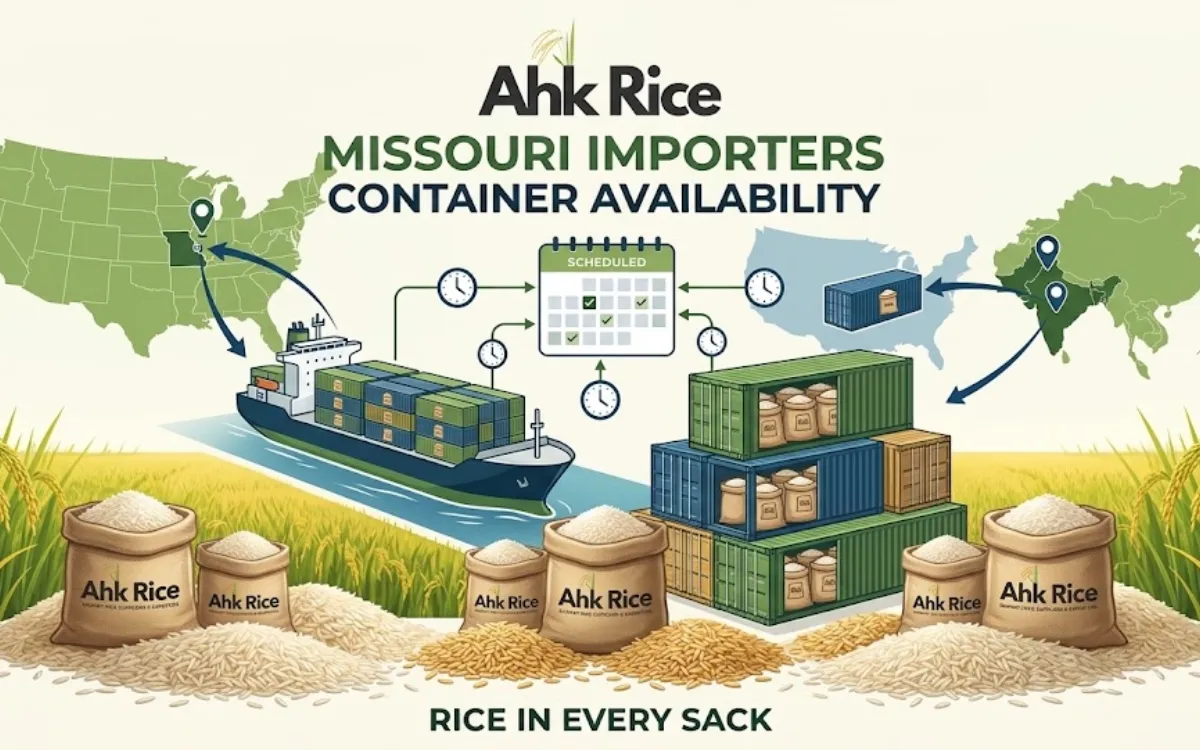
AHK Rice Supports Missouri Importers with Scheduled Container Availability
Missouri rice importers need more than a low FOB price. They need a supplier that connects rice specifications, production scheduling, container booking, export documentation, ocean transit, and inland delivery into one procurement plan. AHK Rice supports this model for U.S. buyers sourcing Pakistani Basmati rice, with scheduled container planning designed to reduce supply interruptions.
The U.S. market remains structurally dependent on imported aromatic rice. USDA reported that U.S. long-grain rice imports reached a projected 37 million cwt for 2025/26, while imports from India and Pakistan remained robust through March 2026. Pakistan supplies the U.S. primarily with Basmati rice.
For Missouri buyers, container availability matters because the state is inland. A container arriving at a coastal port still requires rail or truck movement into Missouri. The procurement decision therefore needs to cover the entire route rather than only the vessel departure date. This is the practical issue explained in:
Why container availability affects international rice procurement.
What is the best solution for Missouri importers facing container availability problems?
The best solution is a scheduled supply program that connects approved rice specifications with production slots, container allocation, vessel booking, documentation, and inland delivery planning before inventory reaches its reorder point. This approach replaces reactive spot buying with predictable procurement.
Missouri importers commonly receive rice through major U.S. gateway ports before moving cargo inland. The correct port depends on the buyer’s warehouse, freight contract, carrier schedule, and available inland service.
A buyer in St. Louis, for example, can evaluate an Atlantic or Gulf routing and compare the total landed cost against a West Coast routing. The cheapest ocean freight does not automatically produce the cheapest delivered rice.
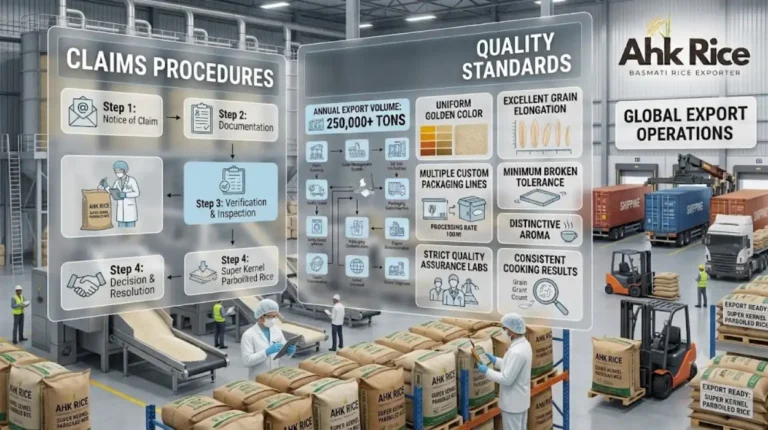
AHK Rice addresses this through coordinated export planning from Pakistan. The company states that it manages rice processing, grading, packaging, documentation, and container loading through an integrated export operation.
The procurement objective is simple: reserve production and shipping capacity early enough that a Missouri distributor does not reach its minimum inventory level while the next container is still waiting for production or vessel space.
Why does scheduled container availability matter for Missouri rice procurement?
Scheduled container availability protects inventory continuity by aligning production with vessel schedules and inland delivery requirements. Missouri importers gain a defined shipment sequence instead of depending on last-minute container bookings after rice production is already complete.
The difference becomes important during high-demand periods. A buyer that orders only after warehouse inventory becomes critical has fewer options for vessel selection, equipment availability, routing, and freight negotiation.
A scheduled program starts with forecasted monthly demand. The importer identifies expected metric tons, product grades, packaging, destination, and required arrival windows. The exporter then plans production and container loading around those requirements.
This model also supports repeat purchasing. A distributor requiring 100 MT every month can plan multiple containers rather than negotiating each shipment independently.
For Missouri buyers, the inland leg also needs to be included in the schedule. Port arrival is not final delivery. Customs release, terminal handling, drayage, rail or trucking, and warehouse receiving all affect the actual inventory date.
Which AHK Rice USA service fits Missouri importers?
The USA export service is designed for importers purchasing Pakistani Basmati rice in commercial quantities, with product selection, packaging, export documentation, container coordination, and destination planning handled through one supplier relationship.
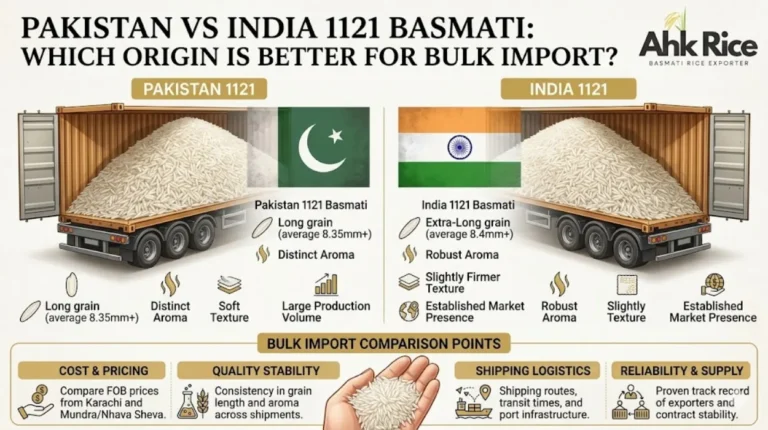
AHK Rice supplies U.S. buyers with varieties including 1121, Super Kernel, and other Pakistani Basmati specifications. Its USA export page identifies container supply, customized quotations, packaging options, export documentation, and shipment coordination as part of the commercial process.
For Missouri wholesalers and distributors, product selection should start with the intended customer segment.
1121 Basmati suits premium retail, restaurant, catering, and foodservice applications where extra-long grain appearance and cooking elongation support premium positioning.
Super Kernel Basmati serves traditional South Asian retail channels where aroma, familiar cooking characteristics, and price positioning influence repeat purchasing.
1509 Basmati provides another commercial option where the buyer needs long-grain Basmati characteristics with tighter cost control. AHK Rice identifies 1509 as a value-oriented option for U.S. restaurants, foodservice distributors, private-label brands, and wholesale importers.
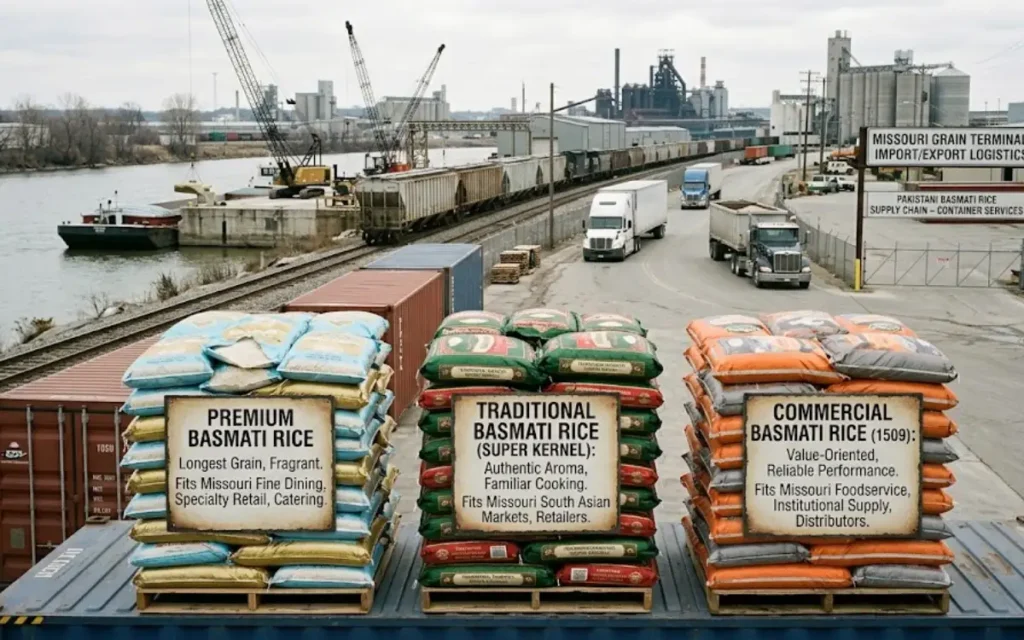
The correct specification must be fixed before production. Grain length, broken percentage, moisture, processing grade, packaging, private-label requirements, and inspection requirements all affect the final quotation.
How does the AHK Rice sample process work before a Missouri container order?
The sample process starts with product specification, moves through sample preparation and courier delivery, continues with buyer approval and commercial quotation, and finishes with production confirmation against the approved specification before container loading.
A practical sample workflow begins with the importer identifying the required variety and grade. The buyer also specifies packaging preferences, expected annual volume, destination port, and intended use.
Step 1: Product selection.
The buyer selects 1121, Super Kernel, 1509, or another required specification. The exporter confirms the available grade and production parameters.
Step 2: Sample preparation.
AHK Rice states that up to 20 kg of rice can be supplied as a free sample, while the buyer covers sample shipping costs. Buyers can also provide their own courier account.
Step 3: Quality evaluation.
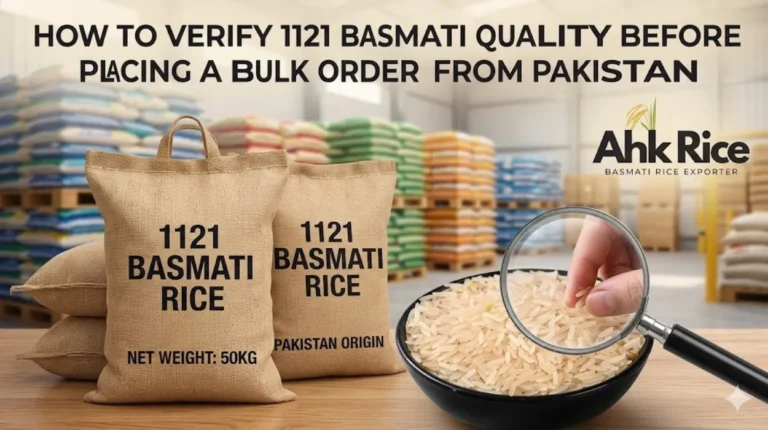
The importer evaluates grain appearance, aroma, cooking performance, broken grains, moisture, purity, packaging presentation, and any laboratory or compliance documentation required for its procurement process.
Step 4: Commercial quotation.
After approval, the exporter prices the exact specification. The quotation needs to identify quantity, Incoterm, destination port, packaging, shipment schedule, and payment conditions.
Step 5: Production confirmation.
The approved specification becomes the production reference. This prevents a buyer from approving one sample and receiving a commercially different grade.
Step 6: Container allocation.
The production schedule is matched with available equipment and vessel booking. This is where scheduled container availability becomes a direct commercial advantage.
Step 7: Shipment and tracking.
After loading, export documentation and shipment information support the buyer’s import and logistics process.
For U.S. importers, compliance preparation is also important. AHK Rice’s USA materials identify FDA-related documentation and U.S. import requirements as part of its export process.
How many shipping days should Missouri importers plan for?
Missouri importers should separate ocean transit from inland delivery. Current 2026 Pakistan-to-U.S. ocean estimates generally run several weeks, while the complete Missouri delivery timeline adds port handling, customs clearance, and inland transportation.
AHK Rice’s current USA guidance lists approximate ocean transit ranges of 32–40 days to New York/New Jersey, 30–38 days to Savannah, 34–42 days to Houston, and 35–45 days to Los Angeles from Pakistan.
A current logistics quotation for Karachi-to-Savannah shows an estimated 33–38 days for a 40-foot high-cube FCL service, demonstrating how actual carrier schedules can differ from generic transit estimates.
For Missouri procurement, a practical planning framework is:
| Market route | 2026 ocean planning range | Missouri planning implication |
|---|---|---|
| Karachi → New York/New Jersey | 32–40 days | Add inland movement to Missouri |
| Karachi → Savannah | 30–38 days | Add port and inland delivery time |
| Karachi → Houston | 34–42 days | Useful for Gulf routing evaluation |
| Karachi → Los Angeles | 35–45 days | Add West-to-Midwest inland movement |
| Karachi → Missouri warehouse | Ocean + inland | Quote as a complete landed schedule |
These are planning ranges, not guaranteed delivery dates. Carrier schedules, transshipment, port congestion, customs clearance, weather, equipment availability, and inland capacity affect actual arrival dates.
The correct purchasing practice is therefore to set a required warehouse arrival date first and work backward through inland transport, port clearance, vessel transit, container loading, production, and specification approval.
What costs should Missouri importers expect for samples and containers?
Sample cost is usually dominated by courier and certification expenses, while commercial container cost depends on rice grade, metric tons, packaging, Incoterm, freight, destination port, inspection, documentation, customs, and inland delivery requirements.
AHK Rice states that sample rice up to 20 kg is free, while the buyer pays sample shipping. The company also states that clients cover the phytosanitary certificate cost when required for samples.
Commercial pricing is different. A current 2026 AHK Rice USA product listing places some Pakistani Basmati specifications from approximately $1,100 per metric ton FOB Karachi, while another current market source indicates Pakistani Basmati offers around $1,135–$1,205 per MT depending on specification and timing. These figures are indicative, not fixed quotations.
A Missouri buyer should therefore request a quotation based on:
| Cost factor | Why it changes the price |
| Rice variety | 1121, Super Kernel, and 1509 have different market positions |
| Processing grade | Steam, White, Sella, Golden Sella, and other grades differ |
| Quantity | Container volume affects unit economics |
| Packaging | Retail, private-label, and bulk formats require different materials |
| Incoterm | FOB, CFR, CIF, or other terms transfer different costs |
| Ocean freight | Carrier, route, equipment, and booking date affect cost |
| Destination port | Port charges and inland distance differ |
| Inspection | Buyer-specific inspection adds cost |
| Inland freight | Missouri delivery requires transport beyond the ocean port |
| Compliance | Documentation and import requirements affect landed cost |
A Missouri importer should compare landed cost per MT, not only FOB price per MT. This gives a more accurate comparison between suppliers and routes.
What results can Missouri importers expect from scheduled container supply?
The main result is greater procurement predictability. Buyers can forecast inventory, schedule purchase orders earlier, reduce emergency sourcing, maintain approved rice specifications, and coordinate warehouse capacity around planned container arrivals.
Consider a Missouri distributor selling 80–100 MT of Basmati rice monthly. A reactive purchasing model waits until stock approaches its reorder point. The next shipment then depends on production availability and vessel space.
A scheduled model creates a rolling supply plan. The importer approves the product specification, establishes expected monthly demand, and reserves production and shipment windows ahead of the physical shortage.
The benefit is not simply faster shipping. The larger benefit is controlled procurement.
AHK Rice also gives buyers access to multiple Basmati formats, allowing procurement teams to align product specification with customer demand rather than purchasing one generic grade for every sales channel.
This is particularly useful for private-label importers. The retail brand depends on consistency across repeat containers. A specification-controlled program reduces the risk of changing grain characteristics between shipments.
How should Missouri importers decide whether AHK Rice is the right supplier?
Missouri buyers should select AHK Rice when they need Pakistani Basmati, specification control, scheduled production, commercial container quantities, export documentation, and a supplier capable of coordinating the shipment from Pakistani origin toward U.S. delivery.
The decision can be reduced to five procurement tests.
1. Product fit.
The exporter must supply the exact Basmati variety, processing grade, grain specification, and packaging required by the buyer.
2. Production control.
The supplier needs a defined process connecting product approval with milling, grading, packing, and container loading.
3. Shipping planning.
The supplier must discuss container allocation and vessel scheduling before the buyer reaches a stockout position.
4. Compliance readiness.
Documentation must support the U.S. import process. FDA and FSVP responsibilities remain important considerations for U.S. food importers.
5. Commercial transparency.
The buyer needs a quotation that separates rice price, freight assumptions, Incoterm, packaging, inspection, and other relevant charges.
AHK Rice meets this decision model through its integrated Pakistan export operation and USA-focused supply structure. The company reports an in-house processing and export pipeline covering paddy procurement, cleaning, milling, grading, sorting, packaging, and container loading.
Importers that need to understand:
How exporters manage container allocation during peak seasons can use this framework to evaluate production scheduling, equipment planning, and alternative routing before confirming a purchase.
How can a Missouri importer get started with AHK Rice?
Start by submitting the destination, product specification, quantity, packaging format, preferred Incoterm, and required shipment window. AHK Rice can then build the commercial quotation around the actual Missouri procurement requirement instead of a generic rice price.
The buyer should prepare five details before requesting pricing:
- Required Basmati variety and grade.
- Total quantity in metric tons.
- Preferred U.S. destination port or Missouri delivery point.
- Packaging and private-label requirements.
- Target shipment or warehouse arrival date.
The next step is sample approval. Once the buyer confirms the rice specification, the commercial order can be planned around production and container availability.
For recurring Missouri demand, the stronger model is a rolling procurement schedule rather than isolated orders. The importer can establish expected monthly or quarterly volumes and coordinate shipment windows before peak booking pressure develops.
In 2026, this approach is increasingly relevant because U.S. rice imports remain substantial while USDA projects tighter domestic supply conditions and record 2026/27 rice imports of 49.8 million cwt.
For Missouri buyers, the purchasing decision is therefore straightforward: secure the rice specification first, schedule production second, allocate containers third, and plan inland delivery before inventory becomes critical. AHK Rice provides the export structure required to turn that sequence into a repeatable supply program.
To discuss product specifications, container availability, destination requirements, and current pricing, request a quote.
Frequently Asked Questions
How does AHK Rice support Missouri rice importers?
AHK Rice supports Missouri importers through scheduled production, container planning, export documentation, rice specification control, and shipment coordination for Pakistani Basmati rice.
How long does rice shipping from Pakistan to the USA take?
Typical ocean transit from Pakistan to U.S. ports ranges from approximately 30–45 days, depending on the destination port, carrier schedule, routing, and transshipment requirements. Missouri delivery requires additional inland transportation.
Which Pakistani Basmati rice varieties can Missouri importers source?
Missouri importers can source varieties such as 1121 Basmati, Super Kernel Basmati, and 1509 Basmati, with processing options and packaging configured according to the buyer’s commercial requirements.
How does scheduled container availability reduce procurement risk?
Scheduled container availability connects production planning with vessel bookings and equipment allocation. This gives importers greater control over replenishment timing and reduces dependence on last-minute container bookings.
How much does a rice sample from AHK Rice cost?
AHK Rice states that samples up to 20 kg are available free of charge, while the buyer covers courier shipping costs and applicable phytosanitary certificate costs.
What information is needed to request a rice quotation?
A buyer should provide the rice variety, grade, quantity, packaging format, destination port or Missouri delivery location, preferred Incoterm, and required shipment window.
What affects the landed cost of Pakistani Basmati rice in Missouri?
Landed cost depends on rice grade, quantity, packaging, FOB price, ocean freight, destination port charges, customs-related costs, inspection, documentation, and inland transportation to Missouri.
Can AHK Rice supply private-label Basmati rice?
Yes. AHK Rice provides packaging options for commercial buyers, including requirements that can be structured around private-label and wholesale distribution needs.
Why should Missouri importers compare landed cost instead of FOB price?
FOB pricing covers the product at the agreed origin point. Missouri buyers also incur ocean freight, port charges, customs-related costs, and inland transportation. Landed cost provides a more accurate supplier comparison.
How can a Missouri importer start sourcing from AHK Rice?
The buyer can begin by specifying the required Basmati variety, quantity, packaging, destination, Incoterm, and target shipment date. The supplier can then prepare the appropriate quotation and sample process.