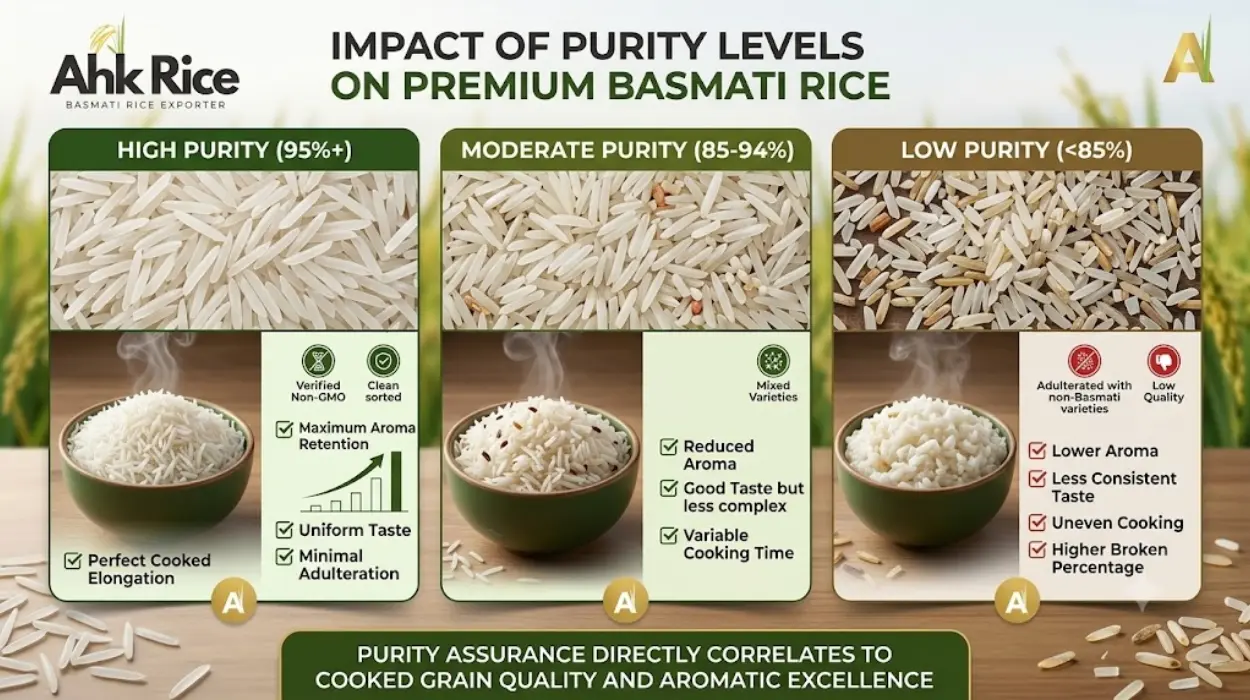
How Do Purity Levels Influence Basmati Rice Market Positioning?
Purity levels directly determine Basmati rice market positioning. Here is why: higher purity creates stronger buyer confidence, better cooking consistency, lower rejection rates, and premium pricing. Rice with 95%–98% varietal purity consistently secures premium retail and wholesale segments, while lower-purity grades compete mainly on price.
Basmati rice purity refers to the percentage of grains belonging to the declared variety. Importers, wholesalers, retailers, and foodservice distributors use purity specifications to classify products into different market tiers. A small difference in purity can significantly affect export pricing, customer satisfaction, and brand reputation.
Understanding purity is essential before choosing a sourcing strategy. Buyers comparing grades can first learn more about varietal identification and quality evaluation through our guide on understanding Basmati rice purity standards and quality assessment methods. Market positioning begins with accurate grading, testing, and classification.
AHK Rice supplies premium Pakistani Basmati varieties through its dedicated service for international Basmati rice export solutions. The company processes, grades, and exports 1121, Super Kernel, and 1509 Basmati varieties to more than 15 countries.
What Does Purity Mean in Basmati Rice Trading?
Purity levels between 95% and 98% command premium market positions because buyers receive consistent grain appearance, aroma, elongation, and cooking performance.
Purity measures the percentage of grains that belong to the declared variety. A shipment labelled as 1121 Basmati should contain the specified proportion of authentic 1121 grains. Mixed varieties reduce consistency and lower market value.
Importers inspect purity because consumers notice visual differences. Different grain lengths, widths, and cooking behaviours create inconsistent retail experiences. Consistency supports repeat purchases.
Quality laboratories verify purity through physical inspection and varietal analysis. Exporters inspect samples before milling, after grading, and before loading containers.
Higher purity strengthens product positioning in supermarkets, specialty stores, and premium hospitality channels. Lower purity grades often target institutional catering and budget retail segments.
How Purity Is Verified
- Inspect representative samples.
- Sort grains by variety.
- Measure grain dimensions.
- Verify varietal characteristics.
- Test cooking performance.
- Grade according to specifications.
- Certify shipment quality.
With purity defined, the next question is how different purity levels compare in commercial markets.
How Do Different Purity Levels Compare in the Market?
Purity above 97% achieves premium positioning, while purity below 90% primarily competes through lower pricing and volume sales.
Different purity levels create distinct commercial categories. Buyers evaluate these categories according to intended use, customer expectations, and regional demand.
Specification Comparison Table
| Attribute | Premium Purity | Standard Purity | Commercial Purity |
|---|---|---|---|
| Varietal Purity | 97–98% | 92–96% | 85–91% |
| Market Position | Premium Retail | Mainstream Retail | Budget Segment |
| Price Stability | High | Moderate | Lower |
| Customer Complaints | Low | Moderate | Higher |
| Visual Uniformity | Excellent | Good | Variable |
| Cooking Consistency | Excellent | Good | Moderate |
| Export Rejection Risk | Low | Moderate | Higher |
Premium purity rice attracts retailers focused on brand differentiation. Standard purity grades balance cost and quality. Commercial grades satisfy price-sensitive channels.
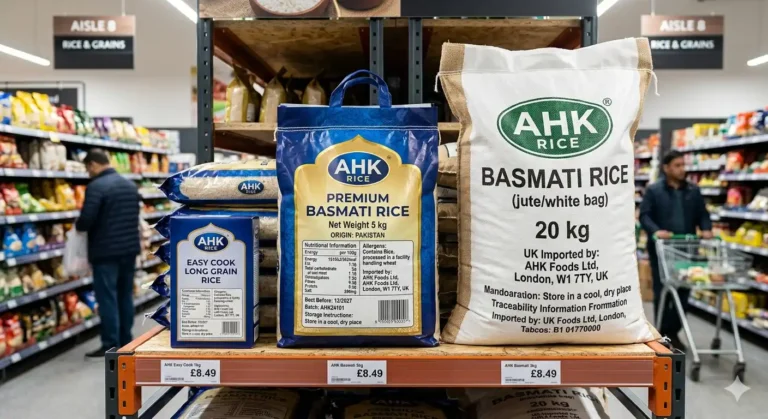
A UK supermarket chain may require 98% purity for private-label packaging. A catering distributor serving large institutions may prioritise cost efficiency and accept lower specifications.
Premium purity also strengthens long-term contracts. Consistent performance reduces quality disputes and improves supplier reliability.
Having compared purity levels, buyers must understand which regions prioritise specific grades.
Which Market Regions Prefer Different Purity Grades?
The UK and European markets prefer higher-purity grades, while parts of the Middle East balance purity with cost efficiency.
Regional demand patterns strongly influence market positioning.
UK and European Markets
UK wholesalers generally prefer:
- 1121 Steam Basmati
- 1121 Sella Basmati
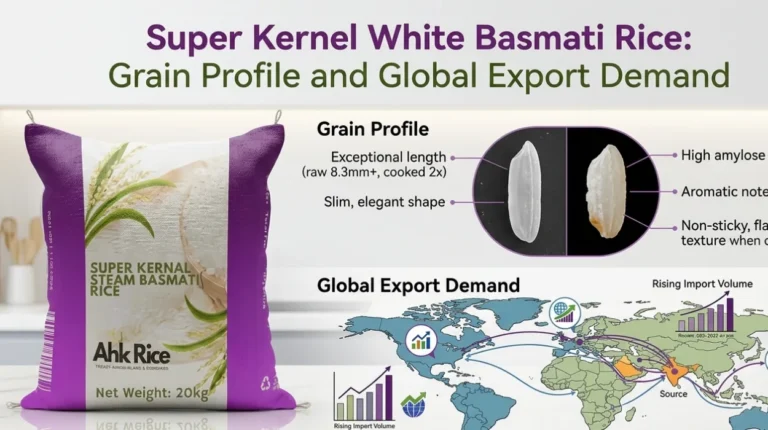
- Super Kernel Basmati
Retail buyers typically seek 97–98% purity. Premium supermarkets focus on consistent grain appearance and cooking performance.
Food safety compliance also supports higher-purity sourcing decisions. Product traceability requirements encourage stricter specification control.
Gulf and Middle Eastern Markets
Middle Eastern buyers commonly source:
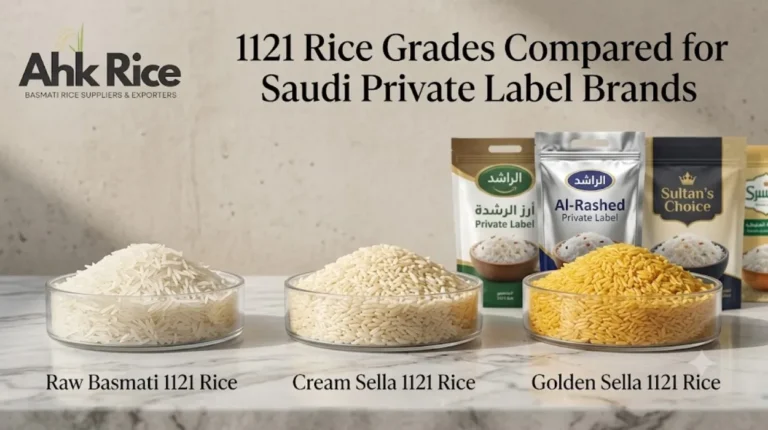
- 1121 Golden Sella
- 1121 White Sella
- 1509 Sella
- Super Kernel Sella
Purity requirements generally range from 94–98%, depending on the distribution channel.
Luxury retail chains favour higher-purity grades. Catering companies often prioritise storage stability and procurement costs.
Regional Grade Preference Comparison
| Region | Preferred Grade | Typical Purity |
|---|---|---|
| United Kingdom | 1121 Steam | 97–98% |
| Europe | Super Kernel White | 96–98% |
| UAE | 1121 Golden Sella | 95–98% |
| Saudi Arabia | 1121 Golden Sella | 94–98% |
| Qatar | 1121 White Sella | 95–98% |
| Oman | 1509 Sella | 94–97% |
Regional preferences directly affect pricing structures, making price comparison the next consideration.
How Does Purity Influence Price Per Metric Tonne?
Higher purity regularly generates £40–£150 additional value per metric tonne because buyers pay for consistency and lower quality risk.
Price differences emerge from supply availability, sorting requirements, and customer expectations.
Higher-purity rice requires additional grading, sorting, and inspection. Exporters invest more resources to achieve tighter specifications.
Typical Export Price Comparison
| Grade Category | Purity Range | Price Difference per MT |
|---|---|---|
| Commercial | 85–91% | Baseline |
| Standard | 92–96% | +£40 to +£80 |
| Premium | 97–98% | +£90 to +£150 |
A distributor purchasing 500 MT annually may realise significant value through premium positioning. Higher retail margins often offset increased procurement costs.
Premium purity also reduces claim rates. Lower rejection risk improves profitability across the supply chain.
Price advantages become even more important when shelf life and storage performance are considered.
How Does Purity Affect Shelf Life and Storage Performance?
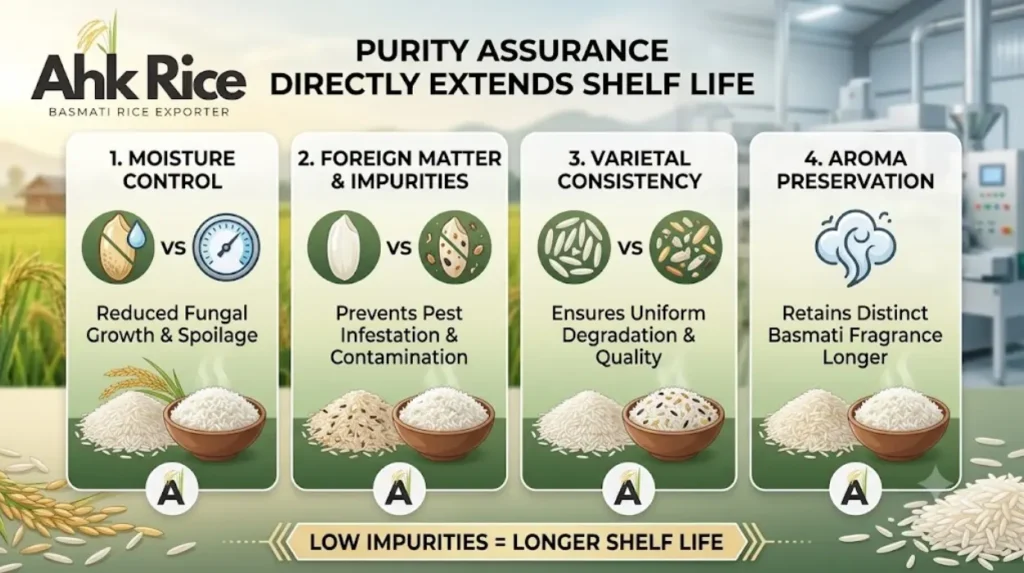
Higher-purity rice maintains more consistent quality during storage because grain characteristics remain uniform throughout the batch.
Shelf life depends on moisture, processing, packaging, and storage conditions. Purity contributes through uniform grain behaviour.
Mixed grain populations absorb moisture differently. Uneven storage performance can affect cooking results over time.
Shelf Life Comparison
| Product Type | Typical Shelf Life |
|---|---|
| Premium Purity Steam | 12–18 Months |
| Premium Purity Sella | 18–24 Months |
| Standard Purity Steam | 12 Months |
| Standard Purity Sella | 15–18 Months |
1121 Golden Sella lasts longer than Steam grades. In high-temperature Gulf warehouses, Golden Sella often maintains quality for up to 24 months. Steam grades typically require faster turnover.
Super Kernel White performs well in climate-controlled UK storage facilities. Uniform grain characteristics support consistent cooking results throughout the storage cycle.
Storage performance helps buyers evaluate the available sourcing solutions.
What Are the Available Solutions for Buyers Seeking Higher Purity?
Laboratory testing, advanced sorting, supplier qualification, and contract specifications provide the most reliable path to higher-purity sourcing.
Buyers can improve procurement outcomes through several approaches.
Supplier-Based Verification
Exporters inspect, grade, and certify products before shipment. Reliable suppliers maintain documented quality systems.
Independent Laboratory Testing
Third-party laboratories verify purity claims before loading containers. Independent testing reduces procurement risk.
Advanced Sorting Technologies
Modern processing facilities use:
- Colour sorting
- Length grading
- Thickness grading
- Density separation
- Optical inspection
These technologies improve consistency and increase achievable purity levels.
Contract-Based Specifications
Procurement contracts should define:
- Purity percentage
- Moisture limits
- Broken grain limits
- Packaging standards
- Inspection procedures
Solution selection depends on buyer objectives, making decision factors critical.
Which Purity Strategy Works Best for Different Buyers?
Premium retail requires maximum purity, while foodservice and institutional channels often balance purity with procurement cost.
Different buyers achieve better outcomes through different specifications.
Decision Framework Table
| Buyer Type | Recommended Purity | Reason |
|---|---|---|
| Premium Retailer | 97–98% | Brand positioning |
| Private Label Brand | 97–98% | Consumer consistency |
| Import Distributor | 95–97% | Margin balance |
| Foodservice Supplier | 94–96% | Cost efficiency |
| Institutional Catering | 92–95% | Volume procurement |
Premium retailers benefit from visual consistency. Consumer expectations remain high in branded environments.
Foodservice operators focus on yield and affordability. Moderate purity often provides the best commercial balance.
Institutional buyers prioritise procurement efficiency. Volume purchasing frequently outweighs premium presentation requirements.
Decision frameworks become more effective when combined with a balanced assessment of advantages and disadvantages.
What Are the Pros and Cons of High-Purity Basmati Rice?
Higher purity improves market positioning and customer satisfaction, but it increases procurement costs and specification requirements.
Advantages
- Higher retail pricing potential
- Stronger brand perception
- Better cooking consistency
- Lower complaint rates
- Reduced rejection risk
A premium supermarket benefits from customer loyalty and stronger shelf differentiation through higher-purity products.
Disadvantages
- Higher procurement costs
- Tighter sourcing requirements
- Reduced supplier availability
- Greater inspection demands
- Longer qualification processes
A wholesale importer may accept slightly lower purity to secure better pricing and larger supply volumes.
Both advantages and disadvantages highlight the importance of selecting purity according to business objectives.
What Decision Factors Should Buyers Evaluate Before Purchasing?
Purity specification, target market, pricing strategy, storage conditions, and supplier capability determine the correct purchasing decision.
Successful procurement begins with market requirements. Retail-focused businesses typically require stricter specifications than institutional buyers.
Pricing strategy should align with customer expectations. Premium consumers willingly pay more for consistency and authenticity.
Storage conditions influence grade selection. Long-term warehousing often favours Sella grades because they maintain quality longer.
Supplier capability determines achievable purity levels. Exporters must inspect, grade, certify, and document every shipment consistently.
Market positioning ultimately depends on matching purity specifications with commercial objectives. The strongest results occur when purity standards align with customer expectations, distribution channels, and pricing strategy.
Frequently Asked Questions
What is considered high-purity Basmati rice?
High-purity Basmati rice generally contains 97–98% varietal purity and delivers superior consistency in appearance, aroma, and cooking performance.
Why do UK importers prefer higher-purity Basmati?
UK importers prioritise consistent retail presentation, customer satisfaction, and reduced quality complaints. Higher purity supports all three objectives.
Does higher purity always mean higher prices?
Yes. Higher purity requires additional grading, sorting, inspection, and certification, which increases production and export costs.
Which Basmati variety is most commonly sold in premium markets?
1121 Basmati remains one of the most widely traded premium varieties because of its grain length and cooking performance.
Is purity more important than grain length?
Both matter. Purity determines consistency, while grain length influences visual appeal and consumer preference.
How is Basmati purity tested?
Inspectors analyse representative samples, sort grain varieties, measure characteristics, and verify conformity with declared specifications.