Why Are Factory Compliance Standards Important for Rice Importers?
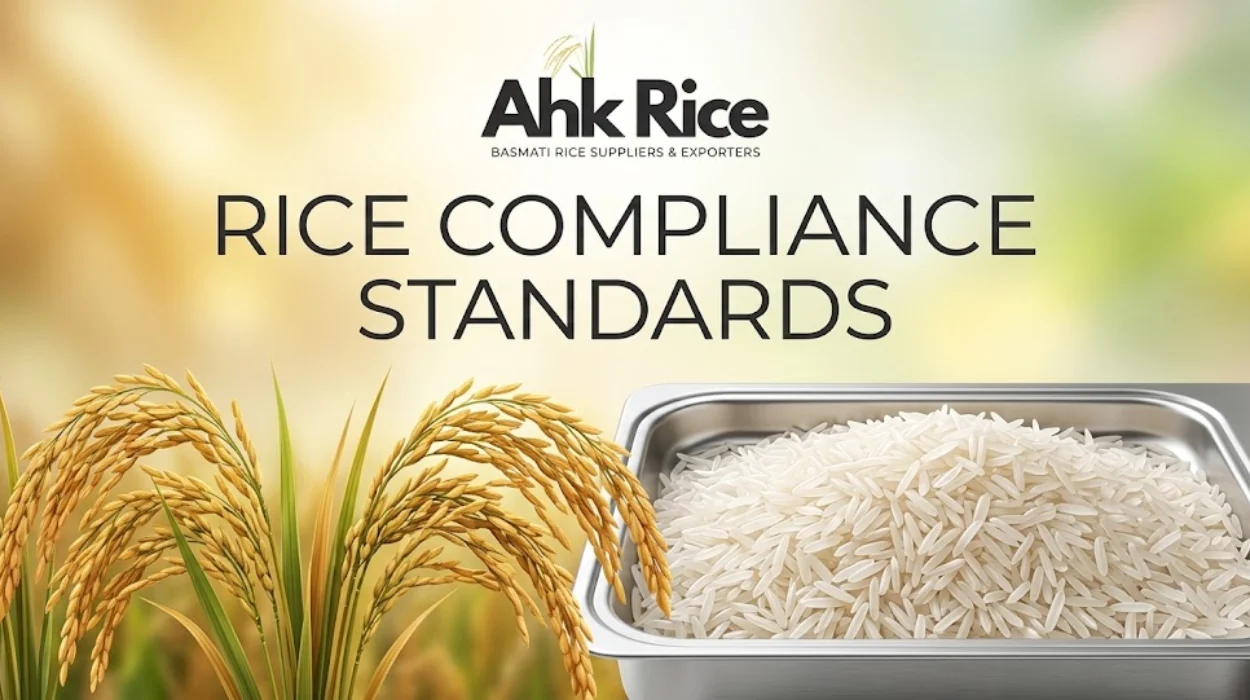
Factory compliance standards are the documented controls that govern how rice is received, processed, tested, packed, stored, and prepared for export. For importers, they provide evidence that a rice processing facility manages food safety, product specifications, hygiene, traceability, and operational risks through controlled procedures.
Rice is an agricultural product, so its quality begins before processing. In Pakistan, Basmati rice is primarily associated with Punjab, while rice production also occurs in Sindh and other agricultural regions. Pakistani export programs commonly include long-grain Basmati varieties such as 1121, Super Kernel, and 1509. Each variety has defined commercial specifications covering grain appearance, length, broken percentage, moisture, foreign matter, milling quality, and cooking characteristics.
Factory compliance connects these product requirements with the physical controls used inside the processing facility. A compliant factory does not simply produce visually clean rice. It controls the conditions that influence safety, consistency, identification, packaging, and shipment records.
What are factory compliance standards in rice processing?
Factory compliance standards are documented rules controlling hygiene, equipment, personnel, processing, testing, traceability, storage, and shipment. They give rice importers measurable evidence that a supplier controls food safety, product specifications, contamination risks, and records properly before export from origin.
A factory compliance standard defines how a processing facility operates and how it proves that its procedures are followed. These standards cover food hygiene, sanitation, pest management, equipment maintenance, employee hygiene, product testing, storage, packaging, and traceability.
International food operations commonly use systems based on HACCP, ISO 22000, BRCGS, or other recognized food-safety frameworks. HACCP, or Hazard Analysis and Critical Control Points, identifies biological, chemical, and physical hazards and establishes controls at relevant stages. ISO 22000 provides a food-safety management system framework. BRCGS Food Safety is a private certification standard used by many retailers and food businesses.
Codex Alimentarius provides internationally recognized food-safety principles. Its General Principles of Food Hygiene, CXC 1-1969, was revised in 2022 and incorporates HACCP principles.
Certification is not the same as legal permission to export. A certificate demonstrates conformity to a defined standard within a stated scope and validity period. Importers still need to verify destination-country requirements, product documentation, labeling, testing, and customs conditions.
In Pakistan, rice is also recognized within the standards and conformity framework administered by the Pakistan Standards and Quality Control Authority, including Basmati and other rice categories.
How does factory compliance work from paddy to export?
Factory compliance works through controlled procedures that begin when paddy or milled rice enters the facility and continue through cleaning, grading, processing, testing, packing, storage, and loading. Each stage creates records that connect product specifications with responsible controls at origin.
The process starts with receiving raw material. Paddy or milled rice is identified by supplier, lot, variety, quantity, and receiving date. Sampling then establishes the initial condition of the material.
The next stage is cleaning. Screens and aspiration systems remove dust, straw, husk fragments, stones, and other foreign material. Destoners separate dense particles such as stones from rice.
For paddy processing, husking removes the outer husk. Brown rice then moves through whitening and polishing equipment when white rice is required. Milling removes bran layers while controlled equipment settings help maintain the desired appearance and yield.
Grading separates kernels according to length, thickness, broken percentage, and other specifications. Color sorting uses optical equipment to remove discolored or defective kernels. Length grading is especially important for long-grain Basmati because buyers often specify grain dimensions and broken-rice limits.
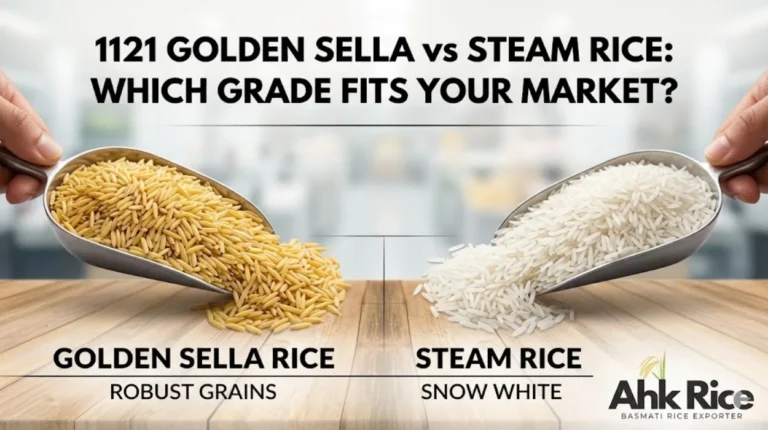
Parboiled or Sella rice follows a different thermal process. Paddy undergoes soaking, steaming, and drying before milling. This process changes grain structure, cooking behavior, color, and resistance to breakage.
After processing, quality-control teams inspect representative samples. Tests can cover moisture, broken kernels, foreign matter, damaged grains, chalkiness, grain length, milling yield, and other contractual specifications. Food-safety testing covers relevant hazards according to the product, supplier risk assessment, and destination requirements.
Finished rice is then packed in bulk or consumer formats. Packaging can include polypropylene bags, woven sacks, laminated retail bags, or customized private-label packaging. Labels identify essential product information according to the destination market.
The final stages include warehouse control, container inspection, loading records, and shipment documentation. Traceability links the finished product back to its processing lot and relevant records.
What are the key components of a compliant rice factory?
Key components include hygienic facility design, sanitation, pest control, employee practices, equipment maintenance, hazard analysis, laboratory testing, traceability, supplier controls, calibration, corrective actions, documentation, packaging control, and storage management. Together, these controls create an auditable system for consistent rice production.
Facility hygiene is the foundation. Floors, walls, drains, ceilings, production zones, and storage areas require conditions that support effective cleaning and prevent contamination.
Sanitation programs specify what is cleaned, how it is cleaned, which equipment is covered, who performs the task, and how completion is recorded. Examples include cleaning conveyors, grading machines, packing equipment, storage areas, and contact surfaces.
Pest control prevents insects, rodents, birds, and other pests from entering production and storage areas. A documented program records inspections, corrective actions, monitoring points, and treatment activities.
Personnel controls address hand hygiene, protective clothing, illness reporting, movement through production zones, and training. Employees handling rice need procedures that reduce contamination risks.
Equipment controls include preventive maintenance, calibration, inspection, and repair. Scales, moisture meters, laboratory instruments, thermometers, and other measuring devices require appropriate calibration or verification.
Hazard analysis identifies relevant biological, chemical, and physical hazards. Examples include microbial hazards, pesticide residues, mycotoxins, heavy metals, foreign materials, and contamination introduced during processing or storage.
Traceability connects incoming material, processing lots, testing records, packaging, warehouse inventory, and shipment documentation. This allows an importer and supplier to identify affected lots when a quality or safety problem occurs.
Corrective-action systems address deviations. A failed test, damaged packaging batch, pest finding, calibration failure, or specification deviation should generate an investigation and documented corrective action.
What benefits do compliance standards provide to rice importers?
Compliance standards benefit importers by reducing food safety uncertainty, specification variation, documentation gaps, contamination exposure, rejected shipments, and recall difficulty. They also provide evidence for supplier approval, customer audits, regulatory reviews, private-label programs, repeat purchasing decisions, and product claims accurately.
The first benefit is supplier evaluation. An importer can compare factories using objective evidence rather than relying only on sales claims.
The second benefit is specification consistency. A controlled processing system establishes repeatable procedures for cleaning, milling, grading, sorting, testing, and packing. This matters when an importer orders the same specification across multiple containers.
The third benefit is regulatory readiness. U.S. food importers, for example, are subject to the Foreign Supplier Verification Program when applicable. FDA requires covered importers to evaluate food hazards and supplier performance and conduct appropriate verification activities. These activities include onsite audits, sampling and testing, and review of relevant food-safety records.
FDA specifically identifies rice among grain raw agricultural commodities addressed in its FSVP guidance.
Factory records therefore become useful evidence during supplier verification. They do not replace the importer’s own regulatory responsibilities.
Compliance also supports recall management. If a problem affects one production lot, traceability records help identify the affected quantity rather than treating all inventory as one undifferentiated shipment.
Which rice products and grades require factory controls?
Factory compliance controls apply across bulk commodity imports, branded retail rice, restaurant supply, private-label programs, ethnic grocery distribution, institutional purchasing, and contract packing. The required evidence changes with destination-country rules, product claims, packaging format, customer specifications, and each risk assessment.
Pakistani Basmati rice is commercially sold in several recognized varieties and processing forms. 1121 Basmati is known for its long grain and is commonly supplied as white, steam, or Sella rice. Super Kernel Basmati is another established long-grain category. 1509 Basmati is commonly supplied as white, steam, or parboiled/Sella rice.
These commercial grades differ in grain dimensions, processing characteristics, aroma, appearance, broken percentage, moisture, and cooking performance. Exact contractual limits should come from the purchase specification rather than a generic description.
Rice factories also process non-Basmati long-grain rice, IRRI-type rice, brown rice, parboiled rice, and broken rice. Each category requires appropriate grading and quality controls.
The destination market determines additional requirements. The United States applies FDA food-import rules and FSVP requirements to covered food importers. Gulf markets apply their own food-control, labeling, conformity, and import procedures. European markets apply EU food-safety and contaminant requirements. Buyers therefore need to match factory documentation with the rules of the destination country.
Certifications also vary by buyer and market. HACCP-based systems, ISO 22000, BRCGS, Halal certification, Kosher certification, organic certification, and customer-specific standards serve different purposes. Not every rice shipment requires every certification.
Where are Pakistani Basmati rice grades imported?
Pakistani Basmati rice is exported to markets across the Middle East, North America, Europe, Africa, and Asia. Import demand differs by variety, grain length, processing form, packaging format, foodservice use, retail positioning, and local requirements for safety and labeling documentation.
The Middle East is an important market for Pakistani Basmati, with Saudi Arabia and the United Arab Emirates representing established destinations for long-grain rice products.
North American markets also import Pakistani Basmati for retail, restaurants, wholesalers, distributors, and ethnic grocery channels. European markets use imported Basmati across retail and foodservice categories, while African and Asian markets purchase different combinations of Basmati and non-Basmati rice.
The commercial grade changes according to the buyer’s application. Retail buyers often require consistent grain appearance and packaging specifications. Restaurants focus on cooking yield, grain separation, aroma, and repeat performance. Distributors require stable specifications across larger shipments.
Factory compliance becomes important across all these applications because the importer is purchasing a repeatable specification rather than a single visual sample.
What common problems and misconceptions affect factory compliance decisions?
Common misconceptions include treating a certificate as proof of batches, assuming one standard satisfies markets, confusing product quality with food safety, and accepting an audit score without reviewing scope, findings, corrective actions, dates, and certificate validity for approving a supplier.
A certification does not prove that every container is identical. It demonstrates that a facility conforms to a defined standard within a specified scope and validity period.
Another misconception is that HACCP, ISO 22000, or BRCGS automatically satisfies every destination-market regulation. Private certification and government regulation are separate systems. An importer must still verify applicable import, labeling, testing, customs, and food-safety requirements.
A third misconception is treating appearance as a complete quality assessment. Bright, uniform rice can still have problems involving moisture, residues, microbiological controls, foreign matter, traceability, or documentation.
Audit scores also require context. An importer should review the audit date, certification body, facility scope, product scope, nonconformities, corrective actions, closure evidence, and certificate status.
The strongest supplier assessment therefore combines factory audits, product specifications, laboratory results, traceability records, certificates, shipment history, and regulatory documentation.
How should rice importers evaluate factory compliance before purchasing?
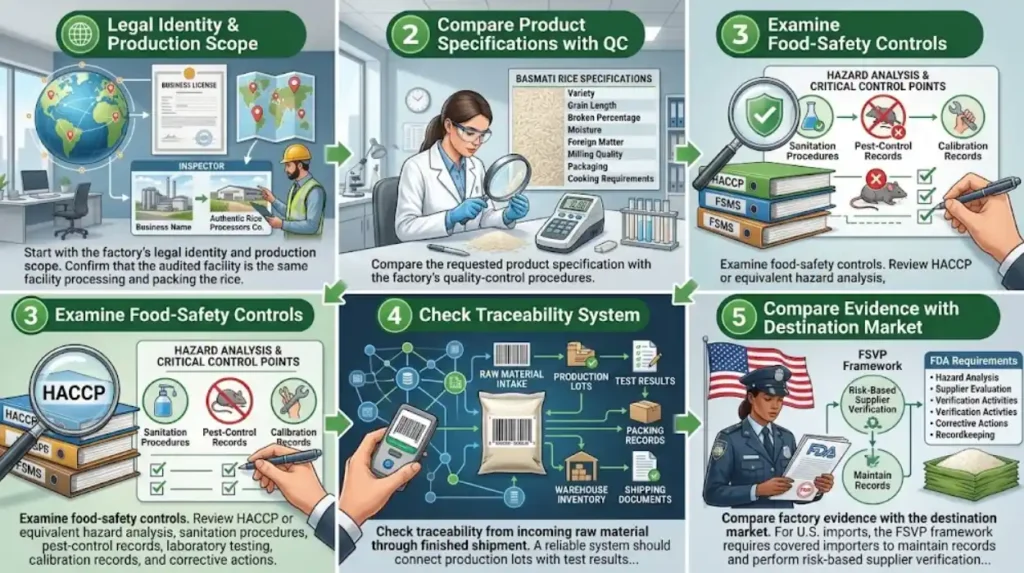
Rice factory compliance is a supply-chain control system, not a single certificate. Importers should connect facility standards, product specifications, testing records, traceability, certifications, destination-market rules, and corrective-action history to determine whether a supplier can consistently meet contractual and regulatory requirements.
Start with the factory’s legal identity and production scope. Confirm that the audited facility is the same facility processing and packing the rice.
Next, compare the requested product specification with the factory’s quality-control procedures. For Basmati rice, review variety, grain length, broken percentage, moisture, foreign matter, milling quality, packaging, and cooking requirements.
Then examine food-safety controls. Review HACCP or equivalent hazard analysis, sanitation procedures, pest-control records, laboratory testing, calibration records, and corrective actions.
Check traceability from incoming raw material through finished shipment. A reliable system should connect production lots with test results, packing records, warehouse inventory, and shipping documents.
Finally, compare factory evidence with the destination market. For U.S. imports, the FSVP framework requires covered importers to maintain records and perform risk-based supplier verification. FDA states that importer verification includes hazard analysis, supplier evaluation, verification activities, corrective actions, and recordkeeping.
This approach turns factory compliance from a certificate-checking exercise into a structured supplier-risk assessment. It also establishes the foundation for understanding how audit evidence demonstrates actual processing controls, which is the focus of the next consideration-stage article:
How audit reports demonstrate rice processing quality controls
Frequently Asked Questions
What are factory compliance standards in rice processing?
Factory compliance standards are documented procedures that control hygiene, sanitation, food safety, processing, testing, traceability, packaging, storage, and shipment preparation in a rice processing facility.
Why are factory compliance standards important for rice importers?
They help importers verify that a supplier controls food-safety hazards, product specifications, contamination risks, traceability, and processing consistency before the rice is exported.
Which certifications apply to rice processing factories?
Common certifications and systems include HACCP, ISO 22000, BRCGS, Halal, Kosher, and organic certification. Requirements depend on the destination market, buyer specifications, product claims, and intended use.
What does HACCP control in a rice factory?
HACCP identifies biological, chemical, and physical hazards and establishes preventive controls, monitoring procedures, corrective actions, verification activities, and records at relevant processing stages.
How does factory compliance affect Pakistani Basmati rice quality?
Compliance controls cleaning, milling, grading, optical sorting, moisture management, testing, packaging, storage, and traceability. These controls support consistent specifications for varieties such as 1121, Super Kernel, and 1509 Basmati rice.
What should importers check in a factory audit report?
Importers should review the audit date, facility identity, certification scope, product scope, audit findings, nonconformities, corrective actions, closure evidence, and certificate validity.
Does a factory certificate guarantee every rice shipment will meet specifications?
No. A certificate demonstrates conformity with a defined standard and scope. Importers should also review shipment-specific specifications, laboratory results, inspection records, samples, and contractual requirements.
How does traceability help rice importers?
Traceability connects raw materials, processing lots, testing records, packaging, warehouse inventory, and shipment documents. It helps identify affected batches when a quality or food-safety problem occurs.