How Does Rice Purity Influence Saudi Arabian Consumer Trust in Pakistan Basmati Rice?
Rice purity directly influences consumer trust because it connects the product name on the package with the grains inside it. For Pakistan Basmati rice sold in Saudi Arabia, purity includes varietal identity, grain uniformity, foreign-matter control, broken-grain control, cleanliness, and accurate labeling. These attributes shape whether consumers receive the expected aroma, appearance, texture, and cooking performance.
Saudi Arabia applies technical regulations and standards to imported food. The Saudi Food and Drug Authority (SFDA) checks imported food through document review, identity checks, physical examination, and laboratory testing when required. Food products must conform to applicable Saudi technical regulations and standards before entering the market.
What is rice purity in Pakistan Basmati rice?
Rice purity is the degree to which a Basmati rice lot contains the declared variety without unintended rice varieties, foreign material, excessive broken grains, damaged kernels, or inconsistent grain characteristics. In Saudi Arabia, purity supports product identity, predictable cooking performance, accurate labeling, and consumer confidence.
Purity is not the same as appearance alone. A bright, polished rice sample can still contain mixed varieties. A premium-looking package can also contain inconsistent grain lengths, broken kernels, chalky grains, or foreign material.
For Basmati rice, varietal identity matters because Basmati is defined by distinctive characteristics. Pakistan’s Trade Development Authority describes Pakistani Basmati as long, slender, aromatic rice with a high length-to-breadth ratio, sweet taste, soft and fluffy texture, and characteristic aroma associated strongly with 2-acetyl-1-pyrroline. Pakistan registered Basmati as a geographical indication under its Geographical Indications (Protection and Registration) Act 2020.
Pakistan’s Punjab is a major production region for aromatic and Basmati rice. The Punjab Agriculture Department lists multiple Basmati and fine aromatic varieties developed through the Rice Research Institute, Kala Shah Kaku. Its current variety list includes PK 1121 Aromatic, Super Basmati, Basmati 515, Punjab Basmati, Chenab Basmati, and newer varieties developed through 2025.
Commercial export terminology also includes varieties and grades such as 1121 Basmati, Super Kernel, and 1509. Processing formats include white, steam, and parboiled or Sella rice. These names identify different product specifications and should not be treated as interchangeable labels.
Why does purity matter to consumers?
A consumer buying a premium Basmati product expects a recognizable result after cooking. The rice should provide the grain appearance, aroma, elongation, and texture associated with the stated variety.
When a bag contains inconsistent kernels, the cooking result becomes less predictable. One portion can contain long grains while another contains shorter grains with different absorption and cooking behavior.
Purity therefore acts as a consistency signal. It reduces the gap between the product claim and the physical product.
How does rice purity work from farm to Saudi retail shelf?
Rice purity develops through controlled variety selection, cultivation, harvesting, drying, storage, milling, cleaning, grading, sorting, laboratory testing, packaging, documentation, and shipment. Each stage controls a different source of contamination, varietal mixing, physical defects, or specification failure.
The process begins with variety identity. Seed selection establishes the starting material. Pakistan’s agricultural research system maintains distinct rice varieties with documented agronomic and grain characteristics. This separation provides the foundation for maintaining varietal identity during commercial production.
After harvest, paddy rice undergoes drying and storage. Moisture control matters because excessive moisture supports deterioration and affects milling performance. Moisture is measurable using standardized analytical methods. GSO ISO 712 covers moisture determination for cereals, including paddy, husked, and milled rice.
Milling removes the husk and produces milled rice. Further processing separates unwanted material and improves kernel uniformity. Cleaning removes materials such as stones, dust, straw, husk fragments, and other foreign matter.
Grading separates kernels according to physical characteristics. Broken kernels are separated from whole kernels. Length grading helps establish the consistency expected for a defined commercial specification.
Optical sorting adds another control layer. Sorters identify and remove kernels that differ by color or visual characteristics. Examples include discolored grains, damaged kernels, chalky grains, and other visually defective material.
Laboratory testing then verifies selected quality parameters. Typical commercial specifications cover moisture, broken grains, foreign matter, damaged kernels, chalky kernels, grain length, and other quality characteristics.
The finished rice is packed according to the intended market specification. Saudi food labeling rules apply to prepackaged foods through SFDA.FD/GSO 9. Arabic labeling is required, while another language can appear alongside Arabic when the information is identical.
At the import stage, SFDA inspection includes documentary, identity, and physical checks. Laboratory testing is used when an inspector determines that testing is necessary. A consignment can be rejected if it fails applicable requirements.
Pakistan’s Department of Plant Protection also regulates phytosanitary export procedures. Its process includes inspection, sampling, treatment when required, and issuance of a phytosanitary certificate according to the importing country’s requirements.
Which components determine rice purity?
Rice purity depends on varietal identity, whole-kernel percentage, broken-kernel percentage, foreign matter, damaged and discolored grains, grain-size uniformity, moisture, cleanliness, and traceability. Together, these components determine whether the physical rice matches the declared commercial specification.
Varietal identity
Varietal identity determines what type of rice is actually inside the package. A pure lot contains the declared variety rather than an uncontrolled mixture of varieties.
For example, a 1121 Basmati specification should not be treated as equivalent to a Super Kernel or 1509 specification simply because all three are marketed as long-grain Pakistani rice.
Kernel uniformity
Uniformity describes how consistently the grains match one another in size and shape. High uniformity creates a more predictable visual and cooking result.
Grain length is especially important in premium Basmati. Pakistan’s agricultural research data records grain-length differences among varieties, including extra-long fine rice varieties.
Broken grains
Broken grains are kernels that do not retain the expected whole-grain structure. A higher broken percentage changes package appearance and cooking behavior.
A specification therefore needs a defined broken-grain tolerance instead of relying on terms such as “premium” or “high quality.”
Foreign matter
Foreign matter includes material that is not rice. Examples include stones, soil particles, plant fragments, husk, and other physical contaminants.
Effective cleaning and sorting reduce these materials before packaging.
Moisture
Moisture affects storage stability, milling behavior, and quality preservation. It is therefore a measurable quality parameter rather than simply a storage concern.
Saudi and Gulf technical standards include recognized methods for determining cereal moisture content, including rice.
Traceability
Traceability connects the finished product with its production and processing records. It supports investigation when a quality deviation appears.
For export shipments, documentation can include commercial invoices, packing lists, certificates of origin, phytosanitary documentation, and other certificates required for the specific commodity or destination. Pakistan’s Department of Plant Protection lists these documents within its export procedure.
What benefits does higher rice purity provide?
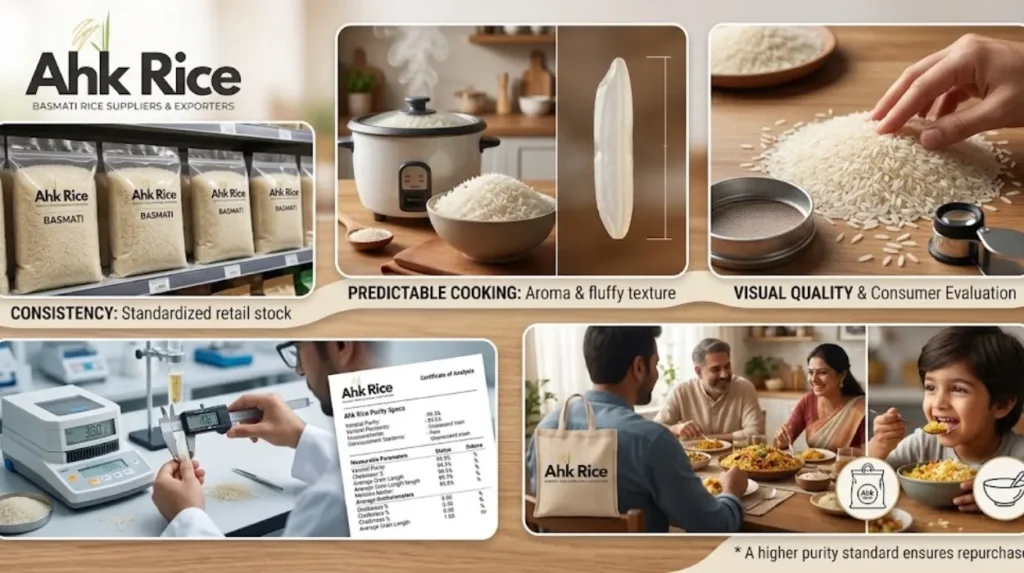
Higher rice purity provides more consistent appearance, cooking behavior, aroma, grain elongation, texture, and package-to-package performance. It also strengthens product identity and makes quality specifications easier to verify through inspection, laboratory analysis, documentation, and traceability.
The first benefit is consistency. A retailer can stock a defined specification when the grain characteristics remain within established limits.
The second benefit is predictable cooking performance. Basmati is valued for long, slender grains, aroma, and separate, fluffy cooked grains. Maintaining a consistent variety and grade supports these characteristics.
The third benefit is visual quality. Consumers often evaluate rice before cooking. Uniform grain length and limited discoloration create a clearer relationship between the package description and the actual contents.
The fourth benefit is specification control. A measurable specification gives importers and retailers concrete quality parameters to evaluate instead of relying only on marketing terminology.
The fifth benefit is consumer trust. Trust develops when repeated purchases produce similar results. If the same product repeatedly delivers consistent grains, aroma, and texture, the consumer has a stronger reason to repurchase it.
This relationship is particularly important for premium Basmati because consumers pay for identifiable characteristics rather than simply for calories or bulk grain.
Where does rice purity matter in the Saudi Arabian market?
Rice purity matters across supermarkets, hypermarkets, specialty food stores, restaurants, catering operations, wholesalers, and household consumption. Each segment uses purity differently, but all depend on consistent product identity, predictable cooking results, and compliance with Saudi food requirements.
Retail packaging places purity directly in front of consumers. A shopper can compare grain appearance, variety claims, origin information, package size, and labeling before purchase.
Restaurants and catering businesses evaluate purity through cooking performance. Basmati used for biryani, pulao, mandi, and other rice dishes needs consistent grain behavior across large batches.
Wholesalers and distributors evaluate purity as a supply-chain attribute. They need repeatable specifications across multiple shipments because inconsistent quality creates complaints downstream.
Food importers also operate within Saudi regulatory controls. Imported food products must comply with applicable regulations, technical requirements, and standards. SFDA requires food importers to register their establishments and imported food items, while imported consignments undergo regulatory checks.
The Gulf Standard GSO 1003:2022 specifically covers rice grains intended for human consumption, including husked, milled, parboiled, and fortified rice, whether packaged or sold in bulk. This provides an important regional technical reference for rice specifications.
For Saudi retail products, labeling also matters. SFDA identifies SFDA.FD/GSO 9 as the principal technical regulation for prepackaged food labeling.
Rice has an additional labeling distinction. SFDA states that single-ingredient foods such as rice are excluded from the nutritional-labeling requirements under the relevant GSO 2233 provision. This does not remove other applicable labeling requirements.
Which certifications and documents support rice purity?
Rice purity is supported by product testing, certificates, traceability records, phytosanitary documentation, origin documentation, and applicable food-safety systems. Legal requirements depend on the shipment and destination, while certifications such as HACCP, ISO 22000, and ISO 9001 function as additional management-system evidence.
A certificate of origin identifies the declared country of origin. This is relevant when the buyer requires proof that the rice originates from Pakistan.
A phytosanitary certificate demonstrates compliance with applicable plant-health requirements. Pakistan’s Department of Plant Protection issues phytosanitary certificates following inspection and compliance with importing-country requirements.
Food-safety management certifications provide a different type of evidence. ISO 22000 addresses food-safety management systems. HACCP identifies and controls food-safety hazards through a structured preventive system. ISO 9001 addresses quality-management systems.
These certifications should not be confused with a laboratory purity result. A management-system certificate demonstrates how an organization controls processes. A laboratory report demonstrates measured characteristics in a tested sample.
Saudi import requirements also include certificates and documents depending on the food product. SFDA lists certificates such as certificate of origin and halal certification among documents that can apply according to the food item, alongside other required documentation.
Organic certification applies when a product is marketed as organic. Saudi requirements for imported organic foods include certification from an accepted certification body and documentation demonstrating compliance with applicable organic requirements.
The correct approach is therefore to separate purity testing, food-safety certification, plant-health certification, origin documentation, and regulatory compliance. They answer different quality questions.
What are the common misconceptions about rice purity?
Rice purity does not mean that every grain has identical dimensions or that polished white rice is automatically pure. Purity requires a defined specification, controlled processing, testing, documentation, and traceability that establish what the rice contains and what variety it represents.
One common misconception is that white color proves purity. It does not. Milling and polishing influence appearance, while varietal purity requires identity control.
Another misconception is that long grain automatically means Basmati. Grain length alone does not establish Basmati identity. Basmati has a broader set of characteristics, including aroma, grain form, cooking behavior, and geographical identity requirements.
A third misconception is that “premium” is a measurable purity grade. It is not sufficient by itself. A commercial specification should identify measurable parameters such as grain length, broken percentage, moisture, foreign matter, and other relevant tolerances.
A fourth misconception is that certifications replace laboratory testing. They do not. A certified management system and a tested rice sample provide different types of evidence.
A fifth misconception is that pure variety and high quality mean exactly the same thing. They do not. A rice lot can have strong varietal identity but still fail a particular specification because of broken grains, discoloration, moisture, or other quality attributes.
This distinction becomes important when comparing pure variety rice with mixed variety rice. Retailers evaluate not only whether a product looks clean, but also whether its declared variety remains consistent across the package and across repeated shipments. This is the foundation for understanding:
Pure variety versus mixed variety rice in Saudi retail
What should Saudi Arabian buyers examine when evaluating rice purity?
Saudi Arabian buyers should examine the declared variety, grain-length specification, broken-grain tolerance, moisture level, foreign-matter limit, sorting method, laboratory results, packaging information, traceability records, and applicable certificates before judging rice purity or consumer-facing quality.
The evaluation should begin with the product identity. The variety should be clearly defined rather than described only with broad terms such as “long grain” or “premium rice.”
Next, review the physical specification. Grain length, broken percentage, foreign matter, damaged grains, chalky grains, and moisture provide measurable criteria for comparison.
Then review processing controls. Milling, cleaning, grading, and optical sorting determine how effectively unwanted material and inconsistent kernels are removed.
The laboratory report should match the shipment specification. A report that tests different parameters from the purchase specification provides limited assurance.
Packaging and labeling should also match the product documentation. Saudi requirements place responsibility on the food supply chain to meet applicable technical regulations and labeling requirements. SFDA’s 2026 regulatory updates continue to maintain an active framework of approved food standards and technical regulations.
Finally, buyers should evaluate consistency across shipments. A single compliant sample establishes the condition of that tested sample. Repeatable specifications, documented controls, and traceability provide stronger evidence of sustained product consistency.
Rice purity therefore functions as a measurable quality concept rather than a marketing phrase. For Pakistani Basmati rice in Saudi Arabia, varietal identity, physical cleanliness, grain uniformity, processing controls, laboratory verification, and regulatory documentation collectively determine whether the product consistently matches consumer expectations.
Frequently Asked Questions
How does rice purity influence Saudi Arabian consumer trust?
Rice purity builds consumer trust by ensuring that the rice inside the package matches the declared variety and expected quality. Consistent grain size, cleanliness, aroma, cooking performance, and limited foreign matter create a more predictable consumer experience.
What does rice purity mean in Pakistan Basmati rice?
Rice purity refers to the consistency of the declared Basmati variety and the control of unwanted materials or quality defects. It includes varietal identity, grain uniformity, broken grains, foreign matter, damaged kernels, moisture, and other measurable specifications.
Why is varietal purity important for Basmati rice?
Varietal purity helps maintain consistent grain length, aroma, appearance, elongation, and cooking behavior. A mixed variety can produce different grain characteristics within the same package, reducing the consistency expected from a defined Basmati product.
How is rice purity tested before export to Saudi Arabia?
Rice purity is evaluated through physical inspection, grading, cleaning, sorting, and laboratory testing. Common quality checks include moisture, broken grains, foreign matter, damaged kernels, chalkiness, grain dimensions, and other parameters included in the agreed product specification.
Does long grain automatically mean Basmati rice?
No. Long grain alone does not establish Basmati identity. Basmati has distinctive characteristics that include grain form, aroma, cooking behavior, and varietal or geographical identity. A long-grain rice can therefore differ from genuine Basmati rice.
What factors determine the purity of Pakistani Basmati rice?
The main factors include variety identity, grain uniformity, broken-grain percentage, foreign matter, damaged or discolored kernels, moisture, milling quality, optical sorting, storage conditions, and traceability. These factors work together to establish a consistent commercial specification.
Does rice purity affect Basmati cooking performance?
Yes. Consistent varietal identity and grain characteristics support predictable cooking behavior. Mixed varieties or inconsistent grain sizes can produce different water absorption, elongation, texture, and cooking times within the same batch.
Which Pakistani Basmati varieties are imported into Saudi Arabia?
Saudi Arabian buyers source different Pakistani rice varieties according to product specifications and market requirements. Commercially recognized Pakistani varieties include 1121 Basmati, Super Kernel, and 1509, with different processing formats such as white, steam, and Sella rice.
Which certifications support the quality of Pakistani Basmati rice?
Depending on the product and shipment requirements, supporting documentation can include laboratory reports, certificates of origin, phytosanitary certificates, halal certification, and food-safety management certifications such as HACCP or ISO 22000. These documents serve different purposes and should not be treated as interchangeable.
How does rice purity differ from rice quality?
Rice purity focuses strongly on varietal identity and the absence or control of unwanted material and unintended varieties. Rice quality is broader and can include moisture, grain appearance, cooking performance, broken grains, milling characteristics, aroma, and other product specifications.
Can polished white rice still contain mixed varieties?
Yes. Polishing improves the appearance and surface condition of rice but does not establish varietal purity. A polished rice lot can still contain kernels from different varieties if variety identity was not controlled during cultivation, procurement, storage, or processing.
Why do Saudi Arabian retailers compare pure and mixed variety rice?
Retailers compare pure and mixed varieties because variety consistency affects product appearance, cooking performance, consumer expectations, and repeat purchasing. A defined pure-variety specification provides a more predictable product identity than an uncontrolled mixture of rice varieties.