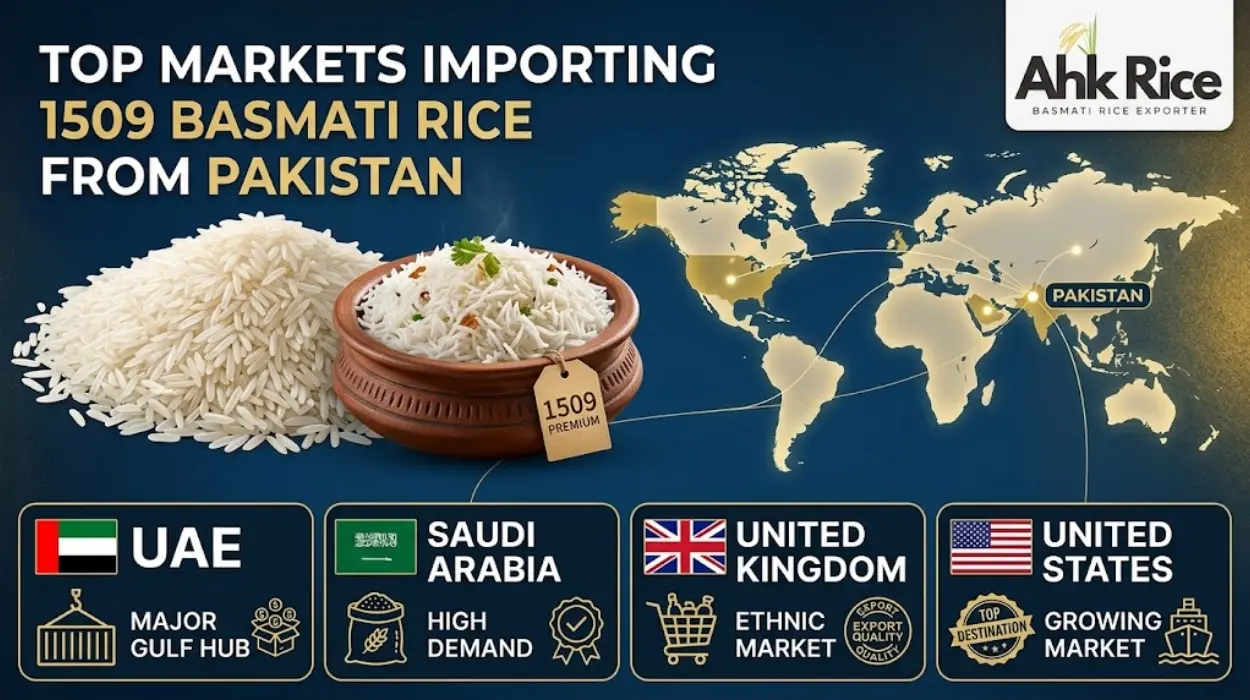
Top Markets Importing 1509 Basmati Rice from Pakistan
1509 Basmati Rice is one of Pakistan’s fastest-growing export rice varieties because it delivers long grain length, strong cooking performance, and competitive pricing. Here is why: importers across the Middle East, Africa, Europe, and Asia source 1509 Basmati Rice to balance quality and cost while maintaining authentic Basmati characteristics.
1509 Basmati Rice has become a major export category within Pakistan’s rice industry. The variety offers a combination of extra-long grains, high yield cultivation, and multiple processing options. Global buyers use it in retail, food service, catering, and wholesale distribution channels. Pakistan cultivates 1509 Basmati primarily in Punjab, where fertile soil and irrigation systems support consistent production.
What Is 1509 Basmati Rice?
1509 Basmati Rice is an extra-long grain aromatic rice variety with grain lengths reaching 8.30–8.50 mm, high yield potential, and multiple export-grade processing options.
1509 Basmati Rice belongs to the Basmati family developed through agricultural breeding programs focused on increasing productivity while maintaining traditional Basmati characteristics. Farmers cultivate this variety extensively because it produces higher yields than older Basmati varieties.
1509 Basmati Rice delivers a distinct aroma, long grain appearance, and excellent cooking expansion. Exporters supply the variety in Steam, White, Golden Sella, Creamy Sella, and Brown Rice grades.
Punjab serves as the primary cultivation region. Farmers cultivate the crop during the Kharif season and harvest it between October and November. Irrigation from canal networks supports stable production throughout the growing cycle.
Which Processing Grades Are Available?
Five major export grades dominate international trade: White Rice, Steam Rice, Golden Sella Rice, Creamy Sella Rice, and Brown Rice.
| Grade | Processing Method | Common Markets | Shelf Life |
|---|---|---|---|
| White Rice | Polished | Europe, Retail | 12-18 months |
| Steam Rice | Steamed Before Milling | Middle East | 18 months |
| Golden Sella | Parboiled | Africa, Gulf | 18-24 months |
| Creamy Sella | Light Parboiling | Gulf, Asia | 18-24 months |
| Brown Rice | Minimal Processing | Health Markets | 12 months |
With the definition of 1509 Basmati Rice established, the next question is how this export product moves from farm to international markets.
How Does 1509 Basmati Rice Processing Work?
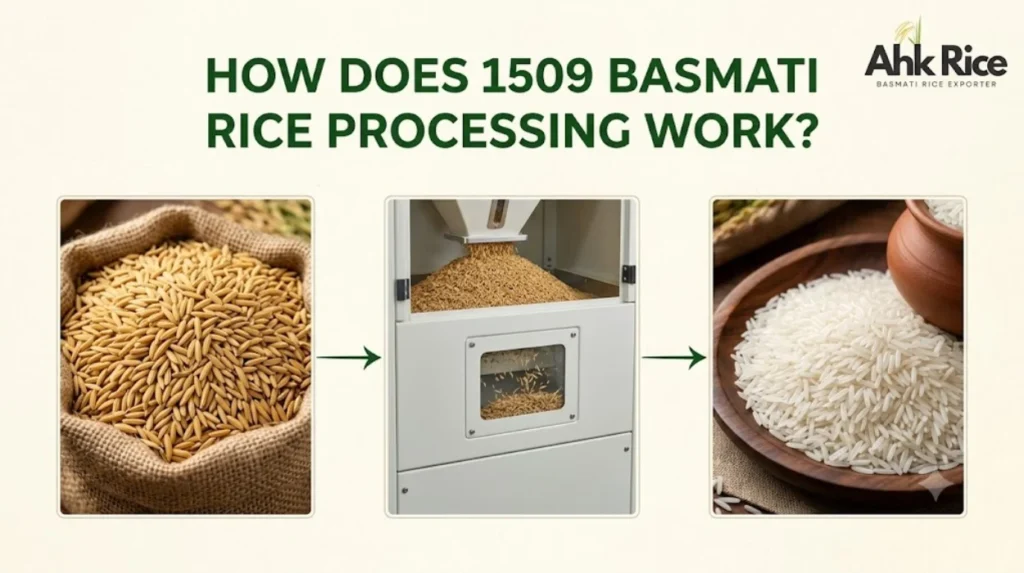
1509 Basmati Rice passes through 9 processing steps before export shipment: cleaning, drying, dehusking, polishing, grading, sorting, testing, packaging, and loading.
Rice processing transforms harvested paddy into export-ready rice. Every stage improves quality, consistency, and food safety compliance.
What Are the Processing Steps?
- Clean the harvested paddy to remove impurities.
- Dry the paddy to target moisture levels.
- Dehusk the grain to remove outer husks.
- Polish the rice according to grade specifications.
- Grade the rice by length and quality.
- Sort the rice using color sorters.
- Test the rice for moisture and purity.
- Package the rice according to buyer requirements.
- Load the cargo into containers for export.
Quality control occurs throughout the process. Export facilities inspect grain length, moisture content, damaged kernels, and foreign matter before shipment.
What Export Packaging Formats Are Common?
Exporters use 1 kg, 5 kg, 10 kg, 20 kg, 25 kg, and 50 kg packaging formats.
Retail importers prefer branded consumer packs. Wholesale buyers prefer PP woven bags. Catering distributors often source 20 kg or 25 kg formats.
Processing standards directly influence product quality, which explains the benefits that attract international buyers.
What Are the Key Components of 1509 Basmati Rice Quality?
Grain length, aroma, elongation ratio, purity, moisture control, and processing grade determine export quality.
Importers evaluate several measurable specifications before procurement decisions.
Which Specifications Matter Most?
Grain length reaches 8.30–8.50 mm, purity exceeds 92–95%, and moisture remains below 14% in export shipments.
Long grain appearance influences retail presentation. Purity standards affect buyer acceptance. Moisture control protects product stability during long shipping periods.
What Certifications Support Export Quality?
International buyers commonly require phytosanitary compliance, fumigation certification, quality inspection reports, and food safety certifications.
Common certifications include:
- Phytosanitary Certificate
- Certificate of Origin
- Fumigation Certificate
- Quality Inspection Certificate
- ISO Certification
- HACCP Certification
- Food Safety Management Certification
European buyers often require additional food safety documentation. Gulf markets prioritize phytosanitary and quality compliance.
Quality specifications create measurable benefits, which explains the variety’s growing popularity worldwide.
What Benefits Make 1509 Basmati Rice Popular?
1509 Basmati Rice offers high cooking expansion, competitive pricing, strong availability, and multiple processing options compared with many traditional Basmati varieties.
Importers evaluate value through performance and supply stability. 1509 Basmati Rice performs strongly in both areas.
Why Do Buyers Choose 1509 Over Other Varieties?
Higher agricultural yields support lower export costs while maintaining authentic Basmati characteristics.
Farmers harvest larger volumes per hectare compared with several traditional Basmati varieties. Increased production improves supply consistency for importers.
Cooking performance also supports demand. The grains elongate significantly after cooking and maintain separation in commercial food preparation.
How Does the Variety Support Different Business Models?
Retailers, wholesalers, distributors, and catering companies use 1509 Basmati Rice for different commercial applications.
Retail brands prioritize grain appearance. Catering companies prioritize volume and cost control. Wholesale distributors prioritize availability and flexible packaging options.
These benefits explain demand growth across multiple regions, making it important to understand the leading import markets.
Which Countries Import 1509 Basmati Rice from Pakistan?
The Middle East, Africa, Europe, and Asia represent the largest destination regions for Pakistani 1509 Basmati Rice exports.
Pakistan exports rice to more than 100 countries worldwide. Several markets consistently import significant volumes of 1509 Basmati Rice.
Why Does the Middle East Import Large Volumes?
Saudi Arabia, UAE, Oman, Qatar, Kuwait, and Bahrain import 1509 Basmati Rice because of strong demand for long-grain aromatic rice.
Gulf consumers traditionally consume Basmati rice in family meals, hospitality services, and catering operations. Steam and Sella grades dominate imports because they perform well in large-scale cooking.
Examples include restaurant chains, hotel groups, and institutional catering providers.
Why Is Africa an Important Market?
West African countries import Golden Sella and Creamy Sella grades because of shelf-life stability and competitive pricing.
Countries such as Ghana, Senegal, Ivory Coast, and Guinea maintain strong rice import demand. Golden Sella remains popular because the parboiling process improves storage performance.
Golden Sella lasts longer than White Rice. In tropical storage conditions, Golden Sella maintains quality for up to 24 months. White Rice generally performs best within 12 to 18 months.
What Drives Demand in Europe?
European importers focus on quality compliance, food safety documentation, and retail packaging standards.
Countries including Germany, the United Kingdom, France, Italy, and the Netherlands import Basmati rice for ethnic retail markets and mainstream grocery channels.
European buyers emphasize traceability and certification requirements. Retail-ready packaging often plays a larger role than bulk shipments.
How Does Asia Contribute to Imports?
Asian markets import 1509 Basmati Rice for wholesale distribution, hospitality, and food processing sectors.
Malaysia, Singapore, and several Central Asian markets continue expanding Basmati rice consumption. Growing urban populations support demand for premium rice categories.
With export destinations identified, the next question concerns practical applications across industries.
What Are the Main Use Cases for 1509 Basmati Rice?
1509 Basmati Rice serves retail, hospitality, catering, food service, wholesale distribution, and private label markets.
Different industries select specific grades according to operational requirements.
Which Grades Suit Retail Markets?
Steam Rice and White Rice dominate retail shelves because of appearance and consumer familiarity.
Retail consumers often evaluate grain appearance before purchase. Long grain length supports premium shelf presentation.
Which Grades Suit Catering Operations?
Golden Sella and Creamy Sella grades perform strongly in large-volume cooking environments.
Catering businesses require consistency and cooking stability. Sella grades maintain grain separation during batch preparation.
Which Grades Suit Wholesale Distribution?
All major grades support wholesale trade because distributors supply multiple customer categories.
Wholesale importers often stock White Rice, Steam Rice, and Golden Sella simultaneously to meet different buyer requirements.
Use cases demonstrate versatility, but several misconceptions continue to influence purchasing decisions.
What Common Misconceptions Exist About 1509 Basmati Rice?
The most common misconceptions involve aroma, grain quality, and market positioning.
Many buyers compare 1509 Basmati Rice exclusively against premium heritage varieties. That comparison ignores the variety’s intended value proposition.
Is 1509 Basmati Rice a Low-Quality Variety?
No. 1509 Basmati Rice meets international export specifications and serves premium retail markets worldwide.
Quality depends on processing standards, grading accuracy, and certification compliance. High-quality 1509 shipments meet strict export requirements.
Does Lower Price Mean Lower Performance?
No. Agricultural productivity reduces production costs without eliminating key Basmati characteristics.
Higher yields support cost efficiency. Long grain appearance, aroma, and cooking elongation remain important strengths of the variety.
Is Golden Sella Always Better Than Steam Rice?
No. Processing grade selection depends on market requirements and storage conditions.
Golden Sella offers longer storage performance. Steam Rice offers a lighter appearance and different cooking characteristics. Gulf retail markets frequently prefer Steam Rice, while African distributors often prefer Golden Sella.
Understanding these distinctions helps buyers evaluate the variety according to application rather than assumptions.
1509 Basmati Rice has become one of Pakistan’s most important export rice varieties because it combines extra-long grain length, reliable supply, competitive pricing, and multiple processing options. Pakistan cultivates the variety primarily in Punjab, processes it through controlled milling systems, and exports it to major markets across the Middle East, Africa, Europe, and Asia. Strong cooking performance, certification compliance, and flexible grade availability continue to support international demand.
For readers comparing export value, grade performance, and procurement economics, “What Benefits Make 1509 Basmati Rice Popular?“ after discussing cost efficiency and cooking performance.
Frequently Asked Questions
Which country imports the most Pakistani Basmati rice?
Saudi Arabia, the UAE, and several Gulf countries consistently rank among the largest importers of Pakistani Basmati rice.
What is the grain length of 1509 Basmati Rice?
Export-grade 1509 Basmati Rice typically measures 8.30–8.50 mm before cooking.
Which processing grade is most popular in Africa?
Golden Sella 1509 Basmati Rice remains one of the most widely imported grades in African markets.
How long does 1509 Basmati Rice last?
Shelf life ranges from 12 to 24 months depending on processing grade, packaging, and storage conditions.
Is 1509 Basmati Rice suitable for retail packaging?
Yes. Importers commonly pack 1509 Basmati Rice in 1 kg, 5 kg, and 10 kg retail formats.
Which certifications are required for export?
Common export documents include Phytosanitary Certificates, Certificates of Origin, Fumigation Certificates, and Quality Inspection Certificates.