1509 Steam Rice Grain Length and Yield Performance Explained
The best choice for most commercial food businesses is 1509 Steam Basmati Rice because it offers an excellent balance of grain length, cooking yield, consistency, affordability, and supply stability compared with many traditional Basmati varieties.
Food importers, wholesalers, restaurant chains, and private-label brands increasingly evaluate rice based on measurable performance rather than marketing claims. Grain length before and after cooking, elongation ratio, head rice recovery, moisture control, broken percentage, and cooking yield all influence purchasing decisions. Buyers comparing different premium Basmati grades should first understand the technical characteristics behind each option. If you are researching why many American buyers have changed their sourcing strategy, read our guide explaining:
Why more food businesses are choosing 1509 Steam Basmati Rice for commercial supply. This educational resource provides the background before making a specification comparison.
Among premium export grades, 1509 Steam Basmati Rice has become one of the fastest-growing export varieties because it combines attractive appearance with reliable cooking performance. AHK Rice, a trusted Pakistani Basmati exporter based in Punjab, processes this variety through modern milling, grading, sorting, and packaging systems while serving customers across more than fifteen countries.
What is 1509 Steam Rice and why is grain length important?
1509 Steam Basmati Rice combines naturally long kernels, excellent cooking expansion, high milling recovery, and consistent quality standards. Grain length directly influences appearance, customer satisfaction, cooking performance, restaurant profitability, and export market acceptance, making it one of the most important purchasing specifications for commercial buyers.
1509 Steam Rice is a premium Basmati variety developed to improve productivity while maintaining the characteristics expected from authentic Basmati rice. The steaming process strengthens the grain before milling. This reduces breakage during processing and improves cooking stability.
Grain length is measured before cooking and again after cooking. Buyers evaluate both measurements because finished presentation matters more than raw dimensions. Restaurants prefer rice that elongates without becoming sticky or breaking apart.
Typical export specifications in 2026 include:
| Specification | Typical 1509 Steam Rice |
|---|---|
| Raw grain length | 8.20–8.40 mm |
| Cooked grain length | 15.5–17.0 mm |
| Elongation ratio | Up to 2.1× |
| Moisture | 12–13% |
| Broken grains | 1–5% (export grade dependent) |
| Foreign matter | Near zero after sorting |
| Average cooking time | 12–15 minutes |
Longer cooked grains create premium plate presentation. This is especially important for restaurants serving biryani, pilaf, Middle Eastern dishes, and fine dining meals.
How does 1509 Steam Rice compare with other premium Basmati varieties?
1509 Steam Rice delivers superior value by combining long grain appearance, excellent elongation, higher agricultural productivity, competitive export pricing, and dependable cooking consistency. Other premium Basmati varieties outperform it only in selected niche markets requiring traditional aroma profiles or extra-long grain presentation.
The most common commercial comparison involves 1509 Steam Rice, 1121 Steam Rice, and Super Kernel Steam Rice.
Technical Specification Comparison
| Attribute | 1509 Steam | 1121 Steam | Super Kernel Steam |
|---|---|---|---|
| Raw Grain Length | 8.20–8.40 mm | 8.35–8.50 mm | 7.20–7.60 mm |
| Cooked Grain Length | 15.5–17.0 mm | 17–18 mm | 13–14 mm |
| Elongation | Excellent | Outstanding | Good |
| Cooking Yield | High | Very High | High |
| Milling Recovery | Excellent | Very Good | Good |
| Price Stability | High | Moderate | High |
| Commercial Value | Excellent | Premium | Standard Premium |
Although 1121 Steam Rice produces slightly longer cooked grains, many buyers choose 1509 because it delivers comparable visual quality at a more competitive cost.
Super Kernel remains popular in selected traditional markets, but many modern food service businesses prioritise cooking efficiency and consistent performance over historical preference.
What solutions are available for buyers seeking better cooking yield?
Commercial buyers can improve cooking yield through proper variety selection, export-grade specifications, quality processing, moisture control, accurate storage, and supplier consistency. The greatest performance improvements come from combining these factors instead of relying on only one purchasing criterion.
Several approaches improve yield performance.
The first solution is selecting a rice variety with naturally high elongation and low breakage. 1509 Steam Rice performs well because the steaming process strengthens the grain before milling.
The second solution involves selecting the correct export grade. Premium grades with fewer broken kernels maintain more uniform expansion during cooking.
The third solution focuses on moisture management. Proper moisture levels preserve grain integrity throughout shipping and storage.
The fourth solution is modern optical sorting. Advanced colour sorters remove defective grains, improving batch consistency.
The fifth solution is consistent milling standards. Reliable processing produces uniform cooking behaviour across multiple shipments.
Professional importers evaluate all five factors rather than comparing only price.
How do different export markets evaluate 1509 Steam Rice?
Regional buying preferences differ because consumers expect different cooking characteristics, grain appearance, aroma intensity, and pricing. Understanding local demand enables importers to select specifications that maximise customer satisfaction while maintaining competitive commercial margins throughout their target markets.
Market Preference Comparison
| Market Region | Preferred Grade | Main Buying Priority |
|---|---|---|
| United States | Premium 1509 Steam (1–2% Broken) | Long grain appearance and value |
| Middle East (UAE, Saudi Arabia, Qatar) | Premium Steam Grade | Elongation and presentation |
The United States food service sector increasingly values consistent grain length, affordability, and dependable supply.
Middle Eastern buyers continue prioritising elegant cooked presentation for hospitality, catering, and traditional cuisine.
How do export prices compare in 2026?
Price comparisons should always consider total commercial value rather than cost per metric ton alone. Higher cooking yield, lower waste, stronger presentation, and improved customer satisfaction frequently offset moderate differences in purchase price between premium Basmati varieties.
Indicative export pricing for 2026 varies according to crop quality, freight conditions, packaging, destination, and contract volume.
| Variety | Average Export Price (USD/MT) |
|---|---|
| 1509 Steam Rice | $900–1,030 |
| Super Kernel Steam | $930–1,080 |
| 1121 Steam Rice | $1,020–1,180 |
These price ranges represent common international bulk export contracts during 2026 and may vary depending on destination, packaging specifications, container availability, and seasonal demand.
Many buyers consider 1509 Steam Rice the strongest value proposition because it offers premium cooking performance without reaching the higher pricing generally associated with 1121 Steam Rice.
How does shelf life compare between premium Basmati varieties?
Shelf life depends primarily on moisture control, storage conditions, packaging quality, and processing standards rather than variety alone. Properly processed premium Basmati rice maintains quality for extended periods while preserving cooking performance throughout international distribution channels.
Shelf Life Comparison
| Variety | Recommended Shelf Life |
|---|---|
| 1509 Steam Rice | 18–24 months |
| 1121 Steam Rice | 18–24 months |
| Super Kernel Steam | 18–24 months |
Storage recommendations include:
- Temperature below 25°C where possible.
- Relative humidity below 65%.
- Clean, dry warehouse conditions.
- Protection from direct sunlight.
- Proper pallet storage with ventilation.
Following these practices preserves grain appearance and cooking quality during long export journeys.
Which method works best for different commercial applications?
The most effective rice selection depends on business objectives instead of marketing claims. Restaurants, retailers, wholesalers, food manufacturers, and private-label brands each prioritise different performance characteristics when evaluating premium Basmati rice for long-term procurement programmes.
Restaurants benefit from high elongation because attractive presentation increases customer satisfaction.
Retail brands often prioritise consistent packaging quality and uniform grain appearance.
Wholesale distributors usually balance price, inventory turnover, and market demand.
Food manufacturers evaluate cooking consistency during large production batches.
Private-label brands require dependable specification compliance across repeated shipments.
There is no universal solution. The best choice depends on operational priorities.
What are the advantages and disadvantages of 1509 Steam Rice?
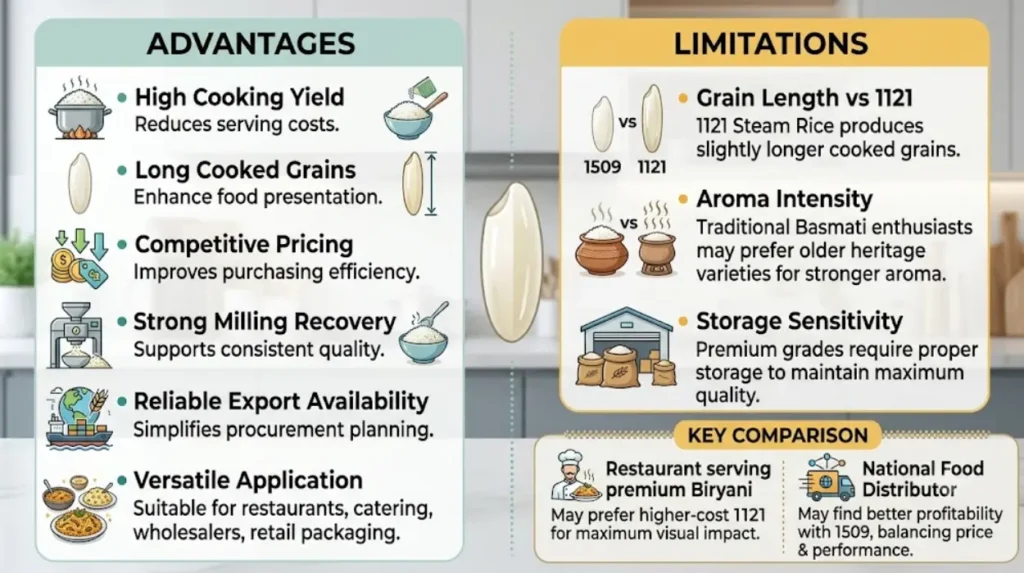
1509 Steam Rice offers significant commercial advantages including consistent grain quality, competitive pricing, strong cooking performance, and reliable availability. Its few limitations relate mainly to buyers seeking the absolute longest cooked grain or stronger traditional Basmati aroma characteristics.
Advantages
High cooking yield reduces serving costs.
Long cooked grains enhance food presentation.
Competitive pricing improves purchasing efficiency.
Strong milling recovery supports consistent quality.
Reliable export availability simplifies procurement planning.
Suitable for restaurants, catering businesses, wholesalers, and retail packaging.
Limitations
1121 Steam Rice produces slightly longer cooked grains.
Traditional Basmati enthusiasts may prefer older heritage varieties for aroma intensity.
Premium grades require proper storage to maintain maximum quality.
For example, a restaurant serving premium biryani may accept the slightly higher cost of 1121 for maximum visual impact. In contrast, a national food distributor supplying hundreds of restaurants may achieve better overall profitability using 1509 Steam Rice because of its balance between price and performance.
Which decision factors matter most before selecting a supplier?
Commercial procurement decisions should prioritise measurable specifications, processing capability, export compliance, supply consistency, logistics performance, and quality documentation. Reliable supplier evaluation reduces operational risk while ensuring stable product performance across repeated international shipments and long-term purchasing contracts.
Commercial Decision Framework
| Decision Factor | Why It Matters | Priority |
|---|---|---|
| Grain Specifications | Ensures consistent quality | Very High |
| Quality Certifications | Supports import compliance | Very High |
| Processing Technology | Improves uniformity | High |
| Supply Capacity | Prevents shortages | High |
| Export Experience | Reduces shipping risk | High |
Experienced exporters also provide complete documentation, container loading supervision, fumigation, inspection support, and custom packaging options.
AHK Rice follows end-to-end processing, modern grading systems, custom packaging, and international export procedures designed for commercial buyers seeking dependable supply consistency. These operational capabilities help maintain specification accuracy across repeated shipments.
Grain length alone does not determine rice quality. Buyers should evaluate cooking yield, elongation ratio, milling recovery, moisture control, shelf life, export pricing, regional market suitability, and supplier capability together.
For many commercial applications in 2026, 1509 Steam Rice delivers one of the strongest combinations of appearance, cooking performance, commercial value, and reliable international availability. These characteristics explain why demand continues to grow among importers, wholesalers, retailers, and food service businesses worldwide, while exporters such as AHK Rice continue supplying premium Pakistani Basmati rice to customers across global markets. Businesses ready to evaluate suppliers can also explore our guide on:
Sourcing 1509 Steam Basmati Rice from Pakistan for commercial USA imports.
Frequently Asked Questions
What is the average grain length of 1509 Steam Basmati Rice?
1509 Steam Basmati Rice typically has a raw grain length of 8.20–8.40 mm and elongates to around 15.5–17.0 mm after cooking, making it ideal for premium food service applications.
How does 1509 Steam Rice compare with 1121 Steam Rice?
1509 Steam Rice offers excellent grain length, high cooking yield, and a more competitive price, while 1121 Steam Rice provides slightly longer cooked grains and is often chosen for premium presentation.
Which export markets prefer 1509 Steam Basmati Rice?
The USA, Canada, the Middle East, Europe, and parts of Africa increasingly import 1509 Steam Basmati Rice because of its consistent quality, attractive appearance, and strong commercial value.
What is the cooking yield of 1509 Steam Rice?
1509 Steam Rice delivers a high cooking yield with excellent grain elongation, low breakage, and fluffy texture, helping restaurants and caterers maximise serving portions.
How long can 1509 Steam Basmati Rice be stored?
When stored in a cool, dry environment with proper moisture control, 1509 Steam Basmati Rice typically maintains its quality for 18–24 months.
What factors should buyers consider before importing 1509 Steam Rice?
Buyers should evaluate grain length, broken percentage, moisture level, quality certifications, milling standards, packaging options, supplier reliability, and export documentation before placing an order.
Is 1509 Steam Rice suitable for restaurants and catering businesses?
Yes. Its long cooked grains, consistent texture, high cooking yield, and competitive pricing make it an excellent choice for restaurants, hotels, catering companies, and food service distributors.
Why is 1509 Steam Rice becoming more popular in 2026?
Growing demand is driven by its balance of premium appearance, reliable cooking performance, stable export supply, and better value compared with many higher-priced Basmati varieties.