Why Do Different Crop Years Produce Different Rice Characteristics?
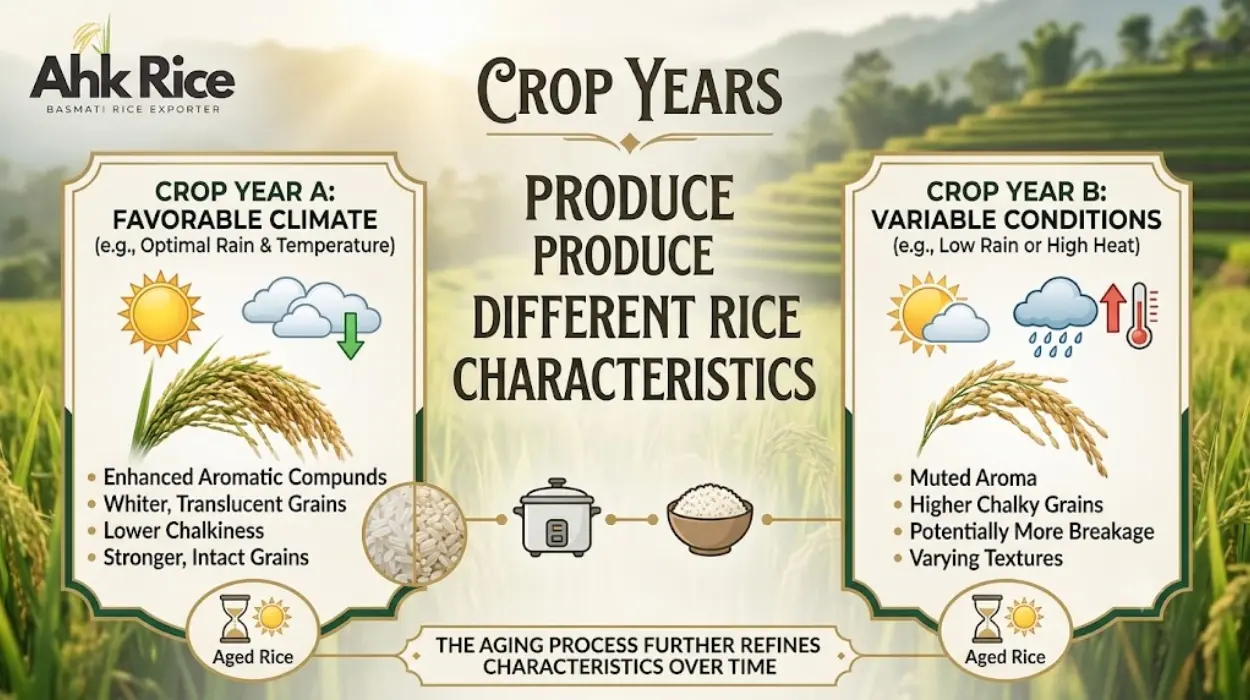
Different crop years produce different rice characteristics because climate, soil moisture, temperature, irrigation levels, and harvest conditions change every growing season. Here is why: rice plants respond directly to environmental conditions during cultivation and grain formation. Changes in rainfall, daytime temperatures, nighttime temperatures, and harvest timing alter grain length, aroma intensity, moisture content, cooking behavior, and storage stability.
Rice is a biological crop rather than a manufactured product. Every harvest year creates a unique combination of starch structure, grain density, and moisture levels. Basmati rice harvested during one season can cook differently from rice harvested in another season, even when both originate from the same variety and region.
Punjab, Pakistan, remains one of the world’s most important Basmati cultivation regions. Farmers cultivate varieties such as 1121 Basmati, Super Kernel Basmati, and 1509 Basmati under seasonal conditions that influence grain quality. Understanding crop years helps importers, wholesalers, retailers, and food service buyers select the correct specification for their market.
What Is a Crop Year in Rice Production?
A crop year is the complete growing and harvesting season that produces a specific rice harvest.
A crop year refers to the period from planting through harvesting. Rice cultivated during one agricultural cycle receives a crop year designation based on the harvest season.
Basmati rice in Pakistan is generally cultivated between May and July. Farmers harvest the crop between October and November. Rice harvested during that period becomes part of that specific crop year.
Crop year identification helps buyers track origin, freshness, aging status, and quality consistency. Exporters, importers, and inspection agencies use crop year information to evaluate product suitability for different applications.
Crop year classification also supports traceability programs. Quality inspectors verify crop-year records during certification and export documentation procedures.
With the crop year defined, the next question is how seasonal conditions influence rice characteristics.
How Do Seasonal Conditions Change Rice Characteristics?
Temperature, rainfall, humidity, irrigation availability, and harvest timing directly influence grain quality.
Rice plants develop differently under changing environmental conditions. Higher temperatures during grain filling accelerate starch formation. Lower temperatures slow grain development and often improve grain structure.
Rainfall distribution influences grain uniformity. Consistent irrigation produces more stable grain formation. Uneven water availability creates variation in kernel size and density.
Humidity levels affect drying efficiency after harvest. Excess moisture increases drying requirements and influences storage conditions.
How Does Temperature Affect Rice Quality?
Temperature controls grain development speed.
Warm growing seasons create faster grain maturation. Faster maturation often produces slightly different starch structures and cooking behavior.
Cooler grain-filling periods encourage gradual starch development. Gradual development often improves grain integrity and cooking consistency.
How Does Rainfall Affect Rice Quality?
Rainfall affects plant health and grain uniformity.
Balanced rainfall supports consistent kernel formation. Excess rainfall increases disease pressure and complicates harvesting operations.
Insufficient rainfall requires additional irrigation. Irrigation management becomes critical for maintaining grain quality standards.
Seasonal conditions shape the crop. The next step is understanding how rice moves from field to finished grain.
How Does Rice Processing Preserve Crop-Year Characteristics?
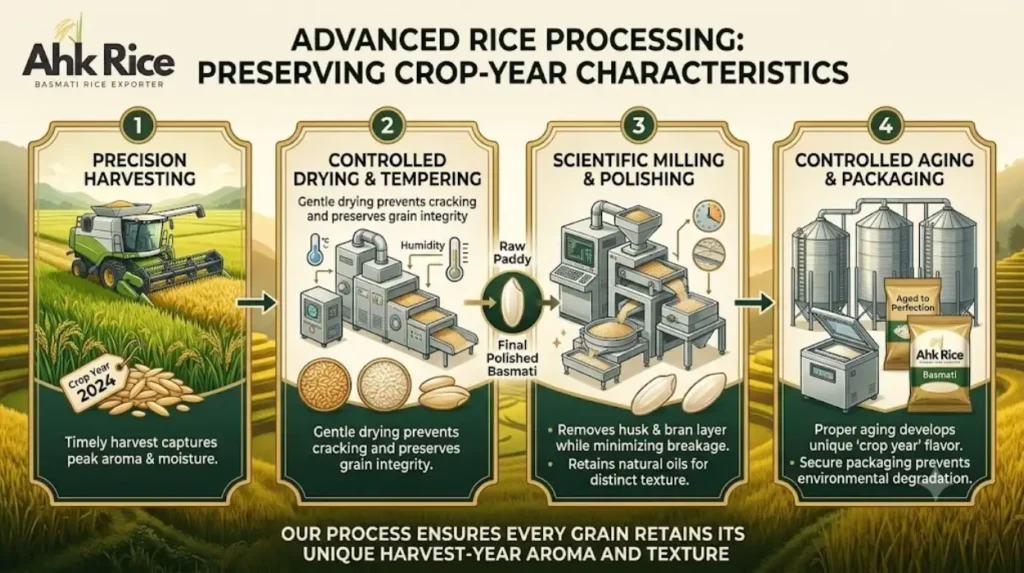
Cleaning, drying, milling, grading, and sorting preserve the quality created during cultivation.
Rice processing does not create crop-year characteristics. Processing preserves the characteristics developed in the field.
The standard processing sequence includes:
- Clean the harvested paddy.
- Dry the grain to target moisture.
- Store the paddy under controlled conditions.
- De-husk the grain.
- Polish the rice.
- Grade the kernels.
- Sort by size and quality.
- Inspect the finished product.
- Package the rice for shipment.
Each processing stage protects grain integrity.
How Does Drying Affect Grain Quality?
Drying reduces moisture to safe storage levels.
Proper drying prevents fungal growth and maintains grain stability. Controlled drying protects aroma compounds and reduces grain stress.
How Does Grading Affect Final Specifications?
Grading separates kernels according to size and quality.
Uniform grading improves cooking consistency. Buyers receive specifications that match their market requirements.
Processing preserves the crop’s identity. The next question is which rice components change between crop years.
Which Rice Components Change Between Crop Years?
Moisture content, starch composition, grain density, aroma strength, and cooking performance vary between harvest years.
Rice characteristics originate from grain chemistry and physical structure.
Different growing conditions alter these internal properties. Small changes create noticeable differences during cooking.
Moisture Content
Freshly harvested rice contains higher moisture levels.
Stored rice gradually stabilizes as moisture balances throughout the grain structure.
Starch Composition
Rice contains amylose and amylopectin.
The ratio between these starches influences texture after cooking. Variations affect grain separation and softness.
Aroma Compounds
Basmati aroma comes from naturally occurring compounds.
Growing conditions influence aroma intensity. Some crop years produce stronger fragrance than others.
Grain Density
Grain density influences water absorption.
Dense kernels absorb water differently than lighter kernels. Cooking times and expansion rates change accordingly.
These components explain why crop years differ. The next question is what benefits crop-year awareness provides to buyers.
What Benefits Does Understanding Crop Years Provide?
Better purchasing decisions, improved product consistency, and stronger quality control result from crop-year knowledge.
Importers use crop-year information to match rice specifications with customer requirements.
Retail brands prefer consistency. Food service operators prioritize predictable cooking performance.
Crop-year evaluation helps buyers anticipate cooking behavior before procurement.
Benefits for Importers
Importers gain better forecasting capability.
Quality expectations become easier to manage across different shipments.
Benefits for Distributors
Distributors improve inventory planning.
Storage requirements become easier to calculate using crop-year information.
Benefits for Food Service Buyers
Restaurants require cooking consistency.
Understanding crop years helps chefs maintain uniform meal quality across large volumes.
Understanding benefits leads naturally to practical applications across global markets.
Where Are Different Crop Years Most Important?
Export markets, retail brands, food manufacturers, and catering operations rely heavily on crop-year information.
Different sectors evaluate rice differently.
Retail Packaging
Retail brands emphasize consistency.
Consumers expect identical cooking results from every purchase.
Food Manufacturing
Manufacturers require stable processing performance.
Rice used in packaged meals must meet strict specifications.
Hospitality and Catering
Large-scale kitchens cook hundreds of portions daily.
Consistent grain behavior reduces operational variability.
International Trade
Importers often compare crop years during sourcing decisions.
Crop-year information supports quality assessments during procurement negotiations.
These use cases show the practical value of crop-year tracking. The next section addresses common misconceptions.
What Are the Most Common Misconceptions About Crop Years?
Newer rice is not always better, older rice is not always superior, and variety alone does not determine quality.
Many buyers misunderstand crop-year effects.
Misconception 1: New Rice Always Performs Better
Fresh rice contains higher moisture levels.
Higher moisture does not automatically improve cooking performance.
Misconception 2: Older Rice Always Has Better Quality
Storage conditions determine aging quality.
Poor storage damages rice regardless of crop year.
Misconception 3: Variety Is the Only Factor That Matters
Variety influences characteristics.
Crop year, cultivation practices, and processing standards also affect final quality.
Misconception 4: All Harvests Produce Identical Results
Agriculture depends on environmental conditions.
Different seasons create measurable differences in grain development.
Correcting these misconceptions creates a more accurate understanding of rice quality.
Why Does Crop Year Matter for Basmati Rice Specifically?
Basmati rice shows stronger crop-year differences because aroma, grain elongation, and texture respond directly to growing conditions.
Basmati varieties possess unique genetic characteristics. Seasonal conditions influence how those characteristics develop.
1121 Basmati responds differently to temperature variations than Super Kernel Basmati. 1509 Basmati exhibits its own seasonal responses. These differences become visible during cooking and sensory evaluation.
Crop-year awareness helps buyers evaluate aroma strength, elongation potential, storage behavior, and cooking consistency. Understanding these relationships creates more informed sourcing decisions and better product performance across international markets.
Frequently Asked Questions
Does every crop year produce different rice quality?
Yes. Temperature, rainfall, humidity, irrigation management, and harvest conditions differ every season and influence grain characteristics.
Why does Basmati rice aroma vary between crop years?
Growing conditions affect the development of natural aromatic compounds within the grain during cultivation.
Does crop year affect cooking performance?
Yes. Moisture content, grain density, and starch composition influence water absorption, texture, and elongation.
Is older rice always better than newer rice?
No. Proper storage conditions determine quality retention. Poorly stored rice loses quality regardless of age.
Why do importers check crop-year information?
Crop-year data helps importers evaluate consistency, predict cooking performance, and maintain quality standards.
Which rice characteristics change the most between crop years?
Aroma intensity, moisture content, grain density, starch structure, cooking texture, and elongation performance show the greatest variation.