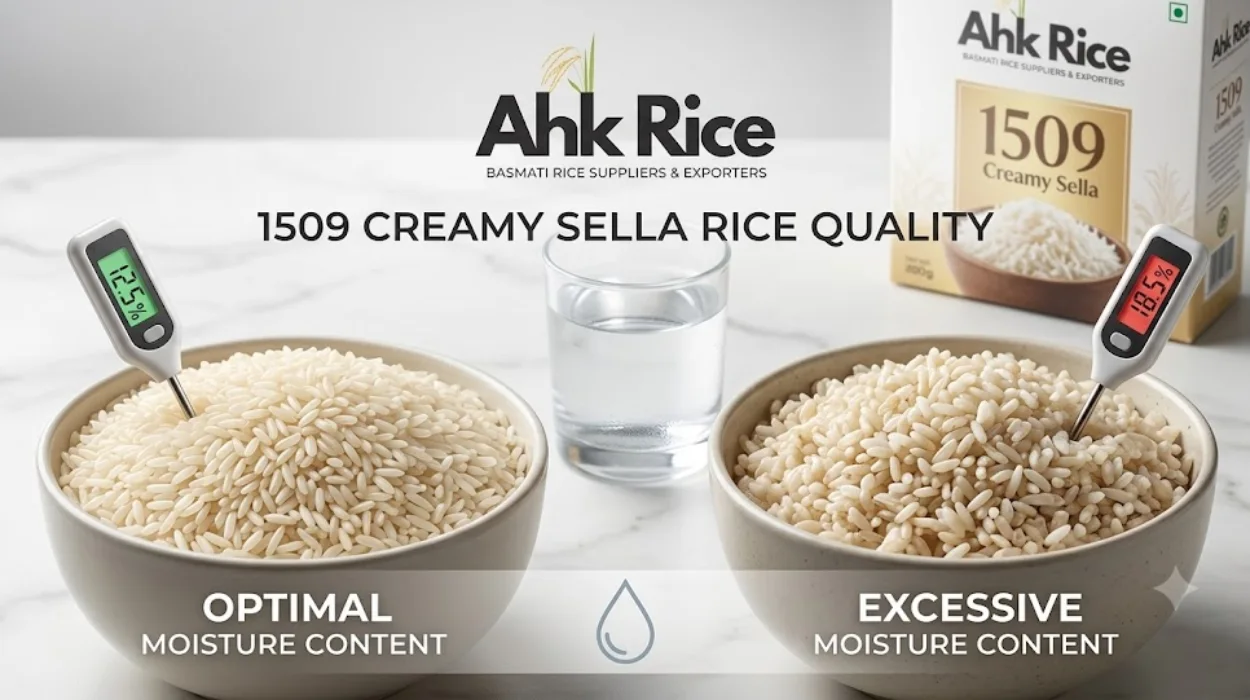
How Moisture Content Impacts 1509 Creamy Sella Rice Quality
Moisture content determines the physical stability, cooking performance, shelf life, and export quality of 1509 Creamy Sella Rice. The internationally accepted moisture range for export-grade Pakistani Basmati rice in 2026 is generally 12.5% to 13.5%, depending on buyer specifications and destination market regulations. Moisture affects every stage of the supply chain, from harvesting and parboiling to milling, packaging, shipping, storage, and final cooking.
Among Pakistan’s premium Basmati varieties, 1509 Creamy Sella Rice has become one of the fastest-growing export products because of its extra-long grain, creamy appearance after parboiling, excellent grain elongation, and high cooking yield. These characteristics remain consistent only when moisture stays within controlled limits throughout processing and international logistics.
Understanding how moisture influences rice quality helps importers, wholesalers, food manufacturers, retailers, and hospitality businesses evaluate rice beyond grain length or appearance alone. Readers interested in how these quality standards remain stable during overseas transportation can later explore the companion article on:
Maintaining grain consistency throughout international shipping.
What Is Moisture Content in 1509 Creamy Sella Rice?
Moisture content is the percentage of water contained inside each rice grain after processing. It determines grain strength, storage stability, milling efficiency, cooking quality, and resistance against spoilage. Export laboratories measure moisture using calibrated digital analyzers before every shipment.
Moisture content represents the total amount of water remaining inside the rice kernel after drying and processing. It is expressed as a percentage of the grain’s total weight.
For export-quality Pakistani 1509 Creamy Sella Rice, laboratories test moisture before:
- Milling
- Packaging
- Container loading
- Export documentation
The measurement follows internationally recognized grain testing procedures.
1509 Creamy Sella Rice differs from white rice because it undergoes a controlled parboiling process before milling. During parboiling, moisture temporarily increases so nutrients migrate into the grain. Controlled drying then reduces moisture to export specifications.
Without accurate drying, grain quality changes rapidly.
How Does Moisture Content Affect 1509 Creamy Sella Rice Quality?
Moisture directly controls grain appearance, kernel hardness, cooking expansion, breakage percentage, aroma preservation, shelf life, and transportation stability. Every one-percent variation changes the physical properties of rice and influences how buyers evaluate commercial quality during inspection.
Water exists inside every rice kernel.
The amount of internal water determines how the grain behaves during processing and cooking.
When moisture remains between approximately 12.5% and 13.5%:
- Grain remains firm.
- Breakage stays low.
- Milling efficiency increases.
- Cooking expansion remains uniform.
- Storage life improves.
If moisture exceeds acceptable export specifications:
- Grain softens.
- Mold growth becomes more likely.
- Insect activity increases.
- Storage temperature rises.
- Packaging loses effectiveness.
If moisture falls below acceptable levels:
- Rice becomes brittle.
- Broken kernels increase.
- Milling losses become higher.
- Cooking texture becomes drier.
- Grain appearance loses consistency.
Every export inspection therefore includes moisture verification.
How Is Moisture Controlled During Processing?
Moisture control begins immediately after harvesting and continues through cleaning, soaking, steaming, drying, milling, grading, polishing, sorting, packaging, and storage. Each processing stage gradually prepares the grain for long-distance export while maintaining consistent internal water levels.
The production of 1509 Creamy Sella Rice follows several controlled stages.
Harvesting
Farmers harvest mature paddy when grain reaches suitable field moisture for processing.
Harvesting too early increases drying requirements.
Harvesting too late increases field losses.
Cleaning
Fresh paddy passes through cleaning machines.
Foreign materials are removed.
Examples include:
- Stones
- Dust
- Straw
- Metal particles
Soaking
The cleaned paddy is soaked in controlled water tanks.
Water enters the grain evenly.
This prepares the rice for parboiling.
Steaming
Steam heats the soaked grain under carefully monitored conditions.
The starch gelatinizes.
The kernel becomes stronger.
The characteristic creamy appearance begins developing.
Drying
Drying removes excess moisture gradually.
Modern drying systems reduce internal moisture evenly across all grains.
Uniform drying prevents stress cracks.
Milling
The husk is removed.
Bran layers are separated.
The creamy color remains intact because of the earlier parboiling process.
Grading
Machines separate kernels by:
- Length
- Thickness
- Shape
- Broken percentage
Uniform grading improves commercial consistency.
Color Sorting
Optical cameras remove defective grains.
Examples include:
- Black kernels
- Chalky grains
- Damaged kernels
Packaging
Rice enters moisture-resistant packaging immediately after quality testing.
Packaging limits external humidity changes during storage and transportation.
What Components Influence Moisture Stability?
Moisture stability depends on harvesting conditions, drying technology, storage environment, packaging materials, warehouse ventilation, transportation practices, and regular laboratory testing. Every component contributes to preserving grain quality from farm to international destination.
Several factors influence moisture stability throughout the supply chain.
Climate
Pakistan’s Punjab region provides favorable growing conditions for Basmati rice.
However, seasonal humidity changes require controlled drying after harvest.
Drying Equipment
Modern continuous-flow dryers produce more uniform moisture than uncontrolled open-air drying.
Uniform drying reduces internal stress inside each grain.
Storage Conditions
Warehouse temperature and humidity influence moisture equilibrium.
Proper ventilation limits unwanted moisture absorption.
Packaging Material
Multi-layer export bags reduce moisture exchange with surrounding air.
Examples include:
- PP woven bags
- BOPP laminated bags
- Kraft paper bags with liners
Container Condition
Dry shipping containers reduce condensation during sea transport.
Container inspections verify cleanliness before loading.
Laboratory Testing
Digital moisture analyzers measure every production batch before shipment.
Testing provides consistent numerical values rather than visual estimates.
What Benefits Come from Proper Moisture Management?
Correct moisture management preserves grain integrity, improves cooking performance, extends storage life, reduces breakage, protects aroma, increases milling efficiency, and supports consistent product quality throughout international distribution channels.
Moisture management creates measurable improvements across the rice industry.
First, it improves milling recovery.
More whole kernels remain intact.
Second, cooking quality improves.
The grains elongate evenly after cooking.
Third, shelf life increases.
Proper moisture reduces microbial activity.
Fourth, grain appearance remains attractive.
Uniform moisture helps preserve the creamy color developed during parboiling.
Fifth, transportation becomes safer.
Stable moisture reduces quality changes during long shipping routes.
Sixth, packaging performance improves.
Dry grains place less stress on packaging materials.
These benefits become especially important for commercial food production where cooking consistency influences finished products every day.
Where Is 1509 Creamy Sella Rice Commonly Used?
1509 Creamy Sella Rice serves retail consumers, restaurants, catering companies, food manufacturers, institutional kitchens, and international wholesalers because of its long grain, reliable cooking yield, and attractive appearance after preparation.
The variety performs well in multiple food applications.
Restaurants value consistent grain separation.
Examples include:
- Biryani
- Pilaf
- Kabsa
Food manufacturers use it in packaged meal production.
Institutional kitchens prefer reliable cooking yield for large-scale meal preparation.
Retail consumers appreciate the extra-long cooked grain and soft texture.
Because the rice absorbs flavors efficiently, it appears in many regional cuisines across international markets.
Which Grades of 1509 Creamy Sella Rice Are Available?
1509 Creamy Sella Rice is available in several commercial grades that differ according to grain length, broken percentage, sorting accuracy, and buyer specifications. Grade selection depends on market requirements rather than cultivation differences.
Exporters classify rice into different commercial grades.
Common grades include:
Premium Sortex Grade
Highest sorting accuracy.
Very low defective grains.
Excellent visual appearance.
Double Sortex Grade
High commercial quality.
Suitable for premium retail markets.
Single Sortex Grade
Good commercial quality.
Often supplied to wholesale buyers.
Broken Grades
Contain higher percentages of broken kernels.
Examples include:
- 5% Broken
- 10% Broken
- 15% Broken
Buyer specifications determine the acceptable broken percentage.
Which International Markets Import 1509 Creamy Sella Rice?
1509 Creamy Sella Rice reaches food service businesses, wholesalers, distributors, retailers, and processors across Asia, the Middle East, Africa, Europe, and North America because of its cooking performance and competitive commercial value.
Pakistan exports this variety to numerous regions.
Major importing markets include:
- Saudi Arabia
- United Arab Emirates
- Qatar
- Oman
- Kuwait
- Bahrain
- Iraq
- United Kingdom
- Germany
- Canada
- United States
- Australia
- South Africa
- Kenya
- Malaysia
Each market establishes individual specifications for:
- Moisture
- Broken percentage
- Grain length
- Packaging size
Import contracts define these quality parameters before shipment.
What Certifications Apply to Export-Grade 1509 Creamy Sella Rice?
Export-quality 1509 Creamy Sella Rice complies with internationally recognized food safety, quality management, and phytosanitary certification systems required by importing countries and commercial buyers in 2026.
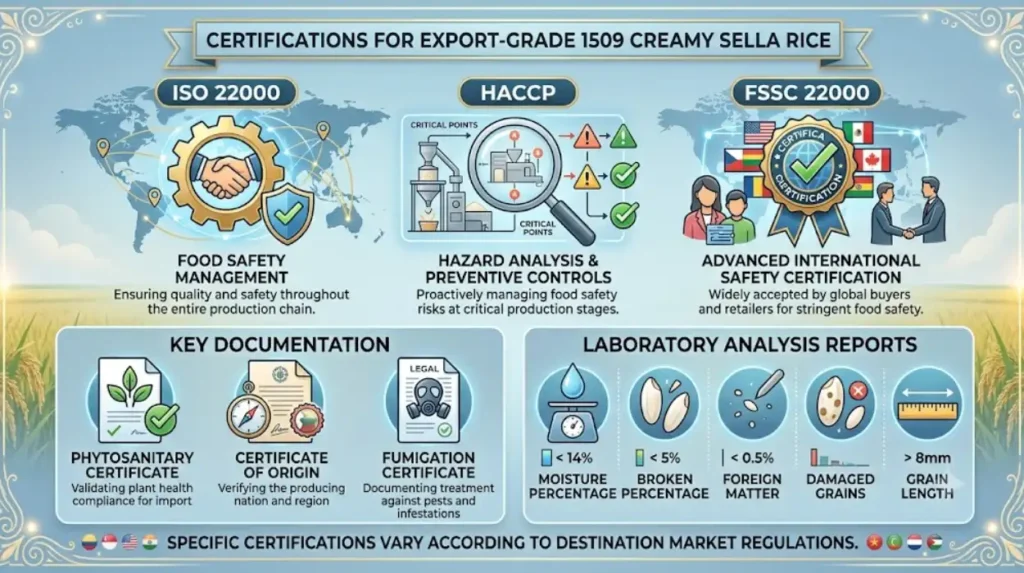
Different markets request different documentation.
Common certifications include:
ISO 22000
Food safety management.
HACCP
Hazard analysis and preventive food safety controls.
FSSC 22000
Advanced food safety certification accepted by many international buyers.
Phytosanitary Certificate
Confirms compliance with plant health regulations.
Certificate of Origin
Verifies the producing country.
Fumigation Certificate
Required by several importing countries.
Laboratory Analysis Reports
These often include:
- Moisture percentage
- Broken percentage
- Foreign matter
- Damaged grains
- Grain length
Certification requirements vary according to destination market regulations.
What Are Common Misconceptions About Moisture Content?
Many people confuse moisture with grain freshness, cooking softness, or rice quality alone. Moisture represents only one measurable quality parameter and works together with variety, processing, grading, storage, and packaging to determine overall product performance.
One common misconception is that higher moisture produces softer rice.
In reality, excessive moisture reduces storage stability.
Another misconception is that very dry rice represents higher quality.
Extremely low moisture increases brittleness and grain breakage.
Some buyers also believe moisture remains constant after packaging.
Rice naturally exchanges moisture with surrounding air unless protected by suitable packaging and storage conditions.
Another misunderstanding is that visual inspection accurately determines moisture.
Professional laboratories use calibrated digital instruments because moisture cannot be measured reliably by appearance alone.
Understanding these facts helps buyers evaluate rice using measurable quality standards instead of assumptions.
Frequently Asked Questions
What is the ideal moisture content for 1509 Creamy Sella Rice?
The ideal moisture content for export-quality 1509 Creamy Sella Rice is generally between 12.5% and 13.5%. This range helps preserve grain strength, cooking quality, storage stability, and international shipping performance.
Why is moisture content important in 1509 Creamy Sella Rice?
Moisture content affects grain hardness, breakage, shelf life, cooking expansion, aroma retention, and resistance to mold or insect activity. Maintaining the correct level ensures consistent quality throughout the supply chain.
How is moisture content measured before export?
Exporters measure moisture using calibrated digital moisture analyzers in quality control laboratories. Every production batch is tested before packaging and container loading to ensure compliance with buyer specifications.
Does high moisture reduce rice quality?
Yes. Excessive moisture increases the risk of mold growth, insect infestation, grain discoloration, and reduced storage life. It also affects the physical stability of the rice during transportation.
Can very low moisture damage 1509 Creamy Sella Rice?
Yes. Moisture levels below the recommended range make rice kernels brittle, increasing broken grains during milling, handling, and transport while reducing cooking performance.
Which countries import 1509 Creamy Sella Rice?
Major importing countries include Saudi Arabia, the UAE, Qatar, Oman, Kuwait, Bahrain, Iraq, the United States, Canada, the United Kingdom, Germany, Australia, South Africa, Kenya, and Malaysia.