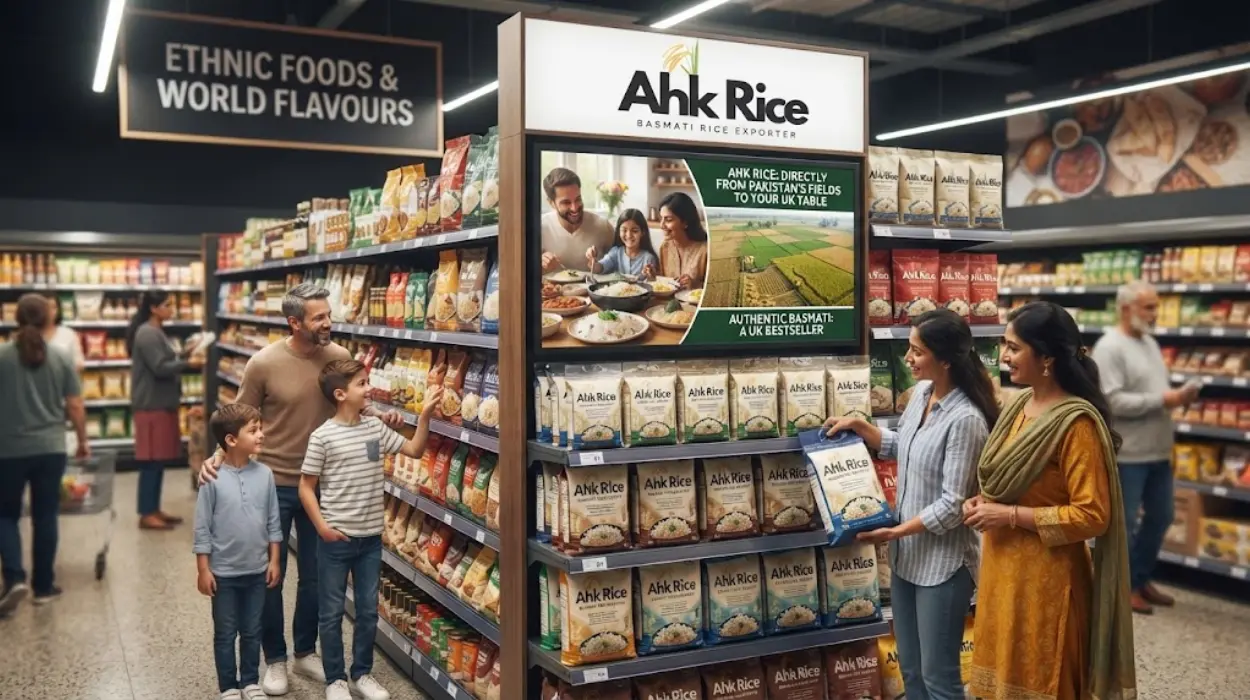
UK Ethnic Food Market Growth and Demand for Pakistani Basmati Rice in 2026
The UK ethnic food market creates expanding opportunities for Pakistani Basmati rice suppliers, particularly in premium retail, independent grocery, wholesale distribution, and foodservice. Here is why: the UK ethnic food market generated an estimated US$3.99 billion in 2026, with projected annual growth of 9.7% through 2033 (source: Grand View Research, UK Ethnic Food Market Outlook, June 2026).
Pakistani Basmati rice serves established South Asian food traditions while reaching mainstream consumers interested in international cuisines. The UK imported approximately US$78.5 million of rice from Pakistan in 2025, according to UN Comtrade data (source: Trading Economics, September 2026). This trade value covers rice categories beyond Basmati alone. Buyers therefore need grade-specific demand analysis rather than treating every rice import as Basmati demand.
For an introduction to grain varieties, cultivation, milling, and processing grades, read the complete guide to Pakistani Basmati rice. This foundation helps importers connect consumer demand with the specifications required for retail and commercial distribution.
What is driving demand for Pakistani Basmati rice in the UK in 2026?
Established South Asian food consumption, ethnic grocery distribution, restaurant demand, and wider interest in international cuisines support the market. Importers can address these channels through differentiated grades, consistent cooking performance, compliant documentation, and appropriate packaging.
Pakistani Basmati rice has a defined position in the UK food market. Its aromatic character, long grains, and use in biryani, pilau, and everyday rice dishes support repeat purchasing. South Asian households provide an established customer base, while restaurants and caterers require dependable bulk supplies.
The wider ethnic food market also creates opportunities beyond specialist stores. Supermarkets, online grocery retailers, and independent food retailers introduce international ingredients to different customer groups. However, growth across ethnic food does not automatically translate into equal growth for every rice variety.
Market entry therefore requires a clear understanding of customer segments. Premium retail buyers prioritize appearance, aroma, packaging, and brand consistency. Wholesalers emphasize landed cost, stock availability, and reliable replenishment. Foodservice operators focus on cooking yield, grain separation, and performance during large-scale preparation.
Pakistan’s established rice-export trade provides a sourcing foundation. The commercial opportunity depends on matching the correct grade to each channel rather than relying on general market-growth figures.
What Pakistani Basmati rice varieties are available to UK buyers?
1121 Basmati, Super Kernel Basmati, and 1509 Basmati offer different combinations of grain length, aroma, processing options, and commercial positioning. Buyers should compare the finished specification rather than selecting a variety by name alone.
1121 Basmati rice
1121 Basmati is a long-grain variety associated with pronounced grain elongation after cooking. White, Steam, Golden Sella, Creamy Sella, and Brown versions address different appearance and preparation requirements. Premium grocery brands can use 1121 for differentiated retail products, while restaurants can select grades according to their recipes.
White rice provides a familiar appearance and suits everyday meals. Steam processing changes the grain’s cooking characteristics, while Golden Sella uses parboiling to improve grain firmness. Buyers should evaluate each grade through a representative cooking test.
Super Kernel Basmati rice
Super Kernel is a traditional Pakistani aromatic Basmati variety. Its natural aroma and established South Asian culinary identity make it relevant to specialist retailers, ethnic wholesalers, and restaurants. A specification commonly requested for commercial assessment includes 7.0–7.5 mm raw grain length, with the final measurement confirmed against the actual lot.
Super Kernel provides an alternative to 1121 for buyers balancing aroma, grain appearance, and purchasing cost. Its suitability depends on broken-grain percentage, moisture, milling quality, and cooking performance.
1509 Basmati rice
1509 Basmati offers a commercial option for buyers balancing long-grain presentation and procurement cost. The variety is associated with shorter crop maturity than traditional long-duration Basmati varieties. Export specifications can include White, Steam, and Golden Sella grades.
A typical commercial specification may target 8.10–8.50 mm raw grain length, subject to the supplier’s declared measurement and the purchased lot. Buyers should verify the exact grade, cooking results, and price before comparing it with 1121.
Importers evaluating these varieties can use the following specification framework before requesting quotations.
How do 1121, Super Kernel, and 1509 compare?
1121 emphasizes long-grain presentation, Super Kernel emphasizes traditional aroma, and 1509 addresses cost-sensitive commercial demand. The appropriate selection depends on the intended customer, processing grade, quality tolerances, and delivered cost.
| Specification attribute | 1121 Basmati | Super Kernel Basmati | 1509 Basmati |
|---|---|---|---|
| Main commercial position | Premium retail and foodservice | Aromatic ethnic retail and wholesale | Cost-conscious retail and bulk supply |
| Raw grain length | Long-grain; confirm lot specification | Common target: 7.0–7.5 mm | Common target: 8.10–8.50 mm |
| Aroma | Characteristic Basmati aroma | Traditional aromatic profile | Aromatic Basmati profile |
| Available processing | White, Steam, Golden Sella, Creamy Sella, Brown | White and parboiled options, subject to supplier | White, Steam, Golden Sella |
| Cooking assessment | Grain elongation and separation | Aroma, texture, and grain integrity | Yield, texture, and batch consistency |
| Typical buyer | Premium retailers and restaurants | Ethnic wholesalers and specialist retailers | Volume retailers, caterers, and distributors |
| Main purchasing consideration | Appearance and cooking performance | Aroma and price balance | Cost per usable cooked portion |
These are indicative commercial positioning differences, not universal guarantees. Final specifications must be verified through the supplier’s product specification and representative sample.
Processing grade changes the result within each variety. White rice suits buyers seeking a familiar appearance, Steam suits recipes requiring a white finished grain, and Golden Sella suits buyers who prioritize firmer grains during bulk cooking. Actual performance depends on processing conditions, storage, and preparation methods.
How do UK retail and foodservice markets differ in grade preferences?
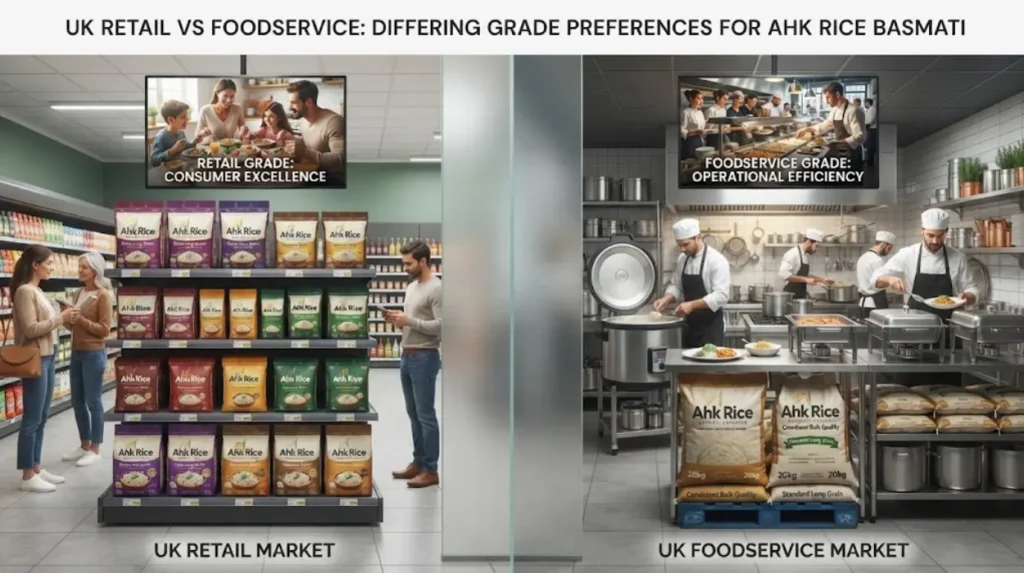
Retail buyers need shelf-ready presentation and repeatable product quality, while foodservice buyers prioritize cooking yield, batch consistency, and cost per serving. Both channels require traceable specifications and dependable supply arrangements.
Retail and ethnic grocery distribution
Retail demand covers independent South Asian grocery stores, specialist food retailers, supermarket ethnic-food aisles, and online shops. These channels can stock 1 kg, 2 kg, 5 kg, and larger household packs according to customer demand.
1121 suits premium ranges that emphasize long grains and presentation. Super Kernel serves consumers who value traditional aroma and familiar culinary characteristics. 1509 provides another option for retailers building price-conscious Basmati ranges.
Retail importers should evaluate bag strength, label accuracy, declared net weight, batch identification, and barcode requirements. Private-label programmes also require consistent artwork, packaging dimensions, and repeatable product specifications.
Restaurants, caterers, and wholesale distributors
Foodservice buyers purchase larger bags and assess rice by its performance in biryani, pilau, banquet meals, and high-volume service. Golden Sella can suit operations that need firm grains and consistent bulk-cooking results. Steam and White grades serve different presentation requirements.
Wholesalers must also account for warehouse capacity, order frequency, and customer-specific grade preferences. A low purchase price does not guarantee a lower operating cost when breakage, inconsistent cooking, or stock losses increase.
The distinction between retail and foodservice demand determines the next comparison: the full commercial cost of each variety.
How do wholesale prices per metric ton compare in 2026?
Indicative FOB prices for premium 1121 and Super Kernel can reach approximately US$1,165–US$1,205 per metric ton, depending on grade and specification. Importers must compare equivalent products and include freight, insurance, customs charges, and inland distribution when calculating landed cost.
A published Pakistan rice wholesale price list dated September 16, 2026, provides the following indicative FOB Karachi benchmarks (source: Pakistan Rice wholesale price list, September 2026).
| Rice grade | Indicative FOB price per MT |
|---|---|
| 1121 White Basmati, premium | US$1,165–1,205 |
| 1121 Sella Basmati, premium | US$1,135–1,175 |
| Super Kernel Basmati, premium | US$1,165–1,205 |
| 1509 Basmati | Obtain a current grade-specific quotation |
Source: Pakistan Rice wholesale pricing. These figures are indicative supplier-published benchmarks, not verified transaction averages or guaranteed October 2026 offers.
FOB Karachi covers the seller’s delivery obligations under the agreed Free On Board terms. The buyer generally arranges the main sea freight and insurance. A CIF quotation includes cost, insurance, and freight to the named destination port, but not every downstream import or delivery expense.
The 1509 price requires a separate quotation based on its grade, broken percentage, packing, and shipment volume. Importers should not assume that 1509 always costs less than every 1121 or Super Kernel specification.
For accurate comparisons, request quotations for the same shipment quantity, bag weight, moisture limit, broken percentage, and delivery basis. A lower FOB price can lose its advantage after freight, clearance, inspection, and distribution costs are included.
Which rice variety offers the right value for different UK buyers?
Premium retailers should evaluate 1121, aroma-focused retailers should assess Super Kernel, and cost-conscious volume buyers should compare 1509 against equivalent alternatives. The final decision should reflect customer expectations and total landed cost rather than one price or specification.
| Buyer requirement | Variety to evaluate | Reason | Main verification |
|---|---|---|---|
| Premium retail presentation | 1121 White or Steam | Long-grain positioning and visual appeal | Grain length and cooked elongation |
| Traditional aromatic range | Super Kernel White | Familiar aroma and ethnic-market relevance | Aroma, broken percentage, and cooking test |
| Firm grains for bulk cooking | Golden Sella grades | Parboiling supports grain integrity | Batch cooking and holding test |
| Price-conscious distribution | 1509 White or Steam | Alternative commercial sourcing option | Landed cost and cooked yield |
| Multiple customer segments | Mixed-variety procurement | Different grades address different needs | Separate specifications and stock planning |
A mixed-variety purchasing strategy can spread demand across premium retail, specialist grocery, and foodservice accounts. It also creates additional inventory complexity. Buyers should forecast sales by grade and avoid importing more product variations than their distribution network can support.
What are the shelf-life differences between Pakistani Basmati rice grades?
Shelf life depends on moisture, packaging integrity, storage temperature, and product condition rather than variety name alone. Buyers should follow the supplier’s declared shelf life and validate it against packaging specifications and warehouse conditions.
White and parboiled Basmati are dry, shelf-stable products when properly processed and stored. Brown rice retains its bran layer, which contains oils that can shorten storage stability compared with well-stored white rice. Actual shelf life depends on the product specification and storage environment.
Retail importers should request the production or packing date, best-before period, lot identification, and recommended storage conditions. Foodservice distributors should rotate stock using first-expiry-first-out procedures and inspect bags for moisture damage or pests.
Hermetic or well-sealed food-grade packaging helps protect rice from moisture and contamination. Store bags in a clean, dry, ventilated warehouse away from direct sunlight, walls with dampness, and chemical products.
No universal shelf-life figure applies to every 1121, Super Kernel, or 1509 shipment. The supplier’s documented product specification should determine the declared period. Buyers should avoid comparing one supplier’s guaranteed shelf life with another supplier’s unverified estimate.
What should UK importers check before buying Pakistani Basmati rice?
UK importers should verify the product specification, food-safety compliance, traceability, packaging, shipment documents, and landed cost before confirming an order. Supplier approval must cover both commercial performance and applicable UK import requirements.
Great Britain applies maximum residue limits to imported food, including rice. Importers should check the relevant rules for their destination and product before shipment (source: Health and Safety Executive, Maximum Residue Levels).
UK official guidance also lists controls affecting rice from Pakistan for pesticide residues, aflatoxins, and ochratoxin A. Importers should review the current requirements and any applicable enhanced controls before dispatch (source: Food Standards Agency, foodstuffs with GB import restrictions).
A practical procurement process follows these steps:
- Define the specification: Record variety, processing grade, grain length, broken percentage, moisture, and acceptable defects.
- Request a representative sample: Test appearance, aroma, cooking performance, and batch consistency.
- Verify compliance: Review relevant laboratory reports, traceability records, and required import documentation.
- Compare quotations: Normalize packing, shipment quantity, Incoterms, freight, and additional charges.
- Approve the shipment: Confirm the final specification, inspection arrangements, packaging, and delivery schedule in writing.
AHK Rice is a Pakistani Basmati rice exporter based in Punjab, supplying 1121, Super Kernel, and 1509 Basmati rice varieties to more than 15 countries. Its service scope includes sourcing, processing, grading, custom packaging, and export coordination. Buyers can review AHK Rice export and supply services when assessing a potential supplier.
The purchasing decision should combine product suitability, documented compliance, and repeat-order consistency. This approach reduces the risk of selecting rice solely on an attractive quotation.
UK ethnic food market growth creates opportunities for Pakistani Basmati rice across specialist retail, wholesale distribution, and foodservice. Importers can build a suitable portfolio by comparing 1121, Super Kernel, and 1509 against customer demand, grade specifications, food-safety requirements, and total landed cost.
AHK Rice supplies these varieties with processing, packaging, and export coordination support. A specification-led purchasing process helps buyers make informed sourcing decisions and build more consistent supply arrangements.
FAQs About UK Ethnic Food Market Growth and Pakistani Basmati Rice
Is the UK ethnic food market growing in 2026?
The UK ethnic food market is estimated at US$3.99 billion in 2026. Grand View Research projects a 9.7% compound annual growth rate through 2033. This broader market forecast does not represent Basmati rice sales alone.
Which Pakistani Basmati varieties should UK importers compare?
Importers should compare 1121, Super Kernel, and 1509 against their target customers. 1121 emphasizes long-grain presentation, Super Kernel offers traditional aroma, and 1509 provides another option for cost-conscious commercial distribution.
What is the wholesale price of Pakistani Basmati rice in the UK?
Indicative September 2026 FOB Karachi prices for premium 1121 White and Super Kernel range from US$1,165 to US$1,205 per metric ton. Actual offers depend on grade, quantity, packaging, and shipment terms. Freight and import expenses must be calculated separately.
Which Basmati grade suits UK restaurants and caterers?
The choice depends on the menu and cooking process. Golden Sella suits operations requiring firm grains during bulk cooking, while White and Steam grades serve other presentation requirements. A cooking trial should confirm performance.
What documents should UK importers request?
Importers should request a commercial invoice, packing list, transport documents, certificate of origin where applicable, product specification, and relevant laboratory or inspection reports. Additional documentation depends on the shipment, applicable controls, and destination requirements.
How can buyers compare suppliers fairly?
Buyers should compare identical grades, grain-length specifications, broken percentages, moisture limits, packing, and Incoterms. They should also assess sample results, traceability, compliance records, and the supplier’s ability to maintain specifications across repeat shipments.
Which Pakistani Basmati brands and varieties are popular in the UK?
Popularity varies by retailer, region, price point, and customer preference. Buyers can evaluate 1121, Super Kernel, and 1509 alongside established retail brands by comparing product specifications, packaging, cooking performance, and market positioning.