Why Must Scottish Buyers Understand Food Import Regulations for Rice?
Scottish buyers must understand rice import regulations because Pakistan-origin rice faces enhanced Great Britain controls for pesticide residues, aflatoxins, and ochratoxin A. Here is why: Scotland applies GB food import rules, while Food Standards Scotland oversees their enforcement in Scotland.
Rice is a cereal and a food of non-animal origin. Scottish buyers importing rice from Pakistan must therefore consider food safety, customs classification, border controls, labelling, documentation, and product-specific restrictions. These requirements apply before the shipment reaches the Scottish market.
The rules also distinguish ordinary rice from higher-risk imported food. Pakistan-origin rice currently appears under Great Britain controls for pesticide residues, aflatoxins, and ochratoxin A. The restriction list was updated on 10 July 2026.
Understanding these rules helps buyers identify the correct rice grade, documents, tests, packaging information, and import procedures before procurement. It also explains why the same Basmati specification needs regulatory review before commercial shipment.
What Are Scottish Rice Import Regulations?
Scottish rice import regulations are the GB food safety, customs, labelling, border-control, and product-specific requirements governing rice entering Scotland for human consumption. Food Standards Scotland states that imported food must meet GB standards.
Scottish rice imports operate within Great Britain’s regulatory framework. Food Standards Scotland sets rules for food imported into Scotland and the rest of Great Britain. Northern Ireland follows different arrangements.
Rice imports therefore involve several regulatory entities. Food Standards Scotland handles Scottish food standards and enforcement guidance. The Food Standards Agency provides Great Britain food import guidance. HM Revenue & Customs handles customs classification and declarations.
Rice also has a specific customs classification system. HMRC places rice under heading 1006, covering paddy rice, husked rice, milled rice, broken rice, and parboiled rice.
Which Rice Types Fall Under These Rules?
The main rice categories include paddy, husked, semi-milled, wholly milled, broken, and parboiled rice under commodity heading 1006. Basmati varieties are commercially distinguished by grain type and processing method.
Pakistani Basmati includes varieties such as 1121, Super Kernel, and 1509. Each variety can undergo different processing routes.
White Basmati normally undergoes dehusking, milling, polishing, grading, and sorting. Sella rice uses parboiling before drying and milling. Steam rice uses steam treatment during processing.
These distinctions matter because the processing condition affects the final product description and customs classification.
With the regulatory definition established, the next question is how a rice shipment moves through the import system.
How Does Rice Import Compliance Work in Scotland?

Rice import compliance follows a sequence of product classification, regulatory screening, documentation, pre-notification, border checks, customs clearance, and market release. Each stage connects the product specification with its legal requirements.
What Steps Does a Scottish Buyer Follow?
Start by identifying the origin, rice type, commodity code, intended use, and applicable controls before confirming the commercial shipment. This establishes the regulatory pathway before loading begins.
- Identify the origin — Confirm Pakistan as the country of origin for Pakistani Basmati rice.
- Classify the rice — Select the appropriate commodity code under heading 1006.
- Check import controls — Review the current Great Britain restrictions for the product and origin.
- Verify testing — Check pesticide, aflatoxin, and ochratoxin A requirements for Pakistan-origin rice.
- Prepare documents — Compile commercial invoices, packing lists, transport documents, and required food-control records.
- Submit notification — Complete the applicable IPAFFS notification for controlled high-risk food.
- Present the consignment — Route controlled goods through the required border-control arrangements.
- Complete checks — Allow documentary, identity, and physical checks where required.
- Clear customs — Complete the customs declaration and applicable tariff requirements.
- Release the rice — Move the consignment into the Scottish supply chain after regulatory clearance.
Pakistan-origin rice is currently listed as controlled food under assimilated Regulation 2019/1793. Current controls cover pesticide residues, aflatoxins, and ochratoxin A.
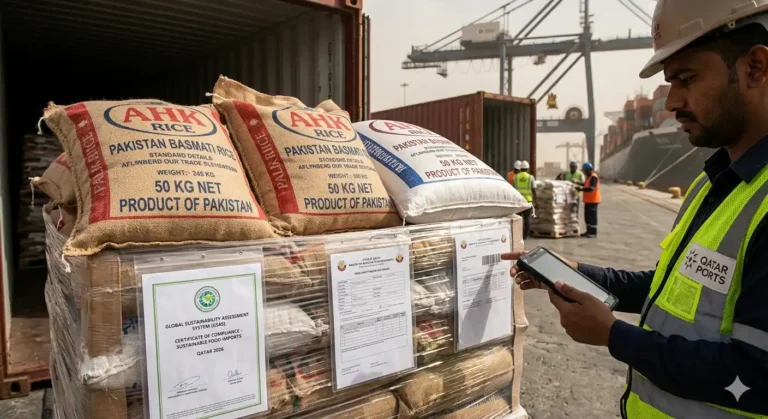
For Annex I products, the importer must submit a CHED-D through IPAFFS before the consignment arrives in Great Britain. Commercial documents also form part of the notification process.
The compliance process therefore connects product testing with border notification and physical movement.
With the import pathway established, the next question is which regulatory components Scottish buyers must review.
Which Components Make Up Rice Import Compliance?
Rice import compliance combines food safety, pesticide controls, mycotoxin controls, customs classification, labelling, documentation, border notification, and official controls. Each component addresses a different regulatory risk.
What Food Safety Controls Apply?
Food safety controls require imported rice to meet GB food safety standards for contaminants, residues, hygiene, composition, and consumer protection. Imported cereals must meet equivalent food hygiene requirements to food produced in Great Britain.
Pakistan-origin rice receives specific regulatory attention. Current controls cover pesticide residues, aflatoxins, and ochratoxin A.
Pesticide testing checks residues against applicable legal maximum residue limits. Aflatoxin and ochratoxin A controls address mycotoxin contamination.
These controls make laboratory verification important during procurement. A commercial specification should therefore identify the required tests before dispatch.
What Documentation Supports the Shipment?
Core import documents include commercial invoices, packing lists, transport documents, product details, and applicable border-control notifications. Controlled food requires accurate documentation linking the shipment to its regulatory declaration.
Commercial invoices identify the buyer, seller, product, quantity, and transaction value. Packing lists identify packages and quantities. Bills of lading identify the transportation movement.
The CHED-D connects the imported food with its official control notification. IPAFFS provides the system used for applicable high-risk food notifications.
Documentation errors create discrepancies between the physical rice and the declared shipment.
With the core components defined, the next question is how these rules benefit Scottish rice buyers.
What Benefits Come From Understanding Rice Import Rules?
Regulatory knowledge reduces clearance errors, improves supplier specifications, supports food safety, strengthens traceability, and helps buyers plan compliant rice shipments before dispatch. These benefits affect procurement, warehousing, retail, and food-service operations.
How Does Compliance Improve Procurement?
Compliance knowledge lets buyers specify origin, variety, processing type, testing, packaging, and documentation before placing purchase orders. A precise specification creates a measurable procurement standard.
A Scottish buyer sourcing 1121 Basmati can define the variety, processing method, packaging format, crop information, moisture specification, broken percentage, and laboratory requirements.
The same approach applies to Super Kernel and 1509 Basmati. Buyers can compare suppliers using consistent technical criteria.
How Does Compliance Support Food Safety?
Compliance controls reduce the risk of contaminated rice entering the Scottish food supply by connecting laboratory evidence with official border controls. Pakistan rice currently faces controls for three contaminant categories.
Laboratory reports provide evidence about specified hazards. Border authorities use documentation and inspections to verify compliance.
Food Standards Scotland states that imported food must meet GB public-health standards. Official controls can include documentary, identity, and physical checks.
Compliance therefore protects consumers while giving importers a structured quality-control framework.
With the benefits established, the next question is where Scottish buyers apply these rules.
Where Do Scottish Buyers Apply Rice Import Rules?
Scottish buyers apply rice import regulations across wholesale distribution, retail packaging, food service, manufacturing, catering, and private-label supply. Each use case creates different documentation and product-control requirements.
Which Retail Applications Require Attention?
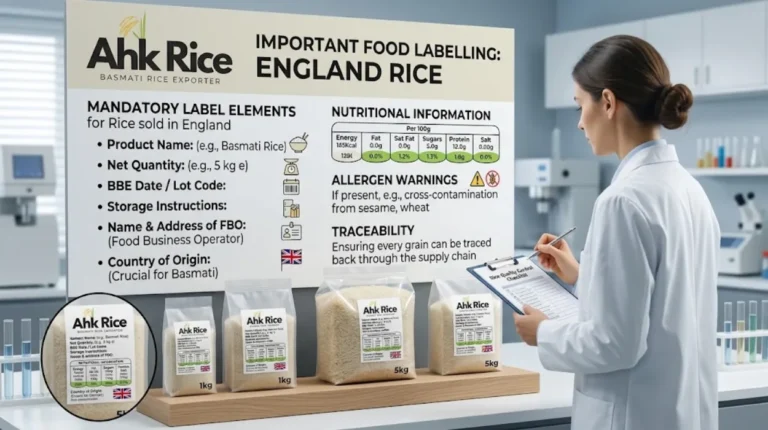
Retail rice requires attention to product identity, packaging, food information, origin information, dates, storage instructions, and responsible food-business details. UK food labelling rules specify mandatory information for pre-packed foods.
A Scottish retailer selling packaged 5 kg Basmati needs compliant consumer-facing information. The packaging must communicate the required food information accurately.
A private-label importer also needs traceability between the Scottish food business, imported consignment, packaging, and supplier documentation.
Which Food-Service Applications Require Attention?
Food-service buyers use rice for restaurants, hotels, caterers, schools, and institutional kitchens, where product traceability and food safety remain essential. Bulk packaging does not remove the underlying food safety requirements.
A catering buyer sourcing 25 kg bags needs clear product identification and traceability records. The buyer also needs documentation supporting the shipment and supplier relationship.
Rice containing animal-origin ingredients follows different rules. Plain Basmati rice does not contain those ingredients, while prepared rice dishes containing meat, fish, eggs, or dairy can trigger additional controls.
These use cases show why product composition must be established before import planning.
With the applications defined, the next question is which certifications apply to imported rice.
Which Certifications Apply to Rice Imported Into Scotland?
No single certificate covers every rice shipment; requirements depend on origin, product risk, processing, and claims such as organic status. Buyers must separate legal controls from commercial certifications.
Which Certifications Are Legally Relevant?
Pakistan-origin rice requires the applicable food-control documentation and testing evidence, while organic rice requires recognised organic certification and import certification. Organic claims have separate certification rules.
Organic rice imported from outside the EU, EEA, and Switzerland into Great Britain requires a GB Certificate of Inspection for each consignment. The exporter’s control body issues the certificate.
Organic businesses must also use approved control bodies. Organic claims cannot appear on labels or commercial material without the required certification.
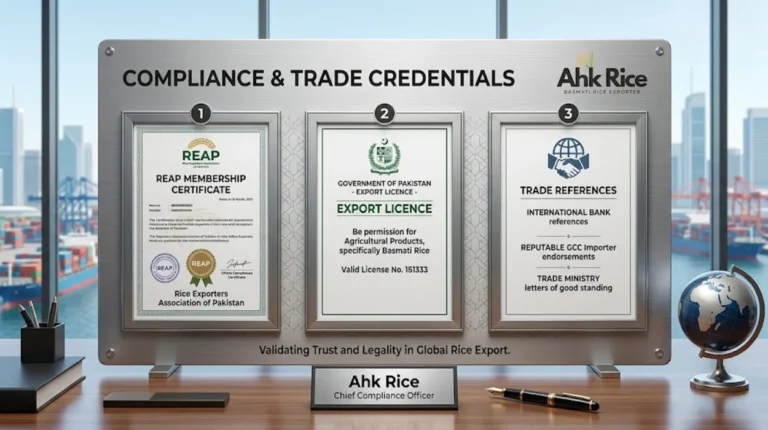
Commercial standards such as HACCP-based food safety systems, ISO 22000, BRCGS, and retailer-specific audits can support supplier qualification. They should not be confused with statutory import certificates.
With certification requirements separated from commercial standards, the next question is which mistakes Scottish buyers should avoid.
What Common Problems Occur With Rice Imports?
Common problems include incorrect commodity codes, incomplete notifications, missing test evidence, inconsistent product descriptions, non-compliant labels, and misunderstanding high-risk controls. These errors can interrupt clearance.
Which Misconceptions Cause Problems?
Pakistan-origin Basmati is not treated as ordinary unrestricted cereal because current GB controls specifically list Pakistan rice for three contaminant categories. The current restriction list confirms this treatment.
Another misconception concerns phytosanitary certification. Rice is listed among certain grains that can enter Great Britain without a phytosanitary certificate under the applicable plant-health guidance.
That does not remove food-safety controls. Plant-health requirements and food-safety requirements operate as separate regulatory systems.
A third misconception concerns certification. HACCP or ISO certification does not replace statutory import controls. A buyer still needs the applicable customs, food-control, testing, and notification procedures.
What Should Buyers Check Before Shipment?
Buyers should verify origin, commodity code, product type, applicable restrictions, laboratory requirements, labels, commercial documents, and IPAFFS notification requirements before loading. This checklist prevents avoidable regulatory gaps.
A buyer should also confirm whether the shipment is conventional or organic. Organic imports require additional certification and documentation.
The buyer should then align the supplier specification with the shipment documents. The variety, grade, quantity, packaging, origin, and testing evidence should describe the same consignment.
For a deeper comparison of how these rules affect commercial shipments, read how UK food import rules affect Basmati rice shipments.
Understanding these common problems completes the regulatory overview and creates a foundation for evaluating specific Basmati shipments.
Why Should Scottish Buyers Treat Rice Regulations as a Procurement Requirement?
Scottish rice buyers should treat import compliance as part of procurement because food safety, border controls, documentation, and product specifications directly affect shipment acceptance. Compliance begins before the supplier loads the container.
Pakistani Basmati rice provides a clear example. Pakistan-origin rice currently faces GB controls covering pesticide residues, aflatoxins, and ochratoxin A.
Scottish buyers sourcing 1121, Super Kernel, or 1509 should therefore establish the regulatory specification alongside the commercial specification.
The process covers cultivation origin, milling, grading, sorting, testing, packaging, documentation, dispatch, border notification, inspection, and customs clearance.
AHK Rice supplies Pakistani Basmati varieties including 1121, Super Kernel, and 1509 from Punjab. Its stated export process covers processing, custom packaging, and export logistics.
Frequently Asked Questions
What rice import rules apply in Scotland?
Scottish rice imports must meet Great Britain food safety requirements. Pakistan-origin rice currently has controls for pesticide residues, aflatoxins, and ochratoxin A.
Does Pakistani Basmati rice require border controls?
Pakistan-origin rice is currently controlled under Great Britain rules for pesticide residues, aflatoxins, and ochratoxin A. Applicable consignments require the relevant border-control notification and procedures.
Does Pakistan rice need a phytosanitary certificate?
Rice is among certain grains covered by Great Britain plant-health exemptions from phytosanitary certification. Food-safety import controls remain separate and still apply to controlled Pakistani rice.
What is CHED-D for rice imports?
CHED-D is the Common Health Entry Document used for applicable high-risk food and feed of non-animal origin. Pakistan rice listed under the relevant controls requires CHED-D notification through IPAFFS.
What tests apply to Pakistani rice?
Current Great Britain controls cover pesticide residues, aflatoxins, and ochratoxin A for Pakistan-origin rice. Buyers should confirm current requirements before every shipment.
Does organic Basmati require extra certification?
Yes. Organic rice imported from outside the EU, EEA, and Switzerland into Great Britain requires a GB Certificate of Inspection for each consignment.
What commodity code covers rice?
Rice is classified under heading 1006, with subcategories covering paddy, husked, semi-milled, wholly milled, broken, and parboiled rice.