Why Do Fine Dining Restaurants Prefer Pakistani Basmati Rice?
Pakistani Basmati rice is a premium aromatic rice recognized for its long slender grain, distinctive fragrance, firm texture, and ability to elongate during cooking. Fine dining restaurants prefer it when rice quality directly affects presentation, aroma, portion consistency, and the final dining experience. Pakistani Basmati is primarily cultivated in the irrigated plains of Punjab, where soil, climate, water availability, and traditional cultivation practices support the development of its characteristic grain and aroma. Pakistan exports Basmati rice to markets across the Middle East, Europe, North America, Africa, and other international destinations.
What makes Pakistani Basmati rice different from ordinary long-grain rice?
Pakistani Basmati differs through its elongated grain, aromatic profile, cooking expansion, firm texture, and separation after cooking. These characteristics give chefs greater control over plated rice dishes, biryani, pulao, rice accompaniments, and composed menus where grain appearance affects perceived food quality.
Basmati is not simply a long-grain rice category. It is a distinct aromatic rice type associated with specific growing regions and measurable physical and sensory characteristics. Pakistani Basmati is strongly associated with Punjab, where Basmati cultivation has developed over generations.
The grain is naturally slender. During cooking, a properly processed Basmati kernel expands mainly in length while retaining a relatively narrow width. This creates the elongated appearance expected in premium rice dishes.
Aroma is another defining characteristic. Basmati contains naturally occurring aromatic compounds that produce its recognizable fragrance after cooking. Fine dining kitchens use this aroma as part of the sensory composition of a dish.
Cooking behavior also matters. High-quality Basmati produces separate grains when the rice is correctly processed and prepared. This is important for dishes where individual grains must remain visually distinct.
The difference becomes particularly important in restaurants because rice is not evaluated only by weight. Chefs evaluate aroma, appearance, mouthfeel, cooking yield, consistency, and compatibility with sauces, meats, vegetables, and spices.
Where is Pakistani Basmati rice grown?
Pakistani Basmati rice is primarily grown in Punjab’s traditional rice-growing belt, where agricultural conditions support aromatic grain development. The production area includes irrigated agricultural zones with suitable soil, temperature patterns, water availability, and established Basmati cultivation practices.
Punjab is Pakistan’s principal Basmati-producing region. The crop is cultivated in areas where farmers have established production systems around rice varieties suited to the local environment.
The growing environment affects the physical and sensory properties of rice. Temperature during grain development influences kernel formation. Water management affects crop growth. Harvest timing influences grain maturity and post-harvest quality.
Basmati rice is harvested after reaching physiological maturity. The harvested paddy contains moisture and plant material that must be managed before milling.
The geographical identity of Basmati also matters in international trade. Pakistan has established specifications and verification mechanisms for Basmati under its geographical indication framework. The Trade Development Authority of Pakistan identifies Basmati characteristics through measurable attributes including chemical composition, shape, taste, and color.
How is Pakistani Basmati rice processed from paddy to finished grain?
Pakistani Basmati processing converts harvested paddy into clean, graded, stable rice through drying, cleaning, dehusking, milling, polishing when specified, sorting, grading, inspection, and packaging. Each stage controls a different quality factor affecting appearance, cooking performance, and commercial grade.
1. Paddy harvesting
Farmers harvest mature Basmati paddy from the field. The harvested material contains rice kernels enclosed within husks along with field debris and other foreign material.
2. Drying
Fresh paddy requires moisture control before storage and milling. Controlled drying reduces excess moisture and stabilizes the grain for subsequent processing.
Moisture management is important because excessive moisture increases storage risks, while excessive drying can increase kernel breakage during milling.
3. Cleaning
Cleaning equipment removes stones, straw, dust, immature material, and other foreign matter. The objective is to create a cleaner paddy stream before dehusking.
4. Dehusking
A rice husker removes the outer husk from paddy. The result is brown rice, which still contains bran layers surrounding the edible kernel.
5. Paddy separation
Unhulled paddy and brown rice are separated. Remaining paddy is returned to the husking stage to improve recovery and reduce unnecessary grain loss.
6. Whitening and milling
For white Basmati rice, milling removes the bran layers and germ from brown rice. The degree of milling determines the appearance and surface characteristics of the finished kernel.
7. Polishing
Polishing removes remaining surface particles and improves visual brightness. The process depends on the required commercial specification.
8. Length grading
Length graders separate kernels according to size. This stage helps establish consistent grain length and reduces variation within the finished batch.
9. Color sorting
Optical color sorters identify and remove discolored or visually defective kernels. This improves uniformity and retail appearance.
10. Final inspection and packaging
The finished rice is tested against the buyer’s specification before packing. Parameters include moisture, broken percentage, grain length, foreign matter, purity, damaged kernels, and other agreed quality characteristics.
Which Pakistani Basmati grades are available?
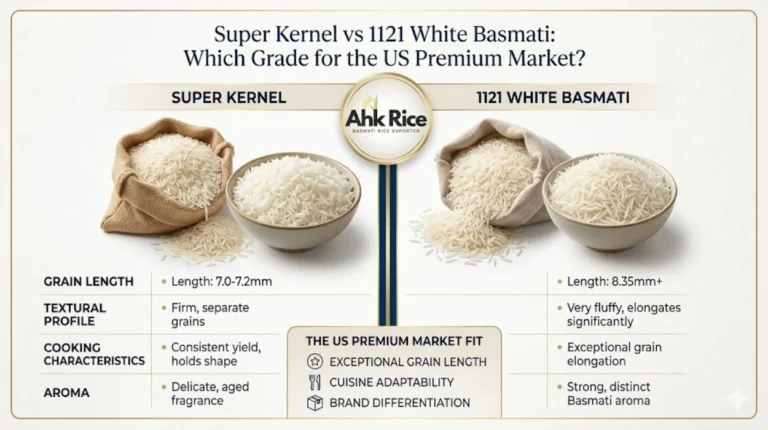
Major Pakistani Basmati grades include 1121 Basmati, Super Kernel Basmati, and 1509 Basmati, with white, steam, Sella, and other processing formats available according to the variety and specification. Grade selection depends on grain length, processing method, cooking behavior, and buyer requirements.
1121 Basmati is known for its exceptionally long slender grain and strong elongation after cooking. It is widely used in biryani, pulao, banquet dishes, and premium foodservice applications.
Super Kernel Basmati is another established Pakistani Basmati category. It provides long grains with strong aromatic characteristics and is used in household, foodservice, wholesale, and premium retail applications.
1509 Basmati is an early-maturing Basmati variety with long grain characteristics. It is processed into formats including white and steam rice according to commercial requirements.
White Basmati rice
White Basmati is conventionally milled rice with the bran and husk removed. It provides a clean appearance and is widely used in restaurant kitchens.
Steam Basmati rice
Steam processing exposes paddy or rice to controlled steaming conditions before drying and milling, depending on the processing system. The process changes kernel structure and improves resistance to cooking-related breakage.
Sella Basmati rice
Sella rice is parboiled rice. The controlled parboiling process changes the physical structure of the grain and produces firmer kernels with strong cooking stability.
Brown Basmati rice
Brown Basmati retains the bran layer after husk removal. It has a darker appearance, firmer texture, and different cooking requirements from white Basmati.
Why does grain consistency matter to fine dining kitchens?
Grain consistency determines how predictably rice cooks, expands, separates, absorbs liquid, and appears on the plate. Restaurants therefore evaluate kernel length, broken percentage, moisture, chalkiness, purity, and variety uniformity before treating a rice specification as suitable for premium foodservice.
A restaurant kitchen operates around repeatable recipes. If one batch cooks differently from another, chefs must change water ratios, cooking times, soaking periods, or holding procedures.
Grain length is one of the most visible quality indicators. A batch containing consistent long kernels creates a more uniform appearance on a finished plate.
Broken grains also affect presentation. Excessive broken kernels produce smaller pieces that cook differently from intact grains. They can also increase starch release and change the visual structure of dishes.
Moisture affects storage and cooking behavior. Rice purchased for professional kitchens therefore requires a defined moisture specification rather than an undefined description such as “fresh” or “premium.”
Purity is equally important. Variety purity reduces the presence of kernels with different physical and cooking characteristics.
These factors explain why restaurant buyers increasingly evaluate rice through measurable specifications rather than product names alone.
For a deeper understanding of the purchasing criteria, the next-stage resource should examine:
How grain consistency affects restaurant rice purchasing decisions. This moves the topic from general product characteristics into commercial evaluation criteria.
What benefits does Pakistani Basmati provide in fine dining?
Pakistani Basmati provides restaurants with aromatic presentation, elongated cooked grains, controlled texture, recipe compatibility, and strong visual differentiation. These attributes support dishes where rice functions as a visible component rather than simply serving as a neutral carbohydrate.
Aroma
The natural fragrance of Basmati contributes to the sensory identity of dishes such as biryani and pulao. Aroma becomes particularly important when rice is served without heavy sauces that mask its natural character.
Grain appearance
Long, separate grains create a refined visual structure. This supports plated dishes where chefs arrange rice alongside grilled meats, curries, seafood, vegetables, or sauces.
Cooking expansion
Basmati expands significantly in length during cooking. This increases the visual volume of a portion without requiring the restaurant to serve an excessive raw quantity.
Texture
Correctly processed Basmati provides a firm, separate grain structure. The exact texture depends on variety, processing method, soaking, water ratio, cooking temperature, and holding conditions.
Menu flexibility
Restaurants use Basmati across multiple cuisines. Examples include Indian and Pakistani biryani, Persian-inspired rice dishes, Middle Eastern preparations, grilled-meat accompaniments, pilaf-style dishes, and contemporary plated menus.
Which restaurant dishes use Pakistani Basmati rice?
Pakistani Basmati is used in dishes where aroma, grain separation, and appearance matter, including biryani, pulao, pilaf, steamed rice, rice bowls, banquet rice, and meat-based rice dishes. The selected variety and processing format depend on the required cooking method.
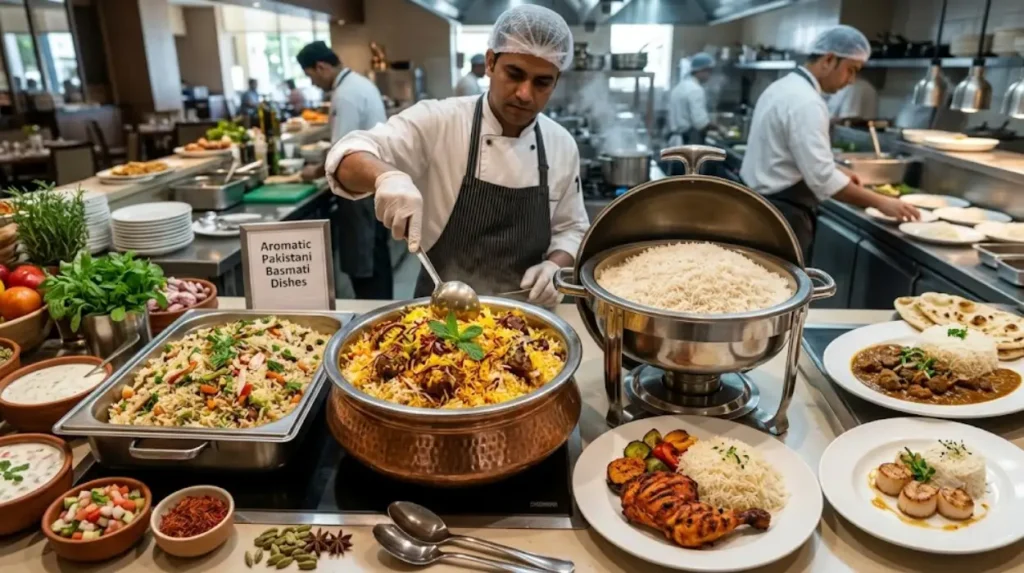
Biryani is one of the clearest applications because the rice must remain elongated and separate after cooking with meat, spices, stock, and other ingredients.
Pulao requires similar grain integrity because rice is cooked with stock, meat, vegetables, or spices.
Steamed rice uses the natural aroma and appearance of Basmati as the primary sensory characteristics.
Fine dining restaurants also use long-grain Basmati as an accompaniment to grilled proteins, curries, roasted vegetables, seafood, and composed tasting-menu dishes.
Large hotels and banquet kitchens evaluate the same characteristics at higher volumes. Their purchasing decisions place additional emphasis on batch consistency because hundreds of portions can depend on a single rice specification.
Which international markets import Pakistani Basmati rice?
Pakistani Basmati rice is exported to major markets across the Middle East, Europe, North America, Africa, and Asia. Saudi Arabia, the United Arab Emirates, the United States, and European destinations represent important commercial markets with different foodservice, retail, labeling, and food-safety requirements.
Middle Eastern markets have established demand for Basmati in restaurants, hotels, catering operations, and retail channels. Saudi Arabia and the UAE are significant destinations for Pakistani rice.
The United States has demand from South Asian restaurants, specialty food distributors, ethnic grocery stores, foodservice suppliers, and premium rice buyers.
European markets evaluate imported rice under national and European food-safety, labeling, traceability, and contaminant requirements. Requirements differ according to the destination market and intended use.
African markets also import Pakistani rice for retail and foodservice consumption. Buyer specifications vary according to local consumer preferences, purchasing power, packaging requirements, and distribution systems.
A restaurant buyer therefore needs more than the statement “Pakistani Basmati.” The commercial specification must identify the variety, processing method, grain length, broken percentage, moisture, packaging, testing requirements, and destination-country compliance conditions.
Which certifications and compliance documents apply to Pakistani Basmati rice?
Rice exports require compliance with the importing country’s food laws and the buyer’s specifications. Common documentation includes food-safety system certification, laboratory analysis, phytosanitary documentation where required, certificate of origin, product specifications, and shipment documents; exact requirements differ by destination.
Codex standards provide an international reference framework for food safety, hygiene, contaminants, pesticide residues, labeling, sampling, and trade. Codex standards are not automatically national law, so importing-country regulations remain controlling.
The Codex Standard for Rice requires compliance with applicable maximum residue limits for pesticides and includes hygiene and safety provisions.
Pesticide residue testing is therefore an important quality-control activity. Codex’s current pesticide database includes maximum residue limits adopted through its 48th Commission session in November 2025.
Food-safety certifications such as HACCP and ISO 22000 are commonly used by food businesses to demonstrate structured food-safety management. Their relevance depends on the buyer’s procurement requirements.
A phytosanitary certificate addresses plant-health requirements where the destination authority requires it. A certificate of origin establishes the declared country of origin.
Laboratory certificates can document parameters such as moisture, broken grains, grain dimensions, pesticide residues, microbiological results, heavy metals, and other agreed specifications.
The critical point is that certification is not a substitute for destination-country compliance. Importing countries can impose requirements that are stricter than international reference standards.
What common misconceptions exist about Pakistani Basmati rice?
The most common misconceptions are that all Basmati rice has identical quality, that longer grain automatically means better rice, that certification guarantees every market requirement, and that restaurant performance depends only on the rice variety. Quality depends on multiple measurable and processing-related factors.
The first misconception is that every Basmati batch performs identically. Variety, crop year, processing, moisture, broken percentage, storage, and cooking method influence performance.
The second misconception is that maximum grain length automatically means maximum quality. Grain length matters, but aroma, purity, cooking behavior, broken percentage, moisture, and cleanliness also affect commercial value.
The third misconception is that “Basmati” alone defines a complete purchase specification. A professional restaurant buyer needs additional parameters.
The fourth misconception is that certification automatically permits entry into every country. Certification supports food-safety management and buyer confidence, but national import requirements remain applicable.
The fifth misconception is that rice quality ends at the mill. Storage, transportation, packaging, warehouse conditions, and restaurant preparation all influence the final cooked product.
Why does fine dining favor consistency over rice length alone?
Fine dining restaurants prioritize predictable cooking results because every service requires repeatable portions, appearance, texture, and aroma. Long grain creates visual value, but consistent grain quality allows chefs to reproduce the same dish across batches, menus, services, and restaurant locations.
A premium restaurant cannot evaluate rice only through a photograph of uncooked grains. The operational test begins when the rice enters the kitchen.
Chefs assess washing loss, soaking behavior, water absorption, cooking expansion, grain separation, texture, aroma, holding stability, and final appearance.
A consistent rice specification reduces adjustments during preparation. This helps kitchen teams maintain standardized recipes and portion controls.
The purchasing decision therefore connects agricultural origin with restaurant operations. Growing conditions determine the raw material. Processing establishes the physical grade. Testing verifies measurable characteristics. Packaging protects the finished product. Cooking reveals the practical performance.
That complete chain explains why Pakistani Basmati remains relevant to fine dining kitchens. Its value comes from the interaction of origin, variety, processing, measurable quality, and cooking performance rather than from grain length alone.
Frequently Asked Questions
Why do fine dining restaurants prefer Pakistani Basmati rice?
Fine dining restaurants prefer Pakistani Basmati rice for its distinctive aroma, long slender grains, firm texture, cooking consistency, and attractive presentation.
What makes Pakistani Basmati rice suitable for restaurant dishes?
Its elongated grains, aromatic profile, separate cooked grains, and reliable cooking performance make it suitable for biryani, pulao, steamed rice, and premium plated dishes.
Where is Pakistani Basmati rice grown?
Pakistani Basmati rice is primarily cultivated in Punjab, especially within established Basmati-growing areas where soil, irrigation, climate, and traditional farming practices support aromatic rice production.
Which Pakistani Basmati varieties do restaurants commonly use?
Restaurants commonly use 1121 Basmati, Super Kernel Basmati, and 1509 Basmati. The appropriate variety depends on the required grain length, cooking method, texture, and menu application.
What is the difference between white, steam, and Sella Basmati rice?
White Basmati is conventionally milled rice. Steam rice undergoes controlled steaming during processing, while Sella is parboiled. Each processing method produces different cooking and texture characteristics.
Why is grain consistency important when restaurants buy Basmati rice?
Grain consistency helps restaurants achieve predictable cooking time, expansion, texture, appearance, and portion quality across different batches and service periods.
Does longer Basmati rice always mean better quality?
No. Grain length is only one quality factor. Restaurants also evaluate broken percentage, purity, moisture, aroma, cooking performance, grain uniformity, and processing quality.
What quality specifications do restaurant rice buyers check?
Restaurant buyers commonly evaluate variety, grain length, broken percentage, moisture, purity, chalkiness, damaged grains, foreign matter, aroma, packaging, and laboratory test results.
Which countries import Pakistani Basmati rice?
Pakistani Basmati rice is exported to markets including Saudi Arabia, the United Arab Emirates, the United States, European countries, and destinations across Africa and Asia.
What certifications apply to Pakistani Basmati rice exports?
Depending on the destination and buyer, requirements can include HACCP or ISO 22000 food-safety systems, laboratory analysis, phytosanitary certificates, certificates of origin, and destination-specific compliance documents.