How Does Grain Consistency Affect Restaurant Rice Purchasing Decisions?
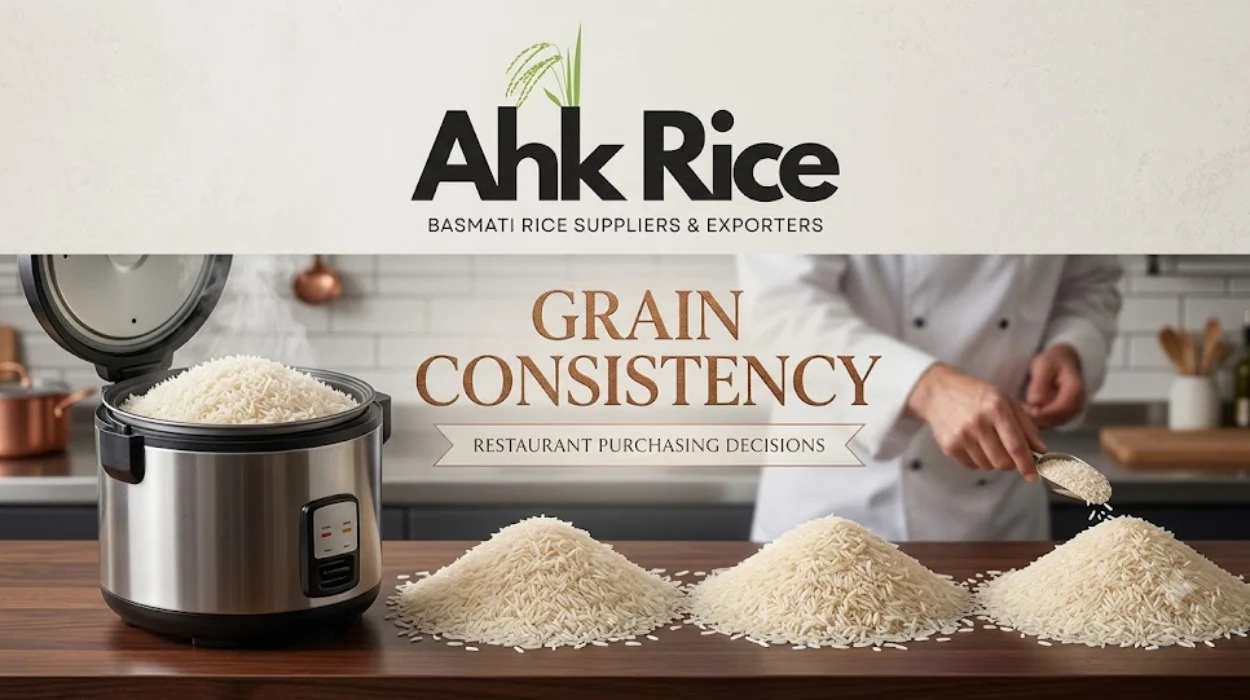
Grain consistency is a stronger purchasing criterion than grain length alone because restaurants need predictable cooking yield, plate presentation, portion control, and repeatable texture across every batch. In 2026, USA and UAE restaurant buyers increasingly evaluate grain uniformity, broken percentage, moisture, processing grade, and supplier quality controls together.
Restaurant procurement teams do not purchase rice only by variety. They purchase a cooking result. Pakistani Basmati varieties such as 1121, Super Kernel, and 1509 differ in grain length, aroma, processing characteristics, and commercial positioning. The first step is understanding why fine-dining kitchens value these characteristics, as explained in:
Why fine dining restaurants prefer Pakistani Basmati rice.
Grain consistency means the uniformity of kernel length, width, maturity, milling quality, moisture, broken grains, and cooking behavior within a shipment. A restaurant receiving inconsistent grains can experience different cooking times, uneven plate appearance, excessive breakage, and variable serving portions.
For buyers evaluating 1121 Basmati rice, AHK Rice’s Pakistani Basmati rice supply for USA buyers provides a useful reference for commercial specifications, packaging formats, and export requirements.
What does grain consistency mean for restaurant rice purchasing?
Grain consistency means maintaining similar kernel dimensions, moisture, broken percentage, cooking expansion, texture, and appearance throughout a rice shipment, allowing restaurant kitchens to reproduce the same cooking result from one batch to the next.
A consistent rice shipment contains grains that behave similarly during washing, soaking, boiling, steaming, and holding. This reduces the need for chefs to adjust water ratios or cooking times after every delivery.
For restaurants, consistency has a direct operational value. A 10-kilogram batch containing predominantly whole, uniform kernels produces a more predictable cooked volume than a batch containing mixed lengths and high breakage.
Grain length is one measurement. Grain uniformity is broader. Two shipments can both average 8.3 millimeters while producing different cooking results if one contains greater variation in kernel size, chalkiness, moisture, or broken grains.
Moisture also influences cooking behavior. Rice with inconsistent moisture absorbs water differently. This can produce some grains that remain firm while others become soft. Restaurant kitchens experience this variation as inconsistent texture rather than as a simple laboratory specification.
Broken grains create another problem. Broken kernels release starch more quickly during cooking. Higher breakage can therefore increase stickiness and reduce the visual separation expected from premium Basmati.
What are the available solutions for improving grain consistency?
Restaurants can improve grain consistency by purchasing specification-controlled grades, using pre-shipment samples, requiring laboratory reports, selecting standardized processing, monitoring broken percentages, and maintaining suitable storage conditions after imported rice reaches the commercial kitchen.
The first solution is grade standardization. Buyers specify the exact variety and processing type instead of purchasing generic “premium Basmati.” A contract can identify 1121 Steam, 1121 Sella, Super Kernel White, or 1509 Steam according to the intended application.
The second solution is sample approval. A restaurant or distributor cooks a representative sample before approving a commercial shipment. The evaluation should cover raw grain appearance, cooked length, aroma, texture, water absorption, breakage, and holding performance.
The third solution is laboratory specification control. Buyers can define limits for moisture, broken grains, foreign matter, chalky grains, grain length, and other relevant quality parameters. These specifications provide measurable acceptance criteria.
The fourth solution is mechanical and optical sorting. Modern rice processing uses cleaning, grading, length sorting, and color sorting to remove foreign material, defective kernels, and inconsistent grains. AHK Rice describes its processing sequence as including cleaning, dehusking, separation, whitening, polishing, grading, and length sorting.
The fifth solution is processing-grade selection. Steam and Sella rice solve different restaurant problems. Steam Basmati emphasizes softer texture and aroma. Sella rice provides stronger structural stability for bulk cooking, reheating, and longer storage.
The sixth solution is controlled storage. Restaurants should protect imported rice from moisture, heat, pests, and contamination. Consistent rice can still deteriorate when storage conditions are poor.
How do different rice approaches compare for restaurants?
Standardized 1121 Steam provides strong presentation and aroma, Golden Sella provides greater structural durability, Super Kernel balances aroma and commercial value, while 1509 offers long-grain performance at a more cost-conscious purchasing position.
| Attribute | 1121 Steam | 1121 Golden Sella | Super Kernel White | 1509 Steam |
|---|---|---|---|---|
| Raw grain profile | Extra-long | Extra-long | Long | Extra-long |
| Cooking texture | Soft, separate | Firm, separate | Soft, aromatic | Soft, separate |
| Aroma | High | Medium-high | Very high | Medium-high |
| Bulk cooking stability | High | Very high | High | High |
| Reheating performance | Moderate-high | Very high | High | High |
| Typical restaurant use | Fine dining | Catering and chains | Premium traditional menus | Cost-controlled premium menus |
| Procurement position | Premium | Operational premium | Aroma-focused premium | Value-oriented premium |
1121 Steam is particularly useful where appearance, aroma, and softer eating texture dominate the menu requirement. The long grain creates strong visual presentation for biryani, pilaf, rice bowls, and plated dishes.
1121 Golden Sella changes the priority toward structural strength. Parboiling strengthens the kernel and improves resistance to overcooking. This makes it suitable for restaurants preparing large quantities before service.
Super Kernel occupies a different position. Its traditional Basmati character and strong aroma appeal to restaurants where flavor identity matters more than maximum grain length.
1509 provides another commercial option. Its shorter cultivation cycle supports competitive procurement while maintaining long-grain characteristics suitable for premium foodservice menus.
The correct choice therefore depends on the restaurant’s operating model rather than on a universal ranking of varieties.
Which Pakistani Basmati grade works best for USA restaurants?
USA restaurants generally benefit from 1121 Steam for premium plated dishes, 1121 Sella for high-volume kitchens, and Super Kernel for traditional South Asian menus where aroma and familiar Basmati character influence customer expectations.
USA restaurant buyers increasingly evaluate imported rice as a foodservice ingredient rather than simply as a commodity. Consistent grain appearance supports portion presentation, while predictable cooking behavior reduces kitchen adjustments.
The USA market also requires import compliance. FDA requirements and the Foreign Supplier Verification Program influence commercial sourcing decisions for imported food products. Buyers therefore evaluate documentation alongside physical rice specifications.
For restaurant chains, the purchasing decision becomes more complex. A chain needs the same cooking result across multiple locations. Grain consistency therefore becomes a supply-chain standard.
Indicative July 2026 FOB Karachi prices for Pakistani Basmati were approximately US$1,135–US$1,205 per metric ton across common 1121 grades, with exact pricing changing according to processing specification and contract terms. Freight to US ports is additional.
1121 Steam and 1121 White usually command a premium positioning when buyers require long grain, visual quality, and premium cooking performance. Sella grades can provide better operational stability for restaurants with larger production volumes.
For USA restaurant chains, the most important question is not simply “Which rice costs less?” It is “Which rice produces the lowest total cost per consistent serving?”
Which Pakistani Basmati grade works best for UAE restaurants?
UAE restaurants generally favor 1121 Sella for high-volume catering and holding stability, while 1121 Steam and Super Kernel suit premium dining concepts that prioritize aroma, softer texture, and attractive plated grain presentation.
The UAE presents a different procurement environment because restaurant operations frequently manage hot warehouse conditions, large catering volumes, and regional dishes requiring long-grain aromatic rice.
1121 Golden Sella is particularly suitable when kitchens prepare large batches for mandi, biryani, kabsa, buffets, and catering functions. Its stronger kernel structure provides greater tolerance during bulk cooking and holding.
Steam Basmati works better when rice moves quickly from kitchen to plate. Fine-dining restaurants can prioritize aroma, softer texture, and white appearance because the product spends less time in holding equipment.
Super Kernel remains relevant for restaurants where traditional Basmati aroma is central to the menu. It provides a balance between grain presentation and aromatic character.
Indicative July 2026 FOB Karachi pricing for the UAE market was approximately US$1,135–US$1,205 per metric ton for major 1121 grades, while Super Kernel was also listed around the upper part of that range. Freight to Jebel Ali is additional.
The UAE retail market also demonstrates active demand for Pakistani Basmati. The UAE Ministry of Economy and Tourism’s June 2026 price platform listed Pakistani Basmati products in Dubai retail channels, confirming continued consumer presence for the category.
How do USA and UAE restaurant rice requirements compare?
USA restaurant buyers emphasize documentation, standardized specifications, chain-wide consistency, and premium presentation, while UAE buyers place greater operational weight on bulk cooking, heat-resistant storage, holding stability, and grades suited to Gulf rice-based dishes.
| Purchasing factor | USA restaurants | UAE restaurants |
| Preferred premium grade | 1121 Steam | 1121 Steam / Golden Sella |
| High-volume grade | 1121 Sella | 1121 Golden Sella |
| Aroma-focused option | Super Kernel | Super Kernel |
| Indicative FOB price/MT | US$1,135–$1,205 | US$1,135–$1,205 |
| Typical storage priority | Controlled warehouse | High heat tolerance |
| Shelf-life planning | 12–18 months | 18–24 months for Sella |
| Main quality concern | Repeatable specifications | Holding and storage stability |
These shelf-life periods represent commercial planning ranges rather than guarantees. Storage temperature, humidity, packaging, rice processing, crop age, and warehouse hygiene directly affect actual product stability.
The difference between the markets is therefore operational. A USA restaurant may prioritize a rice that delivers premium plating quality after rapid preparation. A UAE catering operation may prioritize a rice that survives longer storage and high-volume cooking.
Both markets still require consistent grain dimensions and controlled moisture because these factors influence cooking repeatability.
What are the advantages and disadvantages of different consistency strategies?
Specification-controlled sourcing provides the strongest repeatability, sample approval reduces purchasing uncertainty, Sella processing improves operational durability, and Steam processing enhances premium eating quality; each approach carries different cost, storage, texture, and application trade-offs.
Specification-controlled sourcing has a major advantage: every shipment has measurable acceptance criteria. The disadvantage is that tighter specifications can reduce the pool of suppliers and increase procurement cost.
Sample approval provides practical evidence. A chef can test the exact rice before purchase. The limitation is that one sample cannot replace shipment-level quality controls.
Sella processing provides excellent structural strength. For example, a catering kitchen preparing 100 kilograms of rice can benefit from grains that resist breakage and overcooking. The trade-off is a firmer texture and different visual profile compared with Steam rice.
Steam processing provides a softer, aromatic result. This benefits a fine-dining restaurant serving freshly cooked rice with premium dishes. The disadvantage is lower tolerance for prolonged holding compared with strongly parboiled grades.
Super Kernel provides strong aroma and traditional Basmati identity. It suits restaurants where fragrance is central to the customer experience. Its commercial advantage is balanced performance rather than maximum grain length.
1509 provides cost efficiency. A restaurant can use it where long-grain presentation matters but procurement budgets are more constrained. Its positioning is less focused on the maximum premium characteristics associated with 1121.
Which method works best for different restaurant cases?
Fine-dining restaurants should prioritize Steam Basmati, high-volume catering operations should prioritize Sella, aroma-focused South Asian restaurants should consider Super Kernel, and cost-conscious premium restaurants should evaluate 1509 against their required cooking and presentation specifications.
A fine-dining restaurant serving plated biryani should prioritize grain appearance, aroma, softness, and immediate service. 1121 Steam fits this operating pattern because its cooking profile supports premium presentation.
A large restaurant chain preparing hundreds of portions daily needs stronger standardization. 1121 Sella becomes attractive because the grain structure supports bulk cooking and holding.
A traditional Pakistani or Indian restaurant may prioritize aroma over maximum length. Super Kernel provides a strong fit because aromatic character is central to the dining experience.
A growing restaurant group operating with tighter food-cost targets can evaluate 1509. The variety offers long-grain performance while providing a cost-oriented alternative to higher-priced premium grades.
The decision should always start with the menu and kitchen process. Procurement teams that select rice by variety name alone miss the operational factors that determine actual foodservice value.
What should restaurants consider before approving a rice supplier?
Restaurant buyers should evaluate grain specifications, cooking performance, broken percentage, moisture, processing grade, price, shelf life, documentation, sample results, packaging, and shipment consistency before approving a Pakistani Basmati supplier for recurring commercial purchases.
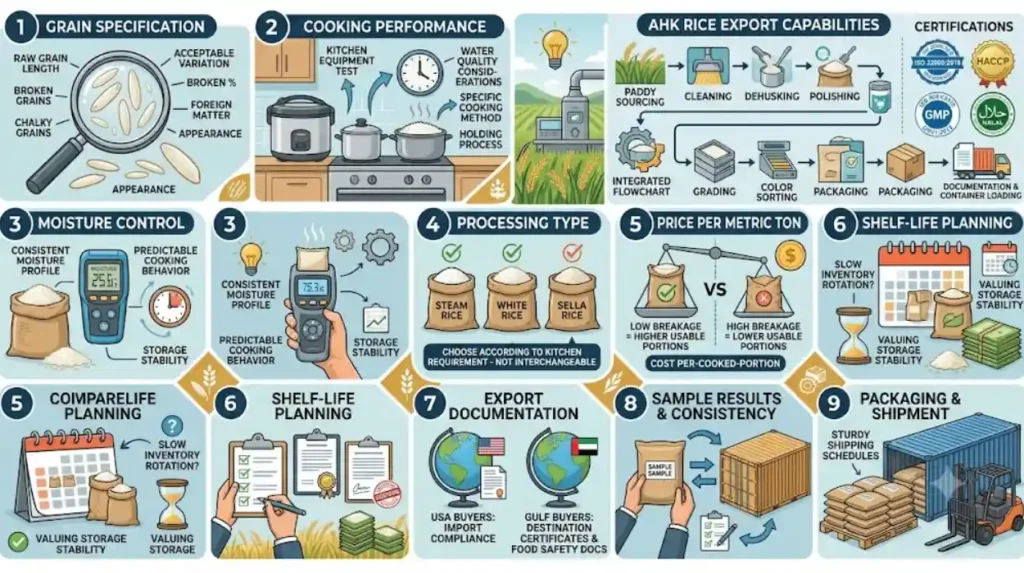
The first decision factor is grain specification. Define raw grain length, acceptable variation, broken percentage, chalky grains, foreign matter, and appearance.
The second is cooking performance. Test the rice using the restaurant’s actual equipment, water, cooking method, and holding process.
The third is moisture control. A consistent moisture profile supports predictable cooking and storage behavior.
The fourth is processing type. Choose Steam, White, or Sella according to the kitchen requirement instead of treating all Basmati as interchangeable.
The fifth is price per metric ton. Compare equivalent specifications. A cheaper grade with higher breakage can produce a higher cost per usable cooked portion.
The sixth is shelf-life planning. Restaurants with slow inventory rotation should place greater value on storage stability.
The seventh is export documentation. USA buyers need appropriate food-import compliance documentation, while Gulf buyers require destination-specific certificates and food safety documentation.
AHK Rice operates an integrated processing and export system covering paddy sourcing, cleaning, dehusking, polishing, grading, color sorting, packaging, documentation, and container loading. Its stated certifications include ISO 22000:2018, HACCP, ISO 9001:2015, GMP, and Halal.
What five factors should form the final restaurant buying decision?
The final decision should balance cooking application, grain uniformity, landed cost, storage requirements, and supplier reliability because these five factors determine whether imported Basmati delivers repeatable kitchen performance and commercially acceptable cost per serving.
| Decision factor | Question restaurant buyers should ask | Best evaluation |
| Cooking application | Is rice plated immediately or held? | Steam vs Sella |
| Grain consistency | Are length and breakage controlled? | Laboratory specification |
| Total cost | What is the usable cost per serving? | Landed cost and yield |
| Storage | How long will inventory remain? | Shelf-life and warehouse conditions |
| Supplier reliability | Can the same specification repeat? | Samples, inspection, documentation |
The first factor prevents product mismatch. A fine-dining kitchen and a 500-meal catering operation should not automatically purchase the same processing grade.
The second factor protects cooking consistency. Grain length without uniformity does not guarantee predictable performance.
The third factor moves purchasing beyond FOB price. Yield, breakage, cooking expansion, freight, duties, packaging, and waste all affect the final food cost.
The fourth factor connects rice selection with inventory management. Restaurants storing rice for extended periods require stronger control over packaging and warehouse conditions.
The fifth factor determines whether the purchasing strategy works beyond one shipment. A restaurant chain needs reproducibility across containers, crop cycles, and production batches.
Grain consistency therefore becomes a commercial performance metric rather than a cosmetic specification. In both the USA and UAE, restaurants can reduce purchasing risk by defining measurable specifications, approving cooking samples, matching processing grade to kitchen operations, and evaluating total cost rather than headline price alone.
For restaurant chains moving from product evaluation to supplier selection, the next-stage resource is the guide to:
Supplying premium Pakistani Basmati rice to USA restaurant chains, where commercial export specifications and USA-focused sourcing requirements can be evaluated.
Frequently Asked Questions
How does grain consistency affect restaurant rice purchasing decisions?
Grain consistency helps restaurants achieve predictable cooking, texture, appearance, portion size, and serving quality. Consistent grains also reduce kitchen adjustments and food waste.
Why is grain length important for restaurant rice?
Grain length affects cooked appearance and presentation. Extra-long Basmati varieties such as 1121 are often selected for premium dishes because the grains elongate visibly after cooking.
Which Pakistani Basmati rice is suitable for restaurants?
1121 Steam suits premium dining, 1121 Sella works well for high-volume cooking, Super Kernel provides strong aroma, and 1509 offers a cost-conscious long-grain option.
Why do restaurants check broken grain percentage?
Broken grains can cook faster and release more starch, affecting texture and visual separation. Restaurants therefore specify acceptable broken percentages when purchasing premium Basmati rice.
How does moisture affect Basmati rice consistency?
Moisture influences water absorption, cooking time, texture, and storage stability. Controlled moisture helps restaurants achieve more predictable results from one batch to another.
Is 1121 Basmati rice suitable for USA restaurants?
Yes. 1121 Basmati is widely suited to USA restaurant applications where extra-long grain appearance, aroma, cooking performance, and premium presentation are important.
Which Basmati rice is best for high-volume restaurant cooking?
1121 Sella is particularly suitable for high-volume operations because its parboiled structure provides strong grain integrity and helps the rice withstand bulk cooking and holding.
Is Super Kernel rice suitable for restaurants?
Yes. Super Kernel is suitable for restaurants that prioritize traditional Basmati aroma, separate cooked grains, and a premium eating experience, particularly in South Asian cuisine.
What should restaurants test before buying Pakistani Basmati rice?
Restaurants should test grain length, broken percentage, moisture, aroma, cooking expansion, texture, appearance, water absorption, holding performance, packaging, and laboratory specifications.
How can restaurants compare Basmati rice suppliers?
Buyers should compare equivalent grades using consistent specifications, sample cooking results, certifications, documentation, price per metric ton, shelf life, packaging, processing controls, and shipment reliability.