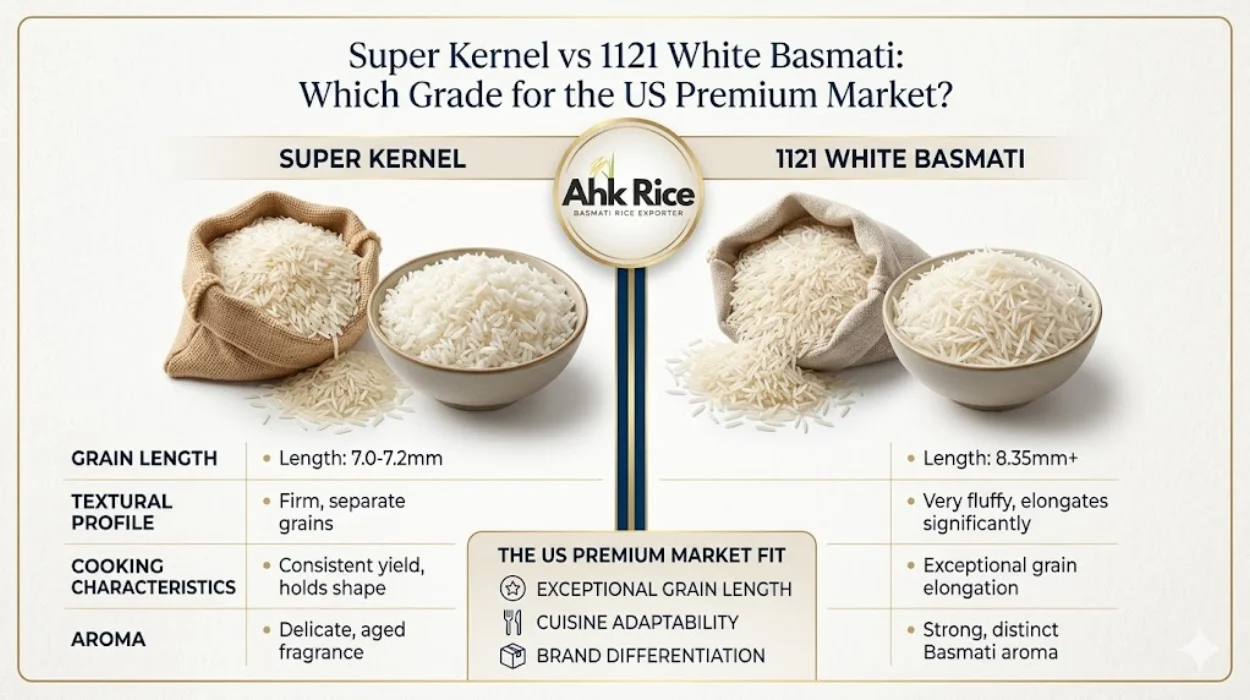
Super Kernel vs 1121 White Basmati: Which Grade for the US Premium Market?
Super Kernel 1121 White Basmati outperforms standard 1121 White Basmati in the US premium market when buyers prioritize grain uniformity, aroma retention, and retail shelf stability. Here is why: Super Kernel undergoes tighter length-based grading, higher polishing consistency, and stricter moisture control, which delivers stronger visual appeal, lower broken ratio, and better retail acceptance compared to conventional 1121 export lots.
This difference matters because the US premium basmati segment does not reward volume alone. It rewards specification control, repeat cooking performance, and predictable retail shelf outcomes. In this context, sourcing decisions shift from variety name to processing precision.
In this comparison, AHK Rice supplies both Super Kernel and 1121 White Basmati through end-to-end milling, grading, and export systems from Punjab, Pakistan. These systems determine final export quality more than the varietal name itself.
To understand this market properly, the educational baseline of grading systems and export standards is explained in this ToFu resource: Basmati grading systems and export processing fundamentals.
What are the available solutions for Super Kernel vs 1121 White Basmati sourcing?
Available sourcing solutions include standard 1121 White Basmati export grade, Super Kernel 1121 premium grade, mixed retail-grade blends, and contract-customized US specification lots defined by broken ratio, grain length uniformity, and moisture control. Super Kernel remains the highest consistency option for US premium retail channels due to stricter grading thresholds.
The market does not operate on a single product type. It operates on grading precision and export configuration.
Standard 1121 White Basmati Export Grade
1121 White Basmati export grade is milled, polished, and sorted for mass international trade.
- Milling removes husk and bran layers
- Polishing increases grain brightness and retail appearance
- Sorting removes major impurities and foreign matter
- Grading separates long grain from broken fractions
This grade performs well in general retail and foodservice but shows variability in grain uniformity.
Super Kernel 1121 Premium Grade
Super Kernel 1121 is a tighter specification subset of 1121 processing.
- Sorting removes short kernels below premium length threshold
- Polishing maintains uniform surface gloss
- Grading reduces broken ratio to minimal export tolerance
- Inspection ensures consistency across shipment lots
Super Kernel targets premium shelf display standards in US retail environments.
Contract-Customized US Specification Lots
US importers often request hybrid specifications.
- Moisture set at controlled export threshold
- Broken ratio customized per buyer channel
- Grain length aligned to retail or foodservice use case
- Packaging adjusted for private label requirements
These solutions dominate supermarket supply chains in the United States.
Blended Commercial Lots
Blended lots mix multiple grades for cost optimization.
- Mixing reduces procurement cost per MT
- Blending increases variability in cooking consistency
- Sorting is partially relaxed to increase yield
- Price competitiveness improves in bulk procurement
This category is used mainly in discount retail channels.
With sourcing options established, the next step is to compare how each approach performs across measurable export specifications.
How do different approaches compare in export specifications and market fit?
Super Kernel 1121 White Basmati leads in grain uniformity, retail presentation, and broken ratio control, while standard 1121 White Basmati leads in cost efficiency and bulk availability. The US premium market favors Super Kernel due to stricter shelf display expectations and brand-driven retail packaging standards.
Comparison in the US market is driven by specification sensitivity rather than variety name alone.
Specification Comparison Table (7 Attributes)
| Attribute | Super Kernel 1121 | Standard 1121 White Basmati |
|---|---|---|
| Grain length uniformity | High consistency across shipment lots | Moderate variation in grain profile |
| Broken ratio | 1.5% – 3.0% export tolerance | 3.0% – 5.0% export tolerance |
| Aroma retention | Strong due to controlled polishing | Moderate due to standard polishing |
| Moisture level | 12% – 13% controlled export range | 12% – 14% range variability |
| Retail appearance | Premium bright polished finish | Standard polished finish |
| Milling control | Tight grading and repeated sorting cycles | Standard milling and grading cycle |
| Price stability | Higher due to premium grading | Lower due to bulk processing |
The US retail segment values visual uniformity because shelf presentation directly affects consumer purchase decisions.
With specifications defined, the next focus is regional demand behavior and pricing structure across the US premium market.
Which method works best for different US premium market cases?
Super Kernel 1121 White Basmati performs best in US retail supermarkets, private label brands, and premium ethnic food chains, while standard 1121 White Basmati performs best in bulk foodservice procurement, restaurant supply chains, and price-sensitive import distribution.
The US premium basmati market divides into two functional regions.
US Retail Premium Market
US retail premium market prioritizes packaging aesthetics and consistency.
- Retail chains require uniform grain display
- Private labels require consistent cooking performance
- Consumer brands demand aroma stability
- Supermarkets reject high broken variation lots
Super Kernel dominates this segment due to predictable shelf behavior.
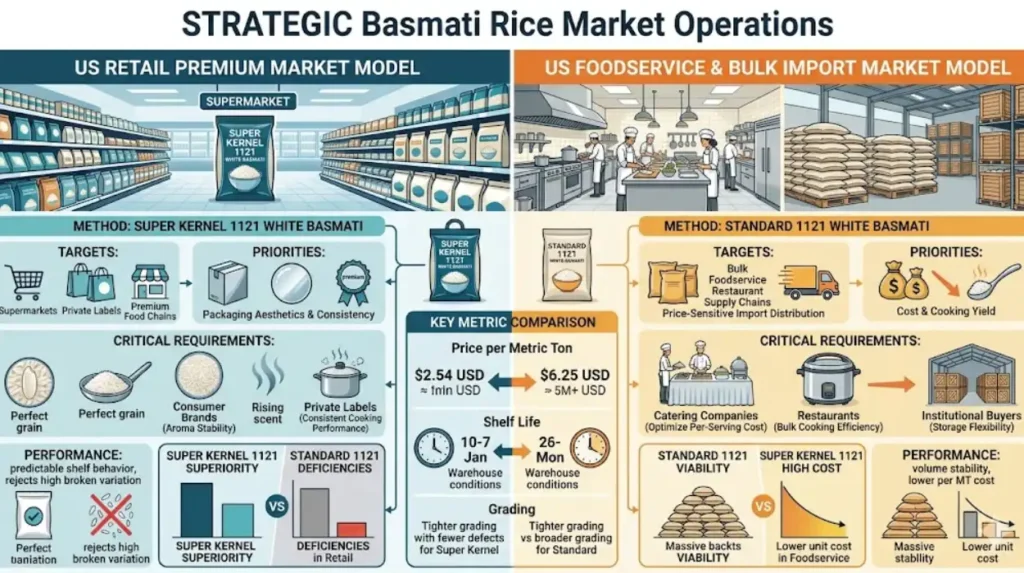
US Foodservice and Bulk Import Market
US foodservice buyers prioritize cost and cooking yield.
- Catering companies optimize per-serving cost
- Restaurants prioritize bulk cooking efficiency
- Institutional buyers focus on storage flexibility
- Import distributors prioritize volume stability
Standard 1121 White Basmati fits this segment due to lower per MT cost.
Price per Metric Ton Comparison (US Import Market)
- Super Kernel 1121 White Basmati: USD 1,450 – 1,850 per MT
- Standard 1121 White Basmati: USD 1,200 – 1,550 per MT
Super Kernel maintains a 10% – 25% price premium due to tighter grading and lower defect ratio.
Shelf Life Comparison (US Storage Conditions)
- Super Kernel: 12–18 months under controlled warehouse storage
- Standard 1121: 10–14 months under similar conditions
Super Kernel maintains stability longer because tighter polishing reduces surface moisture variability.
With market segmentation defined, the next section evaluates operational advantages and limitations of each grade.
What are the pros and cons of Super Kernel vs 1121 White Basmati?
Super Kernel 1121 White Basmati delivers higher retail acceptance, stronger grain uniformity, and better shelf consistency, while standard 1121 White Basmati delivers lower procurement cost, higher bulk availability, and greater flexibility for non-premium distribution channels.
Each grade serves a different supply chain function.
Super Kernel 1121 White Basmati – Advantages
- Grain uniformity increases retail shelf acceptance
- Broken ratio reduction improves cooking appearance
- Aroma retention enhances consumer repeat purchase
- Packaging consistency supports private label branding
Super Kernel 1121 White Basmati – Limitations
- Procurement cost increases per MT
- Strict grading reduces available bulk supply
- Specification compliance increases inspection requirements
- Premium positioning limits discount channel use
Standard 1121 White Basmati – Advantages
- Lower cost improves import margin flexibility
- Higher availability supports bulk procurement cycles
- Easier specification tolerance for mixed shipments
- Wider acceptance in foodservice channels
Standard 1121 White Basmati – Limitations
- Grain variation reduces premium retail appeal
- Higher broken ratio affects visual presentation
- Less stable aroma retention over long storage
- Reduced acceptance in high-end supermarkets
Super Kernel strengthens brand perception in retail environments, while standard 1121 strengthens cost efficiency in distribution networks.
With pros and cons defined, the next step is to identify decision factors that determine final sourcing selection.
What are the key decision factors for US importers choosing between Super Kernel and 1121 White Basmati?
Key decision factors include target sales channel, required grain uniformity, acceptable price per MT range, storage duration, packaging format, and buyer sensitivity to broken ratio thresholds. Super Kernel is selected when retail performance outweighs cost efficiency.
Decision-making in US imports is structured and specification-driven.
Decision Framework Table (5 Factors)
| Factor | Super Kernel 1121 Fit | Standard 1121 Fit |
|---|---|---|
| Sales channel | Retail supermarkets, premium brands | Foodservice, bulk distributors |
| Price sensitivity | Low sensitivity to higher cost | High sensitivity to procurement cost |
| Grain uniformity requirement | Strict uniformity required | Moderate tolerance acceptable |
| Storage duration | Long-term retail warehousing | Medium-term distribution cycles |
| Brand positioning | Premium shelf branding focus | Cost-driven competitive positioning |
Each factor directly impacts procurement decisions in US import contracts.
Processing and Export Control Factors
- Milling precision determines final grain uniformity
- Grading cycles determine broken ratio outcome
- Moisture stabilization determines storage performance
- Inspection protocols determine export certification readiness
These factors define final shipment classification more than origin alone.
With decision factors defined, the final step is aligning sourcing strategy with export execution systems.
Final sourcing alignment for US premium market buyers
Super Kernel 1121 White Basmati is the correct specification for US premium retail success, while standard 1121 White Basmati is the correct specification for high-volume foodservice efficiency. The decision depends on whether brand positioning or cost optimization drives procurement strategy.
US importers that prioritize retail shelf performance consistently select Super Kernel due to stricter grading and lower variability. Buyers focused on bulk movement and institutional supply chains maintain standard 1121 sourcing due to cost efficiency and availability.
In both cases, sourcing consistency depends on controlled milling, grading, and export systems managed by suppliers such as AHK Rice in Punjab, Pakistan, where integrated processing ensures specification compliance for international markets.
The full export decision logic is detailed in the BOFU guide: AHK Rice USA FDA ready super kernel 1121 basmati wholesale quote.
Frequently Asked Questions
What is the main difference between Super Kernel and 1121 White Basmati?
Super Kernel 1121 White Basmati has higher grain uniformity, lower broken ratio, and stricter grading compared to standard 1121 White Basmati. It is designed for premium US retail shelves where visual consistency and cooking performance matter. Standard 1121 focuses more on bulk supply efficiency and cost optimization for foodservice buyers.
Which grade is better for US premium retail supermarkets?
Super Kernel 1121 White Basmati is better for US premium supermarkets because it delivers consistent grain length, brighter polish, and lower defect levels. These features improve shelf presentation and consumer trust. Standard 1121 is less suitable for premium retail but works well in wholesale and restaurant supply channels.
How does price differ between Super Kernel and 1121 White Basmati?
Super Kernel 1121 White Basmati usually costs 10% to 25% more per metric ton due to tighter grading and lower broken ratio. Standard 1121 White Basmati is more affordable and preferred for large-volume imports. The price gap reflects processing precision and export specification control.
What is the shelf life of both rice grades in US storage conditions?
Super Kernel 1121 White Basmati maintains quality for around 12–18 months under controlled warehouse conditions. Standard 1121 White Basmati typically lasts 10–14 months depending on storage humidity and temperature. Super Kernel performs better in long-term retail storage due to tighter polishing and moisture control.
Can both Super Kernel and 1121 White Basmati be used for private label brands?
Yes, both grades can be used for private label brands in the US market. Super Kernel is preferred for premium branding because of its visual consistency and cooking quality. Standard 1121 is used for value-focused private labels where price competitiveness is more important than shelf aesthetics.