Why Are Factory Audits Important for California Rice Importers?
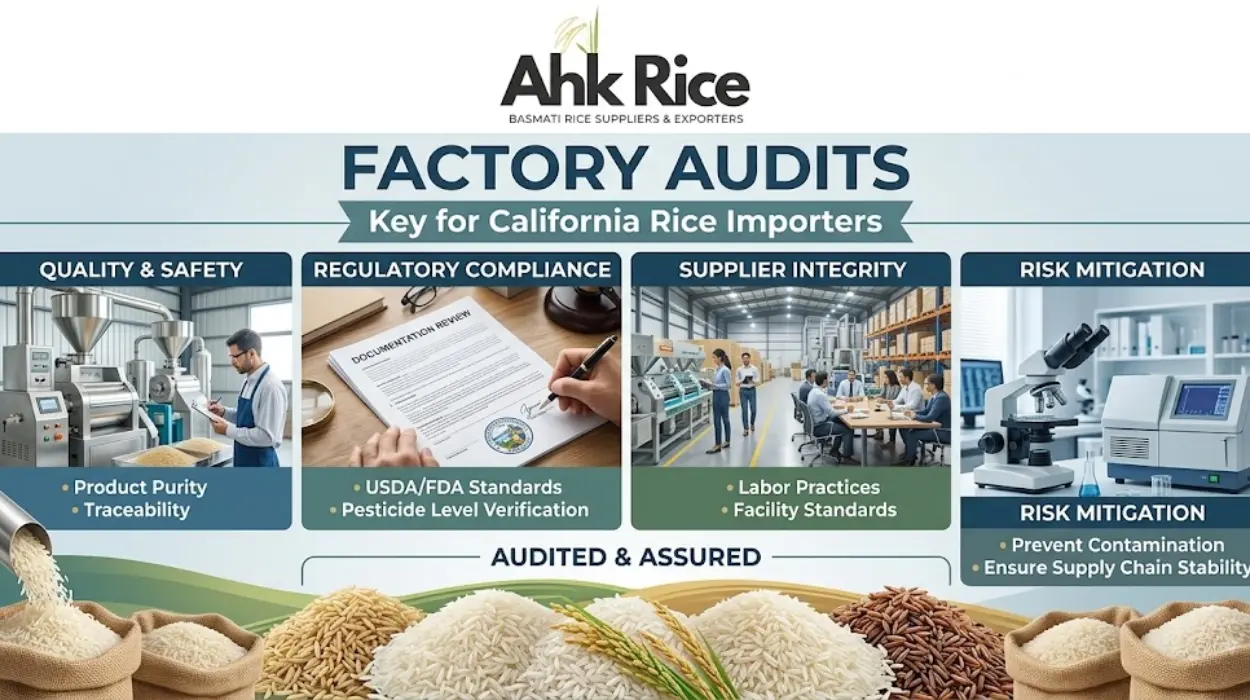
Factory audits are important for California rice importers because they verify how a foreign rice supplier actually controls food safety, processing, quality, traceability, sanitation, storage, and documentation. For Basmati rice imported from Pakistan, an audit connects supplier claims with observable factory practices before commercial shipments begin.
A factory audit is a structured examination of a food-processing facility, its procedures, records, equipment, personnel, and finished-product controls. A rice importer is a U.S. business that purchases or receives rice from a foreign supplier for entry into the United States. A California rice importer operates within the U.S. regulatory environment while often serving retailers, restaurants, distributors, wholesalers, and food-service businesses across California.
The importance of the audit comes from the difference between documents and actual operations. A supplier can provide a specification sheet, laboratory report, certificate, or quality manual. An audit examines whether the factory follows the procedures represented in those documents.
For U.S. food imports, this distinction also connects directly with the FDA Foreign Supplier Verification Program (FSVP). Covered FSVP importers must perform risk-based activities to verify that foreign suppliers produce food in accordance with applicable U.S. food-safety requirements and that imported food is not adulterated. Supplier verification activities include onsite audits, sampling and testing, and reviews of relevant food-safety records.
What is a factory audit for Basmati rice?
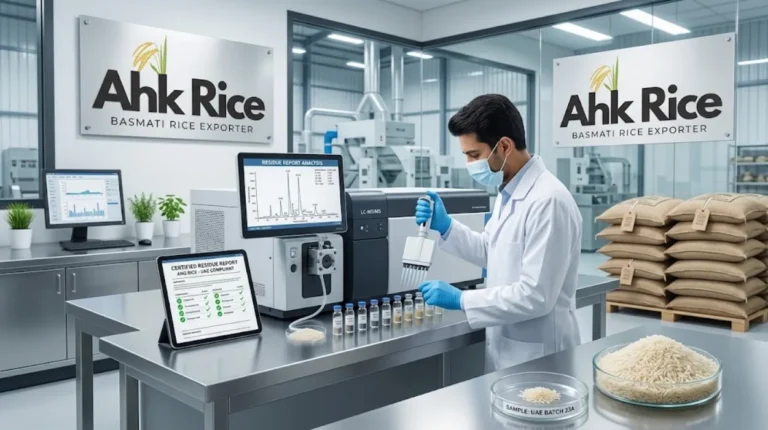
A factory audit is a documented assessment of a rice-processing facility covering food safety, sanitation, equipment, process controls, traceability, testing, storage, personnel practices, and records. It gives an importer evidence about how consistently the supplier controls rice from raw material intake through finished-product dispatch.
For Basmati rice, the audited facility normally handles several stages between paddy procurement and export. These stages include receiving, cleaning, drying or conditioning where applicable, dehusking, milling, polishing, grading, sorting, weighing, packaging, warehousing, and container loading.
The audit therefore examines the system behind the rice, not only the rice itself.
A California importer can use the audit to establish whether a supplier has defined controls for:
- Raw paddy receiving
- Variety identification
- Moisture measurement
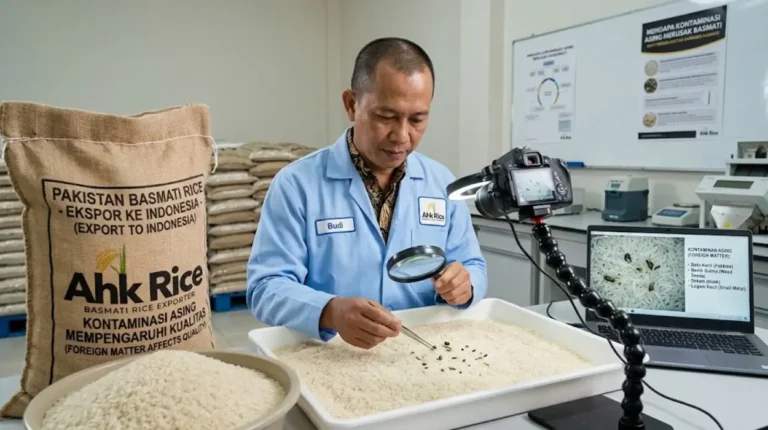
- Foreign-material removal
- Milling
- Optical sorting
- Broken-grain separation
- Metal detection
- Laboratory testing
- Packaging
- Lot identification
- Warehouse management
- Pest control
- Sanitation
- Traceability
- Corrective actions
The audit also establishes whether records exist to prove that these activities occur.
This matters because Basmati is a specification-sensitive product. Importers frequently purchase varieties such as 1121 Basmati, Super Kernel, and 1509 Basmati according to defined grain length, broken percentage, moisture, purity, milling quality, appearance, and packaging requirements.
A supplier audit helps determine whether those specifications are supported by a repeatable production system.
How does a factory audit work?
A factory audit normally begins with supplier documentation, continues through an onsite inspection and employee or management review, examines production and quality records, identifies nonconformities, and ends with corrective actions and verification. The process converts supplier information into evidence that an importer can evaluate.
The first step is supplier prequalification. The importer identifies the legal supplier, manufacturing location, products supplied, certifications, production capacity, export history, and relevant food-safety records.
The second step is document review. The auditor examines documents such as food-safety plans, sanitation procedures, pest-control records, laboratory reports, product specifications, traceability procedures, calibration records, training records, and corrective-action reports.
The third step is the factory walkthrough. The auditor follows the actual movement of rice through the facility.
A typical sequence is:
Raw material → receiving → cleaning → milling → grading → optical sorting → metal detection → packing → finished-goods storage → container loading
The auditor observes whether physical conditions match documented procedures.
The fourth step is record verification. An auditor does not only ask whether a control exists. The auditor checks records showing that the control operated over time.
For example, a moisture-control procedure should have corresponding moisture records. A pest-control program should have inspection and treatment records. A traceability procedure should connect a finished lot with its raw material and production records.
The fifth step is nonconformity classification. A nonconformity is a condition that fails to meet an established requirement. Examples include missing sanitation records, damaged food-contact surfaces, ineffective pest controls, incomplete lot identification, or unverified calibration.
The final step is corrective action. The supplier identifies the cause, implements corrective measures, provides evidence, and closes the finding.
This creates a supplier-verification record that can support the importer’s broader FSVP activities.
What does a rice factory audit inspect?
A rice factory audit examines the physical facility, production process, food-safety controls, quality systems, personnel practices, laboratory controls, traceability, storage conditions, packaging operations, and documentation. Each component addresses a different source of supplier, product, or compliance risk.
Facility and sanitation controls
The auditor examines floors, walls, ceilings, drains, production areas, equipment surfaces, lighting, ventilation, waste handling, handwashing facilities, and cleaning practices.
The objective is to identify conditions that can introduce contamination or interfere with hygienic processing.
Pest control
Rice facilities require documented pest-control systems because stored grain attracts insects and other pests.
The audit checks monitoring points, inspection frequency, treatment records, corrective actions, and evidence of pest activity.
Processing controls
The auditor examines the machinery used for cleaning, dehusking, milling, grading, sorting, polishing, weighing, and packaging.
The inspection focuses on process sequence and control points.
For example, optical sorting should remove defined visual defects. Metal detection should operate according to documented procedures. Weighing equipment should be calibrated against an established standard.
Laboratory and testing controls
A rice supplier can use internal or external laboratories to measure product characteristics.
Typical tests include moisture, broken grains, foreign matter, grain dimensions, purity, milling quality, and microbiological or chemical parameters when required by the product specification or risk assessment.
The auditor examines sampling methods, test methods, equipment calibration, laboratory competence, records, and handling of failed results.
Traceability
Traceability means the ability to follow a product and its records through defined stages of the supply chain.
A strong traceability system links a finished rice lot to information such as raw-material intake, production date, processing line, packaging lot, laboratory results, and shipment documentation.
For example, if a container contains 500 bags from a defined production lot, the supplier should be able to identify the records associated with that lot.
Storage and dispatch
The audit also examines finished-goods warehouses.
Important controls include product identification, segregation, stacking, warehouse cleanliness, pest monitoring, stock rotation, packaging integrity, and container inspection before loading.
The container itself forms part of shipment control. The facility should verify cleanliness, dryness, structural condition, odor, and suitability before loading.
Which quality specifications should California importers examine?
California importers should connect factory-audit findings with measurable rice specifications, including variety, grain length, broken percentage, moisture, foreign matter, purity, milling quality, packaging weight, and lot identification. These specifications provide measurable criteria for evaluating whether production matches the purchase contract.
Basmati grades are usually commercial specifications rather than a single universal U.S. grade category.
For example, an importer purchasing 1121 Basmati can define:
- Variety: 1121 Basmati
- Grain length: contract-specific
- Broken grains: contract-specific percentage
- Moisture: contract-specific maximum
- Foreign matter: contract-specific maximum
- Purity: defined variety purity requirement
- Milling: specified milling condition
- Packaging: specified bag material and weight
- Lot identification: required for traceability
The factory audit then checks whether the facility has systems capable of controlling those specifications consistently.
The United States also maintains official rice standards through the USDA Agricultural Marketing Service (AMS). AMS provides standards for rice, including milled rice, and official inspection can evaluate quality factors against established U.S. standards.
This distinction is important: a Basmati supplier’s commercial specification and a USDA rice grade are not automatically the same thing.
What certifications and documents apply to audited rice factories?
Factory audits, certifications, registrations, and shipment documents serve different purposes. FDA facility registration establishes regulatory registration, FSVP establishes importer verification responsibilities, private food-safety certifications demonstrate system controls, and phytosanitary documents address applicable plant-health requirements.
An importer should distinguish between these categories.
FDA food facility registration applies to facilities that manufacture, process, pack, or hold food for U.S. consumption when registration is required. Most registered facilities must renew every two years. Registration is a regulatory requirement, not a product-quality certification.
FSVP is the U.S. importer’s supplier-verification framework. It requires covered importers to establish and follow an FSVP for each applicable food and foreign supplier.
HACCP means Hazard Analysis and Critical Control Points. It is a preventive food-safety methodology that identifies hazards and establishes controls at relevant process stages.
ISO 22000 is an international food-safety management-system standard. FSSC 22000 and BRCGS are other widely used private food-safety certification schemes.
These private certifications provide useful evidence, but they do not eliminate the importer’s responsibility to evaluate the foreign supplier under applicable U.S. requirements.
For exports from Pakistan, phytosanitary certification is a separate plant-health requirement. Pakistan’s Department of Plant Protection states that export procedures involve inspection, sampling or treatment where required, and issuance of a phytosanitary certificate according to the importing country’s requirements.
The U.S. Department of Agriculture’s Animal and Plant Health Inspection Service also identifies rice among processed plant products that can be subject to U.S. import restrictions based on origin and commodity conditions.
What are the benefits of factory audits?
Factory audits reduce supplier uncertainty by showing whether documented procedures operate in the physical facility. They help importers evaluate food-safety controls, specification consistency, traceability, sanitation, corrective-action capability, production discipline, and documentation before relying on repeat commercial shipments.
The first benefit is supplier qualification.
An importer can compare suppliers using the same audit criteria rather than relying only on quotations or certificates.
The second benefit is food-safety verification.
The audit identifies conditions that documents alone cannot demonstrate, such as poor sanitation practices, inadequate pest controls, damaged equipment, or incomplete employee procedures.
The third benefit is quality consistency.
A supplier with defined sampling, grading, sorting, calibration, and release procedures has a measurable system for controlling specifications.
The fourth benefit is traceability.
An importer can verify whether the supplier can identify affected lots when a quality or safety issue occurs.
The fifth benefit is corrective-action evaluation.
A factory’s response to an audit finding provides information about management discipline. A strong system records the problem, identifies its cause, implements corrective action, and verifies effectiveness.
The sixth benefit is FSVP support.
FDA specifically identifies onsite audits, sampling and testing, and review of food-safety records as possible supplier-verification activities. The appropriate activity depends on the documented risk assessment.
For importers developing their supplier-verification process, the next stage is understanding:
How factory audits reduce risk across the actual Basmati rice import process, from supplier approval through shipment receipt.
Where are factory audits most useful?
Factory audits are most useful before approving a new supplier, before placing high-value orders, after major production changes, following repeated quality failures, and when an importer needs stronger evidence for supplier verification. They are especially useful when product specifications require consistent processing controls.
New supplier qualification
A new supplier has limited performance history with the importer.
An audit provides direct evidence before the importer commits to recurring purchases.
Private-label rice
Private-label programs require consistent packaging, specifications, lot identification, and production controls.
The audit verifies whether the facility can reproduce the required specification across multiple production cycles.
High-volume distribution
Large distributors face higher exposure when one supplier problem affects several customers.
Factory verification provides another layer of supplier evaluation before volume increases.
Food-service supply
Restaurants and food-service distributors require predictable cooking performance and specification consistency.
An audit helps verify the controls behind those characteristics.
Corrective-action follow-up
An audit also works after a problem.
If an importer receives rice with excessive broken grains or inconsistent moisture, the next audit can verify whether the supplier corrected the underlying process.
What common misconceptions do California rice importers have about factory audits?
The most common misconception is that an audit certificate automatically proves U.S. compliance. It does not. An audit is evidence within supplier verification. FDA registration, FSVP records, product requirements, import documentation, phytosanitary requirements, and other applicable controls remain separate responsibilities.
Another misconception is that a certificate replaces an audit.
A certificate demonstrates that an organization or facility meets the scope of a particular certification program at the applicable assessment point. An audit designed around the importer’s specifications examines additional details.
Another misconception is that a clean factory guarantees every shipment is compliant.
Factory conditions and shipment conditions are different control points. Rice can be processed correctly but experience problems through incorrect packaging, documentation, container conditions, handling, or transportation.
Another misconception is that testing one shipment proves supplier consistency.
A laboratory result describes the tested sample. Factory audits examine the system producing repeated lots.
Another misconception is that FSVP is the same as a factory audit.
FSVP is the regulatory framework under which covered U.S. importers verify foreign suppliers. An onsite audit is one possible verification activity within that framework when appropriate. FDA states that verification activities must be based on the risk evaluation and supplier performance.
The final misconception is that California location changes the fundamental federal food-import framework.
A California importer still operates within U.S. federal requirements governing imported food. State-level business, food, labeling, or distribution requirements can apply separately, but the federal FDA import framework remains central to the imported food transaction.
What should a California rice importer record after an audit?
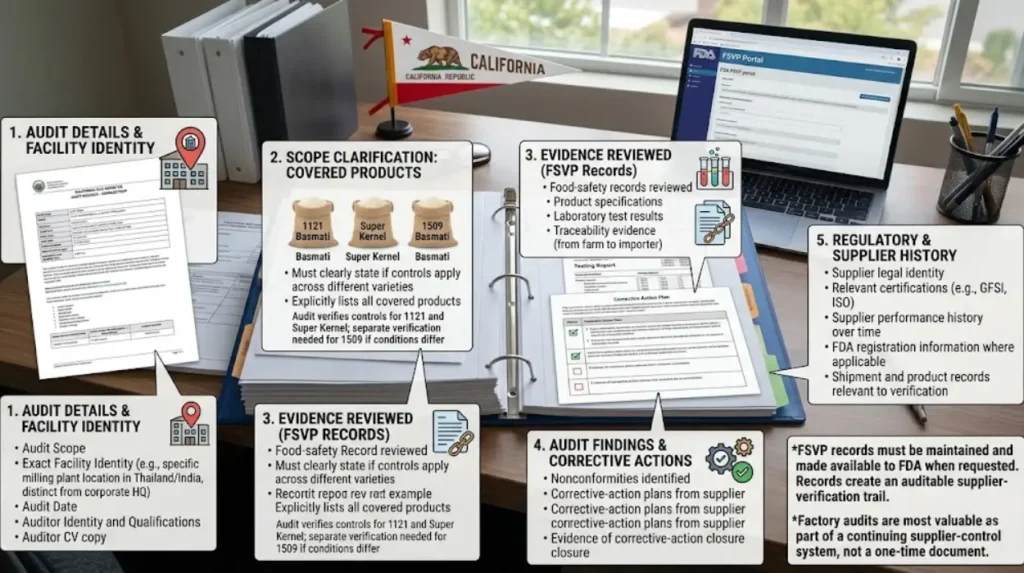
An importer should retain the audit scope, facility identity, audit date, auditor qualifications, findings, evidence reviewed, corrective actions, closure evidence, supplier performance history, and related testing or food-safety records. These records create an auditable supplier-verification trail for future decisions.
The record should identify the exact facility, not only the supplier’s corporate name.
It should also identify the products covered by the assessment.
For example, an audit covering a facility that processes 1121 Basmati should clearly state whether the same controls apply to Super Kernel and 1509 Basmati.
The importer should retain:
- Audit report
- Supplier legal identity
- Facility location
- Audit scope
- Audit date
- Auditor identity and qualification
- Food-safety records reviewed
- Product specifications
- Laboratory evidence
- Traceability evidence
- Nonconformities
- Corrective-action plans
- Corrective-action closure evidence
- Relevant certifications
- FDA registration information where applicable
- Shipment and product records relevant to verification
FSVP records must be maintained and made available to FDA when requested. FDA provides an FSVP portal for electronic submission of records following an agency request.
A factory audit therefore becomes most valuable when it is treated as part of a continuing supplier-control system rather than as a one-time document.
Frequently Asked Questions
Why are factory audits important for California rice importers?
Factory audits help California rice importers verify supplier food-safety controls, sanitation, processing systems, traceability, quality procedures, documentation, and corrective-action practices before relying on commercial shipments.
What does a Basmati rice factory audit check?
A Basmati rice factory audit checks raw-material handling, cleaning, milling, grading, optical sorting, metal detection, laboratory testing, packaging, storage, pest control, sanitation, traceability, and production records.
Do factory audits prove that imported rice is FDA compliant?
No. A factory audit is one supplier-verification activity. FDA registration, FSVP requirements, applicable food-safety controls, import documentation, and other U.S. requirements remain separate compliance responsibilities.
What is FSVP for California rice importers?
FSVP is the Foreign Supplier Verification Program. Covered U.S. importers use risk-based procedures to verify that foreign suppliers produce food according to applicable U.S. food-safety requirements and that imported food is not adulterated.
How does a factory audit reduce rice import risk?
A factory audit reduces risk by identifying weaknesses in sanitation, processing, quality control, traceability, documentation, storage, and corrective-action systems before those weaknesses affect repeated commercial shipments.
What Basmati rice specifications should an importer verify?
Importers should verify variety, grain length, broken percentage, moisture, foreign matter, purity, milling quality, packaging weight, lot identification, and other specifications established in the purchase agreement.
Are certifications enough instead of a factory audit?
No. Certifications provide evidence within a defined certification scope, while a factory audit can examine supplier-specific processes, product specifications, records, equipment, and controls required by the importer.
How often should a rice factory be audited?
Audit frequency should follow the importer’s documented supplier-risk assessment, supplier performance, product risk, previous audit findings, corrective actions, and changes to the supplier’s production or food-safety system.
What certifications can a Pakistani rice factory have?
Relevant certifications can include HACCP-based food-safety systems, ISO 22000, FSSC 22000, BRCGS, and other recognized schemes, depending on the facility and buyer requirements. Certification scope and validity should always be verified.
Is a phytosanitary certificate the same as a factory audit?
No. A phytosanitary certificate addresses applicable plant-health requirements for an export shipment. A factory audit evaluates the supplier’s facility, processing controls, food-safety systems, quality procedures, and records.
What records should California rice importers keep after an audit?
Importers should retain the audit report, facility information, audit scope, findings, corrective actions, closure evidence, relevant certifications, product specifications, testing records, and other supplier-verification documentation applicable to the import.
Can a factory audit guarantee consistent Basmati rice quality?
No single audit guarantees every shipment. An audit evaluates the supplier’s control system, while shipment-specific sampling, testing, specifications, documentation, and receiving controls provide additional evidence of product conformity.