Why Are New Hampshire Restaurants Switching to Premium Basmati Rice?
Premium Basmati rice is gaining attention in restaurant kitchens because it delivers a distinct combination of aroma, long slender grains, separate cooked grains, and predictable cooking performance. For New Hampshire restaurants, these characteristics support biryani, pilaf, rice bowls, curries, grilled meats, and South Asian menus where rice is part of the main dining experience.
The shift is not simply about buying a more expensive rice. It involves choosing a defined variety, grain specification, milling grade, processing method, moisture level, packaging format, and food-safety documentation. In 2026, U.S. rice imports are projected at a record 49.8 million hundredweight for the 2026/27 marketing year, showing the continued importance of imported rice in the American market.
What is premium Basmati rice and why does it matter to New Hampshire restaurants?
Premium Basmati rice is an aromatic long-grain rice selected for grain length, slender shape, fragrance, elongation, separation, appearance, and cooking consistency. These properties give restaurants a recognizable rice texture and presentation across repeated service cycles.
Basmati is a category of aromatic rice associated with India and Pakistan. Its defining characteristics include a slender grain, distinctive aroma, high cooking elongation, and limited width expansion. Research on Basmati identifies aroma, amylose level, gelatinization behavior, grain elongation, milling recovery, head-rice recovery, and color as important quality characteristics.
The word “premium” describes a quality position rather than one single legal grade. A restaurant can specify premium rice through measurable attributes such as grain length, broken-grain percentage, moisture, foreign matter, damaged kernels, chalkiness, aroma, cooking yield, and packaging integrity.
For example, a restaurant preparing 100 portions of biryani needs rice that expands consistently and remains visually separate. A rice with excessive broken kernels changes the finished appearance and increases the risk of a softer, less uniform texture.
New Hampshire restaurants also operate within the wider U.S. food-import system. Imported food must meet U.S. requirements for safety, sanitation, and truthful labeling. FDA requires applicable foreign facilities to register and requires Prior Notice for imported food shipments.
Where is Basmati rice grown and why is Pakistan important?
Basmati rice is primarily associated with the Punjab region of South Asia, with Pakistan producing established aromatic varieties for international markets. Pakistani Basmati production supports export programs that include traditional and modern varieties, such as Super Basmati and 1121.
Pakistan’s Basmati-producing areas are concentrated mainly in Punjab, where soil, irrigation, climate, and traditional cultivation practices support aromatic rice production. Pakistan also produces several recognized rice types beyond Basmati, including PK 385, PK 386, 1121 Basmati, Basmati D-98, and Super Basmati.
Punjab is important because rice quality begins before milling. Variety selection, seed quality, field management, harvest timing, drying, and storage influence the physical and cooking properties of the final grain.
Pakistan also has a legal geographical-indication framework. Its Geographical Indications (Registration and Protection) Act, 2020 defines a geographical indication around qualities, reputation, or characteristics essentially attributable to geographical origin.
For restaurant buyers, origin therefore connects directly with product identification. A specification should state the country of origin, variety, processing type, grade, crop information where relevant, and packaging details instead of using “Basmati” as the only quality description.
Pakistan’s export scale also demonstrates that Basmati is an established international trade product. REAP records 808,643 metric tons of Basmati exports in Pakistan’s 2024–25 export year, with reported Basmati export value of approximately US$830.6 million.
How is premium Basmati rice processed from paddy to restaurant-ready grain?
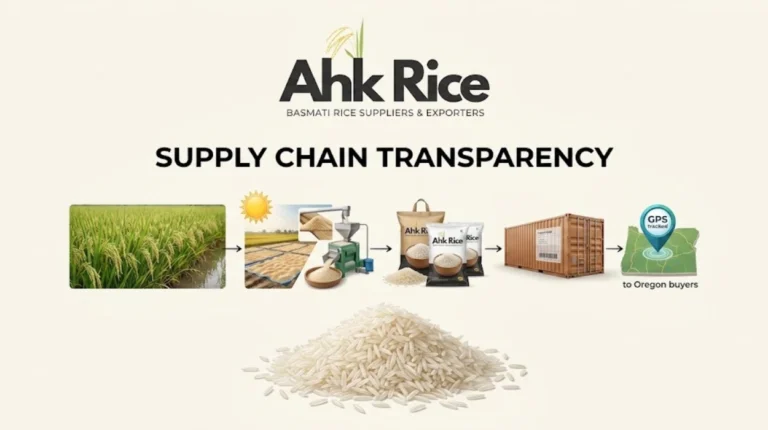
Premium Basmati processing starts with paddy selection and continues through cleaning, drying, milling, sorting, grading, optional steaming or parboiling, quality inspection, packaging, and export preparation. Each stage controls a different physical or food-safety characteristic.
The process begins with paddy, which is the harvested rice grain still enclosed in its husk. Suitable paddy is selected according to variety, maturity, moisture, purity, and physical condition.
The first processing stage is cleaning. Screens, aspirators, magnets, and other separation equipment remove materials such as stones, dust, straw, metal fragments, and unwanted seeds.
The cleaned paddy is dried to a controlled moisture level. Proper drying reduces storage deterioration and prepares the grain for milling. Excessive drying or poor moisture management increases fissuring and breakage.
The next stage is milling. Dehusking removes the outer husk and produces brown rice. Further milling removes the bran layers and produces white milled rice.
Rice is then separated by size and density. Length graders separate whole kernels from broken kernels and other fractions. Color sorters identify grains with visible discoloration and defects.
Processing can also include aging. Aging allows rice characteristics to stabilize and can improve cooking behavior and grain separation. The exact process depends on variety, product specification, and commercial requirements.
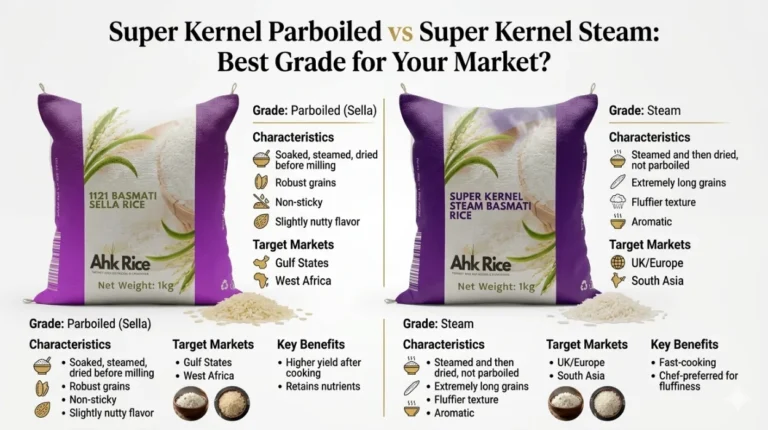
Steam and parboiled products follow a different thermal process. Water and heat alter the grain structure before drying and milling. Pakistani export markets commonly distinguish white, steam, and Sella or parboiled products.
Quality inspection follows processing. Laboratories and quality-control teams evaluate attributes such as moisture, broken percentage, grain length, foreign matter, damaged kernels, milling quality, and cooking performance.
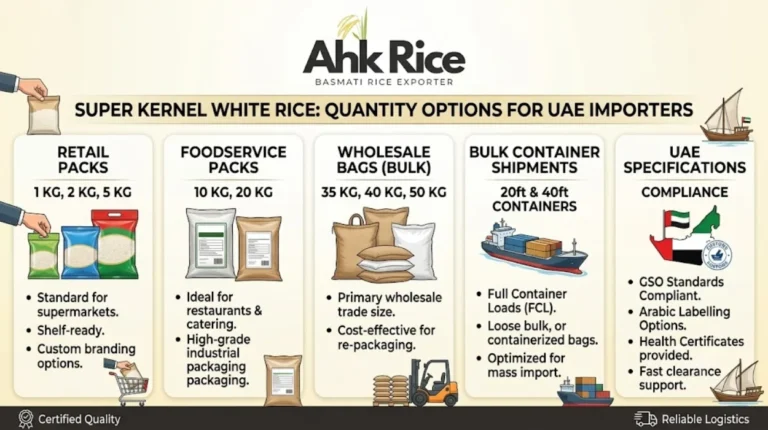
The final stage is packing. Restaurant rice can be supplied in formats such as 5 kg, 10 kg, 20 kg, 25 kg, or larger foodservice bags, depending on the distribution model.
Which premium Basmati varieties and grades are relevant to restaurant kitchens?
Restaurant buyers commonly compare Basmati by variety and processing type rather than using one universal premium grade. Pakistani commercial options include 1121 Basmati, Super Basmati, and 1509, with white, steam, and parboiled forms serving different cooking requirements.
1121 Basmati is recognized for its very long, slender grain and strong visual elongation after cooking. It is frequently selected for biryani, pulao, banquet rice, and dishes where long individual grains create a premium presentation.
Super Basmati is a traditional Pakistani Basmati type. It is valued for aroma, cooking quality, and traditional Basmati characteristics.
1509 is an aromatic long-grain variety used in export markets where buyers prioritize long grain, cooking performance, and a defined price-to-quality position.
White Basmati is milled without the steaming or parboiling treatment used for processed variants. It suits kitchens that want a conventional Basmati cooking profile.
Steam Basmati receives a controlled steaming process before final milling. This changes the grain structure and produces a firm cooked texture that suits high-volume foodservice applications.
Sella, also called parboiled rice in many commercial contexts, undergoes parboiling before milling. The treatment improves grain firmness and reduces the likelihood of excessive breakage during cooking.
Grades also differ according to whole-kernel percentage. A product with a higher head-rice recovery contains more intact kernels. A restaurant serving plated biryani often places greater importance on intact grain appearance than a kitchen using rice primarily as a side ingredient.
A specification should therefore identify the variety and processing type together. “Premium Basmati” alone does not tell a chef whether the product is 1121 Steam, Super Basmati White, or 1509 Steam.
What makes premium Basmati useful in New Hampshire restaurant applications?
Premium Basmati fits restaurant applications where aroma, grain separation, visual length, and repeatable cooking matter. Its strongest uses include biryani, pulao, pilaf, curry meals, grilled dishes, rice bowls, buffets, catering, and banquet service.
Biryani is one of the clearest applications because rice forms a major part of the finished dish. Long, separate grains help preserve the layered appearance of meat, vegetables, spices, and rice.
Pulao benefits from the same grain separation. Each kernel needs to remain identifiable rather than forming a sticky mass.
Pilaf provides another use case. The rice absorbs broth, stock, herbs, spices, and aromatics while maintaining a defined grain structure.
Curry restaurants use Basmati as a neutral aromatic base. The rice complements sauces without becoming visually dominant.
Grilled-meat restaurants can pair Basmati with kebabs, chicken, lamb, or vegetables. Catering operations also benefit because large batches require predictable hydration, expansion, and holding behavior.
Buffet service places additional pressure on rice quality. Rice must remain acceptable during holding without becoming excessively wet or compacted.
These use cases explain why restaurant operators evaluate cooking performance rather than grain length alone. A long raw kernel does not automatically guarantee good cooked performance.
Which quality components determine whether a restaurant receives consistent Basmati?
Restaurant-grade rice quality depends on measurable grain, chemical, cooking, sanitation, packaging, and documentation attributes. The most important components include variety identity, grain length, broken kernels, moisture, purity, aroma, elongation, texture, food safety, and batch consistency.
Variety identity confirms that the rice supplied matches the agreed product. This matters because 1121, Super Basmati, and 1509 have different physical and cooking characteristics.
Grain length establishes the visual specification. Long-grain products require consistent kernel dimensions rather than occasional extra-long grains mixed with shorter kernels.
Broken-kernel percentage affects appearance and cooking behavior. A higher broken percentage changes the visual presentation and can alter water absorption during cooking.
Moisture affects storage stability and processing quality. The specification should include a defined acceptable range rather than treating moisture as an informal inspection point.
Purity covers foreign material and unwanted grains. Examples include stones, husk, weed seeds, and other extraneous matter.
Aroma is another defining Basmati characteristic. Scientific literature identifies aroma as a key quality trait and links Basmati fragrance to its characteristic aromatic compounds.
Cooking performance connects laboratory measurements with restaurant results. Amylose, gelatinization temperature, gel consistency, water uptake, volume expansion, and elongation influence whether cooked rice remains firm, separate, and acceptable during service.
Packaging and documentation complete the specification. The product needs correct labeling, traceability information, lot identification, and records that support the U.S. import process.
What certifications and compliance documents apply to imported Basmati rice?
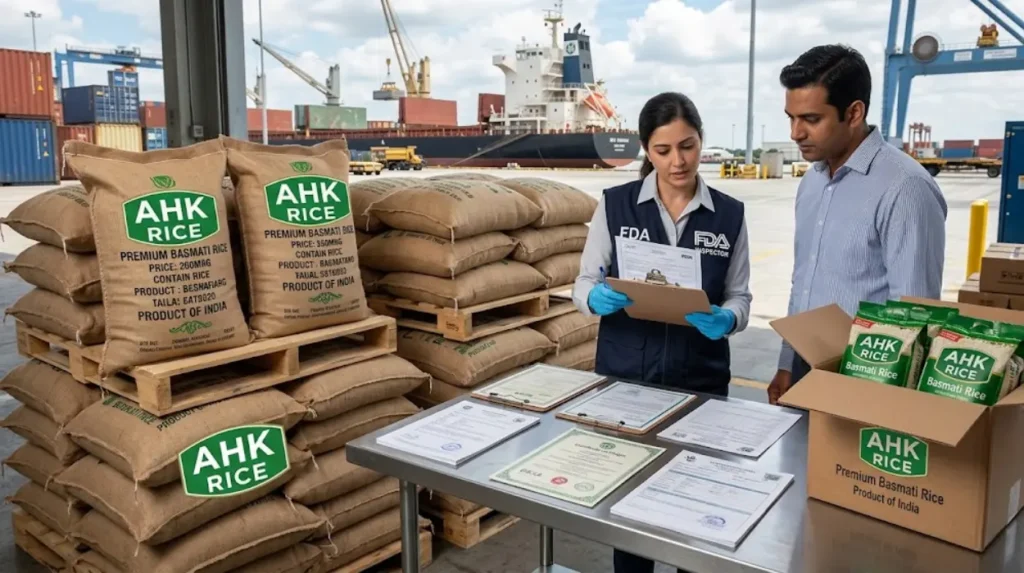
Basmati rice entering the United States must satisfy applicable FDA import requirements, while voluntary food-safety certifications provide additional evidence of controlled manufacturing. Common certifications include HACCP-based systems, ISO 22000, FSSC 22000, BRCGS, and Halal certification.
HACCP means Hazard Analysis and Critical Control Points. It is a preventive food-safety system that identifies hazards and controls them at defined stages.
ISO 22000 is an international food-safety management-system standard. FSSC 22000 builds on ISO-based management requirements with additional food-safety-system requirements.
BRCGS Food Safety is a recognized third-party food-safety certification scheme used across global food supply chains. Its current Food Safety standard is Issue 9 and is used by more than 22,000 sites across more than 130 countries.
Halal certification verifies conformity with applicable Islamic dietary requirements. It is relevant when a restaurant or distributor requires documented Halal status.
These certifications are not interchangeable with U.S. import compliance. FDA states that imported foods must meet U.S. legal requirements, and the FSVP rule places risk-based supplier-verification responsibilities on covered U.S. importers.
Import documentation can include commercial invoices, packing lists, bills of lading, certificates of origin, applicable certificates or laboratory reports, facility information, and Prior Notice information. The exact documentation depends on the shipment and regulatory requirements.
Restaurants purchasing through a U.S. distributor do not normally perform the full import process themselves. The importer and supply-chain partners handle the applicable regulatory obligations. The restaurant’s responsibility is to establish purchasing specifications and verify that the supplied product matches its operational requirements.
What misconceptions cause restaurants to choose the wrong Basmati?
The most common misconception is that longer raw grain automatically means better restaurant rice. Quality depends on variety identity, milling recovery, broken kernels, moisture, aroma, cooking behavior, processing method, safety controls, and batch consistency working together.
The first misconception is that all Basmati is identical. It is not. Variety and processing method produce different cooking outcomes.
The second misconception is that the highest grain length always provides the best value. A restaurant serving curry with rice on the side has different requirements from a biryani specialist serving rice as the visual centerpiece.
The third misconception is that white, steam, and Sella Basmati are interchangeable. They have different processing histories and cooking characteristics.
The fourth misconception is that a food-safety certificate alone proves rice quality. Certification addresses defined management or safety requirements. It does not replace a product specification covering grain length, broken percentage, moisture, aroma, purity, and cooking performance.
The fifth misconception is that a low purchase price represents the lowest operating cost. A restaurant also absorbs waste, rejected batches, inconsistent portions, cooking losses, and menu-quality problems.
The sixth misconception is that a sample approval is enough. A sample establishes an initial benchmark. Consistent commercial production requires lot controls, testing, traceability, and supplier verification.
The practical approach is to define the product before changing suppliers. The specification should identify variety, processing type, grain characteristics, tolerances, packaging, certifications, documentation, and cooking expectations. This creates an objective basis for comparing suppliers instead of relying on brand descriptions alone.
For restaurants moving from general rice purchasing toward a defined premium specification, the next stage is understanding how buyers test and compare samples before approving a new source. The planned consideration-stage article,
How restaurants evaluate rice quality before changing suppliers, fits naturally after this section because it moves from understanding Basmati characteristics to evaluating supplier samples and quality evidence.
Frequently Asked Questions
Why are New Hampshire restaurants switching to premium Basmati rice?
New Hampshire restaurants are choosing premium Basmati rice for its long slender grains, distinctive aroma, separate cooked texture, attractive presentation, and consistent performance in dishes such as biryani, pulao, pilaf, and curries.
What is premium Basmati rice?
Premium Basmati rice is an aromatic long-grain rice selected for characteristics such as grain length, slender shape, aroma, elongation, low broken-kernel percentage, purity, moisture control, and cooking performance.
Where is Pakistani Basmati rice grown?
Pakistani Basmati rice is primarily grown in Punjab, where climate, irrigation, soil conditions, and established cultivation practices support aromatic rice production. Punjab is the main production region for Pakistan’s traditional Basmati varieties.
Which Basmati varieties are suitable for restaurants?
Common Pakistani varieties include 1121 Basmati, Super Basmati, and 1509. Restaurants select between them according to grain length, aroma, cooking behavior, processing type, menu requirements, and purchasing specifications.
What is the difference between white, steam, and Sella Basmati rice?
White Basmati is conventionally milled rice, while Steam Basmati undergoes controlled steaming before milling. Sella is parboiled before milling. These processes produce different textures, firmness, cooking behavior, and applications.
Why is 1121 Basmati popular in restaurants?
1121 Basmati has a very long, slender grain and strong visual elongation after cooking. These characteristics make it suitable for biryani, pulao, banquet meals, catering, and dishes where individual grain presentation is important.
What quality factors should restaurants check before buying Basmati rice?
Restaurants should evaluate variety, grain length, broken percentage, moisture, purity, foreign matter, aroma, chalkiness, damaged kernels, cooking yield, elongation, texture, packaging, traceability, and batch consistency.
Does longer Basmati grain always mean better quality?
No. Grain length is only one quality attribute. Restaurant performance also depends on variety identity, milling quality, broken kernels, moisture, aroma, water absorption, elongation, texture, and consistency between batches.