Import Pakistani Basmati Rice from an Experienced Exporter to Florida, USA
Importing Pakistani Basmati rice into Florida is best handled through an experienced exporter that can control rice specifications, documentation, container preparation, shipment timing, and U.S. import requirements rather than competing only on FOB price. For Florida distributors, restaurants, wholesalers, and ethnic retailers, supplier reliability directly affects landed cost and inventory continuity.
Before selecting a supplier, buyers should understand:
Why export history matters when selecting rice suppliers. A long international track record is useful because it shows whether an exporter can repeatedly manage production, quality inspection, export documentation, container loading, and overseas shipment without treating each order as an isolated transaction.
In 2026, this matters even more because ocean freight remains sensitive to fuel, insurance, routing, and canal conditions. U.S. import volumes and freight costs have also been affected by changing tariff and shipping conditions.
For Florida buyers, the objective should therefore be simple: specify the rice precisely, validate the supplier with a sample, confirm U.S. compliance responsibilities, lock the commercial terms, and schedule the container around realistic production and ocean-transit windows.
What is the best solution for Florida buyers importing Pakistani Basmati rice?
The best solution is a documented supply program combining verified rice specifications, pre-shipment quality control, U.S.-ready export documents, realistic production capacity, and planned ocean logistics, giving Florida buyers predictable quality, manageable landed costs, and fewer shipment-related surprises.
An experienced exporter should begin with the buyer’s actual specification instead of immediately quoting a generic “Basmati rice” price. The specification should identify variety, processing type, grain length, broken percentage, moisture, purity, packing format, crop, quantity, destination port, and inspection requirements.
AHK Rice supplies Pakistani Basmati varieties including 1121, Super Kernel, and 1509. The company operates from Punjab’s rice-producing region and supports processing, custom packaging, export documentation, and shipment preparation for international buyers.
For a Florida buyer, 1121 Steam Basmati can be appropriate when the commercial requirement emphasizes extra-long grains and strong cooking performance. A representative specification can target approximately 8.3 mm+ grain length, moisture below 12.5%, and broken grains below 1%, subject to the final purchase specification and pre-shipment inspection.
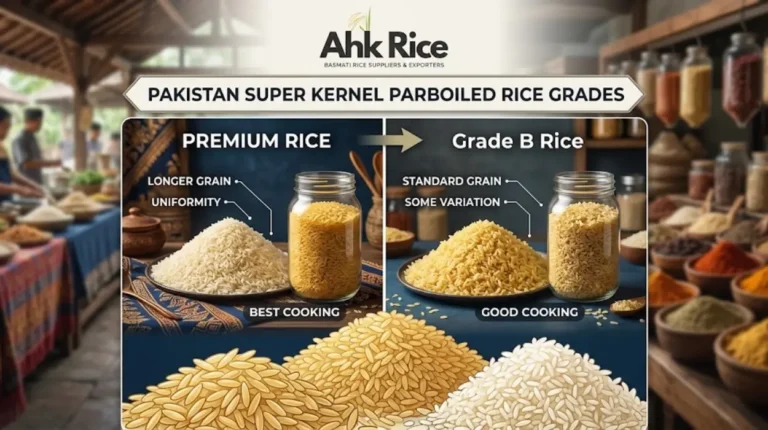
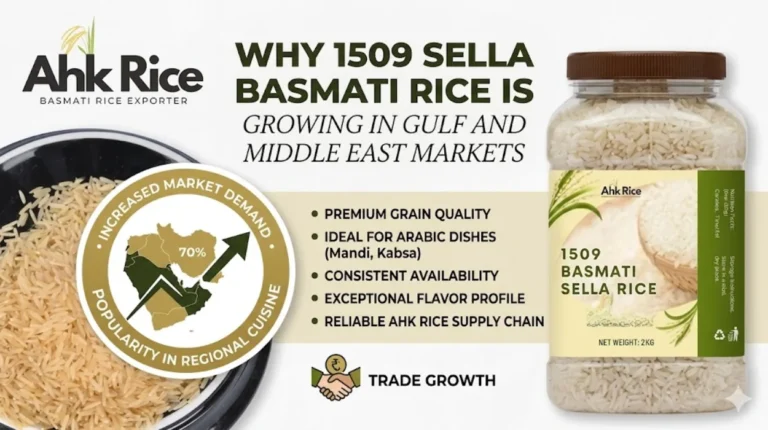
Super Kernel can be considered where the buyer wants a premium Basmati profile with a different grain specification, while 1509 can provide another long-grain option for buyers balancing product positioning and procurement cost. The correct selection depends on the retail, food-service, or wholesale application.
The key point is that the supplier should quote against a defined specification. That prevents a low initial FOB price from hiding differences in grain length, broken percentage, moisture, packaging, or processing.
Why should Florida buyers choose AHK Rice for Pakistani Basmati supply?
Florida buyers should choose AHK Rice when they require an experienced Pakistani supplier capable of coordinating sourcing, milling, grading, packaging, inspection, documentation, and export logistics as one controlled process rather than managing disconnected suppliers.
AHK Rice is positioned as a Pakistani Basmati exporter serving international markets, including the United States. Its product range covers 1121, Super Kernel, and 1509, allowing an importer to compare multiple specifications within one sourcing relationship.
For buyers evaluating the first commercial shipment, the USA rice export service provides the appropriate starting point for discussing product selection, packaging, documentation, and shipment requirements.
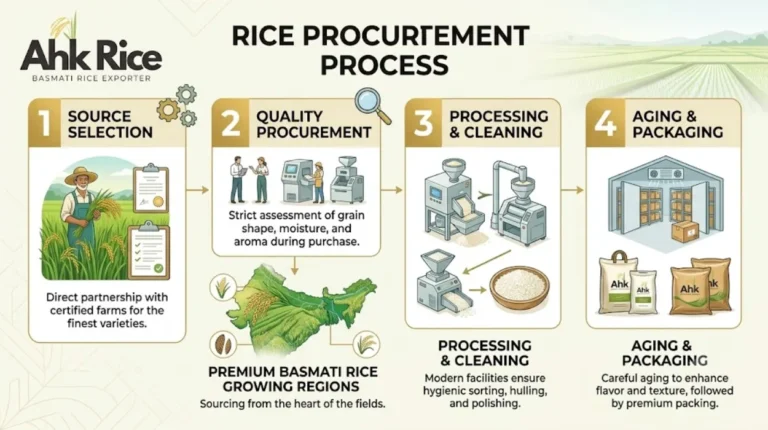
The value of an experienced exporter is not simply the number of years in business. It is the ability to repeat the same operational sequence. Paddy must be sourced and processed. Rice must be milled and graded. The finished product must be inspected against the agreed specification. Packaging must match the buyer’s requirement. Documents must correspond with the shipment. Containers must be loaded correctly. The cargo must then move through the export and ocean-freight process.
AHK Rice can also support private-label and custom-packaging requirements where the buyer wants its own retail or wholesale presentation. This can be important for Florida distributors supplying supermarkets, restaurants, food-service operators, and specialty stores.
A buyer should also compare the supplier using the same framework described in:
How Can Buyers Assess a Rice Exporter’s International Track Record? The comparison should cover export markets, shipment consistency, quality controls, documentation, production capability, and communication rather than relying on a website claim alone.
What should Florida buyers verify before placing a commercial order?
Before placing an order, buyers should verify the exact product specification, representative sample, commercial quotation, packaging, inspection proced=ure, export documents, payment terms, production schedule, loading plan, destination port, and U.S. compliance responsibilities in writing.
The sample process should be treated as a small version of the commercial transaction.
First, the buyer sends the required specification to AHK Rice. This should include the variety, processing type, grain length, broken percentage, moisture target, purity requirement, packing weight, number of bags, private-label requirements, and intended Florida destination.
Second, the exporter confirms availability and provides a commercial indication. A buyer should request the price basis clearly. FOB Karachi, CFR, and CIF are not interchangeable because freight, insurance, and destination charges can change the landed cost.
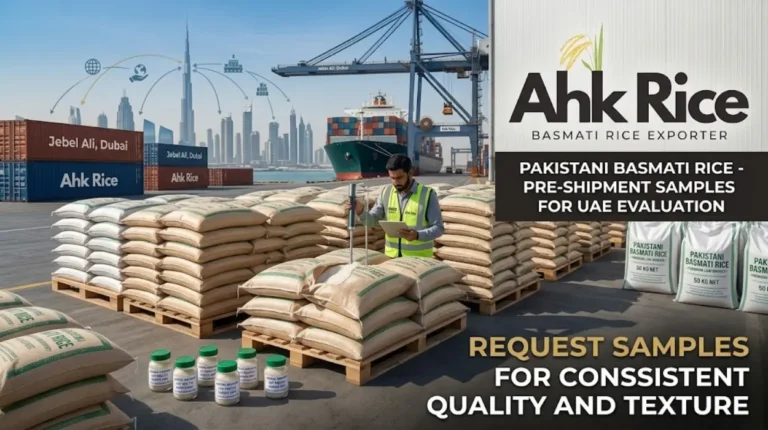
Third, the exporter prepares the rice sample. For a serious bulk requirement, the sample should represent the proposed commercial grade rather than being selected only for visual appearance. The buyer should evaluate grain length, aroma, color, cooking expansion, texture, broken percentage, and overall purity.
Fourth, the buyer approves the sample or requests a revision. If the sample is rejected, the specification should be corrected before production rather than allowing the factory to guess what the buyer wants.
Fifth, once the specification is approved, the parties confirm the commercial contract, quantity, packaging, payment terms, inspection arrangements, shipment window, and destination.
Sixth, the exporter processes and packs the commercial quantity. A pre-shipment inspection can then verify agreed quality characteristics before container loading.
A practical sample budget should be separated from the rice purchase price. Depending on the destination, courier, sample quantity, packaging, and testing requirements, an international sample exercise can reasonably involve approximately US$50–150 for courier and handling, while independent laboratory testing can add roughly US$100–300 or more depending on the requested tests. These are planning ranges, not fixed AHK Rice charges.
The commercial buyer should request an actual sample quotation before assuming any sample cost.
How many shipping days should Florida buyers expect from Pakistan?
Florida buyers should plan the complete procurement cycle around production, documentation, port handling, vessel schedules, and ocean transit rather than quoting one fixed delivery number; a practical planning window is several weeks for production plus roughly 30–45 days for ocean movement.
Shipping time to Florida depends on the selected destination port and vessel routing. Common U.S. East Coast and Gulf options can involve different transshipment patterns, so the exporter should confirm the sailing schedule at the time of booking.
For planning purposes, Florida buyers should distinguish four periods:
| Stage | Typical planning window |
|---|---|
| Sample approval | 3–10 days |
| Commercial production and packing | 7–15 days |
| Export documentation and container loading | 3–7 days |
| Ocean transit and destination handling | 30–45+ days |
These periods can overlap. They should therefore not automatically be added together as a guaranteed delivery time.
Current shipping conditions require additional flexibility. Global maritime routes remain exposed to congestion, fuel costs, security disruptions, and canal restrictions. In August 2026, congestion and higher costs around the Panama Canal have demonstrated how quickly routing conditions can change.
For a Florida importer, the purchase order should therefore include a target shipment date rather than relying only on an estimated arrival date. The buyer should also maintain enough safety stock to absorb vessel delays.
If the cargo is required for a restaurant chain or retail promotion, ordering immediately before the expected stock-out creates unnecessary risk. Experienced importers normally schedule the next shipment while the existing container still has sufficient inventory remaining.
What U.S. import documentation and compliance should be checked?
Florida importers must treat rice as a regulated food shipment and coordinate FDA, customs, labeling, supplier, and shipment documentation before arrival; the exporter provides required origin documents, while the U.S. importer remains responsible for applicable U.S. import obligations.
The U.S. Food and Drug Administration states that imported food must meet U.S. safety, sanitary, and labeling requirements. Imported food is subject to FDA inspection at ports of entry, and non-compliant shipments can be detained.
For a Florida rice importer, the documentation package should be reviewed before loading. Depending on the transaction and applicable requirements, this can include the commercial invoice, packing list, bill of lading, certificate of origin, phytosanitary certificate, fumigation documentation, health or inspection certificates, and other documents requested by the importer or authorities.
The U.S. buyer should also establish its responsibilities for FDA-related requirements and the Foreign Supplier Verification Program where applicable. The exporter should not be expected to replace the importer’s U.S. compliance function.
AHK Rice can coordinate the export-side documentation and shipment preparation so the buyer receives a structured document package rather than collecting paperwork after the container has sailed.
The buyer should check that product names, quantities, weights, package markings, consignee information, and shipment references remain consistent across documents. Small documentation discrepancies can create avoidable clearance delays.
What does Pakistani Basmati rice cost for Florida importers in 2026?
In 2026, Pakistani Basmati pricing should be evaluated as a landed-cost calculation rather than an FOB number alone; variety, grade, crop, packaging, order volume, freight, insurance, inspection, destination charges, and market conditions all affect the final Florida cost.
Indicative July 2026 market references place premium 1121 Basmati around US$1,135–1,205 per metric ton FOB Karachi, with one published benchmark showing approximately US$1,180/MT for 1121 White Basmati.
These figures are market indicators, not a fixed AHK Rice quotation. The actual commercial price should be reconfirmed against the requested crop, grade, packing, volume, payment terms, and shipment date.
A Florida buyer should calculate:
Landed cost = FOB rice value + ocean freight + insurance where applicable + inspection/testing + destination charges + customs-related costs + inland transportation + warehousing and other buyer-side costs.
For example, suppose a buyer purchases 26 MT of 1121 Basmati at an illustrative FOB price of US$1,180/MT. The rice value would be US$30,680 before freight and other charges. A different grade or larger contractual volume could produce a different FOB rate.
The important commercial decision is not whether one exporter quotes US$10–20 less per ton. It is whether that lower quotation represents the same specification and the same delivered scope.
A buyer comparing two quotations should verify grain length, broken percentage, moisture, purity, packing material, bag weight, inspection, fumigation, documentation, Incoterm, shipment timing, and destination charges before selecting the cheaper offer.
AHK Rice should likewise be evaluated against the buyer’s complete specification rather than a headline price.
What results can Florida buyers expect from an experienced exporter?
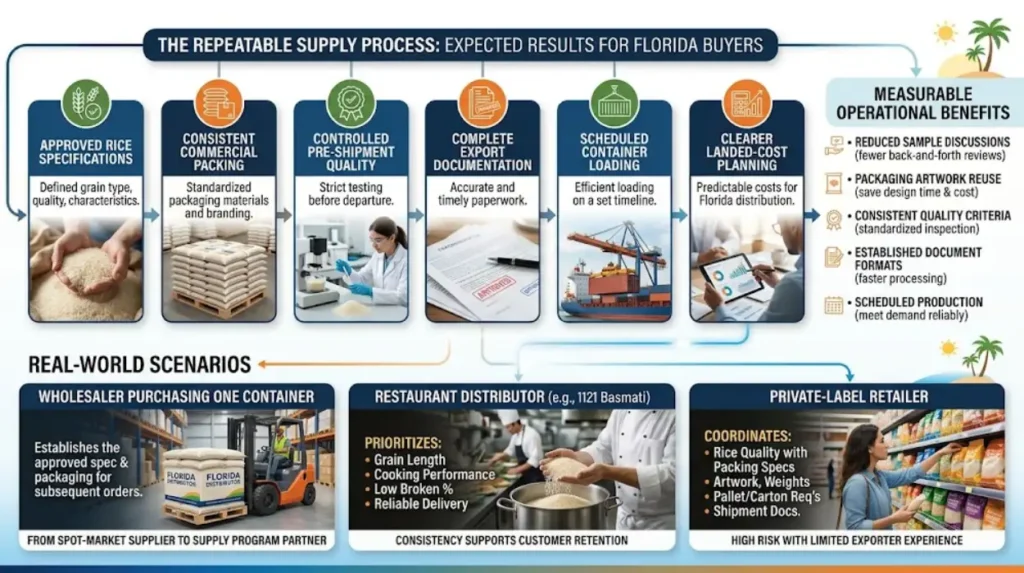
The expected result is a repeatable supply process: approved rice specifications, consistent commercial packing, controlled pre-shipment quality, complete export documentation, scheduled container loading, and clearer landed-cost planning for Florida distribution.
Consider a Florida wholesaler purchasing one container for regional distribution. The first shipment establishes the approved specification and packaging. Once the buyer approves the commercial cargo, that specification becomes the reference for subsequent orders.
This creates measurable operational benefits.
The buyer can reduce repeated sample discussions because the product standard is documented. Packaging artwork can be reused after approval. Quality-control criteria can remain consistent. Shipment documents can follow an established format. Production can be scheduled around expected monthly demand.
For recurring buyers, AHK Rice can therefore become part of a supply program rather than simply a spot-market supplier.
A second scenario involves a restaurant distributor that needs 1121 Steam Basmati for multiple customers. The distributor may value grain length, cooking performance, low broken percentage, and reliable delivery more than the lowest FOB quotation. In this case, supplier consistency directly supports customer retention.
A third scenario involves a private-label retailer. Here, the exporter must coordinate rice quality with packaging specifications, artwork, bag weights, carton or pallet requirements, and shipment documentation. The commercial risk is higher if the exporter has limited experience handling customized export orders.
How should Florida buyers decide whether AHK Rice is the right supplier?
Florida buyers should select AHK Rice when its confirmed product specification, sample quality, documentation capability, shipment schedule, commercial terms, and communication standard meet the buyer’s requirements better than competing suppliers on a complete landed-cost basis.
The final decision should be based on evidence rather than marketing language.
| Decision factor | What the buyer should confirm |
| Product | Variety, processing, grain length, moisture, broken percentage |
| Quality | Sample approval and pre-shipment inspection |
| Supply | Available quantity and repeat-order capability |
| Documentation | Export and U.S.-import documentation responsibilities |
| Logistics | Loading schedule, vessel plan, transit estimate |
| Commercials | FOB/CFR/CIF basis and complete landed-cost assumptions |
A buyer should also distinguish between an experienced exporter and a trading intermediary that simply obtains rice after receiving an order. Both models can work, but the buyer needs to understand who controls the product, processing, quality inspection, packaging, and shipment.
AHK Rice’s value proposition is strongest when the importer needs one coordinated supply process from Pakistani sourcing and processing through packaging and export preparation.
For Florida buyers, the practical sequence is straightforward: define the specification, request the sample, evaluate cooking and physical quality, confirm the commercial quotation, verify documentation, approve packaging, agree inspection, reserve production capacity, and schedule the container.
This approach also reduces the risk of making a purchase decision based only on the cheapest FOB offer. In international rice procurement, the lowest unit price is not necessarily the lowest total cost.
AHK Rice can support buyers that need Pakistani Basmati varieties for Florida distribution while maintaining a defined specification across recurring shipments. The appropriate commercial starting point is a written requirement covering variety, quantity, packing, destination, delivery target, and inspection standard.
For buyers ready to move from supplier evaluation to a defined commercial requirement, submit the specification and shipment details through Request a Quote to begin the procurement process.
Frequently Asked Questions
What is the best Pakistani Basmati rice for Florida buyers?
The best variety depends on the buyer’s market and application. 1121 Steam Basmati suits premium food-service and retail demand, while Super Kernel and 1509 Basmati provide alternative specifications for different price and cooking requirements.
Why should Florida importers choose an experienced Pakistani rice exporter?
An experienced exporter can coordinate sourcing, milling, grading, quality inspection, packaging, documentation, and container loading. This reduces specification inconsistencies and helps buyers maintain reliable supply across repeated orders.
How much does Pakistani Basmati rice cost for Florida importers in 2026?
Pricing depends on variety, grade, crop, quantity, packaging, Incoterm, freight, and market conditions. Buyers should compare complete landed costs rather than evaluating suppliers only by FOB price.
How long does shipping from Pakistan to Florida take?
Ocean transit can commonly require around 30–45 days, depending on the destination port, vessel routing, transshipment, congestion, and prevailing shipping conditions. Production and export preparation require additional time.
What sample process should Florida rice buyers follow?
The buyer should provide the required specification, receive a representative sample, evaluate grain appearance and cooking performance, request laboratory testing if necessary, approve the specification, and then proceed with commercial production and packing.
What does a rice sample from Pakistan cost?
Sample costs vary according to sample quantity, courier destination, packaging, and testing requirements. International courier and handling can commonly range around US$50–150, while independent laboratory testing may add approximately US$100–300 or more.
What documents are required to import Pakistani rice into Florida?
Depending on the shipment, documentation can include a commercial invoice, packing list, bill of lading, certificate of origin, phytosanitary certificate, fumigation documentation, inspection certificates, and documents required for U.S. food-import compliance.
Is AHK Rice suitable for bulk Basmati rice orders to Florida?
AHK Rice can support bulk Pakistani Basmati requirements, including varieties such as 1121, Super Kernel, and 1509, with processing, packaging, export documentation, and shipment preparation coordinated according to the buyer’s specifications.
How should Florida buyers compare rice exporters?
Buyers should compare product specifications, sample quality, export history, production capability, inspection procedures, packaging, documentation, shipment timelines, payment terms, and complete landed cost rather than focusing only on the quoted rice price.
Can AHK Rice provide custom packaging for Florida buyers?
Yes. Custom packaging can be arranged according to the buyer’s requirements, including bag weight, branding, artwork, and packing specifications, subject to order quantity and production requirements.
What quantity can Florida importers order from AHK Rice?
Commercial quantities depend on the selected variety, specification, packaging, and production schedule. Buyers should provide their required metric-ton volume so availability and production capacity can be confirmed before placing an order.
How can a Florida buyer start importing Pakistani Basmati rice?
Start by providing the required variety, quantity, grain specification, packaging, destination, target shipment date, and inspection requirements. AHK Rice can then confirm availability, prepare a sample, provide commercial terms, and plan the export shipment.