Why Does Export History Matter When Selecting Rice Suppliers?
A rice supplier’s export history shows whether it has repeatedly handled international orders, maintained product specifications, completed export documentation, and delivered shipments across different markets. Buyers use this evidence to assess operational reliability before selecting a supplier for recurring rice imports.
What Is Export History in the Rice Trade?
Export history is the documented record of a supplier’s previous international shipments, including destinations, products, quantities, shipment dates, buyers, packaging, certifications, and export documents completed for each transaction.
Export history differs from a supplier’s years in business. A company operating for 10 years with limited international shipments has less useful export evidence than a company with 5 years of documented exports across several markets.
A useful export record contains measurable information. Examples include 25 containers shipped to the United Arab Emirates, 15 containers shipped to Saudi Arabia, or 10 recurring shipments of 1121 Basmati rice to North American buyers.
The record also connects products with markets. Pakistani Basmati rice exporters commonly handle varieties such as 1121 Basmati, Super Kernel Basmati, and 1509 Basmati. Each variety has different grain characteristics, processing requirements, packaging formats, and buyer specifications.
Export history therefore works as an operational record. It helps a buyer determine whether a supplier has experience moving rice beyond its domestic market.
Why Does Export History Matter When Selecting Rice Suppliers?
Export history matters because international rice supply requires coordinated production, quality control, packaging, documentation, customs procedures, freight planning, and shipment execution. Repeated export activity provides measurable evidence that these processes have been performed commercially.
International rice transactions involve more stages than purchasing rice from a local mill. The supplier must source paddy, process the rice, grade the finished product, control moisture, inspect quality, pack the order, prepare documents, and arrange export logistics.
A supplier with established export activity understands these connected stages. Its previous shipments provide evidence of how production and logistics operate under commercial deadlines.
Export history also helps buyers evaluate market familiarity. A supplier shipping to the Middle East handles different buyer requirements from one shipping to Europe or North America. Requirements differ in packaging, labeling, documentation, inspection, and commercial specifications.
For example, a Saudi Arabian distributor can require specific Basmati specifications and retail packaging, while a United States food-service buyer can require bulk packaging, detailed product documentation, and importer-specific labeling.
The objective is not simply to find the supplier with the longest history. The objective is to verify relevant export experience.
How Does International Rice Exporting Work From Production to Shipment?
International rice exporting connects paddy procurement, milling, grading, quality testing, packaging, documentation, container loading, customs clearance, freight booking, and destination delivery into one controlled commercial process.
The process starts with paddy procurement. Paddy is the harvested rice grain before milling. Suppliers source suitable varieties according to the required specification.
The second stage is cleaning. Foreign materials such as stones, dust, straw, and unwanted particles are removed before further processing.
The third stage is milling. The rice passes through equipment that removes the husk and separates edible rice kernels. Milling settings influence head rice recovery, broken rice percentage, and final appearance.
The fourth stage is grading. Grading separates kernels according to characteristics such as length, broken percentage, chalkiness, and uniformity.
The fifth stage is processing. White rice, parboiled rice, steam rice, and Sella rice follow different processing routes. Parboiled and Sella products involve controlled treatment before or during milling, while white rice follows a conventional milling process.
The sixth stage is quality inspection. Parameters include moisture, broken percentage, foreign matter, damaged grains, grain length, variety purity, and other agreed specifications.
The seventh stage is packaging. Rice can be packed in formats such as 5 kg, 10 kg, 20 kg, 25 kg, or larger commercial bags depending on the buyer and market.
The eighth stage is documentation. Export shipments require commercial and logistics documents. These can include the commercial invoice, packing list, certificate of origin, phytosanitary certificate where applicable, bill of lading, and relevant inspection or laboratory documents.
The final stages involve container loading, customs clearance, ocean freight, and destination procedures.
A supplier’s export history provides evidence across these stages instead of showing only production capability.
What Key Components Should Buyers Examine in an Export Record?
Buyers should examine destination markets, shipment frequency, product varieties, container volumes, buyer specifications, documentation, certifications, packaging formats, shipment timing, and evidence of repeat orders when evaluating a rice exporter’s international track record.
Destination markets
Destination history shows whether the supplier has experience with international commercial requirements. Examples include Saudi Arabia, the United Arab Emirates, the United States, Europe, and African markets.
Shipment frequency
Shipment frequency reveals whether exporting is an occasional activity or a recurring business process. Ten documented shipments across 12 months provide stronger operational evidence than one shipment followed by a long gap.
Product varieties
Buyers should match previous export products with their required product. Examples include 1121 Basmati, Super Kernel Basmati, 1509 Basmati, White Basmati, Steam Basmati, and Sella Basmati.
Shipment volume
Container history provides a measurable view of commercial capacity. A supplier shipping 1 container per order has a different operating profile from one regularly shipping 10 or 20 containers.
Specification consistency
Previous contracts should demonstrate consistency in grain length, broken percentage, moisture, purity, packaging, and other agreed specifications.
Documentation
Export records should show experience preparing accurate commercial and regulatory documents. Document accuracy is essential because discrepancies can delay customs processing or create destination-market problems.
Certifications
Certifications should correspond to the buyer’s market and contract requirements. Common food-supply certifications and documents include ISO-based food-safety systems, HACCP-based controls, phytosanitary documentation, certificates of origin, and laboratory analysis reports.
Certification names alone do not prove quality. Buyers should verify the certificate scope, issuing organization, validity period, facility coverage, and applicable product category.
What Rice Grades Should Buyers Understand Before Comparing Suppliers?
Rice grades describe measurable product characteristics and commercial classifications, but grade terminology differs between suppliers and markets. Buyers should define variety, processing type, grain length, broken percentage, moisture, purity, and packaging before comparing export records.
Pakistani Basmati rice is commonly traded in several commercial varieties and processing forms.
1121 Basmati is an extra-long grain Basmati variety widely used in export markets. It is available in forms such as White, Steam, and Sella depending on processing.
Super Kernel Basmati is a traditional long-grain Basmati variety with established demand in retail, food service, and wholesale markets.
1509 Basmati is another long-grain variety used in international trade. It is commonly supplied as White, Steam, or Sella depending on processing requirements.
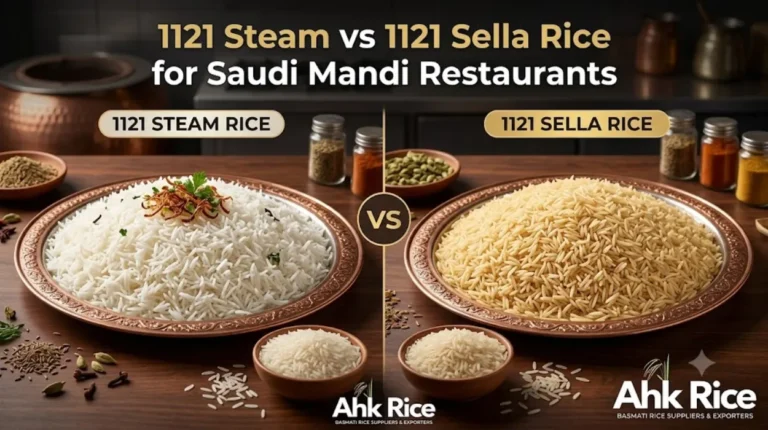
Processing terminology also matters. White rice is conventionally milled. Steam rice receives controlled steaming before final milling. Sella rice is parboiled and processed to produce a distinct cooked appearance and texture.
A buyer should not compare two suppliers only because both quote “Basmati rice.” The underlying specifications can differ significantly.
A commercial specification should identify the variety, processing type, grain length, broken percentage, moisture limit, foreign matter, damaged grains, packaging weight, bag material, and applicable quality tolerances.
What Are the Benefits of Reviewing a Supplier’s Export History?
Reviewing export history reduces supplier-selection uncertainty by giving buyers measurable evidence about market experience, shipment execution, product consistency, documentation capability, production planning, and the supplier’s ability to handle repeated international transactions.
The first benefit is operational verification. Previous shipments demonstrate that the supplier has completed real export processes.
The second benefit is market-specific assessment. A supplier with experience in the buyer’s destination market understands relevant documentation and commercial practices.
The third benefit is product matching. Buyers can determine whether the supplier has previously exported the same variety and processing type.
The fourth benefit is capacity assessment. Shipment frequency and container volume provide evidence about the supplier’s ability to allocate commercial quantities.
The fifth benefit is quality-control assessment. Previous laboratory reports, inspection documents, and product specifications provide evidence of how quality was measured.
The sixth benefit is shipment planning. Historical shipment records help buyers assess whether production and loading schedules align with expected purchasing cycles.
The seventh benefit is risk reduction. A documented history does not eliminate commercial risk, but it provides stronger evidence than unsupported claims about experience.
Where Is Pakistani Basmati Rice Exported?
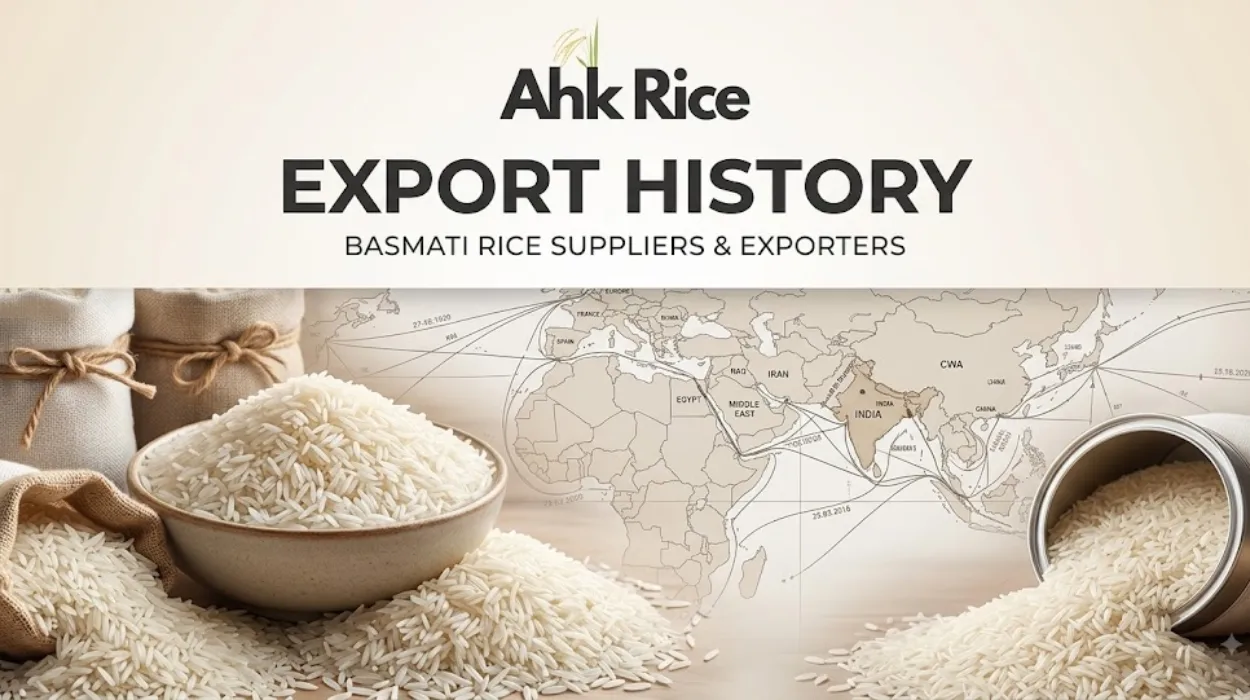
Pakistani Basmati rice is exported to markets across the Middle East, North America, Europe, Africa, and other regions where importers purchase long-grain rice for retail, wholesale, food service, and private-label distribution.
The Middle East is an important destination region for Pakistani rice. Saudi Arabia and the United Arab Emirates have established demand for Basmati varieties used in households, restaurants, catering, and retail distribution.
North American markets include the United States and Canada. Importers in these markets commonly purchase rice for ethnic retail, food service, wholesale, and private-label channels.
European markets also import Pakistani rice. Buyer requirements often focus on food safety, traceability, labeling, pesticide controls, packaging, and documentation.
African markets include multiple countries with demand for rice across wholesale and retail channels. Product selection varies according to local consumer preferences, price positioning, cooking characteristics, and distribution models.
Export history becomes more useful when the supplier has experience in the same region as the buyer. A shipment record from one market does not automatically prove compliance with another market’s requirements.
How Can Export History Be Used in Different Buying Situations?
Export history supports different buying decisions by showing whether a supplier has handled similar products, volumes, packaging formats, destination requirements, and recurring shipment schedules before the buyer enters a new contract.
For retail distribution, buyers should examine previous retail packaging, private-label orders, labeling records, and shipment quantities.
For food service, buyers should examine bulk packaging, cooking specifications, repeat volumes, and consistency between batches.
For wholesale distribution, container quantities, shipment frequency, product variety, and pricing structures become important evaluation factors.
For private-label programs, buyers should examine packaging customization, artwork coordination, labeling compliance, batch identification, and previous custom-packaging projects.
For recurring contracts, buyers should focus on repeated shipments rather than one successful transaction. A supplier that completed six comparable shipments over 12 months provides more relevant evidence than one that completed a single large shipment.
For example, a buyer requiring 5 containers every month should examine whether the exporter has previously managed similar recurring allocations rather than relying on its maximum advertised production capacity.
What Common Problems and Misconceptions Exist About Export History?
The main misconception is that years in business automatically equal export capability. Buyers should distinguish company age from documented international shipments, because export reliability depends on verified products, destinations, volumes, specifications, documentation, and repeated execution.
One common mistake is treating a website statement as export evidence. A list of countries without shipment records provides limited verification.
Another mistake is equating production capacity with export capacity. A large milling operation still requires packaging, documentation, customs coordination, container planning, and freight management.
A third mistake is evaluating only shipment quantity. Large volumes do not prove specification consistency. Buyers should review product quality and contract compliance alongside volume.
A fourth mistake is ignoring shipment frequency. One shipment does not demonstrate recurring supply capability.
A fifth mistake is treating certification as a substitute for export experience. A valid food-safety certification demonstrates compliance with its defined scope. It does not prove that every international shipment was executed successfully.
A sixth mistake is comparing suppliers using different specifications. A quotation for 1121 White Basmati cannot be directly compared with a quotation for 1121 Steam Basmati without adjusting for processing, specification, and packaging.
A seventh mistake is accepting vague claims such as “global exporter” without requesting measurable evidence. Buyers should request shipment destinations, product specifications, available documentation, and relevant historical transaction evidence.
How Should Buyers Verify a Rice Exporter’s International Track Record?
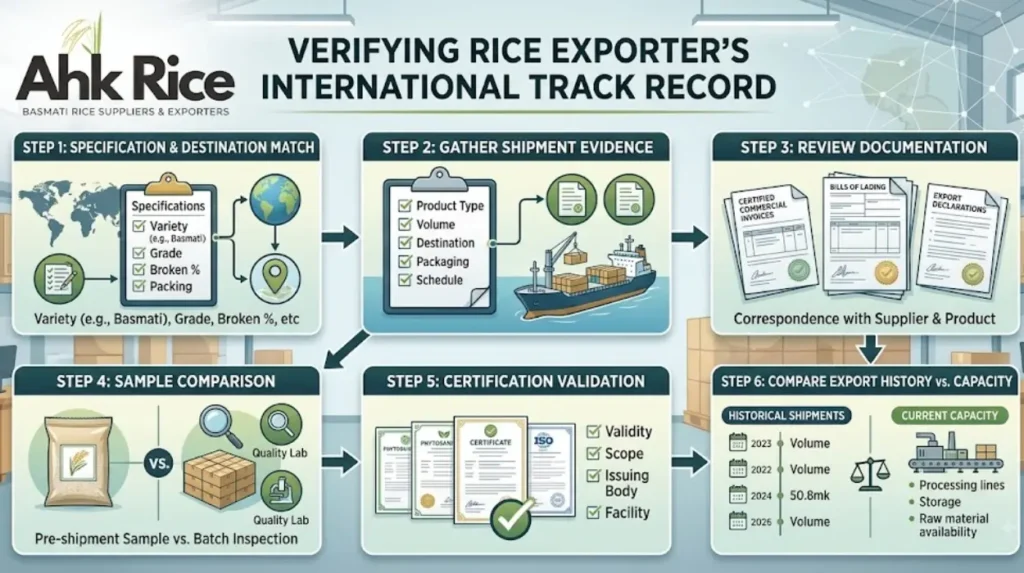
Buyers should verify export history through shipment evidence, product specifications, certificates, documentation, samples, company records, and references that correspond directly with the required destination, product, volume, packaging, and purchasing schedule.
The verification process should begin with the exact purchase specification. Define the variety, processing type, grain length, broken percentage, moisture, purity, packaging, quantity, destination, and shipment frequency.
Next, request evidence of comparable exports. The strongest evidence matches the intended transaction by product, destination, volume, and packaging.
Then review documentation. Confirm that commercial and regulatory documents correspond with the supplier and product being evaluated.
The buyer should also compare samples against the agreed specification. A sample establishes product characteristics before commercial production, while batch inspection confirms consistency during execution.
Certification checks should follow the buyer’s actual market requirements. Certificates should be verified for validity, scope, issuing body, and facility.
Finally, buyers should compare export history with current capacity. Historical shipments demonstrate what happened previously. Current production schedules, raw-material availability, storage, processing lines, packaging capacity, and logistics arrangements determine whether the supplier can execute the next order.
For buyers who want to move from general supplier research to a structured evaluation, the next stage is:
How buyers can assess a rice exporter’s international track record using measurable evidence and comparable criteria.
Frequently Asked Questions
Why does export history matter when selecting a rice supplier?
Export history shows whether a rice supplier has completed international shipments, managed documentation, maintained product specifications, and handled recurring orders across different markets.
What should buyers check in a rice exporter’s history?
Buyers should check export destinations, shipment frequency, container volumes, product varieties, quality specifications, packaging formats, certifications, documentation, and evidence of repeat shipments.
Does company age prove rice export experience?
No. Company age does not automatically prove export capability. Buyers should review documented international shipments and compare previous products, volumes, destinations, and specifications with their intended purchase.
Which Pakistani Basmati rice varieties are commonly exported?
Common Pakistani Basmati varieties include 1121 Basmati, Super Kernel Basmati, and 1509 Basmati. These are supplied in processing forms such as White, Steam, and Sella rice.
How can buyers verify a rice exporter’s international track record?
Buyers can request relevant shipment evidence, product specifications, certificates, inspection reports, export documentation, samples, and information about previous shipments to comparable markets.
What certifications should rice buyers check?
Depending on the destination and contract, buyers can check food-safety certifications, HACCP-based controls, ISO-related certifications, phytosanitary certificates, certificates of origin, and laboratory analysis reports.
Why is shipment frequency important when evaluating rice suppliers?
Shipment frequency indicates whether exporting is a recurring commercial activity. Repeated shipments provide stronger evidence of operational consistency than a single completed export transaction.
Does export volume prove a supplier is reliable?
No. Export volume alone does not establish reliability. Buyers should also evaluate quality consistency, documentation accuracy, shipment timing, product specifications, packaging, and repeat-order performance.
Which markets import Pakistani Basmati rice?
Pakistani Basmati rice is exported to markets across the Middle East, North America, Europe, and Africa, including Saudi Arabia, the UAE, the United States, and Canada.
What is the difference between export history and production capacity?
Export history records previous international transactions, while production capacity describes the supplier’s ability to process and prepare rice for future orders. Buyers should evaluate both before signing recurring contracts.