How Do Indonesian Wholesalers Compare Pakistan 1121 Parboiled and Sella Rice?
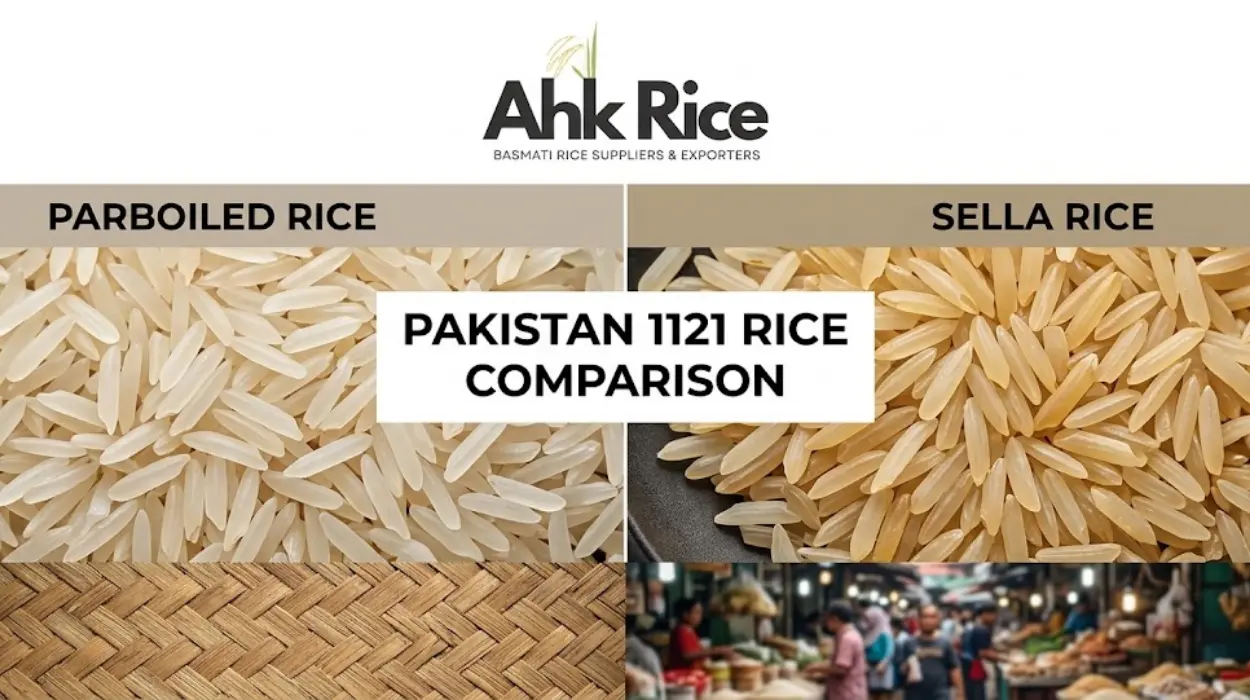
Pakistan 1121 Parboiled and 1121 Sella are commercially the same processing category because Sella means parboiled; Indonesian wholesalers should therefore compare Creamy Sella and Golden Sella specifications, cooking performance, price, shelf life, and supply consistency rather than treating “parboiled” and “Sella” as separate rice varieties.
Indonesian wholesale buyers first need to understand what makes 1121 different from conventional rice before comparing offers. The 1121 designation identifies an extra-long-grain Basmati variety, while parboiling describes the processing method applied before milling. For background on its production, grain characteristics, and wholesale suitability, see:
What makes Pakistan 1121 Parboiled Basmati Rice suitable for Indonesia’s wholesale trade.
For Indonesian buyers, the practical comparison is therefore between 1121 Creamy Sella and 1121 Golden Sella, or between different supplier specifications within the same Sella category. This distinction matters because color, moisture, broken percentage, grain length, cooking behavior, packing, and landed cost determine whether a specification works for a wholesaler’s customers.
What are the available solutions for Indonesian wholesalers buying 1121 rice?
Indonesian wholesalers have three practical sourcing solutions: Creamy Sella, Golden Sella, or a specification-customized 1121 Sella program; each uses parboiling but differs in color, processing intensity, appearance, cooking behavior, price positioning, and suitability for retail, foodservice, or institutional buyers.
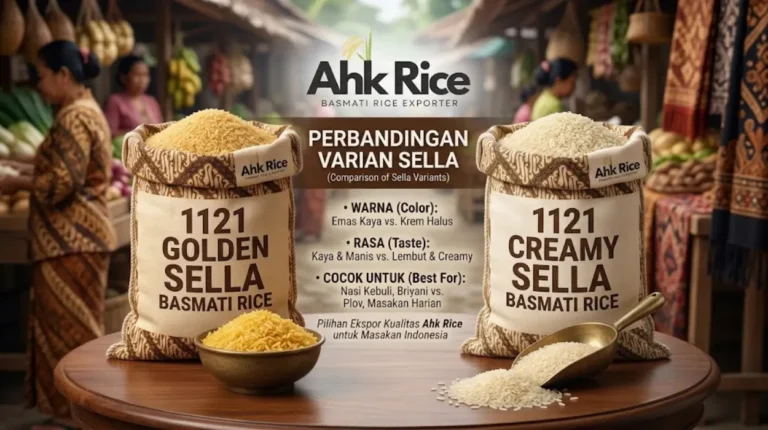
The first solution is 1121 Creamy Sella. This is a lightly parboiled form with a pale cream-to-light-golden appearance. It targets buyers who want the long, slender Basmati grain while maintaining a comparatively lighter visual profile. Typical commercial specifications place average grain length around 8.0–8.3 mm, with moisture commonly controlled around 13% maximum and broken grains around 2% maximum.
The second solution is 1121 Golden Sella. Longer or stronger parboiling produces a deeper golden appearance and a firm cooked grain. This option suits wholesalers whose customers prioritize visibly golden rice, strong grain separation, and resistance to overcooking. Golden Sella is especially established in Middle Eastern rice applications, but its technical cooking advantages also make it relevant when Indonesian foodservice buyers need consistent grain separation.
The third solution is a custom 1121 Sella specification. Instead of purchasing a generic “1121 Sella,” the buyer defines average grain length, broken percentage, moisture, damaged grains, chalky grains, foreign matter, color, milling degree, packaging, crop year, inspection method, and tolerance levels. This approach gives wholesalers a specification they can reproduce across purchase orders.
This specification-led approach is important because commercial suppliers publish different limits. One current Pakistani specification lists 8.40 mm average grain length, 10% moisture, and 2% broken grains, while another lists 8.2 mm average length, 13% maximum moisture, and 2% broken grains. The numbers demonstrate why the product name alone cannot define quality.
How do Pakistan 1121 Parboiled and Sella specifications compare?
The strongest comparison uses measurable attributes rather than product names: grain length, processing, moisture, broken percentage, appearance, cooking texture, and commercial positioning show whether two 1121 Sella offers are genuinely equivalent for wholesale procurement.
| Specification | 1121 Creamy Sella | 1121 Golden Sella |
|---|---|---|
| Processing | Light parboiling / Sella | Stronger parboiling / Sella |
| Average raw grain length | About 8.0–8.3 mm | About 8.2–8.5 mm |
| Typical moisture target | Up to about 13% | Up to about 13% |
| Broken grains | Commonly 0–2% | Commonly 0–2% |
| Appearance | Pale cream to light gold | Golden to deeper amber |
| Cooking behavior | Long, fluffy, separated grains | Firm, highly separated grains |
| Typical positioning | Premium retail and foodservice | Premium foodservice and visual-presentation applications |
These values are commercial specification ranges rather than one universal international grade. A buyer should approve the exact specification before contracting because milling equipment, crop, parboiling intensity, sorting, and supplier tolerances change the final result. Current Pakistani trade listings show 1121 Sella products around 8.3–8.5 mm average grain length, while published supplier specifications show different moisture and defect limits.
The terminology creates another important procurement issue. Parboiled, Sella, and Sela are commonly used interchangeably in Pakistan’s Basmati export trade. The processing involves soaking, steaming, drying, milling, and grading. The process hardens the kernel and improves resistance to breakage during cooking.
Therefore, an Indonesian wholesaler should not ask only, “Is this 1121 parboiled?” The better question is, “Which 1121 Sella specification is being offered, and does the sample match the contractual specification?”
How does processing change the wholesale value of 1121 rice?
Parboiling changes kernel hardness, moisture behavior, cooking stability, and appearance, making Sella more suitable for high-volume cooking where wholesalers need separated grains and predictable performance across restaurants, caterers, retailers, and institutional kitchens.
During Sella processing, paddy is soaked and steam-treated before drying and milling. Heat gelatinizes the starch and changes the physical structure of the grain. After milling, the resulting kernel is harder and generally more resistant to breakage than comparable raw-milled rice.
For wholesalers, the commercial benefit is cooking consistency. A restaurant preparing biryani or a caterer cooking several hundred portions needs grains that remain visibly separate after cooking. A harder parboiled kernel reduces the risk of excessive breakage and clumping when cooking conditions vary.
The processing also affects appearance. Creamy Sella generally provides a lighter presentation, while Golden Sella provides a stronger golden color. The correct choice therefore depends on the customer’s visual expectations rather than assuming that darker color automatically means higher quality.
Grain length is another value factor. Pakistan’s Trade Portal lists 1121 Extra Long Grain Sella around 8.5 mm average grain length, while other current specifications use approximately 8.2–8.3 mm.
A wholesaler should therefore request the average grain length measured under the supplier’s agreed method, not rely on descriptions such as “extra-long” or “XXL.”
Which 1121 Sella approach works best for Indonesia?
Creamy Sella fits buyers prioritizing lighter appearance and premium positioning, Golden Sella fits buyers prioritizing firm separation and stronger color, while customized Sella specifications work best for wholesalers managing multiple customer segments and repeat container programs.
Indonesia is a distinct market because rice imports operate within a food-security and domestic-supply policy environment. Indonesia’s Ministry of Agriculture stated that medium-rice needs are supplied domestically and that imports are directed toward special-rice and industrial requirements under commodity-balance policies.
That makes specification and end-use particularly important for a premium imported Basmati product. A wholesaler should identify the customer segment before selecting the grade.
For premium retail, Creamy Sella can offer an attractive balance between long grain, Basmati identity, lighter appearance, and premium presentation.
For restaurants and catering, Golden Sella can be useful where the buyer values firmness, separation, and visual consistency after bulk cooking.
For specialty distributors, a customized specification provides the strongest control because packaging and grain requirements can be aligned with the distributor’s own brand or customer contracts.
The broader commercial relationship between Pakistan and Indonesia also received policy attention in January 2026, when Pakistan’s Ministry of Commerce described rice as a priority area in bilateral trade discussions.
How do Indonesia and Southeast Asia differ in grade preferences?
Indonesia requires a specification-led approach because imported rice operates within domestic supply and food-policy controls, while broader Southeast Asian specialty markets can provide more room for premium Basmati positioning based on aroma, grain length, cooking performance, packaging, and restaurant demand.
| Market region | Preferred positioning | Indicative FOB price comparison | Shelf-life planning | Main buyer priority |
|---|---|---|---|---|
| Indonesia | Premium 1121 Creamy/Golden Sella for specialty and foodservice channels | About $1,135–$1,185/MT for current 1121 Sella ranges | Up to about 24 months when properly processed and stored | Compliance, specification, landed cost |
| Southeast Asia specialty markets | Premium 1121 Sella with strong grain length and cooking separation | About $1,135–$1,185/MT indicative FOB Karachi | Up to about 24 months under suitable storage | Appearance, cooking quality, brand positioning |
The current indicative FOB Karachi range for 1121 Sella is approximately $1,135–$1,175 per metric ton, with Golden Sella around $1,145–$1,185/MT in one August 2026 commercial listing. These are not Indonesian landed prices. Freight, insurance, destination charges, duties, taxes, inspection, handling, and importer costs must be added before comparing wholesale economics.
Shelf life also requires careful interpretation. Commercial suppliers commonly state up to approximately 24 months for properly stored Sella rice. The actual usable period depends on moisture, packaging, warehouse temperature, humidity, pest control, sanitation, and stock rotation.
For Indonesia, storage planning is especially important because the tropical climate increases the need for controlled warehouse conditions. A buyer should protect bags from moisture, direct heat, floor contact, insects, and prolonged exposure during unloading and storage.
What are the pros and cons of Creamy Sella and Golden Sella?
Creamy Sella offers lighter appearance and broad premium positioning, while Golden Sella provides stronger visual identity and firm cooking performance; neither is universally superior because the commercial advantage depends on customer expectations, cooking method, packaging, and target price.
What are the advantages of Creamy Sella?
Creamy Sella can provide a lighter, cleaner visual profile while retaining the principal advantages of parboiled 1121. Its long grain and separated cooking characteristics support premium retail and foodservice positioning.
Its main limitation is that buyers seeking a pronounced golden appearance may prefer Golden Sella. A wholesaler selling into a market where golden rice is strongly associated with parboiled rice may therefore need the darker grade.
What are the advantages of Golden Sella?
Golden Sella provides a more recognizable parboiled appearance and firm cooking structure. It works well where restaurants want grains that remain separate during large-batch preparation.
Its limitation is positioning. A deeper golden color is not automatically evidence of superior purity, aroma, or grain length. Buyers should evaluate the full specification rather than use color as the sole quality indicator.
Why does customization outperform generic purchasing?
A generic purchase can create specification disputes because “1121 Sella” does not define every quality parameter. A customized contract can establish grain length, moisture, broken percentage, color, defect tolerances, packaging, inspection, and crop requirements before production.
This is especially valuable for wholesalers supplying multiple downstream customers. The buyer can maintain one approved benchmark and compare future shipments against the same specification.
What should Indonesian wholesalers check before selecting a supplier?
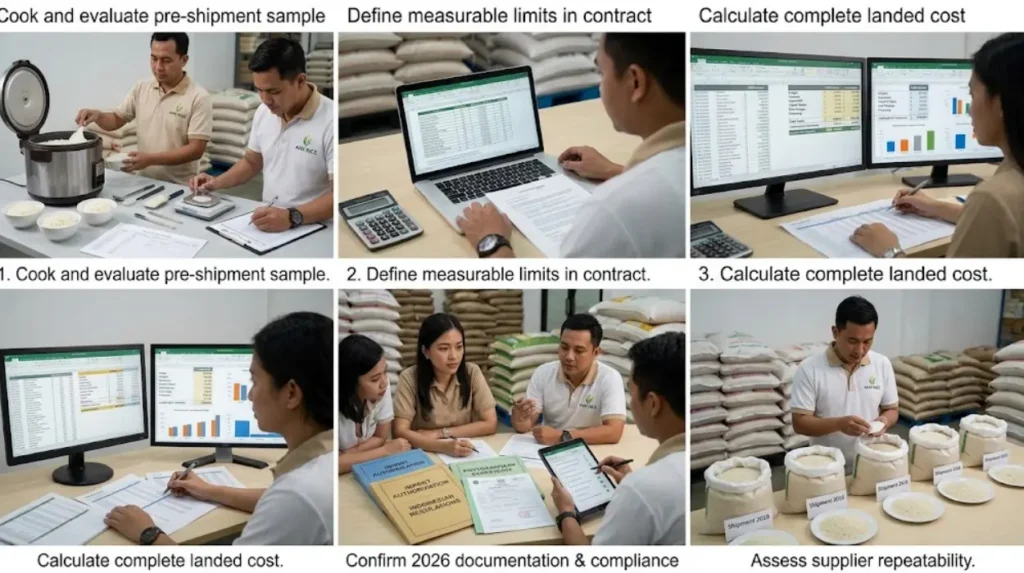
Indonesian wholesalers should evaluate product specification, sample performance, landed cost, documentation, packaging, inspection, shipment planning, and repeatability together because the lowest FOB quotation does not necessarily produce the lowest commercial cost after quality claims and supply disruptions.
The first factor is sample performance. Cook the pre-shipment sample using the intended commercial method. Record grain separation, elongation, aroma, firmness, breakage, and visual appearance.
The second factor is specification control. Put measurable limits into the purchase contract. Avoid relying on descriptions such as premium, extra-long, superior, or export quality without numerical limits.
The third factor is price structure. Compare FOB Karachi with the complete landed cost at the Indonesian destination. A $20/MT FOB difference can become commercially irrelevant if freight, port charges, handling, inspection, financing, or quality losses create a larger downstream difference.
The fourth factor is documentation and compliance. Indonesia’s 2026 regulatory framework continues to emphasize formal requirements around agricultural imports and controlled food supply. Buyers should confirm the applicable import authorization, product classification, origin documentation, phytosanitary requirements, labeling, inspection, and destination procedures before shipment.
The fifth factor is supplier repeatability. The supplier must be capable of producing the approved specification repeatedly, not simply provide one strong sample.
What five factors should determine the final purchasing decision?
A practical purchasing decision should score specification fit, cooking performance, landed price, shelf-life and storage requirements, and supply reliability because these five factors connect product quality with actual wholesale profitability and customer satisfaction.
| Decision factor | What to evaluate | Best evidence |
|---|---|---|
| Specification fit | Grain length, moisture, broken, defects, color | Signed specification sheet |
| Cooking performance | Separation, elongation, firmness, aroma | Controlled sample test |
| Landed economics | FOB, freight, duties, port and handling costs | Complete landed-cost model |
| Storage performance | Moisture protection, shelf life, warehouse conditions | COA and packaging specification |
| Supply reliability | Capacity, inspection, documentation, shipment consistency | Shipment records and QC reports |
This framework prevents a common procurement error: selecting a product based only on the quoted price per metric ton.
A wholesaler can also use the framework to decide between Creamy Sella and Golden Sella by customer segment. If retail buyers prioritize lighter appearance, Creamy Sella receives greater weight. If restaurant buyers prioritize firm separation and golden presentation, Golden Sella receives greater weight.
For larger programs, supplier capacity should also be evaluated against peak demand. A supplier capable of processing, grading, packing, inspecting, documenting, and loading the required volume is more useful than a trader who can quote a low price but cannot repeat the approved specification.
How should Indonesian wholesalers structure the final comparison?
The final comparison should treat 1121 Sella as one parboiled product family and distinguish Creamy and Golden variants through measurable specifications, cooking tests, landed economics, shelf-life planning, and repeat-order capability rather than comparing product names alone.
A strong procurement process begins with the required end-use. Define whether the rice is intended for premium retail, restaurants, catering, foodservice, or institutional distribution.
Next, establish the technical specification. Set average grain length, broken percentage, moisture, color, foreign matter, damaged grains, packaging, and inspection requirements.
Then request samples from shortlisted exporters. Test the rice under the cooking conditions used by the intended customers. The test should measure both raw-grain appearance and cooked performance.
After approval, compare the FOB price per MT and convert it into an estimated landed cost for Indonesia. Do not compare FOB and CNF offers as if they represent the same commercial basis.
Finally, establish the repeat-order benchmark. Each future shipment should be checked against the approved specification and sample. This turns rice purchasing from a one-time commodity transaction into a controlled wholesale supply program.
AHK Rice operates within this specification-led model, with Pakistani Basmati varieties including 1121, Super Kernel, and 1509 and end-to-end processing, packaging, and export coordination. For buyers evaluating the final supply route, the decision-focused article:
AHK Rice Pakistan 1121 Parboiled Basmati Supply for Indonesian Wholesalers is best positioned later in the content journey, after this comparison has established the technical criteria.
Frequently Asked Questions
Is Pakistan 1121 Parboiled Rice the Same as 1121 Sella Rice?
Yes. In Pakistan’s rice export trade, “Sella” or “Sela” generally refers to parboiled rice. The important comparison is between Sella processing types, such as Creamy Sella and Golden Sella, rather than treating parboiled and Sella as separate varieties.
What Is Pakistan 1121 Sella Basmati Rice?
Pakistan 1121 Sella Basmati is an extra-long-grain Basmati rice that has been parboiled before milling. The process improves kernel hardness, reduces cooking breakage, and supports long, separate grains after cooking.
What Is the Difference Between 1121 Creamy Sella and Golden Sella?
1121 Creamy Sella has a lighter cream-to-golden appearance, while Golden Sella has a deeper golden color resulting from its parboiling process. Both can provide long, firm, separated grains when correctly processed and cooked.
Which 1121 Sella Grade Is Better for Indonesian Wholesalers?
The best grade depends on the end customer. Creamy Sella suits premium retail and buyers seeking a lighter appearance, while Golden Sella works well for restaurants and foodservice customers that prioritize firm grains and a stronger golden presentation.
What Grain Length Does Pakistan 1121 Sella Rice Have?
Commercial 1121 Sella specifications commonly target an average grain length of approximately 8.2–8.5 mm. Indonesian wholesalers should confirm the exact contracted grain-length specification because measurements and tolerances vary between suppliers.
What Is the Typical Price of Pakistan 1121 Sella Rice per MT in 2026?
Indicative 2026 FOB Karachi prices for Pakistan 1121 Sella can fall around $1,135–$1,185 per metric ton depending on the Sella type, specification, crop, packaging, and supplier. Indonesian buyers must add freight, duties, port charges, and other landed costs.
How Long Can Pakistan 1121 Sella Rice Be Stored?
Commercial Sella rice can commonly have a stated shelf life of up to 24 months when properly processed, packaged, and stored. Actual storage performance depends on moisture control, warehouse conditions, pest management, packaging, and stock rotation.