How Does 1121 Golden Sella Compare With Creamy Sella for Indonesia?
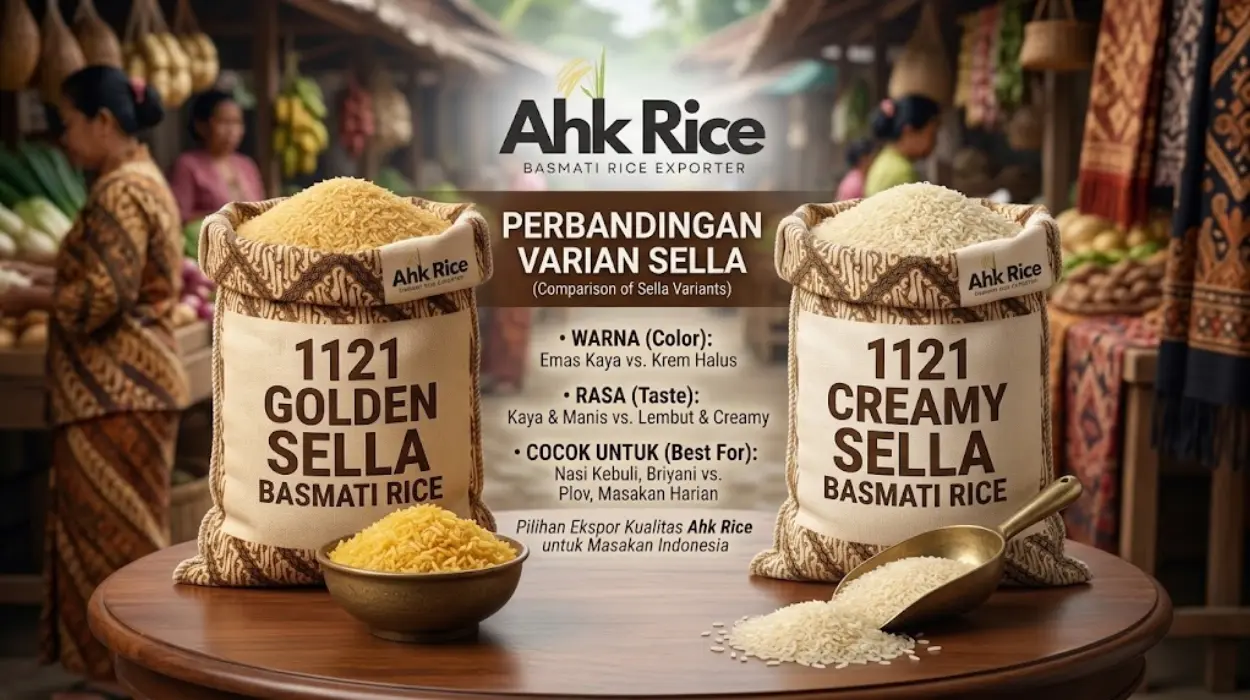
1121 Creamy Sella is the better starting grade for Indonesian buyers seeking lighter appearance and broad foodservice use, while 1121 Golden Sella suits catering operations needing deeper colour and stronger visual separation. Here is why: both are parboiled 1121 Basmati grades, but their processing finish creates different colour, presentation, pricing, and positioning.
Indonesia treats Basmati as a specialty rice category, rather than a mainstream domestic rice substitute. Indonesian authorities identify Basmati among specialty rice products that cannot be sufficiently cultivated domestically, while import controls apply through quota and recommendation mechanisms. For buyers learning how these grades fit the wider 1121 category, the 1121 Sella, Golden Sella and Creamy Sella comparison guide provides the technical foundation.
For Indonesian catering companies, 1121 Golden Sella Basmati Rice is available through AHK Rice’s Pakistan Basmati rice export service. The grade uses parboiling to strengthen the grain before milling, sorting, and polishing. The resulting grain remains firm after cooking and provides a deeper golden presentation.
What are the available solutions for Indonesian buyers?
The two relevant solutions are 1121 Golden Sella and 1121 Creamy Sella, with both using the same 1121 Basmati variety but different colour finishes. Both grades provide extra-long grain performance, parboiled structure, and suitability for commercial cooking.
1121 Golden Sella
1121 Golden Sella receives a stronger parboiling finish that produces a deeper golden appearance. Commercial specifications commonly place average raw grain length around 8.30–8.40 mm, with cooked elongation exceeding the raw length substantially. Comparable export specifications report moisture around 12–13% and broken content around 1–2%.
Golden Sella works particularly well for catering menus where rice appearance affects customer perception. Biryani, pulao, banquet rice, and large-batch rice dishes benefit from clearly separated grains and a pronounced golden finish.
1121 Creamy Sella
1121 Creamy Sella uses the same 1121 Basmati base but produces a lighter creamy or pale-gold appearance. Commercial specifications commonly show grain length around 8.30–8.35 mm, with parboiled texture and low broken content.
Creamy Sella suits buyers who want long grains without a strong golden colour. Its lighter presentation can work better for menus where rice colour should remain closer to white or pale cream.
Seven-attribute specification comparison
| Attribute | 1121 Golden Sella | 1121 Creamy Sella |
|---|---|---|
| Base variety | 1121 Basmati | 1121 Basmati |
| Processing | Parboiled | Parboiled |
| Raw grain length | 8.30–8.40 mm | 8.30–8.35 mm |
| Colour | Deep golden | Creamy / pale gold |
| Texture | Firm, separate grains | Firm, separate grains |
| Broken target | Around 1–2% | Around 1–2% |
| Commercial positioning | Premium visual finish | Broad premium foodservice use |
These specifications vary by crop, mill, contract tolerance, and inspection standard. A buyer should therefore place the agreed specification on the sales contract rather than rely only on the grade name.
The two grades share the same variety and processing family, so the main purchasing difference is presentation rather than a completely different cooking system.
How do Golden Sella and Creamy Sella compare for Indonesia?
Golden Sella has the stronger visual advantage for Indonesian catering, while Creamy Sella offers broader flexibility for lighter-colour menus and price-sensitive premium sourcing. Both grades can deliver firm, separate grains when the processing specification and cooking method are controlled.
Indonesia’s specialty-rice market includes Basmati because domestic production cannot fully supply this category. APEDA’s Indonesian market advisory specifically identifies Basmati as a specialty product required by restaurants and modern culinary channels.
That market structure changes the buying decision. Indonesian importers are not simply comparing rice varieties. They are matching a specialty product with a restaurant concept, customer expectation, import approval, packaging requirement, and landed cost.
Indonesia and Southeast Asian foodservice
Indonesia and the wider Southeast Asian market provide a strong case for Creamy Sella where the buyer wants a lighter rice appearance. Basmati competes with fragrant regional rice categories such as Thai Hom Mali and other Asian aromatic varieties. The World Bank identifies Jasmine as a major Southeast Asian fragrant-rice preference, while Basmati occupies a distinct premium aromatic segment.
Creamy Sella can therefore provide a useful middle position. It delivers the long-grain identity of Basmati while avoiding the stronger golden appearance of Golden Sella.
Golden Sella becomes more attractive for Indonesian catering menus built around biryani-style presentation. Its deeper colour creates stronger visual contrast between individual grains and spices.
GCC and Middle Eastern catering
The GCC represents a different demand pattern. Sella rice is strongly associated with dishes requiring firm, separated grains such as kabsa and mandi. Current Pakistan export specifications position Creamy Sella as the standard Sella grade, while Golden Sella commands a premium for its deeper colour.
The distinction matters for an Indonesian importer selling into Middle Eastern-style restaurants. Golden Sella can support the same operational requirements that make it valuable in Gulf catering.
The market comparison therefore produces a practical conclusion: Indonesia rewards menu-specific selection, while GCC catering more consistently rewards strong parboiled structure and established Sella usage.
What is the price per MT difference between Golden Sella and Creamy Sella?
Golden Sella normally carries a modest premium over Creamy Sella because its deeper colour and tighter visual positioning create additional grade value. Current indicative Pakistan export references place the Golden Sella premium around $15–$20 per MT in comparable Sella specifications.
A separate AHK Rice market reference places 1121 Golden Sella around $980–$1,050/MT FOB Karachi and Creamy Sella around $960–$1,010/MT, depending on specifications, packaging, and order volume.
For a 100 MT procurement, a $20/MT difference represents $2,000 before freight, insurance, duties, port charges, and other landed costs.
| Market region | Preferred starting grade | Indicative FOB positioning | Main reason |
|---|---|---|---|
| Indonesia / Southeast Asia | Creamy Sella | Lower baseline | Lighter appearance and flexible foodservice use |
| Indonesia / Southeast Asia | Golden Sella | +$15–$20/MT typical premium | Stronger visual presentation |
| GCC / Middle East | Golden Sella | Premium positioning | Colour and catering presentation |
| GCC / Middle East | Creamy Sella | Standard Sella positioning | Broad commercial use |
FOB figures are not Indonesian landed prices. Ocean freight, container availability, port charges, customs requirements, packaging, inspection, insurance, and payment terms can change the final cost significantly.
Indonesia’s import environment also requires more attention than the FOB comparison alone. Current Indonesian guidance identifies specialty rice as subject to specific import mechanisms, while imported food packaging and labelling must comply with Indonesian requirements.
Which grade provides the longer shelf life?
Golden Sella and Creamy Sella should be treated as having broadly comparable shelf-life potential because both are parboiled products; storage conditions matter more than colour. A properly processed Sella grade can provide long storage stability under controlled commercial conditions.
A current Pakistan Sella specification cites storage potential of up to 24 months, compared with shorter periods for raw white rice. This advantage comes from the parboiled grain structure and controlled moisture level rather than the golden colour itself.
For Indonesian importers, warehouse conditions deserve more attention than choosing Golden over Creamy solely for shelf life. Temperature, humidity, moisture migration, packaging integrity, pest control, and warehouse hygiene affect stored-rice quality.
Golden Sella should not be marketed as automatically longer-lasting than Creamy Sella. Both grades require a defined moisture specification and appropriate storage environment.
For a long-distance Indonesia shipment, the purchase contract should state crop year, moisture maximum, broken percentage, grain length, packaging specification, and inspection requirements.
Which method works best for different Indonesian catering cases?
Creamy Sella works best for lighter-colour menus and broad premium foodservice, while Golden Sella works best for biryani, banquet service, and menus where colour creates stronger visual value. The correct grade follows the finished dish rather than the raw grain alone.
Choose Creamy Sella for lighter presentation
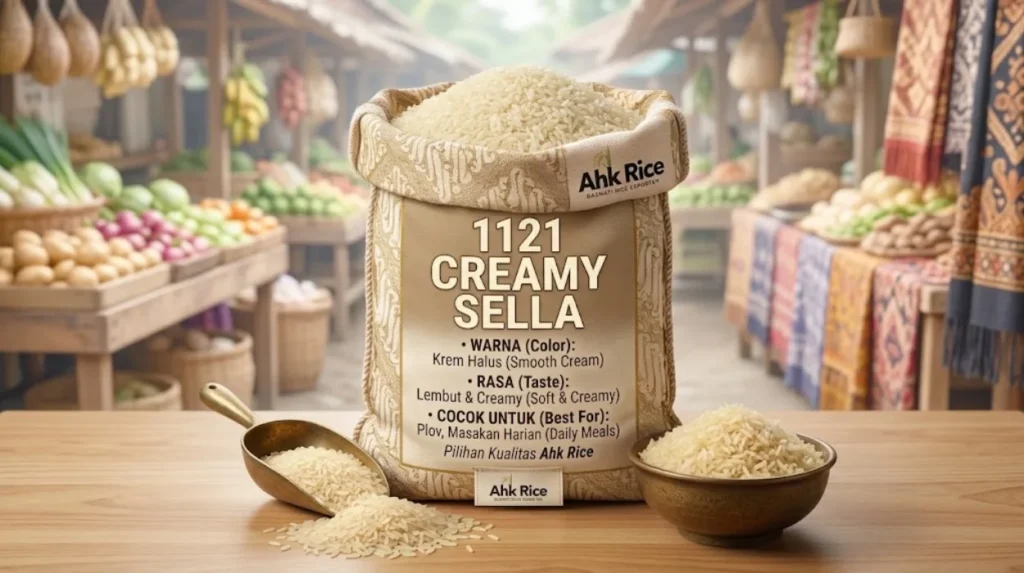
Creamy Sella fits restaurants that want long, separate grains without a pronounced golden colour. The grade can also simplify menu positioning where customers expect a lighter rice appearance.
A distributor supplying several restaurant formats can use Creamy Sella as a more neutral premium specification. The same grade can support biryani, pulao, rice bowls, and catering menus without making the rice colour the primary selling characteristic.
Choose Golden Sella for visual catering impact
Golden Sella fits catering operations that depend on strong visual presentation. Its deeper colour can make large trays of rice appear more distinctive during buffet and banquet service.
The firmer parboiled structure also supports large-batch cooking. A commercial kitchen can prepare substantial quantities while maintaining grain separation through controlled cooking and holding.
Golden Sella therefore creates more value when appearance and grain integrity directly influence the customer’s perception of portion quality.
What are the pros and cons of each grade?
Golden Sella offers stronger colour and premium presentation, while Creamy Sella offers a lighter appearance and broader menu flexibility; neither grade wins every application. The decision depends on the buyer’s menu, customer profile, storage plan, and price target.
| Grade | Pros | Cons | Example application |
|---|---|---|---|
| Golden Sella | Strong colour, firm grain, premium visual impact | Higher purchase premium | Large catering trays and biryani |
| Creamy Sella | Lighter colour, flexible presentation, lower baseline price | Less visual distinction | Restaurants and mixed foodservice |
| Golden Sella | Strong visual consistency | Requires precise colour specification | Banquets and hospitality |
| Creamy Sella | Easier neutral positioning | May appear less distinctive | Distributor portfolios |
| Both | Long grain and parboiled structure | Requires controlled storage | Bulk commercial procurement |
The practical distinction is therefore commercial rather than simply technical. Golden Sella earns its premium through presentation and positioning, while Creamy Sella can protect margin through broader application.
What decision factors should Indonesian importers evaluate?
Indonesian buyers should rank menu appearance, cooking performance, landed cost, import compliance, storage conditions, and specification consistency before selecting either grade. These factors prevent a low FOB price from becoming an expensive landed purchase.
Five-row decision framework
| Decision factor | Choose Golden Sella when… | Choose Creamy Sella when… |
|---|---|---|
| Menu appearance | Deep golden colour improves presentation | Lighter colour suits the menu |
| Catering volume | Large-batch presentation matters | Multiple menu formats require flexibility |
| Price target | $15–$20/MT premium is acceptable | Lower procurement cost has priority |
| Customer expectation | Customers value golden Sella appearance | Customers prefer pale or creamy grains |
| Storage and logistics | The same controlled Sella storage applies | The same controlled Sella storage applies |
Import compliance should remain a separate procurement checkpoint. Indonesia’s current framework distinguishes specialty rice from general consumption rice, and specialty products such as Basmati remain subject to specific controls.
Packaging also requires attention. Indonesian import guidance states that imported rice packaging must meet food-grade requirements and that labelling requirements apply before arrival.
A commercial specification should therefore define the product before shipment. The contract should cover grade, origin, crop year, grain length, broken percentage, moisture, foreign matter, packaging, inspection, and destination terms.
What is the best choice for an Indonesian catering company?
Creamy Sella is the stronger default for Indonesian buyers seeking flexible premium foodservice, while Golden Sella is the stronger choice for visually distinctive catering and biryani-focused operations. Both remain technically viable when specifications are controlled.
Golden Sella makes sense when the buyer can convert its deeper colour into menu value. The additional $15–$20/MT indicative premium remains relatively small against a large catering order.
Creamy Sella makes sense when the buyer needs a neutral premium product across several restaurant formats. Its lighter finish reduces the importance of colour in the final menu presentation.
AHK Rice can supply Pakistani Basmati varieties including 1121, Super Kernel, and 1509, with end-to-end processing, custom packaging, and export handling. The procurement decision should still begin with the Indonesian buyer’s required specification rather than the supplier’s available stock.
For Indonesian catering companies, the best approach is to approve a pre-shipment sample against the final cooking method. The sample should test grain separation, elongation, colour, aroma, broken content, and holding performance after cooking.
With the grade decision established, the final step is matching the approved specification to packaging, inspection, and shipment terms.
Frequently Asked Questions
Is 1121 Golden Sella better than Creamy Sella for Indonesia?
Golden Sella is better for catering menus that benefit from deeper colour and strong visual presentation. Creamy Sella is better for lighter-colour menus and broader foodservice applications.
What is the main difference between Golden Sella and Creamy Sella?
The primary difference is colour intensity created during parboiling. Golden Sella develops a deeper golden appearance, while Creamy Sella retains a lighter creamy or pale-gold appearance.
Does Golden Sella cost more than Creamy Sella?
Yes. Indicative Pakistan export references show Golden Sella commonly carrying about a $15–$20/MT premium over standard Sella specifications.
Which grade has a longer shelf life?
Neither grade should automatically be assigned a longer shelf life. Both are parboiled Sella products, and storage conditions, moisture control, packaging, and warehouse management determine practical shelf stability.
Is Basmati rice allowed into Indonesia?
Indonesia allows specialty rice imports, including Basmati, under specific regulatory mechanisms. Importers must follow the applicable quota, recommendation, approval, packaging, and labelling requirements.
What grain length should buyers request?
A common 1121 specification targets approximately 8.30–8.40 mm average raw grain length. Buyers should define the exact tolerance in the purchase contract rather than relying only on the 1121 name.
Which grade is better for catering?
Golden Sella is stronger for high-volume catering where colour and grain separation support presentation. Creamy Sella is stronger for mixed foodservice portfolios requiring a lighter visual profile.