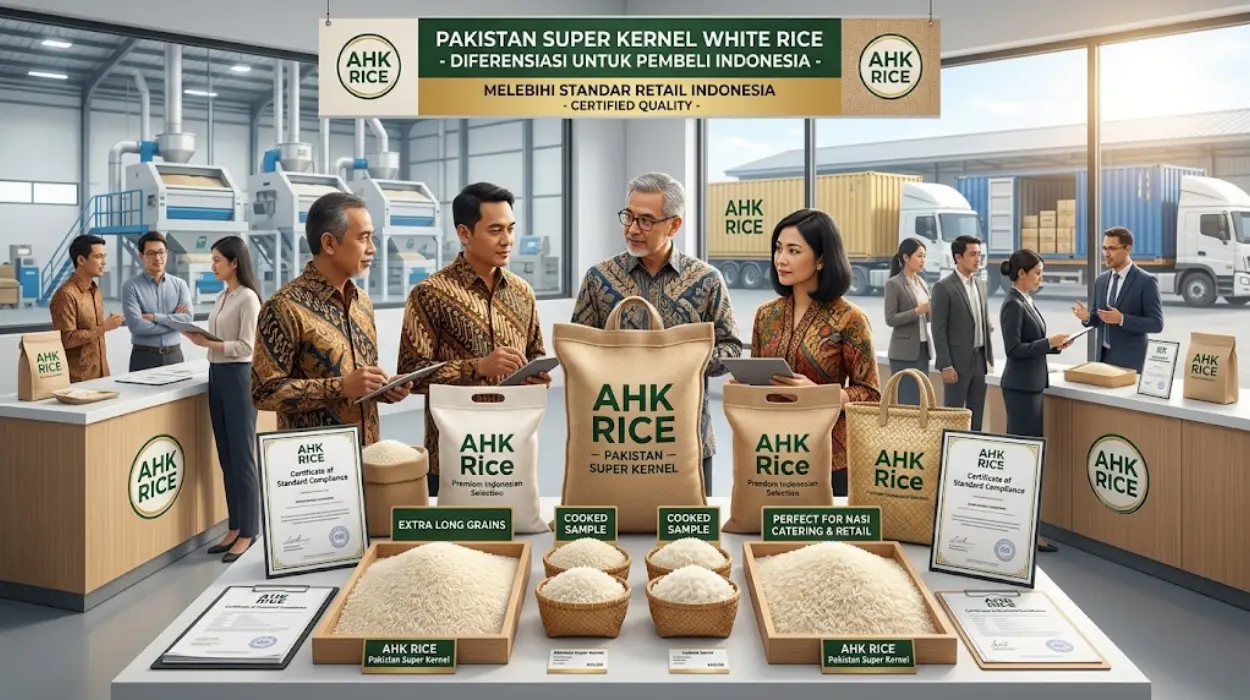
What Makes Pakistan Super Kernel White Rice Different for Indonesian Buyers?
Pakistan Super Kernel White Rice differs through its 7.0–7.2 mm slender grain, traditional Basmati aroma, white polished appearance, and distinct cooking texture. Here is why: variety, cultivation region, milling method, grading, and cooking behavior create its identity for Indonesian rice buyers.
Super Kernel Basmati is a traditional Pakistani aromatic rice variety. It is cultivated mainly in Punjab, where the rice-growing environment supports its characteristic fragrance and slender kernel. Commercial specifications commonly place its raw grain length around 7.0–7.2 mm.
Indonesia provides a different consumption environment from Gulf and European Basmati markets. Indonesian buyers therefore evaluate Super Kernel through grain appearance, aroma, cooking performance, broken percentage, moisture, purity, packaging, and intended application.
The main distinction is not simply grain length. Super Kernel sits between ordinary long-grain rice and extra-long Basmati varieties such as 1121. It provides a recognisable Basmati profile while retaining a different physical specification.
What is Pakistan Super Kernel White Rice?
Pakistan Super Kernel White Rice is a milled Basmati variety with an average raw grain length of about 7.2 mm, white colour, aromatic character, and a soft, fluffy cooked texture. Its identity comes from variety, origin, milling, grading, and cooking performance.
Super Kernel begins as paddy harvested from rice-growing areas of Pakistan. The paddy contains the husk, bran, germ, and edible kernel. Milling removes the outer layers and produces the white rice consumed by households, restaurants, retailers, and foodservice operators.
White rice describes the processing condition rather than a separate rice species. The husk and bran are removed, then the kernels are polished and sorted. Colour sorting removes discoloured grains and improves visual uniformity.
Super Kernel differs from 1121 through physical dimensions. A typical 1121 Basmati specification measures about 8.30–8.50 mm, while Super Kernel commonly measures about 7.20–7.60 mm.
Super Kernel also differs from ordinary non-Basmati long-grain rice through aroma and culinary identity. Indonesian buyers assessing Basmati should therefore compare variety before comparing only the physical length.
With the product identity established, the next question is how cultivation and milling create these characteristics.
Where is Super Kernel Basmati cultivated in Pakistan?
Super Kernel Basmati is associated with Pakistan’s Punjab rice belt, where established Basmati cultivation supports its aromatic profile and slender kernel structure. Punjab remains the central geographic reference for understanding Pakistani Basmati production and quality.
Punjab contains major rice-growing areas connected with Pakistan’s traditional Basmati production. Rice cultivation depends on suitable soil, irrigation, temperature, and seasonal crop management. Farmers cultivate the crop through the rice-growing season before harvesting mature paddy.
The geographical relationship matters because Basmati quality begins before milling. Variety selection, field management, harvesting maturity, and post-harvest handling influence the condition of paddy entering the mill.
Super Kernel is therefore not created by polishing alone. Milling reveals the physical characteristics already present in the harvested kernel. The processor then controls cleanliness, milling degree, broken percentage, and visual uniformity.
This relationship explains why Indonesian buyers should identify the variety, origin, crop condition, and processing specification together rather than treating “white rice” as a complete specification.
How is Pakistan Super Kernel White Rice processed?
Super Kernel White Rice follows a controlled sequence: cleaning, dehusking, milling, polishing, grading, colour sorting, and final inspection. Each stage removes a specific defect or improves a measurable characteristic before the rice enters export packaging.
What happens during primary milling?
Primary milling prepares harvested paddy for edible rice production. The processor first removes field materials and unwanted particles. Clean paddy then enters dehusking equipment, which separates the outer husk from the rice kernel.
The next stage removes the bran layers. This produces the white kernel associated with Super Kernel White Rice. Milling must preserve whole kernels because excessive mechanical stress increases broken grains.
What happens during polishing and sorting?
Polishing improves surface appearance by removing remaining bran particles. Commercial Super Kernel specifications commonly use silky or double-silky polishing. Several Pakistani suppliers specify colour sorting alongside well-milled kernels.
Colour sorting separates grains with unwanted colour variation. The equipment identifies optical differences and removes unsuitable kernels. This improves the visual consistency of the finished batch.
What happens during grading?
Grading separates rice according to physical and quality characteristics. Key parameters include grain length, broken percentage, moisture, chalky grains, damaged grains, foreign matter, and contrasting varieties.
Typical Super Kernel specifications show around 7.2 mm average grain length, up to 2% broken grains, and approximately 12.5–13.5% maximum moisture, although commercial specifications differ by contract.
Indonesian buyers should therefore treat the specification sheet as the controlling document for each shipment.
The processing sequence explains the product’s physical identity; the next question is which grades exist across the Super Kernel range.
What processing grades are available for Super Kernel rice?
The main Super Kernel processing forms are White, Steam, Sella, and Brown, with White representing the standard raw-milled form and Sella representing parboiled processing. Each form changes colour, texture, firmness, and cooking behaviour.
Super Kernel White
Super Kernel White is conventionally milled and polished. The finished kernel has a white appearance and retains the variety’s aromatic character. It suits applications requiring traditional Basmati presentation.
Super Kernel Steam
Steam processing exposes rice to controlled steam before final drying and milling. The process changes kernel structure and produces a firmer cooked texture. Steam rice suits applications requiring greater grain firmness.
Super Kernel Sella
Sella is parboiled rice. The paddy or partially processed rice undergoes controlled soaking, heating, drying, and milling. Parboiling strengthens the kernel and changes its finished colour.
Super Kernel Brown
Brown Super Kernel retains the bran layer after dehusking. The grain therefore has a darker appearance and a different texture from fully milled white rice.
The four forms demonstrate why “Super Kernel” alone does not describe a complete commercial product. Indonesian buyers need the variety plus processing form.
What makes Super Kernel useful for Indonesian food applications?
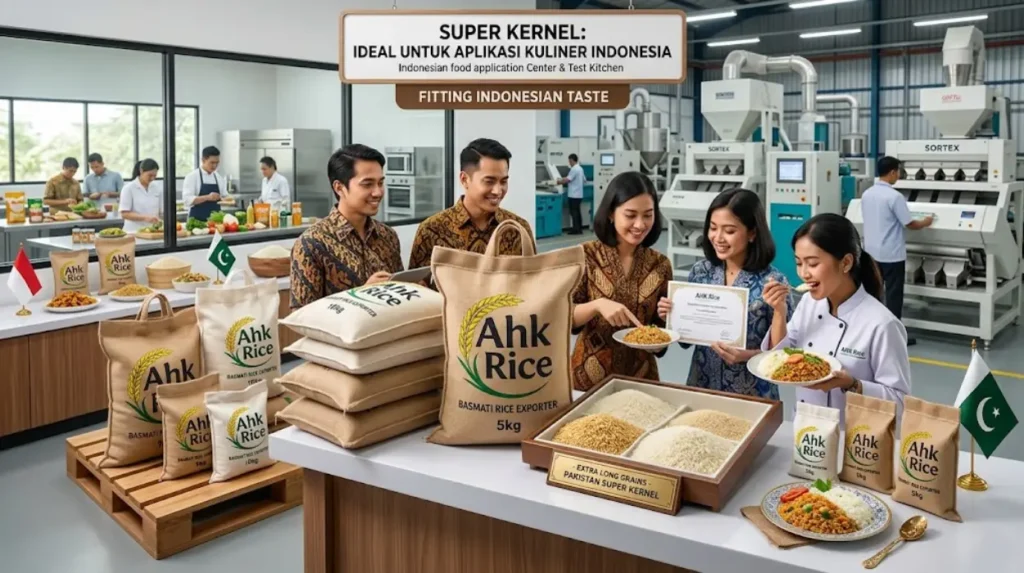
Super Kernel combines aromatic Basmati characteristics with a medium-long slender grain profile, making it suitable for biryani, pilaf, household meals, restaurants, catering, and premium retail applications. The correct application depends on cooking requirements and target positioning.
Retail applications
Retailers can use Super Kernel White for packaged Basmati positioned around aroma, grain appearance, and traditional Pakistani origin. Packaging can use different consumer sizes such as 1 kg, 5 kg, and 10 kg, depending on market strategy.
Restaurant applications
Restaurants use aromatic rice where cooked fragrance and separated grains influence the dish. Super Kernel suits biryani, pulao, rice-based meals, and other South Asian preparations.
Foodservice applications
Foodservice operators evaluate cooking consistency, broken percentage, moisture, and cost per serving. A consistent specification helps kitchens standardise preparation across repeated cooking cycles.
Indonesian retailers evaluating these attributes can continue into a specification-based purchasing framework through how Indonesian retailers evaluate Pakistan Super Kernel White Rice specifications.
The application determines which specifications deserve the closest attention; the next question addresses the common misunderstandings surrounding the product.
What are the common misconceptions about Super Kernel White Rice?
Super Kernel is not defined by grain length alone, and White does not mean unprocessed rice. Variety, milling degree, broken percentage, moisture, purity, aroma, cooking behaviour, and processing form together define the commercial product.
One misconception treats Super Kernel as equivalent to 1121 Basmati. The varieties have different physical dimensions. Super Kernel commonly measures around 7.2 mm, while 1121 reaches about 8.3 mm or more before cooking.
Another misconception treats polished appearance as proof of superior quality. Polishing affects surface appearance, but quality control also requires moisture testing, broken-grain measurement, foreign-matter control, and inspection.
A third misconception assumes every supplier uses identical specifications. Published commercial specifications show differences in moisture, broken percentage, chalky grains, and other tolerances.
A fourth misconception treats Basmati certification as a single universal certificate. Export documentation depends on destination requirements, buyer specifications, food-safety controls, and shipment conditions.
For Indonesian imports, relevant documentation can include a commercial invoice, packing list, certificate of origin, phytosanitary documentation, fumigation documentation where required, and laboratory or inspection certificates specified by the buyer or authorities.
The product’s differences become clear when variety, processing, quality parameters, and documentation are evaluated as one specification system.
Why does Super Kernel White Rice differ from other Pakistani varieties?
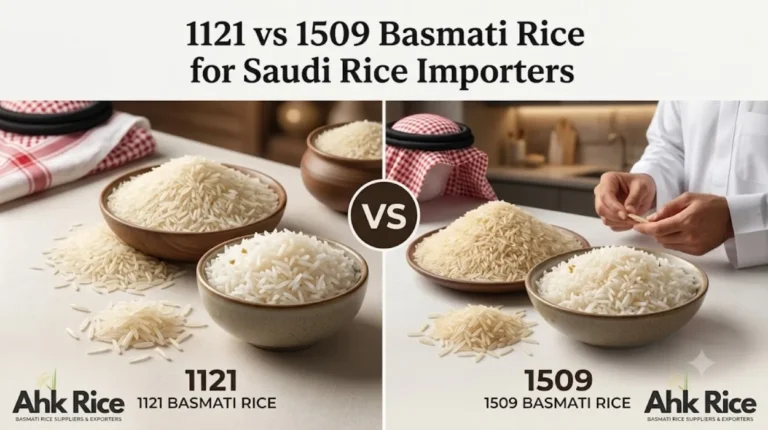
Super Kernel occupies a distinct position because it combines approximately 7.2 mm raw grain length with traditional aroma and white-milled presentation, unlike longer 1121 and shorter non-Basmati varieties.
| Attribute | Super Kernel White | 1121 White | 1509 White |
|---|---|---|---|
| Variety type | Basmati | Basmati | Basmati |
| Raw grain length | ~7.2 mm | ~8.3–8.5 mm | ~8.0–8.3 mm |
| Appearance | White | White | White |
| Aroma | Distinctive Basmati | Strong Basmati | Aromatic |
| Processing | Raw-milled | Raw-milled | Raw-milled |
| Typical use | Retail, restaurants, catering | Premium retail, foodservice | Retail, foodservice |
| Main distinction | Traditional aromatic profile | Extra-long grain | Long grain with different variety profile |
The comparison shows why Indonesian buyers should specify the variety before selecting a supplier. Grain length, aroma, milling, cooking behaviour, and defect tolerances create different commercial outcomes.
Super Kernel White Rice therefore stands apart through a combination of Pakistani Punjab origin, approximately 7.2 mm grain length, aromatic character, white milling, and controlled grading.
With these specifications understood, Indonesian buyers can evaluate the product using measurable criteria rather than relying on the name “Basmati” alone.
What should Indonesian buyers check before evaluating Super Kernel White Rice?
Indonesian buyers should verify variety, origin, average grain length, broken percentage, moisture, milling degree, colour sorting, crop information, packaging, inspection documents, and applicable import certificates.
A complete product specification should state the variety as Super Kernel. It should identify Pakistan as the country of origin and provide the measured grain length.
Quality parameters should state maximum moisture and broken percentage. They should also define limits for chalky grains, damaged grains, foreign matter, paddy grains, and contrasting varieties.
Processing information should identify the milling degree and colour-sorting process. Packaging information should state bag material, net weight, labeling requirements, and packing configuration.
Certification should match the actual shipment and buyer requirement. Food-safety systems can include HACCP, ISO-based systems, GMP, and Halal controls. Published Pakistani rice manufacturers list these systems among their facility certifications.
Indonesian buyers should also review inspection and phytosanitary requirements before shipment. These documents support traceability and confirm that the shipment meets the applicable trade and plant-health requirements.
The complete specification provides the practical bridge between understanding Super Kernel and evaluating it for Indonesian procurement.
Frequently Asked Questions
Is Super Kernel Basmati grown in Pakistan?
Yes. Super Kernel is a Pakistani Basmati variety associated with the Punjab rice-growing region.
What is the average grain length of Super Kernel White Rice?
Commercial specifications commonly place the average raw grain length around 7.0–7.2 mm, although contractual specifications differ between suppliers.
Is Super Kernel the same as 1121 Basmati?
No. Super Kernel commonly measures around 7.2 mm, while 1121 commonly measures around 8.3–8.5 mm before cooking.
What is the difference between Super Kernel White and Sella?
White rice is conventionally milled after dehusking, while Sella is parboiled before final milling. Sella generally produces a firmer cooked kernel.
What certifications apply to exported Super Kernel Rice?
Applicable documentation depends on the destination and contract. Food-safety systems can include HACCP, ISO, GMP, and Halal, while shipment documentation can include phytosanitary and inspection certificates.
What foods use Super Kernel White Rice?
Super Kernel White suits biryani, pulao, rice meals, restaurant dishes, catering, and packaged retail applications.