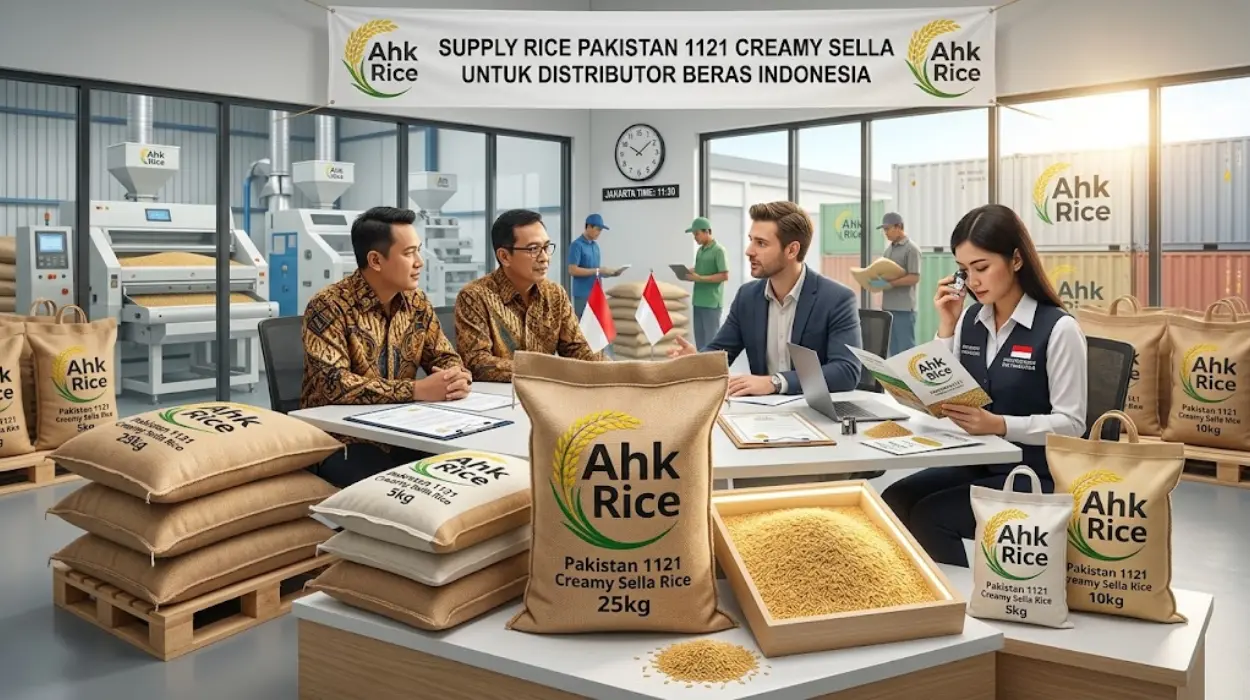
AHK Rice Pakistan 1121 Creamy Sella Supply for Indonesian Rice Distributors
1121 Creamy Sella is the strongest starting specification for Indonesian distributors seeking extra-long grain, lighter appearance, firm cooking performance, and premium positioning. Here is why: the grade combines 1121 Basmati with controlled parboiling, while AHK Rice can align processing, packaging, inspection, and export logistics with the buyer’s specification.
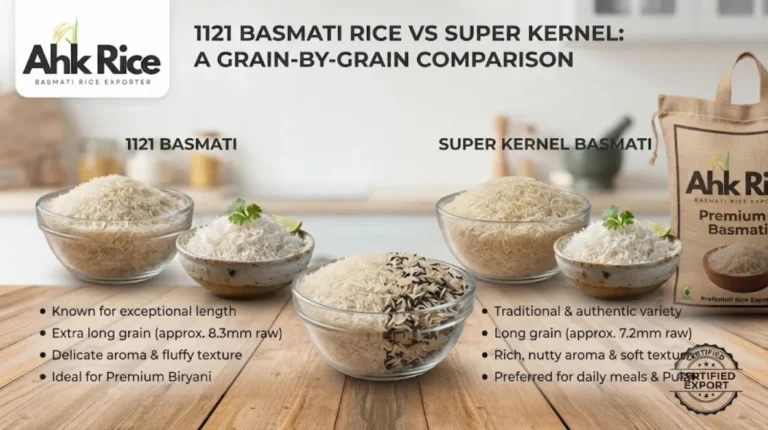
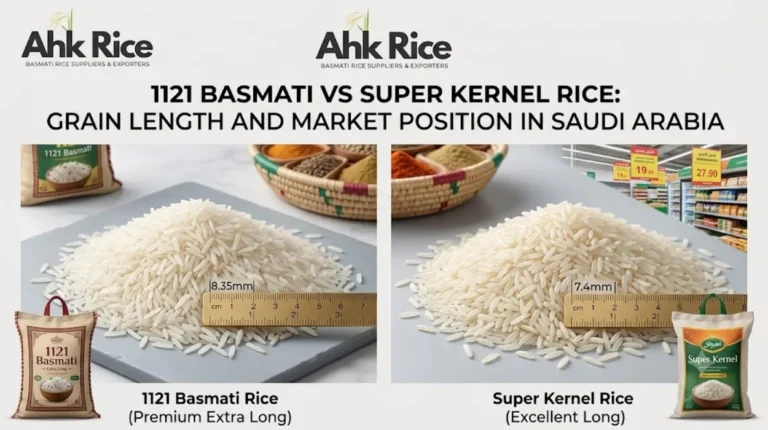
Indonesian distributors should first understand the product specification before comparing quotations. Pakistan 1121 Basmati commonly reaches 8.30–8.50 mm in raw grain length. Creamy Sella uses parboiling but retains a lighter creamy or pale-gold appearance. This combination suits retail, foodservice, restaurants, and specialty Basmati channels.
For background, distributors can review why Indonesian buyers consider Pakistan 1121 Creamy Sella Basmati Rice before moving into commercial procurement.
What is the best solution for Indonesian rice distributors?
The best solution is a specification-controlled 1121 Creamy Sella program covering grain length, moisture, broken percentage, packaging, inspection, and shipment terms. This reduces quality variation and makes landed-cost comparisons more reliable.
1121 Creamy Sella works best when the distributor serves customers who want long Basmati grains without a deep golden colour. The parboiled structure supports firm grains and separate cooking. That performance suits biryani, pulao, catering meals, restaurant production, and premium retail.
AHK Rice can process, grade, sort, pack, and prepare 1121 Creamy Sella for export against an agreed specification. Its published Indonesian 1121 material identifies low broken content, long grain, and controlled quality as key commercial characteristics.
What specification should buyers approve?
A practical commercial specification should define 1121 Basmati, Creamy Sella processing, approximately 8.30–8.50 mm grain length, controlled moisture, low broken percentage, purity, packaging, and inspection terms. Exact tolerances should appear in the sales contract.
| Attribute | Recommended commercial reference |
|---|---|
| Variety | 1121 Basmati |
| Processing | Creamy Sella / parboiled |
| Raw grain length | 8.30–8.50 mm |
| Colour | Creamy / pale gold |
| Broken target | Around 1–2% |
| Moisture | Contract-specific controlled level |
| Packaging | 5 kg, 10 kg, 25 kg, 40 kg or 50 kg |
These values provide a procurement framework rather than a substitute for the approved sample. Crop year, milling method, processing intensity, and buyer tolerance can change the final specification.
With the product specification established, the next decision is selecting an exporter capable of executing it consistently.
Why choose AHK Rice for 1121 Creamy Sella supply?
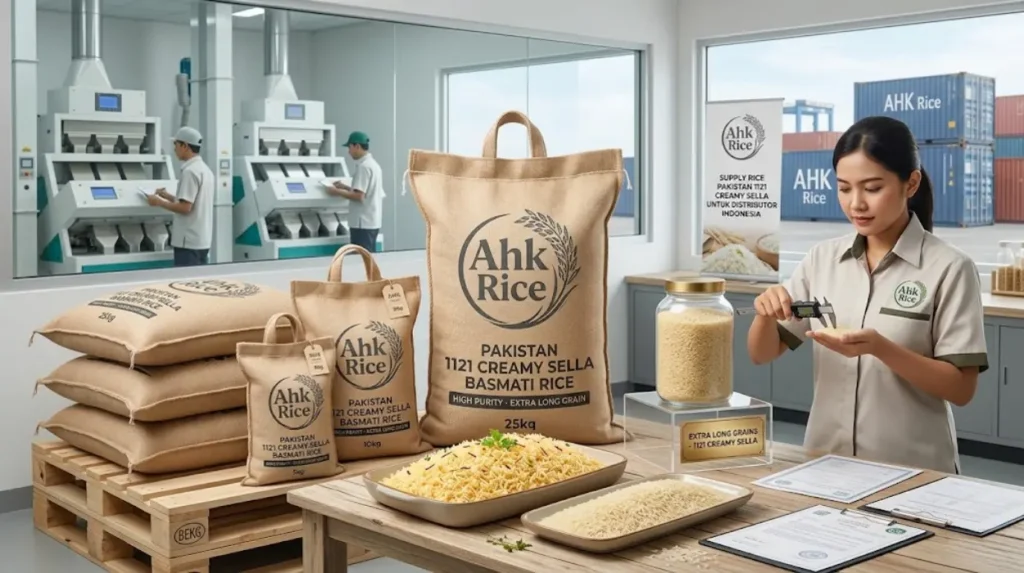
AHK Rice combines Punjab sourcing with processing, grading, sorting, customized packaging, inspection support, and export documentation. This gives Indonesian distributors one commercial workflow from product approval through container dispatch.
AHK Rice — Pakistan Basmati Rice Export Service
AHK Rice operates from Bucheki, Nankana Sahib, Punjab, a major rice-growing region. The company supplies 1121, Super Kernel, and 1509 Basmati varieties. Its published service model covers processing, grading, colour sorting, customized packaging, and export documentation.
Quality control should begin before loading. AHK Rice states that shipments can undergo pre-shipment inspection through organizations such as SGS and Bureau Veritas. Buyers can therefore make inspection part of the purchase specification rather than treating it as an afterthought.
The commercial advantage is specification continuity. A distributor can approve one reference sample, reproduce its measurable characteristics in the contract, and inspect the production lot before container loading.
With supplier capability established, the next question is what operational results Indonesian distributors can expect.
What results can be expected from the supply program?
Indonesian distributors can expect more consistent cooking performance, controlled grain presentation, clearer procurement specifications, and a structured export workflow when the approved specification is maintained. These outcomes protect resale quality and purchasing decisions.
Creamy Sella’s parboiled structure supports firm grains and separation during cooking. A restaurant distributor can therefore position the product for biryani, pulao, buffet rice, and other high-volume applications. Retail distributors can emphasize extra-long grain and lighter appearance.
A distributor can also use multiple pack sizes to address different channels. Larger bags can serve foodservice customers, while smaller packs can support retail distribution. AHK Rice states that customized packaging is available for export orders.
How long does shipping to Indonesia take?
Allow approximately 14–21 days of sea transit after dispatch planning, while the complete order cycle can reach about 4–6 weeks from purchase confirmation. Production, documentation, port handling, vessel schedules, and destination clearance affect the total timeline.
| Indonesian destination | Planning range |
|---|---|
| Jakarta / Tanjung Priok | About 15–20 days sea transit |
| Surabaya | About 15–20 days sea transit |
| Broader Pakistan–Indonesia sailing | About 18–28 days |
AHK Rice has published a broader workflow of production, documentation, port clearance, and sea transit. Another current Pakistan export reference gives 18–28 days for Indonesia depending on destination and vessel movement.
Distributors should therefore plan inventory against a range rather than a single arrival date. Vessel schedules, transshipment, congestion, customs processing, and inland delivery can extend the final timeline.
With expected performance and transit planning defined, pricing becomes the next commercial decision.
What factors affect the price of 1121 Creamy Sella?
1121 Creamy Sella pricing depends on crop year, grain specification, broken percentage, moisture, quantity, packaging, inspection, freight, destination port, and Incoterm. FOB price alone cannot determine the distributor’s final margin.
A current published Pakistan market reference places 1121 Sella around US$1,135–1,175 per MT FOB Karachi. Golden Sella is listed slightly higher on that reference, while exact Creamy Sella pricing remains specification-dependent. These figures are indicative and require a confirmed quotation.
Landed cost should include the FOB or CFR/CIF rice value plus applicable freight, insurance, port charges, customs expenses, inspection, handling, and inland delivery. Indonesian import controls can also affect timing and documentation.
Indonesia’s regulatory framework requires buyers to verify the applicable import category, approvals, destination requirements, and documentation before shipment. Current Indonesian rules regulate agricultural imports including rice.
What does the sample process cost?
AHK Rice offers samples up to 20 kg without charging for the rice, while the buyer normally covers courier and Phytosanitary Certificate costs. Sample expenses can be waived in the final commercial quote after a successful order.
The complete sample process should follow these steps:
- Confirm the required variety, Creamy Sella grade, grain length, broken percentage, moisture, packaging, and destination.
- Prepare the representative rice sample against the requested specification.
- Test the sample for relevant physical and quality parameters.
- Arrange the Phytosanitary Certificate required for the sample shipment.
- Dispatch the sample through the buyer’s courier account or an agreed courier arrangement.
- Evaluate raw appearance, cooked elongation, aroma, separation, texture, and colour.
- Approve the commercial specification before bulk production.
- Inspect the finished lot before container loading.
The buyer should record the approved sample as the commercial reference. This prevents disputes caused by verbal descriptions such as “premium,” “extra-long,” or “low broken.”
With sampling and pricing clarified, the final step is converting approval into a shipment order.
How can Indonesian distributors get started?
Start with the destination port, required monthly volume, Creamy Sella specification, preferred packing, Incoterm, and inspection requirement. These details allow AHK Rice to prepare a commercially relevant quotation instead of a generic price.
A distributor should provide the destination port first. Jakarta and Surabaya can have different freight and handling conditions. The buyer should then state whether the requirement is FOB, CFR/CNF, or CIF.
The next step is defining quantity. Container volume affects the unit economics because freight and handling costs are distributed across the shipment. Repeat buyers can also structure procurement around scheduled replenishment rather than occasional spot purchases.
Packaging should follow the intended sales channel. A foodservice distributor may prefer larger PP woven bags. A retail distributor may require branded smaller packs, printed artwork, and destination-market labeling.
Inspection should also be agreed before production. The contract should identify the inspection organization, sampling method, specification tolerances, and point of inspection.
AHK Rice can then coordinate processing, packing, documentation, container loading, and shipment. Its Indonesian export material identifies a network of major shipping lines and supports both buyer-managed and supplier-managed freight arrangements.
The final decision should be based on landed cost, specification consistency, sample approval, and shipment reliability rather than FOB price alone.
What should distributors check before placing the bulk order?
Distributors should verify the approved sample, 1121 Creamy Sella grade, grain length, moisture, broken percentage, packaging, inspection terms, documents, Incoterm, destination port, and delivery timeline. These controls connect procurement with measurable outcomes.
Indonesia’s rice import framework can require information covering rice type, volume, broken level, origin, destination port, and applicable import authorization. Buyers should confirm current requirements with their Indonesian import and customs representatives.
A strong purchase order should therefore contain the exact specification. It should not rely solely on the phrase “1121 Creamy Sella.” The specification should identify measurable tolerances and packaging requirements.
The buyer should also align the shipment schedule with warehouse inventory. A 15–28-day sea-transit range still requires production and documentation time before the vessel departs.
AHK Rice provides a suitable sourcing model for distributors that need Pakistani Basmati, controlled processing, customized packing, inspection support, and export logistics in one workflow.
For a specification-based commercial quotation, request a customized price quotation.
Frequently Asked Questions
Is 1121 Creamy Sella suitable for Indonesian distributors?
Yes, it suits premium retail, restaurants, catering, and specialty Basmati distribution.
The grade combines 1121’s long grain with parboiled cooking performance.
Its lighter creamy appearance differs from deeper Golden Sella.
Buyers should approve cooking performance through a representative sample.
The final specification should be written into the purchase contract.
How long does Pakistan 1121 Creamy Sella take to reach Indonesia?
Sea transit commonly requires about 15–20 days on the stated Indonesia route.
Broader Pakistan–Indonesia sailing references show approximately 18–28 days.
Production and documentation add time before vessel departure.
The complete order cycle can reach about 4–6 weeks.
Distributors should plan inventory using a delivery range.
How much does 1121 Creamy Sella cost per MT?
Pricing depends on specification, volume, crop year, packing, freight, and Incoterm.
A current published 1121 Sella benchmark is about US$1,135–1,175/MT FOB Karachi.
Creamy Sella requires a specific quotation based on the agreed specification.
Landed Indonesian cost differs from FOB Pakistan pricing.
Buyers should compare complete landed cost before selecting a supplier.
How does AHK Rice handle samples?
AHK Rice can provide up to 20 kg of rice for sampling without charging for the rice.
The buyer normally covers courier and Phytosanitary Certificate expenses.
The buyer tests appearance, cooking, aroma, texture, and grain separation.
Approved samples become the reference for bulk production.
Sample-related charges can be addressed in the final commercial quotation.
What should Indonesian distributors specify before ordering?
Specify variety, Creamy Sella processing, grain length, moisture, broken percentage, packaging, inspection, destination, and Incoterm.
Confirm the destination port before freight pricing.
Approve a representative sample before bulk production.
Confirm Indonesian import documentation with the local importer.
Use the same specification for production and pre-shipment inspection.