How Should Indonesian Distributors Compare Pakistan Rice Suppliers for Supply Continuity?
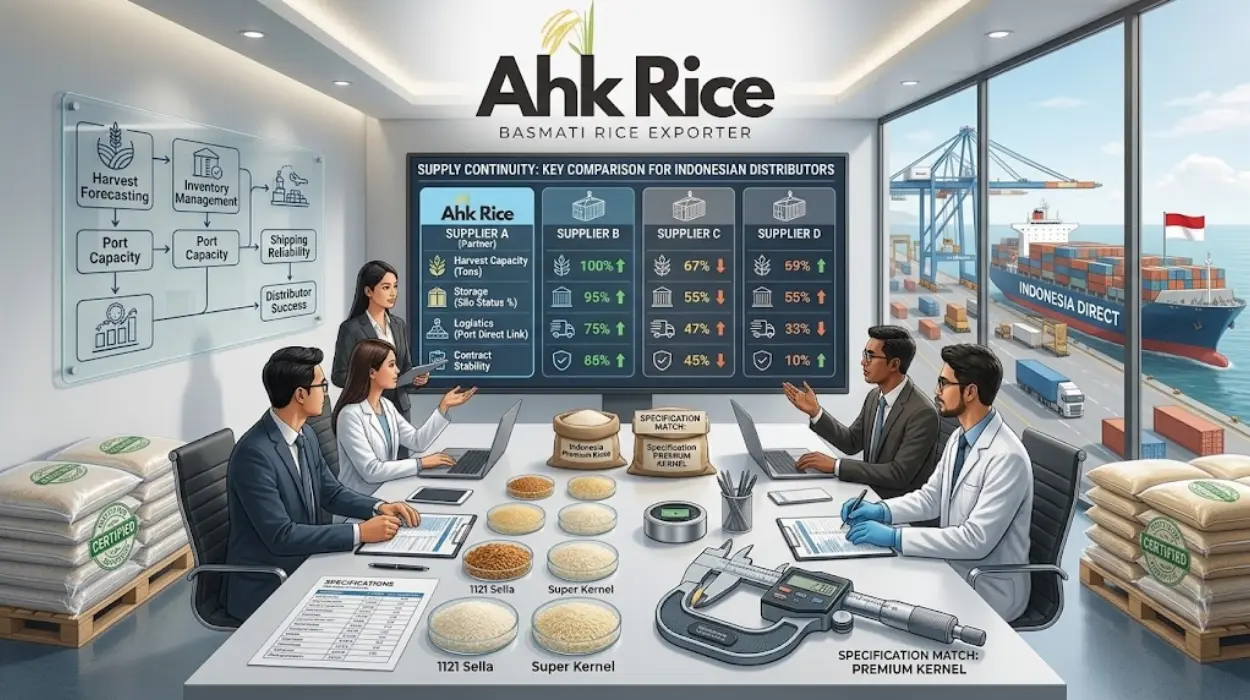
Indonesian distributors should compare Pakistan rice suppliers through contract reliability, processing capacity, stock availability, and export documentation. A supplier with consistent specifications and repeatable dispatch schedules offers stronger supply continuity than a supplier competing only on price. Here is why: Indonesian distributors need predictable rice arrivals, stable cooking performance, and manageable inventory costs across multiple distribution cycles.
Supply continuity connects procurement, milling, quality inspection, packaging, shipping, and import clearance. A distributor buying 500 MT monthly needs more than an attractive quotation. The supplier must maintain agreed grain specifications, communicate production schedules, and coordinate shipments with Indonesian import requirements. This guide explains how to evaluate those capabilities and compare suitable supply methods.
What are the available solutions for Indonesian distributors?
Contract supply, scheduled purchasing, and spot procurement provide three main solutions for Indonesian distributors. Contract supply offers the strongest planning structure, scheduled purchasing balances flexibility with continuity, and spot procurement suits short-term requirements. Each approach connects purchasing decisions with stock levels, processing capacity, and shipping schedules.
Contract supply establishes an agreed purchasing relationship for a defined period. The agreement can specify rice variety, processing grade, packaging, quantity, price basis, and shipment schedule. A distributor ordering 1,000 MT quarterly gains a clearer procurement framework than a buyer requesting separate quotations for every shipment.
Scheduled purchasing separates a larger annual requirement into smaller shipment commitments. A distributor can plan 200 MT every month instead of receiving 2,400 MT in one shipment. This method supports warehouse planning and reduces the pressure of storing large quantities.
Spot procurement involves buying available rice for immediate or short-term requirements. The buyer compares current quotations and chooses a supplier based on price, specification, and dispatch readiness. Spot procurement works for urgent replenishment, but repeated reliance on it creates greater exposure to changing availability.
How does contract supply support continuity?
Contract supply connects a distributor’s forecast with a supplier’s production and dispatch schedule. The buyer defines expected monthly volumes and acceptable specification ranges. The supplier plans paddy procurement, milling, sorting, packaging, and shipment allocation around those requirements.
A 1,200 MT annual requirement can become twelve monthly shipments of 100 MT. This schedule gives both parties a measurable supply target. The distributor can compare planned arrivals against warehouse demand and identify shortages before they affect customers.
Contract supply also creates a framework for quality verification. The agreement can specify grain length, broken percentage, moisture, foreign matter, and packaging requirements. The buyer receives a consistent reference for comparing shipments across the contract period.
How does scheduled purchasing compare with spot procurement?
Scheduled purchasing gives distributors greater control over future inventory. Spot procurement gives buyers more freedom to change suppliers and volumes. The difference matters most when Indonesian wholesalers serve retailers with regular rice consumption.
A distributor with predictable demand benefits from scheduled purchasing. A buyer facing irregular demand benefits from spot procurement. The strongest procurement plan can combine both methods, using scheduled shipments for core demand and spot purchases for temporary shortages.
With the available purchasing methods established, the next question is how distributors should compare supplier specifications and commercial performance.
How should Indonesian distributors compare Pakistan rice suppliers?
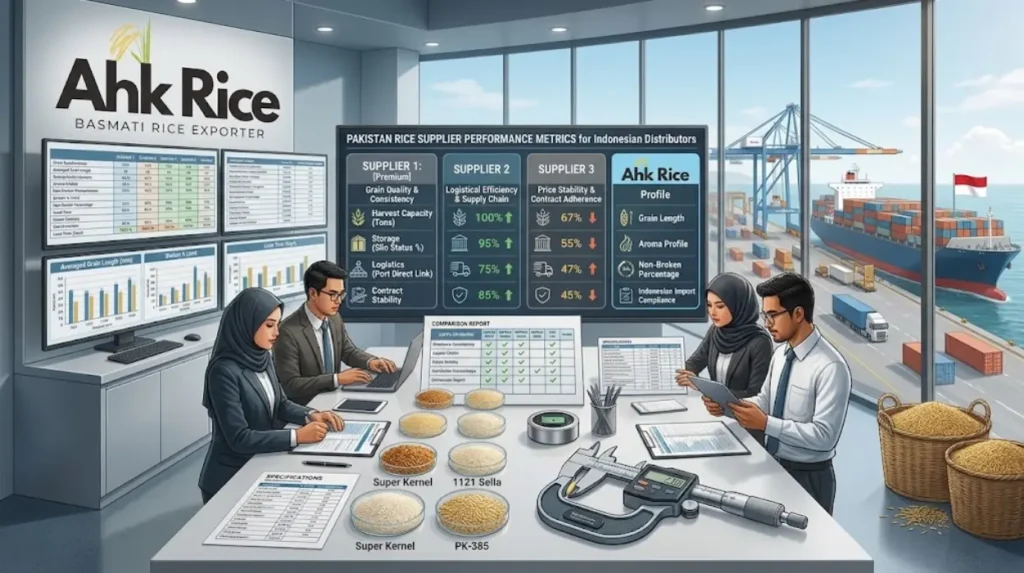
Indonesian distributors should compare suppliers across seven attributes: grain specification, processing consistency, supply capacity, quality verification, packaging, logistics, and commercial terms. A supplier’s lowest price does not establish the best value without evidence of reliable quality and repeatable delivery.
The following table provides a practical specification comparison for three common purchasing approaches. The values are planning examples, not guaranteed market quotations.
| Attribute | Contract supply | Scheduled purchasing | Spot procurement |
|---|---|---|---|
| Supply planning | Annual or quarterly commitment | Monthly or periodic orders | Immediate requirement |
| Volume example | 1,200 MT annually | 100 MT monthly | 20–100 MT per order |
| Specification control | Fixed contract specification | Order-based specification | Available stock specification |
| Price structure | Agreed price formula or quotation | Shipment-based quotation | Current market quotation |
| Quality verification | Pre-shipment and contract checks | Shipment-by-shipment checks | Available inspection records |
| Packaging | Planned retail or wholesale format | Order-specific format | Existing stock format |
| Continuity risk | Lower with reliable performance | Moderate | Higher |
Which rice specifications should buyers compare?
Grain specification describes the physical and cooking attributes that define a rice grade. Indonesian distributors should compare variety, grain length, broken percentage, moisture, foreign matter, and milling quality.
Pakistan 1121 Basmati is known for its long slender grain. Super Kernel Basmati offers a traditional aromatic profile and long grain appearance. Pakistan 1509 Basmati provides another long-grain option for buyers comparing retail and foodservice requirements.
The first product mention should connect readers to the supplier’s service page: AHK Rice Pakistan Basmati rice export and custom packaging services.
How do processing methods affect continuity?
Processing consistency determines whether repeated shipments maintain the same physical and cooking characteristics. Pakistani rice suppliers commonly mill, dehusk, polish, grade, sort, and package rice before export.
1121 Steam Basmati undergoes steam processing that supports a firm cooked grain and long appearance. 1121 Sella Basmati undergoes parboiling and drying, creating a different cooking texture and processing profile. 1509 Steam Basmati offers a long-grain steam-processed option for buyers comparing grade performance.
Distributors should request a processing specification sheet before approving a supplier. The sheet should identify variety, processing type, broken percentage, moisture, and packaging. A consistent specification reduces the risk of receiving a different grade during later shipments.
How should buyers verify supplier capacity?
Supply capacity describes the quantity a supplier can process, pack, and dispatch within an agreed period. A supplier offering 1,000 MT annually must demonstrate a practical production and logistics plan for that volume.
Capacity verification should cover milling throughput, available paddy, warehouse storage, packaging equipment, and export dispatch arrangements. The buyer should also review previous shipment records and the supplier’s ability to manage repeated orders.
AHK Rice supplies 1121, Super Kernel, and 1509 varieties from Punjab to more than 15 countries. Its end-to-end processing and custom packaging services support distributors comparing integrated supply arrangements.
With supplier capacity and product specifications established, the next step is comparing market requirements and the cost of maintaining inventory.
Which Pakistan rice grades suit different Indonesian market regions?
Western Indonesia generally benefits from consistent wholesale specifications, while Eastern Indonesia requires stronger inventory planning because longer distribution routes increase the importance of shipment timing. Both regions can use the same rice grades, but demand patterns and warehouse conditions influence the best purchasing method.
Indonesia is an archipelago with major commercial centres across Java, Sumatra, Kalimantan, Sulawesi, and Papua. Distribution distance affects domestic freight, inventory allocation, and replenishment timing. A supplier’s export schedule must therefore align with the distributor’s local warehouse network.
What should distributors in Western Indonesia prioritize?
Western Indonesia includes major distribution centres such as Jakarta, Surabaya, and Medan. Buyers serving these markets should prioritize consistent quality, regular shipment schedules, and packaging suitable for wholesale and retail distribution.
1121 Steam Basmati suits buyers seeking long grain appearance and firm cooked rice. Super Kernel Basmati suits buyers seeking an aromatic long-grain option. 1509 Steam Basmati suits distributors comparing value-oriented long-grain products.
A distributor receiving 100 MT monthly can compare these grades through a standardized sample test. The test should record cooked grain length, aroma, texture, broken percentage, and packaging performance.
What should distributors in Eastern Indonesia prioritize?
Eastern Indonesia includes markets such as Makassar, Ambon, Jayapura, and surrounding distribution areas. Buyers serving these locations should prioritize reliable shipment planning, suitable packaging, and sufficient warehouse stock.
Golden Sella Basmati offers a parboiled option for distributors comparing cooking performance and storage planning. 1121 Steam Basmati offers a different texture and processing profile. Super Kernel Basmati supports buyers comparing aroma and long-grain characteristics.
A distributor serving Eastern Indonesia can maintain a larger safety stock for products with longer replenishment routes. The correct stock level depends on demand, domestic freight, warehouse capacity, and supplier dispatch reliability.
How should price per MT compare across regions?
Price per MT means the total rice cost for one metric tonne under a defined commercial basis. Buyers must distinguish FOB pricing from CIF pricing. FOB covers the supplier’s export delivery to the agreed loading point. CIF includes cost, insurance, and freight to the destination port.
The following examples use illustrative quotations to explain the comparison method. They are not live market prices.
| Grade | Western Indonesia FOB example | Eastern Indonesia CIF example |
|---|---|---|
| 1121 Steam | $950–$1,050/MT | $1,030–$1,150/MT |
| 1121 Sella | $960–$1,070/MT | $1,040–$1,170/MT |
| Super Kernel | $900–$1,020/MT | $980–$1,120/MT |
| 1509 Steam | $850–$950/MT | $930–$1,050/MT |
The examples show how freight and destination costs affect landed pricing. A distributor should compare the same grade, packaging, quantity, and commercial basis across suppliers.
How should shelf life affect inventory decisions?
Shelf life describes the period rice maintains acceptable quality under specified storage conditions. The supplier should state the applicable storage conditions and product shelf-life information.
A distributor storing rice for 6 months requires different planning from a buyer holding stock for 12 months. Warehouse temperature, humidity, packaging, and pest control affect quality preservation.
For example, a distributor comparing 1121 Steam and 1121 Sella should request the supplier’s documented shelf-life specification for each processing type. The buyer should not assume that every processing grade has the same storage performance.
With regional purchasing requirements and cost comparisons established, the next question is which supply method offers the strongest fit for each distributor.
Which supply method works best for different Indonesian distributors?
Contract supply works best for distributors with predictable demand, scheduled purchasing suits buyers with moderate flexibility, and spot procurement suits urgent replenishment. The correct method depends on forecast accuracy, storage capacity, working capital, and the consequences of delayed shipments.
When should distributors choose contract supply?
Contract supply suits distributors serving retail chains, foodservice groups, and established wholesale networks. These buyers often know their expected monthly demand and can plan inventory before placing orders.
A distributor requiring 1,200 MT annually can negotiate a 12-month supply arrangement. The agreement can define 100 MT monthly shipments, approved grades, packaging, and quality inspection requirements.
Contract supply reduces repeated quotation work and creates a framework for resolving quality or delivery disputes. The buyer still needs to evaluate the supplier’s production performance and contract terms before committing.
When should distributors choose scheduled purchasing?
Scheduled purchasing suits distributors with regular but changing demand. A buyer can commit to quarterly volumes while adjusting shipment quantities based on sales performance.
A distributor expecting 600 MT over six months can plan 100 MT monthly shipments. The buyer can increase the next shipment after stronger sales or reduce it after slower demand.
Scheduled purchasing offers a balance between continuity and flexibility. It works best when the supplier accepts clear order schedules and maintains consistent specifications.
When should distributors choose spot procurement?
Spot procurement suits buyers needing short-term stock. A distributor facing an unexpected retail order can purchase available rice without entering a long-term contract.
Spot procurement can provide competitive pricing during favourable market conditions. However, the buyer must verify the available grade, packaging, quality records, and dispatch schedule before ordering.
Spot procurement works poorly as the sole strategy for distributors with predictable high-volume demand. Repeated spot purchases increase exposure to price changes and availability constraints.
With the three purchasing methods compared, the next section examines their advantages and limitations through practical examples.
What are the pros and cons of each supply approach?
Contract supply provides the strongest planning structure but reduces purchasing flexibility. Scheduled purchasing balances control and adaptability, while spot procurement offers speed but creates greater continuity risk. Distributors should compare these trade-offs against their actual demand and warehouse conditions.
What are the advantages of contract supply?
Contract supply offers predictable purchasing arrangements and clearer quality expectations. A distributor can plan annual demand and negotiate a consistent specification with the supplier.
Contract supply also supports better coordination between production and shipping. The supplier can schedule milling, packaging, inspection, and dispatch around agreed shipment dates.
The main limitation is reduced flexibility. A distributor committing to 1,200 MT annually must manage the commercial consequences of lower demand. Contract terms should therefore define shipment adjustments and order quantities.
What are the advantages of scheduled purchasing?
Scheduled purchasing offers flexibility without abandoning regular supply planning. The buyer can plan monthly shipments while adjusting quantities according to demand.
The main limitation is the need for accurate communication. Late order confirmations or changing specifications can disrupt production and dispatch schedules.
A distributor should establish a written ordering calendar. The calendar should include order confirmation dates, production deadlines, inspection dates, and shipment windows.
What are the advantages of spot procurement?
Spot procurement offers immediate access to available stock. The buyer can compare current quotations and purchase the required quantity without a long-term commitment.
The main limitation is uncertainty over future availability. The supplier may not have the same grade or packaging available during the next purchasing cycle.
Spot procurement works best as a supplementary method. A distributor can use scheduled shipments for core demand and spot purchases for short-term shortages.
With the advantages and limitations established, the next section identifies the factors that should determine the final supplier decision.
What decision factors should Indonesian distributors use?
Indonesian distributors should prioritize specification consistency, capacity, quality verification, logistics, and commercial transparency. These factors connect the supplier’s operational performance with the distributor’s ability to maintain stock and serve customers.
How should buyers evaluate supplier quality?
Quality evaluation should begin with a documented product specification. The specification should identify variety, processing type, grain length, broken percentage, moisture, foreign matter, and packaging.
The buyer should request samples and compare them through a standardized cooking test. The test should record cooked grain length, aroma, texture, and appearance.
How should buyers evaluate logistics?
Logistics evaluation should cover production lead time, export documentation, container planning, port handling, and expected shipment timing. The supplier should explain the process from order confirmation to dispatch.
A distributor should compare the supplier’s estimated shipment schedule with its own warehouse replenishment requirements. A reliable schedule reduces the risk of stockouts.
How should buyers evaluate commercial terms?
Commercial evaluation should distinguish FOB, CIF, and other agreed pricing bases. The buyer should compare the same grade, quantity, packaging, and destination across suppliers.
The supplier should also provide clear payment terms and documentation requirements. Transparent commercial terms reduce unexpected costs during procurement.
How should buyers evaluate contract flexibility?
Contract flexibility describes the buyer’s ability to adjust quantities, shipment dates, and approved specifications. A distributor with changing demand needs more flexibility than a buyer with fixed monthly orders.
The contract should define permitted changes and the required notice period. Clear terms reduce disputes and support more predictable supply planning.
How should buyers evaluate supplier communication?
Communication affects every stage of the supply chain. The supplier should provide timely updates on production, quality inspection, packaging, and dispatch.
A distributor should identify a responsible contact for order coordination. Regular communication helps the buyer respond to delays before they affect customer deliveries.
The following framework converts these factors into a practical supplier comparison tool.
| Decision factor | Question to ask | Evidence to request | Priority |
|---|---|---|---|
| Specification consistency | Can the supplier repeat the same grade? | Product specification and sample test | High |
| Supply capacity | Can the supplier fulfil planned volumes? | Capacity details and shipment history | High |
| Quality verification | How does the supplier inspect rice? | Inspection records and quality reports | High |
| Logistics | Can the supplier meet shipment windows? | Production and dispatch schedule | High |
| Commercial terms | Are price and contract terms transparent? | Quotation and contract draft | High |
A distributor can score each supplier from 1 to 5 for every factor. The total score creates a structured comparison instead of relying on price alone.
How should Indonesian distributors build a reliable Pakistan rice supply plan?
A reliable supply plan combines a defined rice specification, a realistic demand forecast, scheduled shipments, documented quality checks, and clear commercial terms. This approach gives distributors a practical framework for comparing suppliers and reducing supply interruptions.
The first step is to define the required grade and packaging. The distributor should specify whether it needs 1121 Steam, 1121 Sella, Super Kernel, or 1509 Steam. The specification should also include broken percentage, moisture, foreign matter, and packaging format.
The second step is to calculate annual and monthly demand. A distributor requiring 1,200 MT annually can use a monthly planning figure of 100 MT. This figure becomes the starting point for supplier capacity discussions.
The third step is to compare quotations on the same commercial basis. The buyer should compare FOB with FOB or CIF with CIF. Mixing pricing bases creates inaccurate comparisons.
The fourth step is to approve a sample before confirming the commercial order. The sample should represent the proposed grade and processing type. The buyer should record the results of the cooking and physical quality checks.
The fifth step is to establish shipment milestones. The supplier should provide order confirmation, production, inspection, packaging, and dispatch dates. These milestones help the distributor track progress.
The sixth step is to define contract terms. The agreement should cover quantity, quality, price basis, packaging, payment, shipment timing, and dispute procedures.
AHK Rice supports distributors comparing Pakistani Basmati rice supply through 1121, Super Kernel, and 1509 varieties. Its Punjab-based processing and export operations provide a basis for evaluating integrated supply arrangements.
What should Indonesian distributors do next?
Indonesian distributors should compare suppliers through a documented specification and procurement plan before choosing a long-term supply arrangement. The best supplier is the one that matches product quality, capacity, logistics, and commercial terms with the distributor’s actual demand.
Contract supply suits distributors with predictable annual demand. Scheduled purchasing suits buyers needing flexibility within regular shipments. Spot procurement suits urgent requirements and supplementary stock.
A supplier comparison should begin with product samples and a clear quotation. The buyer should then evaluate capacity, inspection procedures, packaging, and shipment planning. This process creates a stronger foundation for repeat purchasing.
Frequently Asked Questions
What is the best Pakistan rice grade for Indonesian distributors?
1121 Steam, 1121 Sella, Super Kernel, and 1509 Steam suit different purchasing requirements. Distributors should compare grain appearance, cooking texture, aroma, broken percentage, and price before selecting a grade.
How can Indonesian distributors maintain rice supply continuity?
Distributors can maintain continuity through demand forecasting, scheduled purchasing, supplier capacity verification, and documented shipment planning. A contract arrangement provides a stronger planning structure for regular high-volume demand.
What should buyers compare in Pakistan rice supplier quotations?
Buyers should compare rice variety, processing type, quality specification, packaging, quantity, FOB or CIF pricing, payment terms, and shipment schedule. The same comparison basis is essential for accurate supplier evaluation.
Is contract supply better than spot procurement?
Contract supply suits distributors with predictable demand and regular shipments. Spot procurement suits urgent replenishment. A combined approach can support core demand through scheduled supply and short-term needs through spot purchases.
How should Indonesian distributors check rice quality before ordering?
Distributors should request a representative sample and product specification. The evaluation should cover grain length, broken percentage, moisture, foreign matter, cooking texture, aroma, and appearance.