AHK Rice Pakistan Contract Basmati Supply for Indonesian Distributors
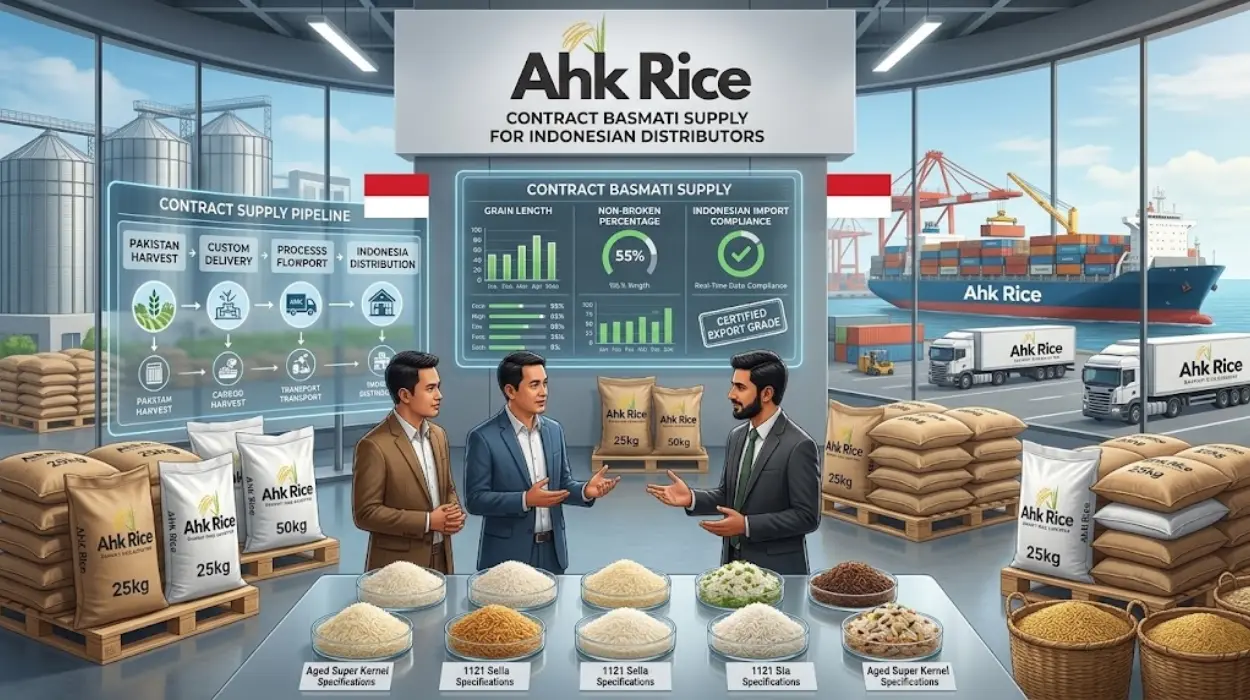
AHK Rice Pakistan contract Basmati supply gives Indonesian distributors a structured way to secure consistent rice grades, planned shipment schedules, and repeatable quality specifications. Here is why: contract supply connects annual demand forecasts with agreed grades, packaging, inspection, and dispatch planning. This reduces the uncertainty of buying separate shipments from different suppliers.
Indonesian distributors need continuity across retail, wholesale, and foodservice channels. A single delayed shipment can interrupt customer orders and increase replacement costs. The right supplier therefore provides more than rice. The supplier provides a repeatable procurement process. This article explains the contract supply model, suitable Basmati grades, sample costs, shipping timelines, and the decision process for Indonesian buyers.
What is the best solution for Indonesian distributors needing consistent Basmati supply?
Annual contract supply with agreed specifications, scheduled shipments, and quality verification provides the strongest solution for Indonesian distributors managing recurring Basmati demand. Here is why: contract planning connects procurement with inventory requirements, while documented specifications make each shipment easier to evaluate.
The main problem is supply variation. Different suppliers can offer different grain lengths, moisture levels, broken percentages, and processing standards. A distributor then faces inconsistent cooking performance and changing customer expectations. Contract supply addresses this problem through a single agreed specification.
The educational article [Why Does Annual Supply Consistency Matter to Indonesian Basmati Rice Distributors?] should be read before setting the contract quantity. It explains why continuity matters for distributors managing recurring customer orders.
Which Basmati grades suit Indonesian distribution contracts?
1121, Super Kernel, and 1509 Basmati provide three practical grade options for Indonesian distributors seeking differentiated retail and wholesale products. Here is why: each grade supports a different balance of grain appearance, product positioning, and purchasing requirements.
| Grade | Main commercial use | Contract specification |
|---|---|---|
| 1121 Basmati | Premium retail and foodservice | Long grain, aroma, low broken percentage |
| Super Kernel Basmati | Premium and mainstream distribution | Grain uniformity, aroma, cooking performance |
| 1509 Basmati | Mid-premium retail and wholesale | Competitive pricing, long grain, consistent processing |
1121 Basmati supports premium positioning through its long grain appearance and aromatic cooking profile. Super Kernel Basmati offers another premium option for distributors seeking a recognizable Pakistani Basmati variety. 1509 Basmati provides a practical choice for price-sensitive channels.
The contract should specify the selected grade, processing type, broken percentage, moisture, packaging, and shipment quantity. These details create a measurable purchasing standard.
With the contract requirements established, the next question is how AHK Rice can support the complete supply process.
Why choose AHK Rice for Indonesian Basmati contract supply?

AHK Rice connects Pakistani Basmati sourcing with processing, packaging, inspection, and export coordination for Indonesian distributors. Here is why: a coordinated supply process reduces the number of separate procurement decisions required for recurring shipments.
AHK Rice supplies Pakistani Basmati rice from Punjab and supports export requirements through its Basmati rice export service. The service includes product sourcing, processing, custom packaging, and export coordination.
What does the contract supply process include?
A documented contract should define the rice grade, processing standard, quantity, packaging, delivery schedule, and inspection requirements before production begins. Here is why: each requirement becomes a reference point for evaluating the finished shipment.
AHK Rice can structure the procurement process around the distributor’s annual demand. The buyer selects the required grade and processing type. The supplier then confirms the specification and prepares the commercial quotation.
The contract should include these core details:
- Grade specification
- Processing type
- Broken percentage
- Moisture requirement
- Packaging format
- Contract quantity
- Shipment schedule
- Inspection arrangement
- Payment terms
- Delivery terms
Contract planning works best when the distributor provides realistic demand estimates. A buyer ordering 20 tonnes monthly needs a different shipment structure from a buyer ordering 200 tonnes quarterly.
The next step is understanding how the supplier verifies the rice before dispatch.
How does AHK Rice verify Basmati quality before shipment?
Quality verification should cover grain appearance, moisture, broken percentage, processing consistency, packaging, and shipment documentation. Here is why: these attributes influence product acceptance, storage performance, and customer satisfaction.
Which quality attributes matter most?
Grain length, broken percentage, moisture, and processing consistency are central specifications for repeat Basmati procurement. Here is why: distributors need the same product characteristics across multiple shipments.
1121 Basmati should be evaluated against the agreed grain specification. Super Kernel Basmati requires consistent grain appearance and processing. 1509 Basmati should meet the agreed commercial grade and broken percentage.
Moisture control supports storage stability. Broken percentage influences product appearance and cooking performance. Colour sorting helps remove visibly discoloured grains and foreign material. Packaging protects the rice during handling and shipment.
AHK Rice can coordinate quality checks around the agreed contract specification. The buyer should confirm the inspection scope before production begins.
What documents should Indonesian distributors request?
Commercial invoices, packing lists, certificates of origin, and applicable inspection documents support a traceable export shipment. Here is why: complete documentation helps the importer verify the shipment against the purchase contract.
The exact documentation depends on the agreed trade terms and Indonesian import requirements. The importer should confirm customs, food safety, and labelling requirements before shipment.
With quality and documentation defined, the next question is how the contract performs in practical shipment planning.
What results can Indonesian distributors expect from contract supply?
Contract supply can improve procurement predictability, reduce repeated specification negotiations, and support more consistent product availability. Here is why: the buyer and supplier establish a repeatable process before each shipment.
How does contract supply improve distribution planning?
Scheduled shipments help distributors align imported rice with expected sales, warehouse capacity, and customer orders. Here is why: procurement decisions become part of the annual distribution plan instead of isolated purchases.
A distributor supplying supermarkets may require regular shipments of 1121 Basmati. A wholesale distributor may prefer larger quarterly shipments of Super Kernel or 1509. The contract can reflect these different demand patterns.
Contract supply does not eliminate every logistics risk. Port congestion, customs delays, and changes in import requirements can still affect delivery. Buyers should therefore include realistic shipment windows and communication procedures.
How should Indonesian distributors compare suppliers?
Supplier comparison should focus on specification control, shipment planning, documentation, and repeat-order capability rather than price alone. Here is why: a lower initial price does not compensate for inconsistent quality or missed delivery dates.
The related consideration-stage article, [How Should Indonesian Distributors Compare Pakistan Rice Suppliers for Supply Continuity?], provides a framework for evaluating supplier performance. Use that comparison before selecting the final contract partner.
| Decision factor | Buyer requirement |
|---|---|
| Grade consistency | Same agreed grade across shipments |
| Quality control | Documented inspection process |
| Packaging | Agreed bag size and material |
| Shipment planning | Defined dispatch schedule |
| Commercial terms | Clear price and payment conditions |
A practical decision should compare the complete landed cost and supply reliability. This approach gives the distributor a clearer basis for choosing the contract structure.
What affects the price of contract Basmati supply?
Contract Basmati pricing depends on grade, processing type, quantity, packaging, inspection, freight, and agreed delivery terms. Here is why: each specification adds a measurable production or logistics requirement.
Which factors influence the quotation?
Grade selection and processing requirements create the first major pricing differences between contract options. Here is why: premium grades and additional processing can increase production costs.
1121 Basmati generally serves premium channels. Super Kernel provides another premium specification. 1509 Basmati can support distributors seeking a competitive price point.
Packaging also affects the quotation. Standard commercial bags may suit wholesale distribution. Custom retail packaging requires additional artwork, printing, material, and production coordination.
Freight depends on the shipment size, destination port, carrier, and agreed trade term. FOB pricing excludes the buyer’s ocean freight and destination costs. CIF pricing includes freight and insurance to the agreed destination port.
What sample costs should buyers expect?
A sample quotation should separate rice cost, packaging, inspection, freight, and destination charges so the distributor can compare suppliers accurately. Here is why: a single combined price can hide differences in specifications or delivery terms.
The following figures are illustrative planning examples, not live AHK Rice quotations.
| Cost component | Example amount |
|---|---|
| Basmati rice | USD 1,050 per MT |
| Custom packaging | USD 25 per MT |
| Inspection and documentation | USD 10 per MT |
| Ocean freight | USD 65 per MT |
| Example CIF total | USD 1,150 per MT |
For a 20 MT shipment, the illustrative CIF value equals USD 23,000. Actual pricing depends on the confirmed grade, packaging, shipment date, and destination port.
The buyer should request a written quotation with the specification and delivery term stated clearly. This prevents price comparisons between different product standards.
With the pricing structure understood, the next question is how Indonesian distributors should start the contract.
How can Indonesian distributors get started with AHK Rice?
Indonesian distributors should begin with a demand forecast, grade selection, sample approval, and written contract specification. Here is why: each step reduces uncertainty before the buyer commits to recurring shipments.
What information should the buyer provide?
The buyer should provide annual quantity, preferred grade, packaging format, destination port, and required shipment schedule. Here is why: these details allow the supplier to prepare a commercially relevant quotation.
A distributor should also state the intended market. Retail buyers may require custom printed packaging and consumer-facing labelling. Wholesale buyers may prioritize larger bags and efficient warehouse handling. Foodservice buyers may focus on cooking consistency and bulk delivery.
What is the sample approval process?
A practical sample process includes specification confirmation, sample preparation, inspection, buyer approval, and contract finalization. Here is why: sample approval gives the buyer a reference product before the larger shipment.
- Confirm the grade and processing type.
- Confirm the required packaging.
- Request the sample specification.
- Review grain appearance and cooking performance.
- Approve the sample.
- Confirm the contract quantity.
- Agree the shipment schedule.
- Finalize payment and delivery terms.
Sample costs depend on the requested quantity, packaging, courier service, and inspection requirements. The supplier should confirm these costs before dispatching the sample.
How long does shipping to Indonesia take?
A realistic shipping plan should allow for production, export documentation, port handling, ocean transit, and Indonesian customs clearance. Here is why: the full delivery timeline extends beyond the vessel’s ocean transit.
For planning purposes, Indonesian distributors can use the following indicative timeline:
| Stage | Planning duration |
|---|---|
| Contract and production | 10–20 days |
| Export documentation | 3–7 days |
| Port handling and loading | 3–7 days |
| Ocean transit | 20–35 days |
| Destination clearance | 5–10 days |
The complete planning window is approximately 41–79 days. Actual delivery depends on the departure port, destination port, vessel schedule, customs requirements, and shipment readiness.
The supplier should confirm the dispatch date and estimated arrival window before the buyer places the purchase order.
What is the final decision for Indonesian Basmati distributors?
Indonesian distributors should choose contract supply when recurring demand, consistent specifications, and planned shipment schedules matter more than one-time purchasing flexibility. Here is why: a documented supply relationship supports repeat procurement and clearer commercial planning.
AHK Rice offers a practical route for distributors sourcing Pakistani Basmati rice. The buyer can select 1121, Super Kernel, or 1509 Basmati, then define the required processing, packaging, inspection, and delivery terms.
The final decision should follow the sample approval and written quotation. The buyer should compare the complete commercial terms, not only the rice price.
Contact AHK Rice to discuss your Indonesian distribution requirements and request a contract supply quotation.
Frequently Asked Questions
What are the benefits of buying Pakistani Basmati rice through an annual supply contract?
An annual supply contract helps Indonesian distributors plan recurring rice purchases with clearer specifications and shipment schedules. AHK Rice can supply 1121, Super Kernel, and 1509 Basmati according to agreed requirements. The contract also supports consistent packaging, quality checks, and commercial planning. This approach reduces the need to negotiate every shipment separately. Buyers should confirm quantities, delivery terms, and inspection requirements before signing.
Which Pakistani Basmati rice grade is best for Indonesian distributors?
The best grade depends on the distributor’s customer segment and selling price. 1121 Basmati suits premium retail and foodservice buyers seeking long, aromatic grains. Super Kernel Basmati supports premium distribution with consistent grain appearance. 1509 Basmati offers a practical option for mid-premium and price-sensitive markets. AHK Rice can help buyers compare these grades against their intended applications.
How much does contract Basmati rice supply from Pakistan to Indonesia cost?
Contract pricing depends on the rice grade, processing type, order quantity, packaging, inspection, and delivery terms. Custom retail packaging can increase the cost per metric tonne. FOB and CIF quotations also include different logistics expenses. Indonesian distributors should request a complete quotation showing rice, packaging, freight, and applicable charges. The final price becomes clear after the supplier confirms the shipment specification.
How long does it take to ship Basmati rice from Pakistan to Indonesia?
A complete shipment plan includes production, export documentation, port handling, ocean transit, and destination clearance. A practical planning window is approximately 41–79 days, depending on the route and shipment requirements. Ocean transit alone commonly takes several weeks. AHK Rice can coordinate dispatch planning around the agreed contract schedule. Buyers should confirm estimated loading and arrival dates before placing an order.
How can Indonesian distributors start a Basmati rice supply contract with AHK Rice?
Start by sharing your annual demand, preferred Basmati grade, packaging format, and destination port. AHK Rice can then prepare a quotation based on the required specification. Buyers should review the sample, confirm quality requirements, and approve the commercial terms. The contract should define quantity, price, payment, inspection, and shipment schedules. This process gives distributors a clear foundation for recurring Pakistani Basmati rice procurement.