How to Evaluate a Basmati Rice Sample Before Ordering
The most reliable way to evaluate a Basmati rice sample is to compare physical specifications, cooking performance, purity, and commercial terms against your purchase requirements. Here is why: a sample that looks attractive can still fail during cooking, storage, or commercial quality inspection. A structured evaluation identifies these differences before you commit to a shipment.
Basmati rice buyers need more than a visual inspection. Grain length, moisture, broken percentage, aroma, texture, and processing quality determine the product’s value. Your sample should represent the grade, crop year, and processing specification stated in the supplier’s offer.
What Makes Pakistan Basmati Rice Suitable for Indonesian Buyers? explains the broader quality characteristics that influence sourcing decisions. This educational foundation helps buyers understand why sample testing matters before comparing suppliers, grades, and commercial offers.
What Should You Check First When Evaluating a Basmati Rice Sample?
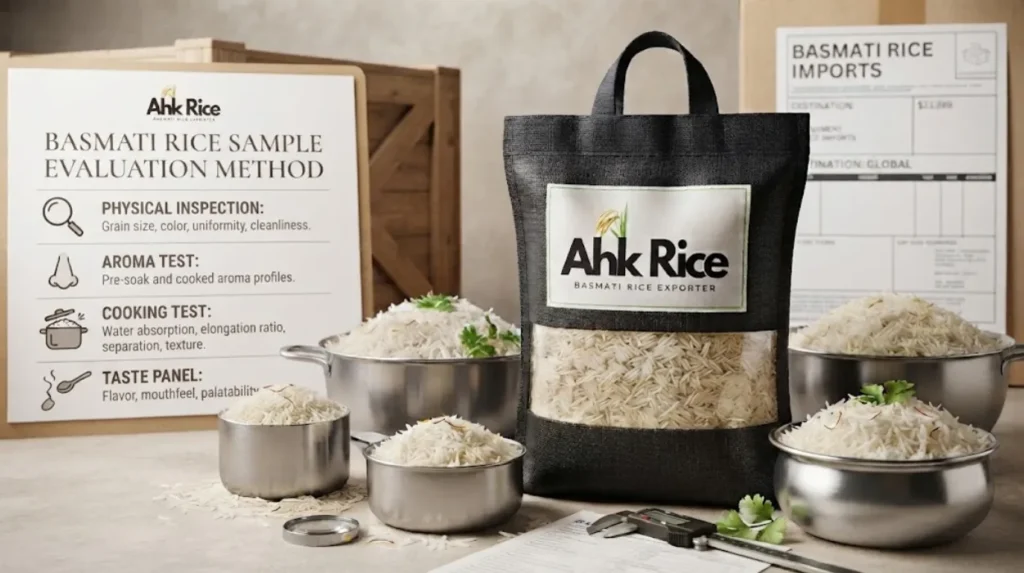
Check the sample identity, grain appearance, purity, moisture, broken percentage, aroma, and cooking performance before reviewing price. These checks establish whether the physical product matches the supplier’s stated specification.
Confirm the Sample Identity
A sample represents a specific product specification. Record the supplier name, variety, processing type, crop year, sample date, and stated grain length. Confirm whether the sample is 1121, Super Kernel, or 1509 Basmati rice.
The processing type also matters. Steam, Sella, and Golden Sella rice use different processing methods. These methods influence grain appearance, cooking texture, and storage characteristics.
Request a written specification alongside the sample. A specification defines the measurable requirements for the shipment. It prevents confusion between a premium sample and a lower-grade commercial order.
Inspect Grain Appearance
Grain appearance reveals differences in milling, sorting, and physical quality. Examine the sample under consistent lighting. Spread approximately 100 grams of rice on a clean, flat surface.
Check the following characteristics:
- Grain length and uniformity
- Grain width and shape
- Colour consistency
- Chalky or immature grains
- Broken grains
- Red, yellow, or discoloured grains
- Foreign matter
- Insect damage
Long, uniform grains support consistent cooking and attractive presentation. However, appearance alone does not prove aroma, texture, or purity.
Measure Moisture and Broken Percentage
Moisture measures the water content in rice. It affects storage stability, milling performance, and cooking results. Use a calibrated moisture meter to obtain a repeatable reading.
Broken percentage measures the proportion of broken rice within the sample. A higher broken percentage changes cooking behaviour and reduces the proportion of whole grains.
A practical commercial sample report records moisture, broken percentage, foreign matter, damaged grains, and chalky grains. The buyer can then compare the results against the agreed shipment specification.
With the basic inspection complete, the next step is comparing the physical and processing characteristics of available Basmati grades.
How Do Pakistani Basmati Rice Grades Compare in Sample Evaluation?
1121, Super Kernel, and 1509 differ in grain profile, processing performance, and market positioning. Compare each grade against your required cooking result, customer segment, and purchase specification.
1121 Basmati Rice
1121 Basmati is a long-grain variety widely used in premium retail, foodservice, and export markets. Its long grain profile supports an attractive cooked presentation.
1121 Steam undergoes steam treatment before drying and milling. The process supports a distinct cooked texture and grain appearance.
1121 Sella undergoes parboiling before drying and milling. Parboiling changes the grain structure and supports firmer cooked grains.
Golden Sella is a parboiled Basmati rice with a golden colour. Its appearance and cooking characteristics suit buyers seeking a distinctive rice presentation.
Super Kernel Basmati Rice
Super Kernel Basmati is a traditional long-grain Basmati variety associated with aromatic rice production in Pakistan. It provides a different grain profile from 1121.
Super Kernel samples should receive the same inspection as 1121. Examine grain uniformity, aroma, cooking texture, broken percentage, and processing consistency.
The variety offers a useful comparison for buyers serving customers who prefer traditional Basmati characteristics. The final choice depends on the required product specification.
1509 Basmati Rice
1509 Basmati is a long-grain variety used in export markets. It provides another option for buyers comparing grain appearance, processing type, and commercial value.
1509 Steam and 1509 Sella require separate sample evaluation. Processing changes the grain’s physical and cooking characteristics.
A buyer should not approve 1509 based only on its raw grain length. Cooking performance, broken percentage, and consistency across the sample determine its suitability.
Seven-Attribute Specification Comparison
| Attribute | 1121 Basmati | Super Kernel Basmati | 1509 Basmati |
|---|---|---|---|
| Variety | 1121 | Super Kernel | 1509 |
| Grain profile | Long grain | Traditional long grain | Long grain |
| Processing options | Steam, Sella, Golden Sella | Steam, Sella | Steam, Sella |
| Raw grain inspection | Length and uniformity | Length and uniformity | Length and uniformity |
| Cooking evaluation | Aroma, elongation, texture | Aroma, texture, separation | Aroma, elongation, texture |
| Common buyer focus | Premium presentation | Traditional Basmati profile | Value and grain performance |
| Sample comparison | Grade-specific specification | Grade-specific specification | Grade-specific specification |
The comparison shows why a single visual standard cannot determine the best grade. Each variety needs evaluation against its intended commercial use.
Which Sample Testing Methods Provide the Most Reliable Results?
A combined physical inspection, laboratory test, and cooking trial provides the strongest evaluation. Each method measures a different quality dimension, so no single test establishes complete commercial suitability.
Physical Inspection
Physical inspection examines the sample’s visible characteristics. Use a clean tray, consistent lighting, a scale, and a representative sample.
A 100-gram inspection identifies obvious differences in broken percentage, foreign matter, colour, and grain uniformity. A larger sample improves confidence in the result.
Laboratory Testing
Laboratory testing measures characteristics that visual inspection cannot establish accurately. Common tests include moisture, broken percentage, foreign matter, damaged grains, and other agreed quality parameters.
Use an accredited laboratory for contractual quality disputes or high-value purchases. A laboratory report provides measurable evidence for comparing suppliers.
Cooking Trial
Cooking trials reveal how the rice performs in the kitchen. Use the same water ratio, cooking method, soaking time, and cooking temperature for each sample.
Record the following results:
- Grain elongation
- Aroma
- Texture
- Separation
- Stickiness
- Cooking time
- Broken grains after cooking
- Appearance after cooling
A cooking trial becomes more useful when every supplier follows the same method. Consistent preparation prevents the cooking process from distorting the comparison.
Packaging and Storage Evaluation
Packaging protects rice during handling, transport, and storage. Inspect the sample packaging for material quality, sealing, labelling, and product identification.
A packaging trial also helps buyers compare retail and wholesale formats. The correct packaging depends on the destination market, distribution channel, and storage conditions.
The testing methods establish measurable quality differences. The next question is how those differences affect buyers in specific market regions.
How Should Buyers Compare Basmati Rice Samples for Different Markets?
Gulf buyers often prioritise storage stability and cooking consistency, while Southeast Asian buyers frequently compare aroma, texture, and retail presentation. The final specification must reflect each market’s customers.
Gulf Market Region
The Gulf market includes countries such as Saudi Arabia, the United Arab Emirates, Qatar, Kuwait, Bahrain, and Oman. Buyers commonly evaluate rice for household consumption, catering, restaurants, and wholesale distribution.
1121 Steam and 1121 Sella provide useful comparison options for premium and foodservice applications. Golden Sella also suits buyers seeking a distinct cooked appearance and firm grain structure.
Gulf buyers should inspect moisture, broken percentage, packaging strength, and storage requirements. Warehouse temperature and distribution duration influence the practical value of each specification.
Southeast Asian Market Region
Southeast Asian markets include Indonesia, Malaysia, Singapore, and the Philippines. Buyers often evaluate rice for retail, restaurants, catering, and wholesale channels.
1121 and Super Kernel offer different grain and aroma profiles. 1509 provides another option for buyers comparing price and cooking performance.
Indonesian buyers should compare cooked grain separation, aroma, texture, and packaging suitability. Restaurant buyers require repeatable cooking results across multiple batches.
Indicative Price Comparison
Price depends on grade, processing type, crop year, broken percentage, packaging, order quantity, and delivery terms. The following figures are illustrative comparison examples, not current supplier quotations.
| Grade | Gulf market example | Southeast Asian market example |
|---|---|---|
| 1121 Steam | $1,050–$1,250 per MT | $1,100–$1,300 per MT |
| 1121 Sella | $1,000–$1,200 per MT | $1,050–$1,250 per MT |
| 1509 Steam | $850–$1,050 per MT | $900–$1,100 per MT |
| Super Kernel | $1,000–$1,250 per MT | $1,050–$1,300 per MT |
These figures demonstrate how the same grade can carry different landed costs across markets. Freight, insurance, documentation, and destination charges change the final purchase price.
Shelf-Life Comparison
Shelf life depends on moisture, processing, packaging, storage temperature, humidity, and pest control. A fixed shelf-life period cannot apply to every rice product.
Golden Sella often suits buyers seeking longer storage stability under controlled conditions. Steam rice requires evaluation against the supplier’s stated storage recommendation.
For a Gulf buyer storing rice in a temperature-controlled warehouse, a documented storage specification supports inventory planning. For a buyer using a hot, non-climate-controlled warehouse, moisture control and packaging protection become more important.
The market comparison shows why buyers should evaluate a sample against the destination environment. The next step is choosing a method that fits the purchase decision.
Which Sample Evaluation Method Works Best for Different Buyers?
Retailers need appearance and packaging consistency, restaurants need cooking performance, and wholesalers need measurable specifications. The best method combines these requirements with the buyer’s distribution and storage conditions.
Retail Buyers
Retail buyers should prioritise grain appearance, packaging, aroma, and cooked presentation. Customers often compare rice brands through visible grain quality and cooking results.
A retail sample should match the proposed packaging format. The buyer should inspect the filled bag, label information, sealing quality, and product appearance.
Restaurant Buyers
Restaurant buyers should prioritise cooking performance, texture, aroma, and batch consistency. A sample must perform under the kitchen’s actual cooking method.
Use the restaurant’s standard recipe during the trial. Record water ratio, soaking time, cooking time, and cooked yield.
Wholesale Buyers
Wholesale buyers should prioritise price, specification consistency, packaging strength, storage stability, and shipment documentation. Their purchase decision depends on the full supply chain.
A wholesale sample should support a written specification and commercial inspection plan. The buyer should compare the sample against the proposed shipment tolerance.
Importers and Distributors
Importers and distributors should combine physical, laboratory, cooking, and commercial evaluation. Their purchase risk includes product quality, freight cost, customs clearance, and customer acceptance.
A structured sample approval process reduces confusion between product quality and commercial terms. It also supports repeat orders against an agreed specification.
What Are the Pros and Cons of Different Sample Evaluation Approaches?
Visual inspection is fast, laboratory testing provides measurable evidence, and cooking trials reveal practical performance. Combining these methods improves reliability, but increases evaluation time and cost.
| Method | Advantages | Limitations | Best use |
|---|---|---|---|
| Visual inspection | Fast and inexpensive | Cannot verify all quality attributes | Initial screening |
| Laboratory testing | Measurable results | Requires time and testing cost | Contract approval |
| Cooking trial | Reveals practical performance | Results depend on preparation | Restaurant and retail evaluation |
| Packaging trial | Tests handling and presentation | Requires packaging samples | Retail and wholesale |
| Commercial comparison | Connects quality with cost | Requires accurate quotations | Final procurement |
A visual inspection can reject an unsuitable sample quickly. Laboratory testing can verify specific quality parameters. Cooking trials can reveal differences that laboratory data does not describe.
The most reliable approach uses all three core methods before final approval. The next section converts those methods into a practical procurement framework.
What Decision Factors Should Guide Final Sample Approval?
Approve a sample only after it meets the required quality specification, cooking result, packaging standard, commercial terms, and destination-market requirements. Each factor must support the final purchase decision.
Five-Row Decision Framework
| Decision factor | Questions to answer | Evidence required |
|---|---|---|
| Product specification | Does the sample match the ordered variety and processing type? | Written specification |
| Physical quality | Does the sample meet grain, moisture, and broken limits? | Inspection or laboratory report |
| Cooking performance | Does the rice deliver the required texture and aroma? | Standardised cooking trial |
| Packaging | Does the proposed packaging protect the product? | Packaging sample |
| Commercial terms | Does the total cost fit the purchase plan? | Formal quotation |
A buyer should record the results in a sample approval sheet. The sheet should include the sample code, supplier name, inspection date, test results, cooking observations, and approval status.
A sample approval sheet creates a reference for future shipments. It also helps resolve disputes when the delivered rice differs from the approved specification.
How Can AHK Rice Support Sample-Based Basmati Procurement?
AHK Rice supplies Pakistani 1121, Super Kernel, and 1509 Basmati rice with end-to-end processing, custom packaging, and export support. Buyers can compare product specifications before ordering.
AHK Rice is a Pakistani Basmati rice exporter based in Punjab. The company supplies rice to 15+ countries and supports buyers through the export process.
The available varieties include 1121, Super Kernel, and 1509. Buyers can compare grain characteristics, processing types, packaging requirements, and destination-market needs.
End-to-end processing connects milling, sorting, grading, packaging, and dispatch. This structure helps buyers evaluate the product against the specification required for their market.
Custom packaging supports different retail, wholesale, and foodservice requirements. The packaging format should match the distribution channel and storage conditions.
The final decision should rest on measurable quality and commercial requirements. A sample evaluation provides the evidence needed to compare the available options.
Frequently Asked Questions
How much rice should I use for a sample evaluation?
Use approximately 100 grams for an initial physical inspection and a consistent quantity for cooking trials. Larger samples support more reliable commercial testing.
Should I compare Steam and Sella rice separately?
Yes. Steam and Sella use different processing methods, so they produce different grain characteristics and cooking results. Compare each processing type against its own specification.
Can a sample guarantee the quality of a full shipment?
A sample cannot guarantee every shipment condition. A written specification, inspection plan, and agreed quality tolerances provide stronger protection.
What should I do when the sample passes visual inspection but fails cooking?
Record the cooking results and compare them with the agreed cooking requirements. Ask the supplier to review the processing specification before approving the shipment.