1121 vs 1509 Basmati Rice: Which Is Better for Export Buyers?
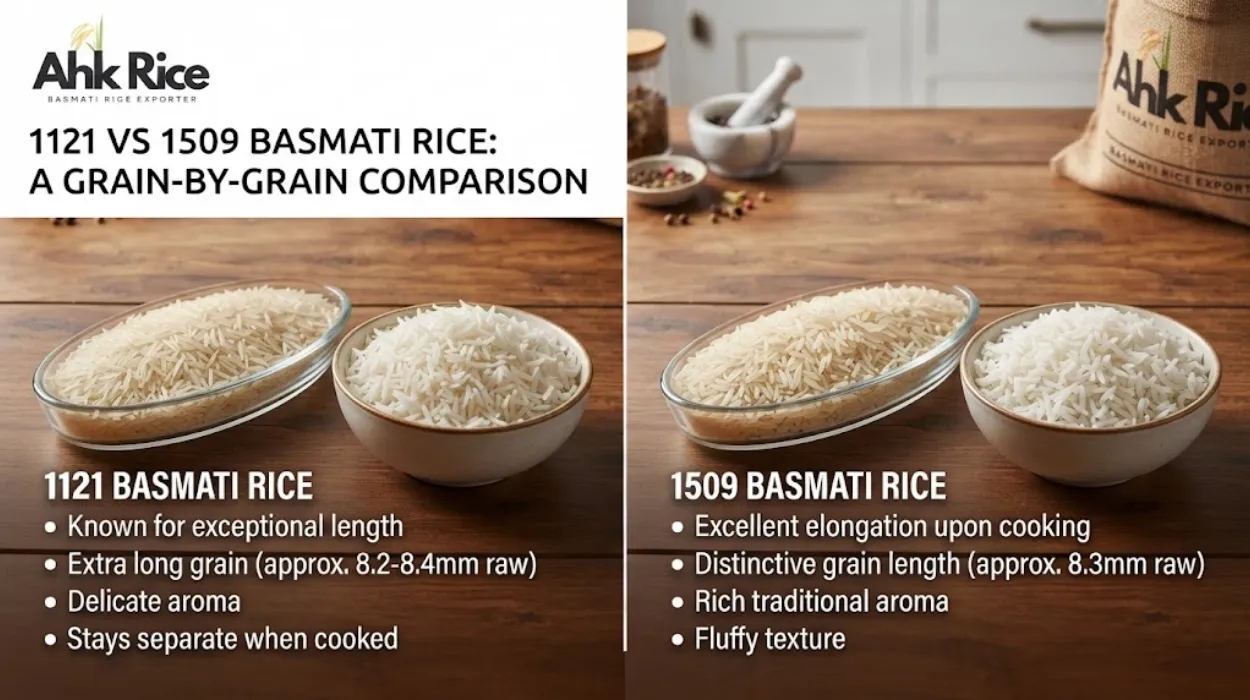
1121 Basmati suits premium retail and HORECA markets, while 1509 Basmati suits value-focused wholesale and high-volume distribution. Here is why: 1121 delivers longer grain, stronger elongation, and higher premium positioning, while 1509 provides competitive pricing and efficient bulk procurement. Current Pakistani market comparisons place 1121 around 8.2–8.5 mm and 1509 around 7.4–8.0 mm, depending on specification.
Export buyers should first understand the processing and grading differences before choosing a variety. This guide to Pakistan Basmati rice grades and processing explains how grain length, processing, cooking performance, and export specifications affect procurement decisions.
What are the available solutions for export buyers?
Export buyers have two main variety solutions: 1121 for premium positioning and 1509 for cost-controlled volume supply. Each variety also comes in processing forms such as White, Steam, Sella, and Golden Sella, creating different cooking, storage, and market applications.
1121 Basmati is an extra-long aromatic rice variety. Pakistani producers cultivate it mainly in Punjab. The variety is recognized for long raw grain, strong aroma, and substantial cooked elongation. Premium retailers, restaurants, caterers, and hospitality buyers commonly use these characteristics to support higher-value positioning.
1509 Basmati is another long-grain Basmati variety. It offers strong cooking performance with a lower procurement position than 1121. Its shorter crop cycle also supports efficient supply planning. This makes 1509 relevant for wholesalers, foodservice distributors, and value-oriented retail programs.
The first solution is 1121 Steam or Sella. Steam processing strengthens the grain while maintaining a light appearance. Sella uses parboiling before milling and produces firmer grains with strong separation after cooking.
The second solution is 1509 Steam or Sella. These forms preserve the variety’s long-grain identity while providing a lower-cost procurement route. The processing method still determines firmness, appearance, storage behavior, and cooking performance.
AHK Rice supplies Pakistani 1121, 1509, and Super Kernel Basmati varieties through processing, grading, sorting, packaging, and export coordination. Buyers can define the variety, processing form, grain specification, packaging, and destination before comparing commercial offers.
With the two variety solutions defined, the next step is comparing them through measurable export attributes.
How do 1121 and 1509 Basmati compare?
1121 leads in grain length and premium presentation, while 1509 leads in procurement efficiency and value positioning. The commercial difference becomes clearer through grain length, elongation, aroma, processing, price, shelf stability, and target market.
| Attribute | 1121 Basmati | 1509 Basmati |
|---|---|---|
| Raw grain length | About 8.2–8.5 mm | About 7.4–8.0 mm |
| Cooked elongation | Up to about 2.2× | Up to about 1.9× |
| Aroma profile | Strong, traditional Basmati aroma | Moderate to strong aroma |
| Processing forms | White, Steam, Sella, Golden Sella | White, Steam, Sella, Golden Sella |
| Price position | Premium | Value-oriented |
| Main buyer segment | Premium retail, HORECA | Wholesale, foodservice, value retail |
| Storage planning | About 12–16 months for some published specifications | About 14–18 months for some published specifications |
Published market comparisons identify 1121 as the longer-grain option and 1509 as the more economical alternative. A current AHK Rice comparison for China lists 1121 White at $1,250–$1,600 per MT and 1509 White at $850–$1,050 per MT. It also lists shelf-stability planning of 12–16 months for 1121 and 14–18 months for 1509 under its stated specifications.
These figures are indicative rather than universal contract specifications. Crop year, processing method, broken percentage, moisture, packaging, order volume, and Incoterm change the final commercial value.
Grain length remains the clearest physical distinction. A longer 1121 kernel creates stronger visual expansion after cooking. A 1509 kernel remains long-grain but occupies a more economical specification position.
Price creates the second major difference. A 2026 Pakistan market reference places 1509 around $780–$1,050 per MT FOB Pakistan, depending on processing and specification.
GCC market references show a similar segmentation. Current indicative export ranges place 1121 Golden Sella around $1,250–$1,450 per MT and 1509 Steam around $900–$1,100 per MT. These figures are origin-market indicators rather than fixed landed prices. (source: REAP export data, December 2025)
The comparison therefore depends on what the importer values. Premium grain presentation supports 1121. Procurement efficiency supports 1509. Processing then determines which form fits the buyer’s operation.
Which method works best for different market cases?
1121 works best for premium retail and hospitality, while 1509 works best for high-volume wholesale and value-focused foodservice. The correct selection depends on customer expectations, price architecture, cooking requirements, storage conditions, and the required retail or foodservice position.
Premium retail buyers
1121 suits premium retail because its long grain creates stronger shelf presentation. Retail brands can position the product around extra-long grain, aroma, and cooked elongation.
1121 Steam suits premium retailers seeking a lighter appearance with firm cooked grains. 1121 Sella suits customers seeking stronger grain separation and a parboiled cooking profile.
1509 also fits retail programs. Its lower price position allows distributors to create a more accessible Basmati tier while maintaining long-grain characteristics.
HORECA buyers
1121 supports hotels, restaurants, and catering operations that use grain length as part of dish presentation. Biryani, pilaf, banquet rice, and premium rice dishes benefit from visible cooked elongation.
1509 supports HORECA operations that prioritize food cost and consistent batch output. Its long-grain structure provides an economical alternative for daily service.
Wholesale distributors
1509 suits wholesalers serving price-sensitive customers. Lower acquisition cost creates more room for competitive retail pricing and high-volume distribution.
1121 suits wholesalers serving premium customer segments. The higher purchase price aligns with customers who specifically demand extra-long grain and premium Basmati characteristics.
Institutional supply
1509 provides a practical option for institutional buyers managing large recurring volumes. Procurement teams can use the variety to control rice cost while retaining long-grain cooking characteristics.
1121 fits institutional contracts that specify premium grain appearance. The higher price requires a customer segment capable of absorbing the additional procurement cost.
With the use cases separated, the next comparison focuses on two important export regions.
How do market preferences differ between the GCC and China?
GCC buyers commonly prioritize 1121 Sella, Golden Sella, and Steam, while Chinese buyers divide demand between premium 1121 and cost-efficient 1509. Both regions evaluate grain length, cooking performance, price, processing, storage, packaging, and customer positioning.
GCC market
GCC importers commonly use 1121 Sella, Golden Sella, and Steam for retail, catering, hospitality, and Basmati-focused foodservice. Parboiled grades provide firm grains and strong separation for large-batch cooking.
Current GCC export references place 1121 Golden Sella around $1,250–$1,450 per MT. 1121 Steam sits around $1,150–$1,350 per MT. 1509 Steam sits around $900–$1,100 per MT. These are indicative origin prices and vary by crop, specification, packaging, and destination. (source: REAP export data, December 2025)
Shelf-life planning for GCC buyers generally emphasizes Sella and properly stored processed rice. Current commercial references place Sella storage planning around 18–24 months under suitable storage conditions.
Hot warehouse conditions make packaging and moisture control important. Buyers should protect bags from direct heat, moisture, insects, and floor contact.
China market
Chinese importers divide Basmati demand between premium retail and institutional supply. 1121 suits premium retail because its long grain and aroma support higher-value presentation. 1509 suits institutional buyers seeking lower procurement costs.
A current AHK Rice comparison lists 1121 White at $1,250–$1,600 per MT and 1509 White at $850–$1,050 per MT. The same comparison lists 12–16 months of shelf-stability planning for 1121 and 14–18 months for 1509 under its stated conditions.
The regional difference is therefore commercial rather than purely technical. GCC buyers often emphasize parboiled cooking performance. Chinese buyers can separate premium retail demand from institutional volume demand.
With regional preferences established, the next step is evaluating the advantages and trade-offs of each variety.
What are the pros and cons of 1121 and 1509?
1121 provides stronger premium presentation but carries a higher procurement cost, while 1509 lowers acquisition cost but offers less extreme grain elongation. The trade-off matters most when importers calculate margin, customer expectations, cooking yield, and annual purchasing volume.
1121 advantages
Extra-long grain creates stronger visual presentation after cooking. This characteristic supports premium retail, biryani, pilaf, and hospitality applications.
High cooked elongation creates a distinctive plate appearance. Restaurants can use this feature as part of premium dish presentation.
Strong aroma supports traditional Basmati positioning. Premium consumers often associate fragrance with higher-value rice.
Premium market recognition supports higher-value product segmentation. Retailers can create separate tiers around 1121 specifications.
1121 disadvantages
Higher purchase price increases working-capital requirements. The buyer needs sufficient market positioning to recover the additional cost.
Higher specification sensitivity makes grain length, broken percentage, and processing consistency important. A premium buyer expects the delivered lot to match the approved sample.
Storage planning requires controlled warehouse conditions. Moisture and packaging damage can reduce the usable value of premium rice.
1509 advantages
Lower procurement cost supports volume purchasing. Importers can use the price difference to serve broader customer segments.
Strong cooking performance provides useful long-grain characteristics for foodservice. The variety remains suitable for daily commercial cooking.
Efficient supply positioning supports wholesalers and distributors. Lower acquisition cost can improve price competitiveness.
Broad processing flexibility allows Steam and Sella formats. Buyers can select processing according to customer requirements.
1509 disadvantages
Shorter grain profile provides less visual elongation than 1121. Premium retailers focused heavily on grain length may prefer 1121.
Lower premium positioning limits suitability for some luxury retail programs. The variety fits stronger value propositions.
Customer perception can differ by market. Importers should validate consumer acceptance through samples before changing an established premium specification.
The advantages and trade-offs show why variety selection should follow a measurable procurement framework.
What decision factors should export buyers use?
Export buyers should compare grain length, processing, price, cooking performance, shelf life, and market positioning before approving either variety. A structured framework prevents buyers from selecting rice from price alone and helps align the specification with the final customer.
| Decision factor | 1121 | 1509 |
|---|---|---|
| Premium presentation | Very strong | Strong |
| Procurement economy | Lower efficiency | Higher efficiency |
| Grain elongation | Very high | High |
| Foodservice value | Premium menus | Daily volume service |
| Retail positioning | Premium tier | Value-premium tier |
The first factor is customer positioning. Premium customers usually require the strongest visual grain characteristics. Value-focused customers prioritize acceptable Basmati performance at a competitive cost.
The second factor is processing. Steam, Sella, Golden Sella, and White grades create different cooking outcomes. Buyers should compare the same processing form across suppliers.
The third factor is price. Buyers should compare FOB with FOB, CFR with CFR, and CIF with CIF. Mixing Incoterms creates misleading price comparisons.
The fourth factor is storage. A longer stated shelf life does not remove the need for moisture control, pest protection, suitable packaging, and stock rotation.
The fifth factor is sample performance. Buyers should cook the sample using the intended commercial recipe. The evaluation should cover aroma, elongation, separation, firmness, breakage, and portion yield.
With the decision framework complete, buyers can match the variety to the commercial objective rather than selecting only by name.
How should buyers select between 1121 and 1509 before ordering?
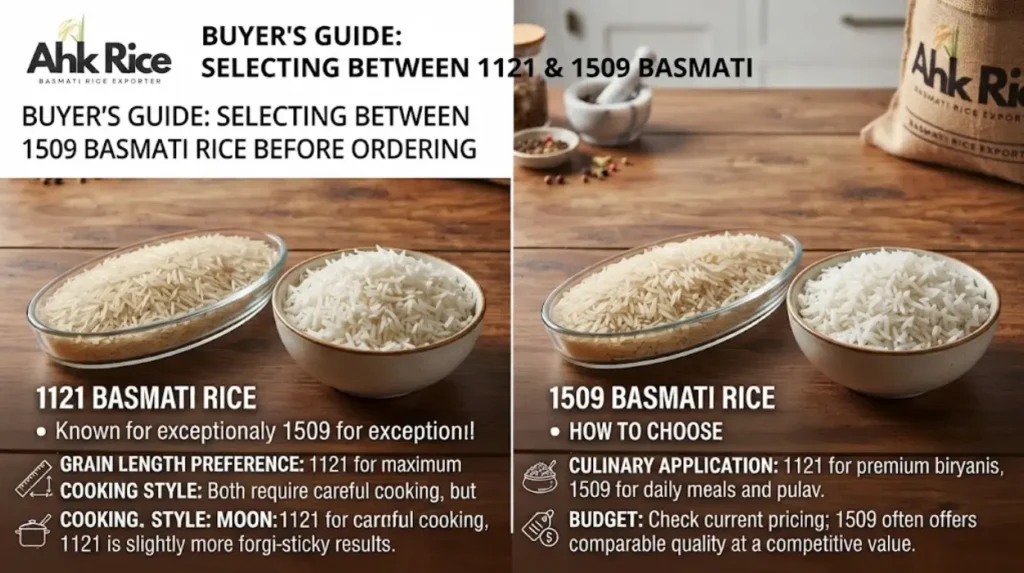
Select 1121 for premium grain presentation and 1509 for cost-controlled volume supply, then confirm processing, specifications, samples, packaging, and Incoterms before contracting. This process creates a measurable purchasing decision and reduces variation between quotation, sample, production, and shipment.
Start with the end customer. Define whether the rice serves premium retail, hospitality, foodservice, wholesale, or institutional distribution.
Define the processing form. Specify White, Steam, Sella, or Golden Sella rather than ordering only by variety name.
Define the measurable specification. Include average grain length, broken percentage, moisture, foreign matter, damaged grains, color, and packaging.
Request the commercial sample. Cook the sample using the intended recipe and compare raw appearance, cooked length, aroma, separation, firmness, and portion yield.
Confirm the commercial terms. Compare quantity, packaging, inspection, shipment schedule, FOB or CIF basis, destination port, and required export documents.
For buyers evaluating a premium 1121 supply program, the decision-stage article AHK Rice 1121 Basmati premium export supply from Pakistan is the appropriate next resource.
The comparison therefore ends with a specification decision. 1121 fits premium value creation. 1509 fits cost-controlled volume distribution. The approved sample should determine the final commercial grade.
Frequently Asked Questions
Is 1121 Basmati better than 1509 Basmati?
1121 provides longer grain, stronger cooked elongation, and stronger premium positioning. 1509 provides long-grain cooking performance at a lower procurement position. The suitable variety depends on the buyer’s target market and cost structure.
Which is cheaper, 1121 or 1509 Basmati?
1509 is generally cheaper than 1121. Current Pakistan market references place 1509 below 1121 across comparable processing categories. Exact prices change with crop year, grade, broken percentage, packaging, volume, and Incoterm.
Which Basmati rice has longer grain?
1121 generally has the longer raw and cooked grain profile. Published specifications commonly place 1121 around 8.2–8.5 mm, while 1509 specifications vary around 7.4–8.0 mm.
Is 1509 suitable for export buyers?
Yes. 1509 suits wholesale, foodservice, institutional, and value-oriented retail programs. Its lower procurement position supports high-volume purchasing while retaining long-grain Basmati characteristics.
Which variety suits Gulf importers?
Gulf buyers commonly use 1121 Sella, Golden Sella, and Steam for premium retail, catering, and hospitality. 1509 also serves value-focused retail and wholesale channels.
Which variety suits premium retail?
1121 generally suits premium retail because its longer grain and cooked elongation create stronger shelf and plate presentation. Steam and Sella processing provide different texture and appearance profiles.
Does processing matter more than variety?
Both matter. Variety determines the basic grain structure. Processing determines firmness, appearance, cooking behavior, and storage characteristics. Buyers should specify both before requesting quotations.
How should an importer compare prices?
Compare identical varieties, processing grades, specifications, quantities, packaging, and Incoterms. FOB prices should not be compared directly with CIF prices because freight and destination costs differ.
What should buyers test in a rice sample?
Test grain length, broken percentage, aroma, cooking elongation, separation, firmness, moisture, appearance, and portion yield. Use the intended commercial cooking method during evaluation.
Which variety offers better value?
1509 generally provides stronger procurement value for volume buyers because its purchase price is lower. 1121 provides stronger premium value where customers pay for longer grain and higher-end presentation.