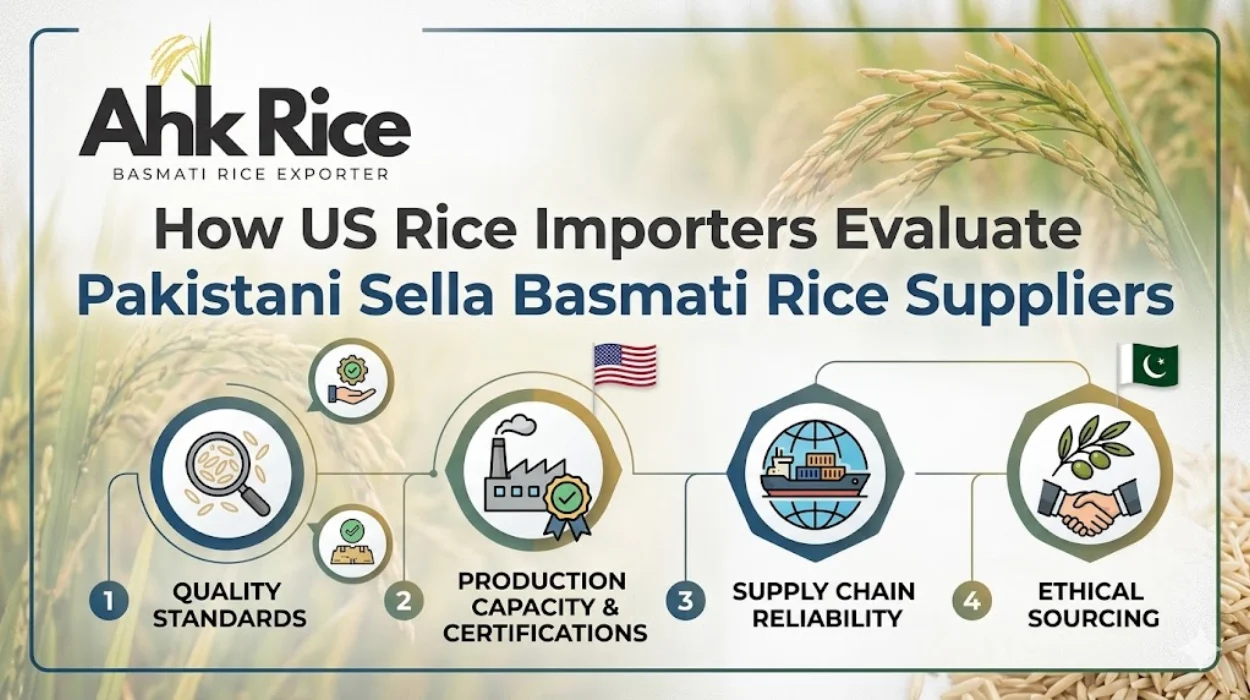
How US Rice Importers Evaluate Pakistani Sella Basmati Rice Suppliers
US rice importers achieve better supply consistency, lower claim rates, and stronger retail performance when they select Pakistani Sella Basmati rice suppliers based on processing standards, quality verification systems, export capability, and documentation compliance rather than price alone. Here is why: supplier evaluation directly affects grain consistency, customs clearance, inventory turnover, and consumer satisfaction in the US market.
Pakistani Sella Basmati rice continues to gain attention because of its extra-long grain length, strong cooking performance, and competitive pricing compared with other premium aromatic rice origins. Importers new to this category can first explore how Pakistani Basmati rice is cultivated, processed, graded, and exported through our guide to Pakistan’s Basmati rice export industry.
Buyers researching supplier qualifications often begin by understanding the broader Pakistani Basmati industry and processing ecosystem. A useful starting point is learning how Pakistan cultivates, mills, grades, and exports premium Basmati varieties through the supply chain in our guide on Pakistani Basmati rice exports.
AHK Rice is a trusted Pakistani Basmati rice exporter based in Punjab, supplying 1121, Super Kernel, and 1509 varieties to more than 15 countries through complete processing, packaging, and export services.
What do US Rice Importers evaluate before selecting Pakistani Sella Basmati Rice Suppliers?
Grain quality, processing consistency, food safety compliance, export experience, documentation accuracy, packaging capability, and shipment performance form the seven primary evaluation criteria used by professional importers when selecting Pakistani suppliers.
US rice importers evaluate suppliers through measurable standards rather than marketing claims. Each criterion directly influences import costs and customer satisfaction.
Specification Comparison Table
| Attribute | Premium Supplier Standard | Average Supplier Standard |
|---|---|---|
| Grain Length | 8.20–8.40 mm | 7.70–8.00 mm |
| Broken Percentage | 2–5% | 10–15% |
| Moisture Content | 12–13% | 14–15% |
| Purity Level | 95–98% | 85–90% |
| Color Sorting | Advanced optical sorting | Basic sorting |
| Food Safety Documents | Complete export file | Partial documentation |
| Shipment Reliability | On-time dispatch schedules | Variable schedules |
Grain length remains the first inspection point because consumers associate long grains with premium Basmati quality. Importers frequently request pre-shipment samples for cooking tests before placing container orders.
Processing consistency receives equal attention. Pakistani Sella Basmati rice undergoes parboiling before milling. This process strengthens the grain structure and reduces breakage during transportation and cooking. Suppliers that maintain consistent parboiling parameters deliver more uniform product performance.
Documentation also affects supplier selection. US importers require certificates that support customs clearance and food safety compliance. Missing documentation creates delays and increases landed costs.
Supplier evaluation begins with specifications, but buyers also compare sourcing approaches and supplier models. The next question is how these approaches differ.
How do different Pakistani Sella Basmati Rice supplier approaches compare?
Direct mill exporters, trading companies, integrated exporters, regional consolidators, and sourcing agents represent the main supplier categories, but integrated exporters consistently provide better quality control and traceability.
Different supplier models create different levels of operational control.
Direct Mill Exporters
Direct mill exporters cultivate supplier relationships with farmers, mill paddy rice, grade finished products, and export directly to buyers.
Advantages include better traceability and direct quality control.
Limitations include lower flexibility when buyers require multiple rice varieties from different regions.
Trading Companies
Trading companies source rice from multiple mills and arrange exports.
Advantages include access to several grades and varieties.
Limitations include inconsistent processing standards between source mills.
Integrated Exporters
Integrated exporters manage procurement, milling, grading, packaging, quality inspection, and export operations.
Advantages include centralized quality control and consistent specifications.
Limitations include slightly higher operating costs that may influence quotations.
Regional Consolidators
Regional consolidators collect rice from smaller mills and prepare export shipments.
Advantages include access to niche grades.
Limitations include variable quality consistency.
Sourcing Agents
Sourcing agents represent overseas buyers and coordinate procurement.
Advantages include local market knowledge.
Limitations include additional commission costs.
Supplier Model Comparison
| Supplier Type | Quality Control | Traceability | Pricing Stability | Export Support | Best For |
| Direct Mill | High | High | Medium | Medium | Bulk buyers |
| Trading Company | Medium | Low | High | Medium | Mixed sourcing |
| Integrated Exporter | High | High | High | High | Retail importers |
| Consolidator | Medium | Medium | Medium | Low | Spot purchases |
| Sourcing Agent | Depends on supplier | Medium | Medium | High | First-time importers |
US importers increasingly prefer integrated exporters because they reduce communication gaps and simplify quality verification procedures.
Supplier type influences performance, but market destination also affects purchasing decisions. The next question is which grades perform best in different US market segments.
Which Pakistani Sella Basmati Rice grades work best for different US market segments?
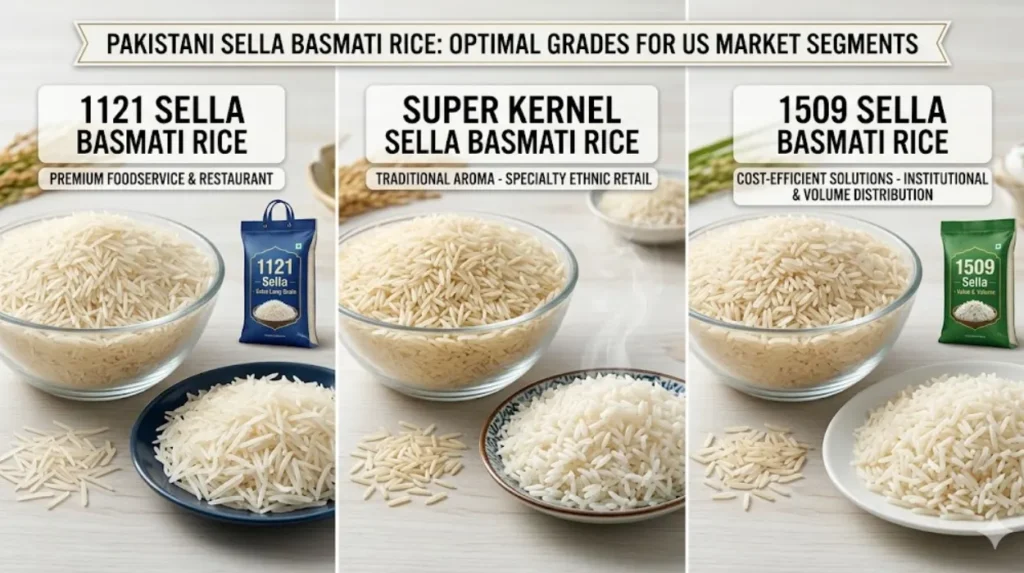
1121 Sella dominates retail and foodservice channels, Super Kernel serves premium ethnic markets, and 1509 Sella offers cost-efficient solutions for volume-driven distribution networks.
Grade selection depends on the target customer segment.
1121 Sella Basmati Rice
1121 Sella Basmati rice delivers extra-long grain length and exceptional elongation after cooking.
The variety regularly reaches 8.20–8.40 mm before cooking and expands significantly after preparation.
US ethnic retailers and restaurant chains prefer this grade because consumers recognize its appearance and cooking quality.
Super Kernel Sella Basmati Rice
Super Kernel offers traditional Basmati aroma and premium sensory characteristics.
The variety appeals to specialty retailers targeting South Asian and Middle Eastern consumers.
1509 Sella Basmati Rice
1509 Sella provides strong grain length while maintaining lower procurement costs.
The variety supports institutional buyers, food distributors, and value-focused retail programs.
Market Preference Comparison
| Market Segment | Preferred Grade | Main Purchase Factor |
| Premium Retail | 1121 Sella | Grain appearance |
| Ethnic Grocery Chains | Super Kernel Sella | Aroma |
| Foodservice | 1121 Sella | Cooking yield |
| Institutional Catering | 1509 Sella | Cost efficiency |
| Wholesale Distribution | 1509 Sella | Volume purchasing |
Grade selection determines product positioning, but importers also evaluate pricing and storage performance. The next section compares these commercial factors.
How do price and shelf life comparisons influence supplier evaluation?
1121 Sella commands higher prices but delivers superior market acceptance, while 1509 Sella reduces procurement costs and maintains strong storage performance.
Pricing affects profit margins, but landed cost calculations must include quality performance.
Price Comparison per Metric Ton
| Grade | Typical Export Price Range (USD/MT) |
| 1121 Sella | $1,050–1,300 |
| Super Kernel Sella | $950–1,150 |
| 1509 Sella | $850–1,050 |
Price fluctuations depend on crop conditions, freight rates, and global demand (source: REAP export data, December 2025).
1121 Sella costs more because buyers value its appearance and cooking performance. US retailers often recover the premium through higher shelf pricing.
1509 Sella lowers procurement costs. Institutional buyers frequently select this option because volume requirements outweigh premium branding considerations.
Shelf Life Comparison
| Grade | Shelf Life |
| 1121 Sella | 18–24 months |
| Super Kernel Sella | 18–24 months |
| 1509 Sella | 18–24 months |
Proper storage conditions maintain quality throughout the shelf-life period.
1121 Sella maintains grain integrity during long-distance transportation. In warm warehouse environments, the variety preserves appearance and cooking performance effectively.
1509 Sella also performs well during storage. Large distributors often select this grade for extended inventory cycles.
Commercial performance matters, but buyers still need practical decision criteria. The next section provides a framework for supplier selection.
What are the pros and cons of different supplier evaluation strategies?
Factory audits provide maximum verification, third-party inspections reduce risk, sample-based evaluation offers speed, documentation reviews ensure compliance, and long-term partnerships improve consistency.
Each evaluation strategy serves a different procurement objective.
Pros and Cons Comparison
| Strategy | Advantages | Limitations |
| Factory Audit | Direct verification | Travel costs |
| Third-Party Inspection | Independent assessment | Additional fees |
| Sample Testing | Fast evaluation | Limited scope |
| Documentation Review | Compliance confirmation | Does not verify production |
| Long-Term Partnership | Consistency | Requires supplier commitment |
Factory audits reveal processing standards directly. Buyers inspect milling lines, grading systems, and packaging operations.
Third-party inspections provide independent verification. Many US importers use this approach before first shipments.
Sample testing remains common because cooking performance determines consumer satisfaction.
Documentation reviews ensure compliance with import requirements.
Long-term partnerships typically generate the most stable results because suppliers understand buyer specifications over time.
Evaluation methods identify supplier strengths, but final selection requires a structured framework. The next section explains how buyers make final sourcing decisions.
What decision factors help US Rice Importers choose the right supplier?
Quality consistency, documentation readiness, processing capability, logistics reliability, and communication responsiveness create the strongest supplier selection framework for long-term import success.
Professional importers use a structured evaluation process.
Decision Framework
| Decision Factor | Importance | Evaluation Method |
| Quality Consistency | High | Sample testing |
| Documentation | High | Compliance review |
| Processing Standards | High | Factory inspection |
| Logistics Performance | Medium | Shipment history |
| Communication | Medium | Response time |
Step 1: Verify Quality Standards
Request laboratory reports and production specifications.
Inspect grain length, moisture content, purity levels, and broken percentages.
Step 2: Review Export Documents
Request export documentation packages.
Verify certificates required for customs and food safety compliance.
Step 3: Evaluate Processing Operations
Inspect milling, grading, sorting, and packaging procedures.
Confirm that suppliers maintain consistent production controls.
Step 4: Assess Logistics Capability
Review shipment schedules and export experience.
Verify container loading procedures and delivery performance.
Step 5: Compare Long-Term Value
Calculate total landed costs rather than focusing only on quoted prices.
Assess consistency, reliability, and quality performance together.
US rice importers that follow this framework reduce sourcing risk and improve supply chain stability. The next stage involves evaluating supplier-specific capabilities and procurement requirements before finalizing contracts.
Conclusion
Integrated exporters with strong processing controls, complete documentation systems, and consistent quality verification procedures provide the best sourcing outcomes for US rice importers. Supplier evaluation should focus on measurable standards rather than price alone. Grain specifications, processing consistency, export compliance, and logistics performance collectively determine long-term import success. Buyers who apply structured evaluation methods achieve stronger retail performance, lower claims, and more reliable supply chains.
For buyers moving from supplier evaluation to procurement decisions, the next recommended resource is our article explaining the key supplier qualification criteria and purchasing checkpoints before importing Pakistani Sella Basmati rice: What US Buyers Should Look for When Importing Pakistani Sella Basmati Rice.
Frequently Asked Questions
How do US rice importers verify the quality of Pakistani Sella Basmati rice suppliers?
US rice importers verify quality through grain samples, laboratory reports, factory inspections, and third-party audits. Buyers inspect grain length, moisture content, purity levels, broken percentage, and cooking performance before approving a supplier.
Why do US importers prefer Pakistani Sella Basmati rice?
US importers prefer Pakistani Sella Basmati rice because it offers extra-long grains, strong cooking elongation, competitive pricing, and consistent quality. The variety performs well in retail, foodservice, and ethnic grocery markets across the United States.
What documents should Pakistani Sella Basmati rice suppliers provide to US buyers?
Pakistani suppliers should provide a commercial invoice, packing list, certificate of origin, phytosanitary certificate, fumigation certificate, bill of lading, and quality inspection reports. Complete documentation helps prevent customs delays and compliance issues.
Which Pakistani Sella Basmati rice grade is most popular in the US market?
1121 Sella Basmati rice is the most popular grade among US buyers. The variety offers grain lengths of 8.20–8.40 mm, excellent cooking yield, and strong consumer acceptance in retail stores and restaurants.
What is the most important factor when selecting a Pakistani Sella Basmati rice supplier?
Quality consistency is the most important factor when selecting a supplier. Consistent grain specifications, reliable shipments, proper certifications, and responsive communication help importers reduce sourcing risks and maintain customer satisfaction.