1121 Basmati vs Super Kernel: Aroma and Price Comparison
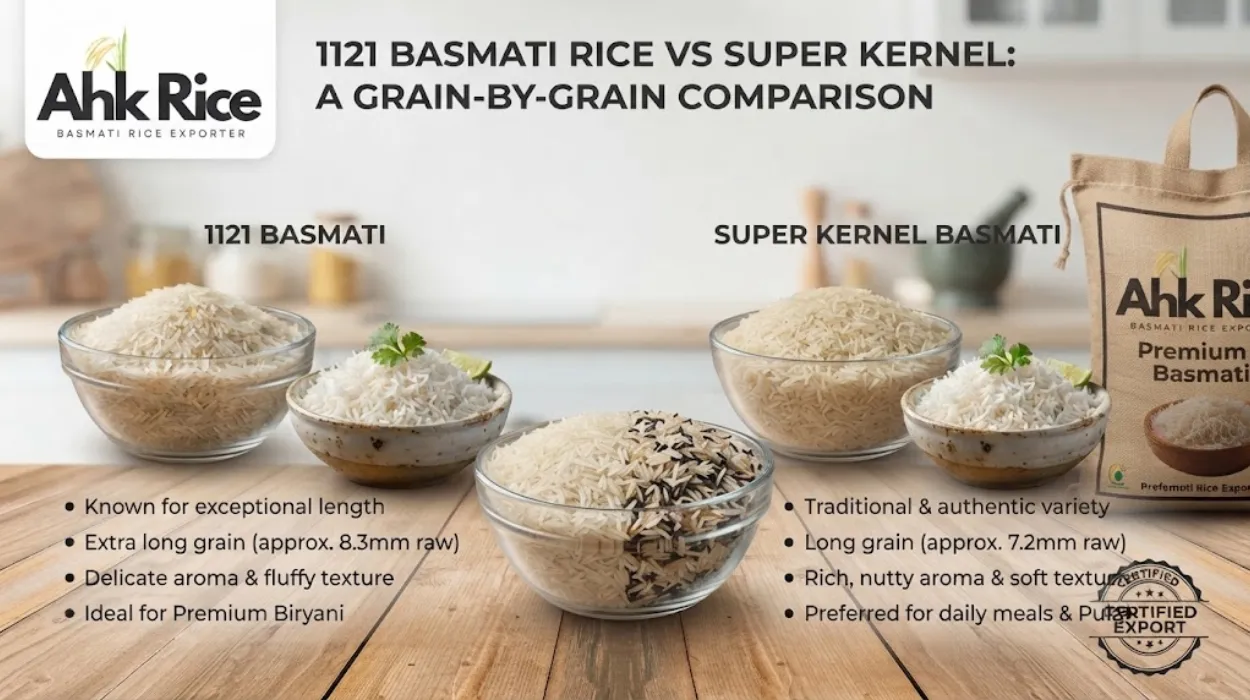
1121 Basmati suits buyers prioritising extra-long grain and visual premium, while Super Kernel suits buyers prioritising traditional aroma and balanced procurement cost. Here is why: 1121 typically reaches about 8.3 mm raw length, while Super Kernel averages around 7.2 mm, creating different commercial positioning. Current indicative Pakistan FOB references place premium Basmati around $1,135–$1,205 per metric ton, depending on variety and processing type. (source: PakistanRice.com, September 2026)
The comparison becomes clearer through grain structure, aroma, cooking behaviour, processing options, price, and market demand. Buyers can also use the broader [Super Kernel Basmati grain and cooking guide] as an educational reference before comparing commercial specifications.
AHK Rice supplies 1121, Super Kernel, and 1509 Basmati rice from Punjab. Its supply process covers processing, grading, sorting, custom packaging, inspection, documentation, and export coordination for international buyers.
What are the available solutions for buyers comparing 1121 and Super Kernel?
The main solutions are 1121 White, 1121 Steam, 1121 Sella, Super Kernel White, and Super Kernel Sella, with each grade serving different price, aroma, cooking, and market requirements. Buyers should compare the processing form before comparing the variety itself, since processing directly changes appearance, cooking behaviour, and commercial price.
1121 Basmati
1121 Basmati is an extra-long grain Basmati variety cultivated in Pakistan. Its raw grain commonly measures around 8.3 mm. Its cooked grain expands substantially and creates strong visual impact in biryani, pilaf, retail packs, and foodservice dishes. (source: PakistanRice.com, September 2026)
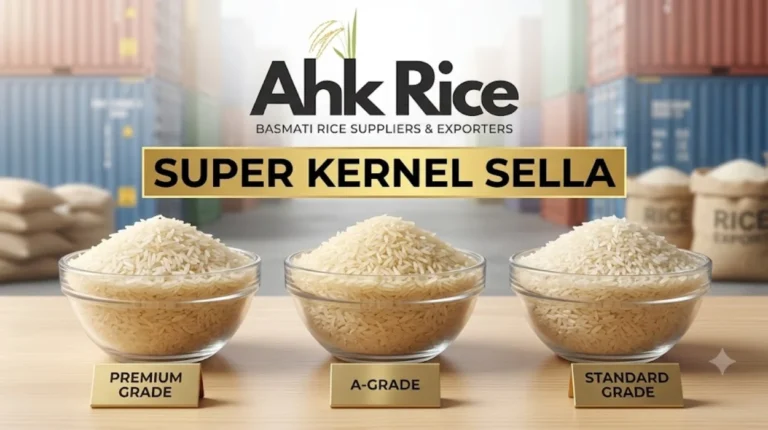
1121 White Basmati retains its natural white appearance and aromatic profile. 1121 Steam uses steam processing to strengthen the grain while maintaining a relatively light appearance. 1121 Sella is parboiled and offers firmer grains with strong handling performance.
Super Kernel Basmati
Super Kernel Basmati is a traditional aromatic Basmati variety associated with Punjab. Typical raw grain length ranges around 7.2–7.6 mm across published specifications. The variety is recognised for strong traditional Basmati fragrance and separate cooked grains.
Super Kernel White provides the most direct comparison with 1121 White. Its shorter grain does not reduce its Basmati identity. Instead, the variety competes through aroma, traditional taste, cooking performance, and price positioning.
With the available grades defined, the next step is to compare their measurable specifications side by side.
How do 1121 Basmati and Super Kernel compare?
1121 leads in raw grain length and visual elongation, while Super Kernel provides strong traditional aroma and a different cost position; both serve premium Basmati demand. The correct comparison depends on the buyer’s intended market, customer expectations, processing grade, and target landed cost.
| Attribute | 1121 Basmati | Super Kernel Basmati |
|---|---|---|
| Raw grain length | Around 8.3 mm | Around 7.2–7.6 mm |
| Aroma | Strong natural Basmati aroma | Strong traditional Basmati aroma |
| Cooked elongation | Very high | High |
| Main visual advantage | Extra-long slender grain | Traditional slender grain |
| Common processing | White, Steam, Sella | White, with Sella available in some supply programs |
| Indicative FOB position | About $1,135–$1,205/MT | About $1,165–$1,205/MT |
| Typical commercial positioning | Premium visual and long-grain segment | Aroma-led premium segment |
Published market references show overlapping FOB ranges. One current benchmark lists 1121 at approximately $1,135–$1,205/MT and Super Kernel at approximately $1,165–$1,205/MT. These are indicative origin prices, not fixed quotations. (source: PakistanRice.com, September 2026)
A buyer should therefore avoid treating Super Kernel as automatically cheaper. Processing type, crop year, broken percentage, moisture, purity, packaging, order volume, and shipment timing can change the final quotation.
1121 creates stronger visual differentiation through its longer grain. Super Kernel creates differentiation through traditional fragrance and flavour. The commercial choice changes with the customer segment.
With the specification comparison established, market-region requirements provide the next layer of the decision.
Which grade fits GCC and Middle Eastern buyers?
GCC buyers commonly evaluate 1121 Sella, Golden Sella, Steam, and aromatic Super Kernel against cooking volume, grain appearance, storage conditions, and retail positioning. Parboiled grades receive strong attention in foodservice because firmer kernels handle high-volume cooking and distribution effectively.
GCC markets include the United Arab Emirates, Saudi Arabia, Qatar, Kuwait, Bahrain, and Oman. Buyers in these markets often purchase Basmati for restaurants, catering operations, wholesalers, supermarkets, and institutional kitchens.
1121 Sella provides a strong visual grain profile with firm cooked texture. Golden Sella adds a distinctive golden appearance and strong handling characteristics. Super Kernel serves buyers that place greater emphasis on traditional aroma and flavour.
Current indicative Pakistan-origin benchmarks place 1121 Sella around $1,135–$1,175/MT FOB in published market listings. White Basmati and Super Kernel can sit around $1,165–$1,205/MT depending on specification. (source: PakistanRice.com, September 2026)
GCC storage also makes processing selection important. AHK Rice market guidance places Golden Sella at approximately 18 months of practical storage under suitable conditions, compared with around 12 months for Steam. Actual storage performance depends on moisture, packaging, temperature, humidity, and pest control.
A distributor holding larger inventories can therefore evaluate Golden Sella for storage stability. A faster-moving foodservice distributor can evaluate Steam or White Basmati where cooking profile and appearance meet customer requirements.
The GCC comparison shows that variety alone does not determine value. Processing and inventory requirements matter equally.
Which grade fits UK and European buyers?
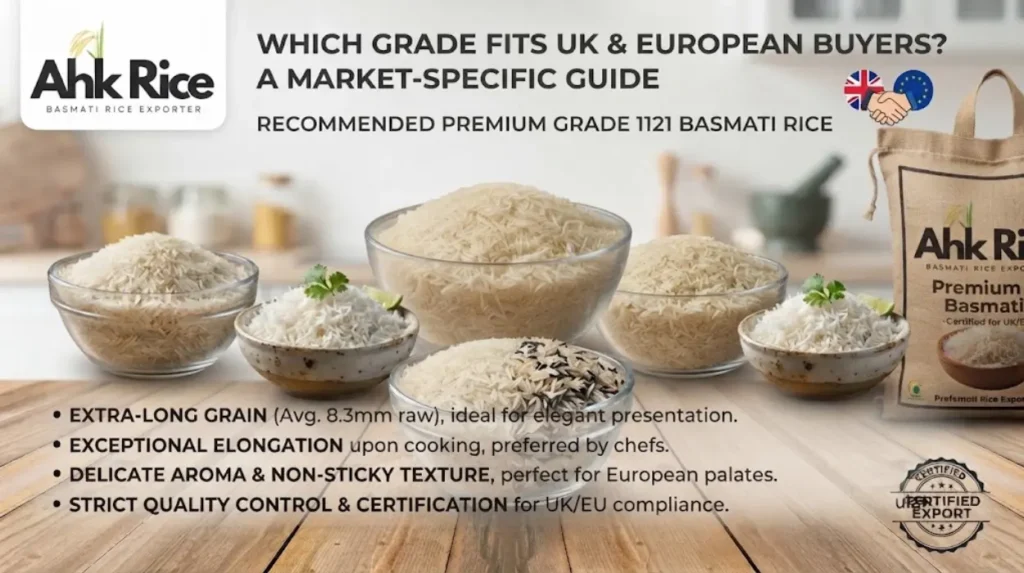
UK and European buyers can evaluate 1121 White, 1121 Steam, and Super Kernel according to retail appearance, aroma, packaging, cooking performance, compliance, and landed cost. White Basmati provides a clean retail appearance, while Super Kernel gives aroma-led differentiation within premium aromatic rice categories.
UK importers often divide demand across retail, wholesale, restaurants, and ethnic foodservice. Each channel creates a different specification requirement.
1121 White fits premium retail packs where long, slender grains create immediate shelf differentiation. Super Kernel fits buyers seeking a traditional aromatic profile with a different grain presentation.
Indicative Pakistan-origin pricing for comparable premium Basmati can sit around $1,165–$1,205/MT FOB. Freight, insurance, port charges, customs, clearance, and inland transport then determine the European landed cost. (source: PakistanRice.com, September 2026)
Shelf-life planning also depends on processing and storage. Properly milled rice has strong storage potential under dry, pest-controlled conditions. Moisture exposure, heat, oxygen, and packaging damage reduce quality regardless of variety.
A UK wholesaler with rapid stock turnover can therefore prioritise product fit over maximum storage duration. A distributor maintaining larger inventories should give greater weight to packaging integrity and storage conditions.
With GCC and European requirements separated, buyers can now compare the commercial advantages and limitations of each variety.
What are the pros and cons of 1121 Basmati and Super Kernel?
1121 provides stronger visual length and premium presentation, while Super Kernel provides traditional aroma and a distinctive value proposition; each has commercial advantages and limitations. The decision should connect those attributes with actual customer demand rather than relying on variety reputation.
1121 Basmati advantages
Extra-long grain creates stronger visual appeal in cooked dishes and retail packaging. This attribute supports premium biryani, pilaf, restaurant, and supermarket positioning.
Multiple processing formats provide greater specification flexibility. Buyers can select White, Steam, or Sella according to cooking and storage requirements.
High cooked elongation creates a visible difference between raw and cooked grain. This supports premium presentation in foodservice and retail applications.
1121 Basmati limitations
Higher premium positioning can increase procurement cost for buyers whose customers focus primarily on aroma and flavour.
Visual specifications require tighter control of grain length, broken percentage, and sorting. A buyer purchasing premium 1121 should define these parameters in the contract.
Super Kernel advantages
Traditional aroma creates strong sensory differentiation. Buyers serving customers familiar with classic Pakistani Basmati can use this attribute as a product-positioning advantage.
Balanced commercial positioning makes Super Kernel useful where buyers need premium Basmati characteristics without making extra-long grain the primary selling point.
Cooking separation supports biryani, pilaf, restaurant, catering, and household applications. Published specifications describe Super Kernel as a dry and separate cooking rice with strong natural aroma.
Super Kernel limitations
Shorter raw grain provides less visual elongation than 1121. Retailers selling primarily through grain appearance may therefore prefer 1121.
Processing availability can vary by supplier. Buyers should confirm whether White, Steam, or Sella formats are available before comparing quotations.
These advantages and limitations become more useful when converted into a practical procurement framework.
Which method works best for different buying cases?
1121 works best for visual-premium retail and long-grain foodservice, while Super Kernel works best for aroma-led demand, traditional Basmati positioning, and buyers balancing sensory quality with procurement cost. The table below converts product differences into practical purchasing decisions.
| Buying case | Main requirement | Suitable option | Primary reason | Check before order |
|---|---|---|---|---|
| Premium retail | Long visual grain | 1121 | Strong shelf presentation | Grain length and broken percentage |
| Aroma-led retail | Traditional fragrance | Super Kernel | Strong aromatic profile | Aroma and purity |
| Premium restaurants | Long cooked grain | 1121 Steam/Sella | Visual and cooking performance | Cooking test |
| Traditional restaurants | Aroma and separation | Super Kernel White | Classic Basmati profile | Aroma and texture |
| Large inventory distribution | Storage stability | 1121 Sella / Golden Sella | Firm kernels and storage suitability | Moisture and packaging |
A buyer should treat this framework as a specification starting point. The final selection still requires sample approval and commercial quotation.
Sample approval should cover raw appearance, grain length, aroma, cooking expansion, texture, broken percentage, colour, foreign matter, moisture, and packaging suitability.
A commercial quotation should then identify variety, processing grade, crop year, quantity, packing, FOB basis, payment terms, inspection requirements, and shipment window.
With the decision cases mapped, the final stage is to identify the factors that should control the procurement decision.
What decision factors should buyers check before ordering?
Buyers should compare aroma, grain length, processing, FOB price, landed cost, shelf life, customer demand, sample performance, and supplier consistency before selecting 1121 or Super Kernel. Price becomes meaningful only after the product specification remains comparable.
Aroma: Test the raw grain and cooked rice. Record fragrance intensity against the approved sample.
Grain length: Measure representative grains rather than relying only on product names. 1121 commonly targets around 8.3 mm raw length, while Super Kernel commonly falls around 7.2–7.6 mm.
Processing: Specify White, Steam, or Sella. Processing changes cooking texture, appearance, and storage behaviour.
Price: Compare the FOB price per metric ton against identical specifications. Avoid comparing a White quotation against a Sella quotation without adjusting the basis.
Landed cost: Add freight, insurance, port charges, customs, clearance, inland transport, and other destination expenses.
Shelf life: Match the processing grade with expected stock rotation. Control warehouse temperature, humidity, pests, and packaging integrity.
Sample performance: Cook the sample using the intended commercial recipe. Record expansion, separation, aroma, texture, and breakage.
Supplier consistency: Request inspection records and use the approved sample as the reference for repeat shipments.
AHK Rice supplies Pakistani Basmati from Punjab, including 1121, Super Kernel, and 1509, with end-to-end processing, custom packaging, and export coordination.
The comparison therefore leads to a specification-based decision. 1121 serves buyers where grain length and premium visual presentation drive demand. Super Kernel serves buyers where traditional aroma and sensory identity carry greater commercial importance.
What should buyers compare before requesting a commercial quotation?
Buyers should send a complete specification before requesting price, including variety, processing, grain length, broken percentage, moisture, packaging, quantity, destination, and Incoterm. This approach produces more useful quotations because suppliers price against the same commercial requirements.
A strong specification should identify the desired variety first. The buyer should then define processing type, target grain length, broken percentage, moisture, purity, packaging format, bag weight, quantity, and destination port.
The buyer should also specify whether the quotation requires FOB, CFR, or CIF terms. FOB compares origin-side product value. CFR adds ocean freight. CIF adds insurance.
A sample should represent the intended commercial grade. The buyer should approve the sample before bulk production and retain the approved specification for future orders.
For the decision stage, the related guide 1121 Basmati Rice FOB Price for Global Importers can be linked here to move readers from comparison into detailed commercial pricing.
AHK Rice can then evaluate the requirement across available 1121, Super Kernel, and 1509 specifications and coordinate processing, packaging, inspection, documentation, and shipment preparation.
The strongest procurement process connects the product specification with the commercial objective. Variety selection should follow customer demand, not simply the lowest quoted price.
Frequently Asked Questions
Is 1121 Basmati more aromatic than Super Kernel?
Super Kernel is widely positioned around strong traditional Basmati aroma, while 1121 combines strong aroma with a longer grain profile. Aroma intensity also depends on crop, aging, storage, and processing conditions.
Is Super Kernel cheaper than 1121 Basmati?
Super Kernel can occupy a different price position, but it is not automatically cheaper. Current indicative market ranges overlap, with published benchmarks placing 1121 around $1,135–$1,205/MT and Super Kernel around $1,165–$1,205/MT. (source: PakistanRice.com, September 2026)
Which rice has longer grains, 1121 or Super Kernel?
1121 has the longer raw grain. Typical commercial specifications place 1121 around 8.3 mm and Super Kernel around 7.2–7.6 mm. The difference becomes more visible after cooking because 1121 has greater elongation.
Which is better for restaurants, 1121 or Super Kernel?
The suitable variety depends on the restaurant’s menu and customer expectations. 1121 fits dishes where extra-long grains create visual presentation. Super Kernel fits dishes where traditional Basmati aroma is the stronger selling attribute.
Which variety is better for retail packaging?
1121 suits premium retail packaging where long grain length creates immediate visual differentiation. Super Kernel suits aroma-led retail positioning where traditional Basmati fragrance carries greater importance.
How should importers compare FOB prices?
Importers should compare FOB prices only after matching variety, processing grade, grain length, broken percentage, moisture, packaging, quantity, and crop year. They should then calculate freight and destination costs separately.
Does processing affect shelf life?
Yes. Processing influences kernel strength, storage behaviour, and cooking performance. Golden Sella generally provides a longer practical storage window than Steam under suitable conditions, while warehouse conditions remain critical.
What should a buyer test in a Basmati sample?
A buyer should test grain length, aroma, colour, purity, broken percentage, cooking expansion, texture, separation, and overall appearance. The commercial sample should represent the specification intended for bulk production.