Source Punjab-Origin Basmati Rice with Farm-to-Port Traceability for USA Distributio
USA rice importers need more than a competitive price per metric tonne. They need verified product specifications, documented origin, consistent milling quality, compliant packaging, and shipment records that support distribution planning. A traceable supply process helps importers evaluate Pakistani Basmati rice before committing to a commercial order.
For background on growing regions, start with where Pakistani Basmati rice is grown across Punjab’s Basmati belt. This educational topic explains the origin behind the grain, while commercial sourcing requires additional verification of the actual lot, processing facility, and export shipment.
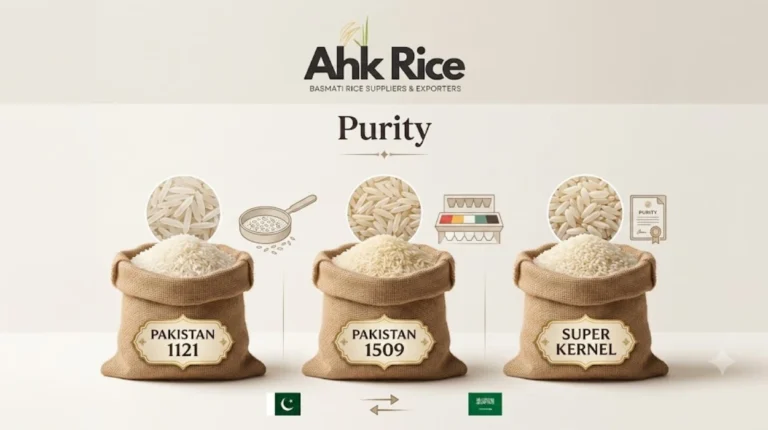
AHK Rice is a Pakistani Basmati rice exporter based in Punjab, supplying 1121, Super Kernel, and 1509 Basmati rice to international markets. Its sourcing and export workflow can help USA distributors assess specifications, approve samples, arrange packaging, and coordinate shipment documentation.
What Is the Best Solution for Sourcing Traceable Punjab-Origin Basmati Rice?
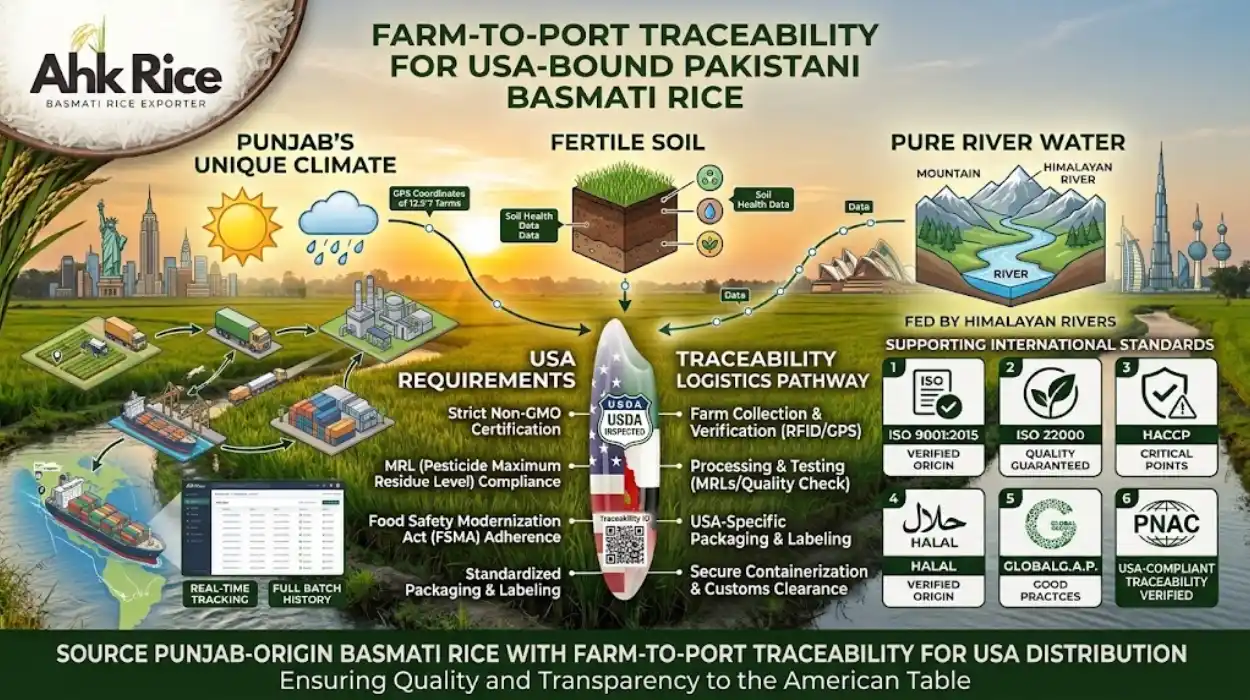
The practical solution is to select a Punjab-origin Basmati supplier that documents each order’s product specifications, lot identification, processing details, quality checks, and shipping records. Importers should verify the evidence against the agreed contract before approving production and dispatch.
Farm-to-port traceability connects the rice’s stated origin with its processing and export journey. It should not rely solely on a supplier’s general claim that its rice comes from Punjab. Buyers need shipment-specific information that identifies the product being purchased and the records available for verification.
A commercial sourcing specification should include:
- Origin: Punjab sourcing region and available supporting origin documentation.
- Variety: 1121, Super Kernel, or 1509 Basmati rice.
- Grain quality: Length, broken percentage, moisture, appearance, and agreed grade.
- Processing: Milling, grading, sorting, and any steam or parboiling treatment.
- Lot identification: Batch or lot references connecting quality records to the shipment.
- Packaging: Bag material, net weight, labeling requirements, and private-label instructions.
- Export documentation: Applicable commercial, transport, origin, and phytosanitary documents.
Buyers should request the available traceability records before finalizing the purchase order. The records should identify what can be verified at farm or procurement level, at the processing facility, and during container loading. The level of traceability depends on the supplier’s documented system.
Why Choose AHK Rice for USA Distribution?
AHK Rice offers USA importers access to Pakistani Basmati varieties, processing coordination, customized packaging, and export shipment support. Buyers can define their required specifications, evaluate samples, and agree on documentation and commercial terms before authorizing a container shipment.
Explore AHK Rice’s Basmati rice supply and export services to assess the available varieties and discuss sourcing requirements. The right product depends on your distribution channel, customer expectations, target selling price, and cooking performance requirements.
AHK Rice supplies three relevant Basmati options:
1121 Basmati rice: This variety suits premium retail, specialty grocery distribution, and foodservice buyers seeking long grains and recognizable Basmati cooking characteristics. Steam, Golden Sella, Creamy Sella, and other available specifications should be confirmed for the individual order.
Super Kernel Basmati rice: Super Kernel suits importers targeting traditional Pakistani Basmati customers who value aroma, grain appearance, and familiar cooking performance. Buyers should specify the required grade, grain length, broken percentage, and moisture limit.
1509 Basmati rice: This variety gives buyers another option when evaluating grain appearance, cooking performance, and commercial cost. Steam and other processing formats should be selected according to the intended retail or foodservice application.
The purchasing decision should compare actual samples and written specifications rather than relying on variety names alone. AHK Rice and the buyer should agree on acceptance criteria, inspection arrangements, packaging details, and the documents required before production or dispatch.
How Does Farm-to-Port Traceability Work?
A documented traceability workflow links procurement information, processing records, quality checks, packaging identification, and container dispatch records. USA importers should request the records available for each stage and confirm that lot references remain consistent across the final shipment documents.
The process starts with sourcing information. The exporter identifies the stated origin and the relevant procurement or stock records available for the order. Processing records then establish how the selected rice was milled, graded, sorted, and prepared for export.
Quality checks establish whether the product meets the agreed specification. These may include grain measurements, moisture analysis, broken-grain assessment, and other tests required by the contract or destination. Where applicable, a certificate of analysis (COA) records the results of agreed testing.
Packaging identification connects the finished bags with the relevant product and lot information. Before loading, the buyer can request available inspection records, packing details, and container-loading evidence. The exporter should explain which records are routinely available and which require a separate inspection arrangement.
A typical traceability file may include:
- Origin and procurement records available for the lot.
- Product specification and processing information.
- Quality inspection results or an agreed COA.
- Packing list and batch or lot references.
- Container and shipment details.
- Applicable origin, phytosanitary, and commercial documents.
Traceability claims must match the actual records. If farm-level identity cannot be independently established, the exporter should describe the documented origin accurately rather than promise complete individual-farm tracking.
Which Basmati Specifications Should USA Importers Confirm?
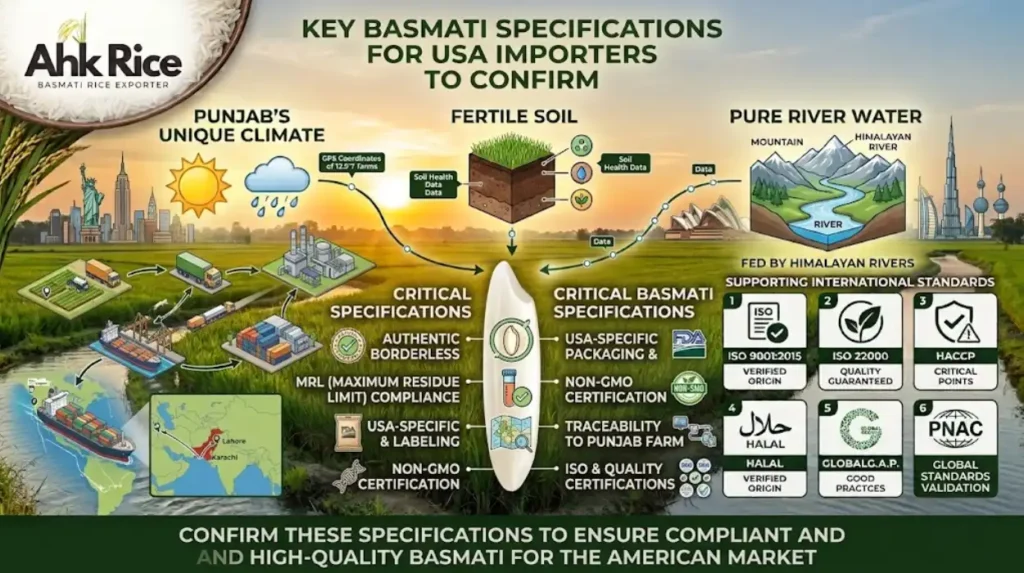
USA distributors should approve a written specification covering variety, grain length, moisture, broken percentage, processing method, appearance, packaging, and testing requirements. These parameters establish a measurable basis for sample approval, pre-shipment inspection, and commercial acceptance.
| Specification | What the buyer should confirm |
|---|---|
| Variety | 1121, Super Kernel, or 1509 |
| Grain length | Agreed raw-grain measurement and tolerance |
| Broken percentage | Contractual maximum |
| Moisture | Agreed maximum, commonly targeted at 12–13% for relevant grades |
| Processing | Raw, Steam, Golden Sella, or another agreed format |
| Food safety | Applicable testing and regulatory requirements |
| Packaging | Bag weight, material, labeling, and palletization if required |
| Inspection | Sampling method, testing laboratory, and acceptance criteria |
The values must be confirmed for the specific grade rather than treated as universal guarantees. Importers should also assess aroma, cooked elongation, texture, and separation through practical cooking tests.
For a more detailed comparison of the production factors behind these characteristics, read how Punjab’s climate, soil, and river water influence Basmati grain length and aroma. That comparison provides agricultural context, while the purchase specification determines the quality the exporter must deliver.
What Shipping Time Should USA Importers Expect?
Ocean freight from Pakistan to the United States requires route-specific planning. An indicative planning allowance is approximately 25–40 days at sea, depending on the destination port, carrier schedule, transshipment, and congestion; total order lead time also includes preparation, documentation, and customs clearance.
| Destination | Indicative ocean transit planning |
|---|---|
| US East Coast | Approximately 25–40 days |
| US Gulf Coast | Approximately 25–40 days |
| US West Coast | Approximately 25–40 days |
These are planning estimates, not guaranteed schedules or live carrier quotations. The actual route may include transshipment, and a specific sailing can take longer. The buyer should obtain a current carrier schedule and confirm the estimated arrival date before committing to a retail launch or warehouse replenishment.
The complete lead time begins before vessel departure. It includes order confirmation, stock availability or processing, packaging, quality approval, container booking, export clearance, and loading. After arrival, customs processing, applicable inspections, port handling, and inland transportation affect the delivery date.
AHK Rice should confirm the proposed loading window and available shipping options against the actual order. USA importers should also coordinate with their customs broker and verify the applicable import requirements before shipment.
What Factors Affect the Cost of Punjab-Origin Basmati Rice?
The landed cost depends on the selected variety, grade, order quantity, packaging, inspection requirements, freight, insurance, customs charges, and inland delivery. Buyers should compare quotations using the same specifications and Incoterm to understand the actual cost of distribution.
The rice price reflects variety, crop availability, grain quality, processing, and the contracted broken percentage. Premium specifications and additional sorting can affect the export price. Custom-printed bags, smaller retail packs, and special labeling requirements may also change the production cost.
Shipping and destination expenses form another part of the calculation. Depending on the agreed Incoterm, the quotation may exclude or include some combination of origin handling, ocean freight, insurance, and destination charges. Import duties, customs brokerage, inspection, warehousing, and domestic transport should be assessed separately where applicable.
A useful comparison should include:
- Product price per metric tonne.
- Packaging and printing charges.
- Inspection and testing costs.
- Origin handling and export documentation.
- Ocean freight and insurance, where included.
- Destination charges, duties, and inland transport.
- Payment terms, lead time, and contractual quality remedies.
Request a written quotation with the currency, quotation validity, Incoterm, shipment quantity, and destination port clearly identified. Avoid comparing an FOB quotation directly with a CIF quotation without adjusting for the services included.
How Can USA Buyers Request Samples and Approve an Order?
The sample process should verify product suitability before the buyer commits to a commercial shipment. Importers submit their required specifications, review sample and courier costs, conduct cooking and quality tests, approve the final grade, and confirm the contract before dispatch.
A practical sample-to-order process with AHK Rice follows these stages:
Step 1: Submit the purchasing specification. Identify the variety, processing method, target grain length, broken percentage, moisture limit, packaging requirements, and estimated order quantity. Include the intended USA port and distribution channel.
Step 2: Confirm sample availability and charges. Agree on the sample quantity and available grade. A commercial sample of up to 20 kg may be considered, subject to availability and arrangement. The buyer covers courier shipping and applicable phytosanitary charges. Obtain an actual courier quotation before sending the sample because cost depends on weight, destination, service, and handling requirements.
Step 3: Evaluate the sample. Inspect grain appearance, aroma, uniformity, and broken content. Cook the rice using the intended commercial preparation method. Record water absorption, elongation, texture, and separation to compare the sample with the distributor’s requirements.
Step 4: Approve the specification. Confirm the accepted grade in writing. Agree on the COA requirements, inspection method, bag artwork, net weight, labeling, and contractual tolerances. A sample approval should not replace a written specification for the commercial lot.
Step 5: Confirm the commercial order. Finalize quantity, price, payment terms, Incoterm, production or stock allocation, and shipment window. Clarify the process for handling any discrepancy between the delivered goods and agreed specifications.
Step 6: Review documents and dispatch. Request the agreed quality records, packing list, invoice, transport documentation, and applicable certificates. Confirm that the shipment information matches the order before the container departs.
This process gives buyers a documented decision trail from sample assessment to container shipment. It also helps identify disagreements before they become costly destination-side disputes.
What USA Import Requirements Should Buyers Check Before Shipment?
USA importers should verify food facility, prior notice, customs, labeling, and applicable rice-specific requirements with qualified compliance professionals before dispatch. Requirements depend on the product, parties involved, shipment details, and current federal rules.
The US Food and Drug Administration (FDA) regulates many food imports. Depending on the circumstances, requirements can include facility registration, prior notice of imported food, applicable preventive-control obligations, and compliance with food labeling rules. Customs entry and tariff classification should be reviewed with a licensed customs broker.
Buyers should establish who is responsible for each regulatory step. Confirm that product descriptions, country-of-origin declarations, lot details, and packaging information are consistent across the relevant records. Additional testing or certificates may be required depending on the product and applicable regulations.
AHK Rice can coordinate export-side documentation according to the agreed order. The USA importer remains responsible for confirming its own importer obligations and ensuring that the product is admissible before shipping.
How Should USA Distributors Decide Whether to Proceed?
Proceed when the supplier’s documented origin, approved sample, written quality specification, landed-cost calculation, shipment plan, and regulatory checks meet the distribution requirements. Hold the order if critical records, quality tolerances, or responsibilities remain unclear.
A buyer’s final review should cover five decisions: product suitability, traceability evidence, commercial viability, delivery timing, and compliance readiness. Each should be supported by written information rather than verbal assurances.
For example, a premium grocery distributor may prioritize 1121 grain length, aroma, retail packaging, and consistent appearance. A wholesale foodservice supplier may focus more heavily on cooking performance, broken percentage, bulk bag sizes, and cost per serving. Both buyers benefit from the same documented approval process, but their specifications will differ.
AHK Rice provides a sourcing option for distributors seeking Pakistani Basmati varieties with coordinated processing, packaging, and export arrangements. Define the required grade and evidence first, compare the complete landed cost, and approve the shipment plan before placing a repeat-volume order.
To discuss your required variety, sample arrangements, traceability documents, and USA shipment specifications, request a quotation from AHK Rice.
Frequently Asked Questions
1. What does farm-to-port traceability mean for Basmati rice?
It links available origin and procurement records with processing, quality checks, packaging, and shipment information.
The specific records depend on the supplier’s documented tracking system.
Importers should request lot-level evidence before approving the purchase.
Farm-level traceability should not be claimed without supporting records.
The final documentation should match the actual commercial shipment.
2. Which Punjab-origin Basmati varieties can USA distributors source?
Common options include 1121, Super Kernel, and 1509 Basmati rice.
1121 is often evaluated for its long grain and premium presentation.
Super Kernel serves buyers seeking traditional Pakistani Basmati characteristics.
1509 provides another option for price and application comparisons.
Final specifications and availability must be confirmed with the exporter.
3. How long does shipping from Pakistan to the USA take?
Ocean transit can require approximately 25–40 days as a planning estimate.
Actual timing varies by port, carrier, transshipment, and congestion.
Processing and export clearance add time before vessel departure.
Customs, inspections, and inland delivery affect the final arrival date.
Importers should confirm a current schedule for their specific shipment.
4. Who pays for rice samples and courier shipping?
Sample availability and quantity should be agreed with the supplier first.
The buyer covers courier shipping and applicable phytosanitary charges under the proposed sample arrangement.
Courier costs depend on weight, destination, service, and handling requirements.
Importers should obtain a confirmed quotation before shipment.
Commercial sample approval should be followed by a written purchase specification.
5. What documents should USA Basmati rice importers request?
Request the commercial invoice, packing list, and applicable transport documents.
Ask for available origin records and shipment-specific quality or COA results.
Confirm applicable phytosanitary and other export certificates for the product.
Verify FDA, customs, prior notice, and labeling obligations with qualified professionals.
The required document set depends on the shipment and current regulations.