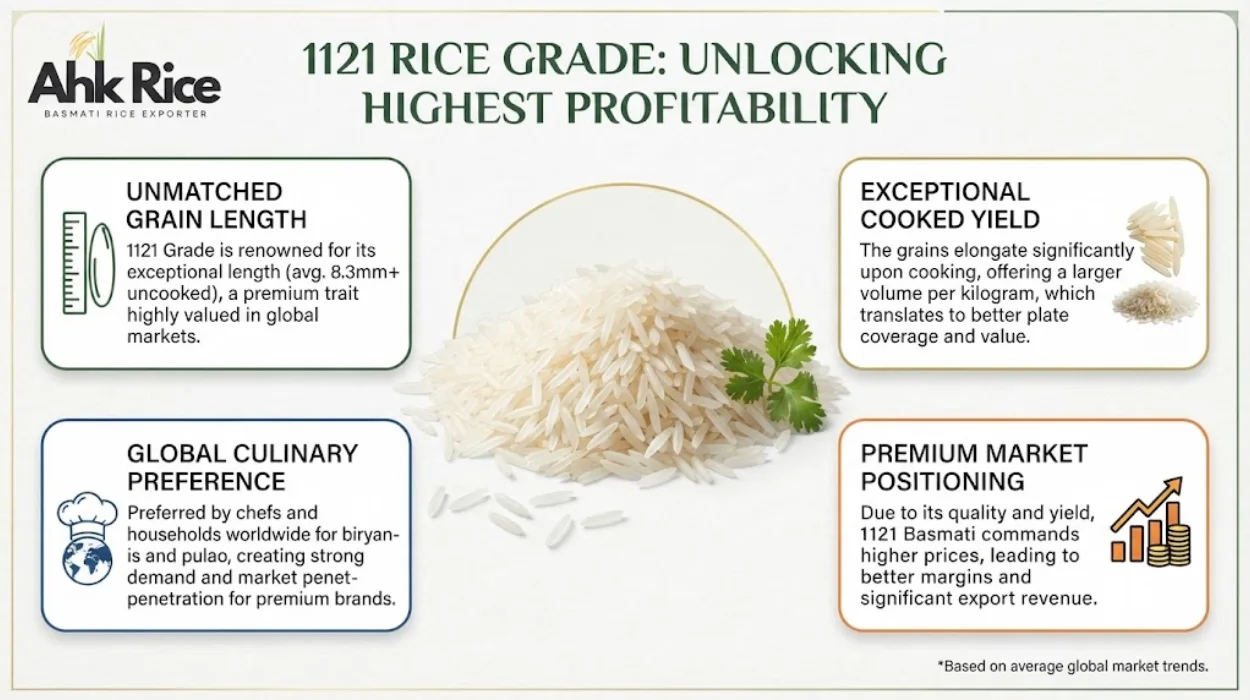
Which 1121 Rice Grade Gives Highest Profit Margin?
1121 Steam can deliver the highest selling price, while 1121 Golden Sella can deliver stronger inventory economics. Here is why: current FOB references place Steam around $1,160–$1,200/MT and Golden Sella around $1,145–$1,185/MT. Profit margin depends on procurement cost, processing cost, yield, packaging, breakage, storage, and destination demand.
The right grade therefore depends on the buyer’s commercial model. A premium retailer values appearance and aroma. A catering distributor values grain strength and storage stability. For a broader understanding of Pakistani Basmati varieties, cultivation, processing, and export quality, see What Makes Pakistani Basmati Rice Different? The comparison below then focuses specifically on 1121 profit economics.
What are the available 1121 rice solutions?
Four commercial solutions cover most 1121 procurement needs: White, Steam, Creamy Sella, and Golden Sella. Each uses the same 1121 variety but applies different processing methods, creating different cooking performance, storage characteristics, market positioning, and cost structures.
1121 White Basmati
1121 White uses conventional milling, polishing, grading, and sorting. It retains a bright white appearance and traditional Basmati aroma. Current indicative FOB references place 1121 White around $1,165–$1,205/MT.
White rice suits premium retail channels where consumers evaluate brightness, aroma, grain appearance, and cooking performance. Its shorter storage planning window increases the importance of inventory turnover and moisture-controlled warehousing.
1121 Steam Basmati
1121 Steam receives controlled steam treatment before final drying and milling. This strengthens the grain and supports consistent cooking. Current indicative FOB pricing sits around $1,160–$1,200/MT.
Steam often suits premium retail, restaurants, hotels, and foodservice buyers. The grade combines long grain presentation with a firm cooking structure. Its commercial value comes from premium positioning rather than simply the lowest procurement cost.
1121 Creamy Sella
Creamy Sella is a lightly parboiled 1121 grade with a pale cream appearance. Parboiling strengthens the grain before milling. The process supports separation during cooking and improves storage stability.
Creamy Sella works for buyers seeking Sella performance without the deeper golden appearance. Its pricing generally sits below or around Golden Sella depending on specifications, crop, packaging, and market demand.
1121 Golden Sella
Golden Sella receives controlled parboiling that produces a deeper golden appearance and firm grain structure. Current indicative FOB references place Golden Sella around $1,145–$1,185/MT.
Golden Sella supports large-volume catering, wholesale distribution, and markets where golden colour and grain separation are important. Its longer storage planning window can reduce inventory pressure during slower distribution cycles.
AHK Rice supplies 1121 alongside Super Kernel and 1509, with processing, grading, colour sorting, custom packaging, and export coordination available for international buyers.
The available grades create different commercial models, so the next step is comparing their measurable specifications.
How do the different 1121 approaches compare?
1121 Steam leads on current indicative selling price, while Golden Sella leads on storage durability. White leads on bright appearance, and Creamy Sella balances parboiled performance with lighter colour.
Seven-attribute specification comparison
| Attribute | 1121 White | 1121 Steam | 1121 Creamy Sella | 1121 Golden Sella |
|---|---|---|---|---|
| Raw grain length | 8.20–8.40 mm | 8.20–8.40 mm | 8.20–8.40 mm | 8.20–8.50 mm |
| Processing | Milled | Steam treated | Light parboiled | Parboiled |
| Colour | Bright white | Off-white | Pale cream | Golden amber |
| Grain strength | Medium | High | High | Very high |
| Indicative FOB/MT | $1,165–$1,205 | $1,160–$1,200 | Around $1,135–$1,175 | $1,145–$1,185 |
| Shelf-life planning | 12–18 months | 12–18 months | 18–24 months | 18–24 months |
| Main commercial use | Premium retail | Retail and foodservice | Retail and foodservice | Catering and wholesale |
Current market references support these indicative price ranges, while AHK Rice’s published specifications show similar distinctions in processing, grain strength, storage, and commercial use. Actual quotations vary by crop, broken percentage, moisture, packaging, quantity, and Incoterm.
Price alone does not establish profit margin. A $20/MT selling premium can disappear through higher processing costs, lower milling yield, expensive packaging, or slower inventory movement.
For example, a 50 MT order priced $15/MT higher creates $750 additional revenue before costs. The same premium becomes meaningful only when the extra processing and storage costs remain below that amount.
The commercial comparison therefore needs market conditions, not only FOB prices.
Which 1121 grade works best for different markets?
Gulf buyers generally place stronger value on Sella durability and cooking separation, while Southeast Asian buyers often balance appearance, premium positioning, storage, and landed cost.
Gulf market: Saudi Arabia, UAE, Qatar, and Iraq
Gulf markets provide strong use cases for Sella grades. Catering operations often prepare rice in large batches. Grain strength and separation therefore affect cooking yield and operational consistency.
Golden Sella fits distributors managing longer warehouse cycles. Published AHK Rice market material places Golden Sella around 18–24 months of shelf-life planning under suitable storage, compared with around 12–18 months for Steam.
Steam fits premium restaurants and retail programs that prioritize bright presentation, aroma, and softer eating texture. Saudi market comparisons identify Steam as a premium retail option and Golden Sella as a strong catering specification.
For Gulf procurement, the commercial calculation should include warehouse temperature. A hot warehouse can increase inventory risk. Longer-lasting Sella reduces pressure to liquidate stock quickly.
Southeast Asia: Indonesia and the Philippines
Southeast Asian buyers face different procurement conditions. Indonesia and the Philippines require attention to tropical humidity, packaging protection, inventory rotation, and landed cost.
Golden Sella provides longer storage planning. Current AHK Rice market references place Golden Sella around 18–24 months, while Steam generally sits around 12–18 months.
Steam can work well for hotels, premium restaurants, and retail brands where presentation carries greater value. Golden Sella suits wholesale and foodservice channels that need stronger handling performance.
The difference becomes important when inventory remains in warehouses for several months. A lower FOB price does not necessarily produce a better commercial result if the grade turns slowly or requires more frequent replenishment.
With regional differences established, the next question is how price and shelf life affect the margin calculation.
How do price and shelf life affect profit margin?
Margin comes from the spread between total landed cost and realized selling price. A grade with a lower FOB price can generate more profit when it reduces storage losses, processing costs, breakage, or inventory pressure.
A simple export margin formula is:
Gross margin = Selling price − procurement cost − processing cost − packaging cost − inspection cost − logistics cost − finance cost.
This formula explains why Steam cannot automatically be called the most profitable grade. Its current FOB price can exceed Golden Sella by roughly $15/MT, but the difference represents revenue rather than net margin.
Golden Sella creates another type of commercial value. Its parboiled structure supports longer storage planning and strong cooking performance. A distributor can therefore hold stock for longer without relying on rapid turnover.
Shelf-life comparison
| Grade | Indicative planning period | Commercial implication |
|---|---|---|
| 1121 White | 12–18 months | Faster inventory rotation |
| 1121 Steam | 12–18 months | Premium turnover model |
| 1121 Creamy Sella | 18–24 months | Longer distribution cycle |
| 1121 Golden Sella | 18–24 months | Strongest storage flexibility |
These periods are planning references rather than universal expiry declarations. Moisture, packaging, temperature, humidity, pest control, sanitation, and storage practices determine actual product stability.
A buyer holding 100 MT for six months needs a different commercial calculation from a buyer moving the same volume within 30 days. Inventory speed changes the value of storage life.
The price and shelf-life relationship shows why margin must be calculated from the complete supply chain.
What are the pros and cons of each 1121 grade?
Steam offers premium selling potential, Golden Sella offers storage strength, White offers visual appeal, and Creamy Sella offers balanced Sella performance. Each creates different cost and demand conditions.
1121 Steam
Pros: Steam provides strong grain presentation, high aroma perception, and premium positioning. It suits restaurants, hotels, and premium retail.
Cons: Steam normally requires tighter inventory rotation than Sella. Its higher selling price does not guarantee higher net margin.
Example: A premium retailer moving 50 MT quickly can monetize Steam’s price position without carrying long warehouse stock.
1121 Golden Sella
Pros: Golden Sella provides strong grain durability, cooking separation, and longer storage planning. It suits catering and wholesale distribution.
Cons: Golden colour does not suit every retail segment. Some consumers prefer the bright appearance of white or steam rice.
Example: A Gulf distributor holding several months of inventory can benefit from the longer storage window and lower handling risk.
1121 White
Pros: White rice provides bright appearance and familiar consumer presentation. It suits premium retail packaging.
Cons: White rice generally offers a shorter storage planning period than Sella. Faster turnover becomes more important.
Example: A supermarket distributor with weekly replenishment can use White without relying heavily on long-term storage.
1121 Creamy Sella
Pros: Creamy Sella combines parboiled grain strength with a lighter colour. It suits buyers wanting Sella performance without deep golden colour.
Cons: Its market identity can be less distinctive than Golden Sella. The commercial premium depends heavily on destination demand.
Example: A distributor serving mixed retail and foodservice customers can use Creamy Sella as a middle-position specification.
With the advantages and limitations defined, the final decision should use measurable procurement factors.
Which factors should buyers use to choose the profitable grade?
Buyers should compare realized selling price, total landed cost, processing yield, inventory speed, and market demand before selecting a 1121 grade for margin.
| Decision factor | What to measure | Commercial question |
|---|---|---|
| Selling price | Realized price per MT | What price can the market support? |
| Processing cost | Milling and treatment cost | How much does the grade cost to produce? |
| Yield | Whole grain recovery | How much saleable rice results from paddy? |
| Inventory cycle | Monthly stock movement | How quickly will the buyer sell the shipment? |
| Market fit | Retail or foodservice demand | Does the specification match the customer? |
Factor 1: Selling price
Compare confirmed quotations under identical Incoterms. FOB prices cannot be compared directly with CIF or CNF offers.
Factor 2: Processing cost
Calculate milling, parboiling, steam treatment, polishing, grading, sorting, and packaging costs separately. This identifies the real production spread.
Factor 3: Yield
Measure whole grain recovery and broken percentage. A higher selling price loses value when the processing yield falls.
Factor 4: Inventory cycle
Match shelf-life planning with actual monthly consumption. Golden Sella provides more storage flexibility, while Steam suits faster turnover models.
Factor 5: Market fit
Match the grade to the buyer segment. Gulf catering often emphasizes Sella performance, while premium retail can place greater emphasis on appearance and aroma.
This framework makes the answer more precise: the profitable grade is the one that produces the strongest net spread after all commercial costs.
How should an importer calculate the highest-margin 1121 grade?
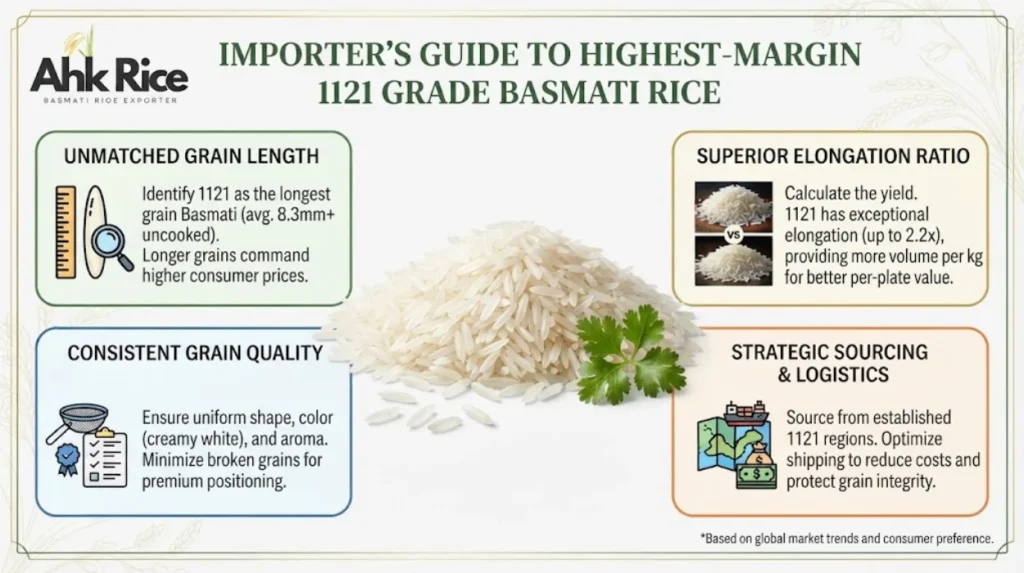
Calculate the margin separately for White, Steam, Creamy Sella, and Golden Sella using the same shipment size, Incoterm, packaging, destination, and quality specifications.
Start with the same quantity for every comparison. A 50 MT model provides a practical baseline.
Record the FOB price for each grade. Add packaging, inspection, documentation, freight, insurance, destination charges, and inland delivery.
Next, calculate expected selling revenue. Use the buyer’s actual wholesale or retail selling price instead of an assumed premium.
Then subtract every direct and indirect shipment cost. Include financing, storage, handling, and expected breakage or quality losses.
Finally, divide gross profit by realized sales revenue:
Profit margin % = Gross profit ÷ realized sales revenue × 100.
This method prevents a common procurement error. Buyers often select the grade with the highest FOB selling price while ignoring processing economics and stock turnover.
For an exporter, AHK Rice can align grade, packaging, quality specifications, and export requirements around the target market. AHK Rice provides 1121, Super Kernel, and 1509 varieties with processing, grading, colour sorting, custom packaging, and export documentation support.
The final decision should therefore come from a destination-specific quotation rather than a generic price table.
Frequently Asked Questions
Which 1121 rice grade has the highest selling price?
Current indicative FOB references place 1121 White around $1,165–$1,205/MT, slightly above Steam and Golden Sella ranges. Selling price does not equal profit margin because production, packaging, storage, and logistics costs differ by grade.
Is 1121 Steam more profitable than Golden Sella?
Not automatically. Steam currently carries a modest FOB price premium in some published references. Golden Sella provides longer storage planning and strong grain durability. The more profitable option depends on the buyer’s complete landed cost and selling price.
Why does Golden Sella have strong profit potential?
Golden Sella combines premium 1121 grain characteristics with parboiling, strong grain structure, and longer storage planning. Its commercial value becomes stronger for wholesalers and caterers managing large inventories or longer distribution cycles.
What is the shelf life of 1121 Golden Sella?
Commercial planning references commonly place Golden Sella around 18–24 months under suitable storage. Actual stability depends on moisture, packaging, temperature, humidity, pest control, sanitation, and stock rotation.
What is the shelf life of 1121 Steam?
Commercial planning references commonly place 1121 Steam around 12–18 months. Buyers should use the supplier’s documented product specification and storage conditions rather than treating the range as a universal expiry date.
Which 1121 grade suits Saudi Arabia?
Saudi buyers use different grades for different channels. Steam suits premium retail and restaurant applications, while Golden Sella suits catering and wholesale operations requiring stronger storage and cooking performance.
Which 1121 grade suits Indonesia?
Indonesian buyers can use Steam for premium retail and hotel applications. Golden Sella suits wholesale and foodservice channels requiring longer storage planning. Tropical warehouse conditions make moisture control and packaging especially important.
How should buyers compare 1121 rice prices?
Compare prices under identical specifications and Incoterms. Match grain length, broken percentage, moisture, processing type, packaging, quantity, inspection, freight, and destination charges before calculating the final margin.
What is the most important factor in 1121 rice profitability?
The most important factor is the net spread between realized selling price and total landed cost. Procurement price alone does not show profitability. Yield, processing, storage, packaging, logistics, and market demand all affect the final result.