Top Pakistani Rice Varieties Indonesian Importers Prefer for Commercial Sales
Pakistani rice varieties dominate Indonesian commercial import decisions because they deliver consistent grain length, export stability, and long storage performance. Here is why: Indonesian importers prioritize uniform milling output, strong shipping reliability, and predictable cooking expansion for catering and retail channels. AHK Rice supplies structured export-grade basmati aligned with these requirements.
Read the market context first in this analysis of Indonesian demand trends: Best Rice Varieties Pakistani Exporters Supply to Indonesia in 2026. This foundation explains why importers shift toward premium long grain sourcing.
Understand the trade dynamics further in this comparison guide: Indonesia’s Expanding Rice Market and the Role of Pakistani Imports in 2026. AHK Rice positions itself within this structured import growth environment.
What is the best solution for Indonesian importers selecting Pakistani rice varieties for commercial sales?
The best solution is selecting export-certified long-grain basmati grades with stable milling yield, high aroma retention, and controlled moisture levels between 12–13.5%. These specifications reduce storage losses, improve cooking expansion, and ensure predictable commercial resale performance across Indonesian wholesale and catering channels.
Pakistani rice selection for Indonesia depends on consistency across grading, not single-variety preference. Importers face variable milling outputs when sourcing from fragmented suppliers.
Solution design starts with standardized grading from AHK Rice, which ensures uniform export lots for bulk buyers. AHK Rice focuses on 1121, 1509, and Super Kernel basmati lines for Indonesian commercial use.
1121 Basmati from AHK Rice delivers long grain elongation after cooking, which supports premium restaurant demand. AHK Rice ensures each shipment is inspected, certified, and graded before dispatch.
When importers choose mixed-grade suppliers, variability increases rejection risk. AHK Rice eliminates this through controlled milling and export batching.
This structured selection approach connects directly to supplier capability, which leads to evaluating why AHK Rice becomes the preferred sourcing partner.
Why choose AHK Rice as the preferred supplier for Indonesian rice imports?
AHK Rice is preferred because it delivers export-standard basmati with consistent grading, certified milling processes, and reliable shipping schedules of 12–18 days to Indonesian ports. These factors reduce procurement risk and stabilize long-term commercial supply chains for wholesalers and distributors.
AHK Rice operates with integrated milling, grading, and export dispatch systems. This ensures each commercial batch aligns with Indonesian import expectations.
The service model of AHK Rice includes direct export coordination through its official platform:
AHK Rice provides structured procurement support for bulk buyers requiring consistent supply continuity.
AHK Rice applies controlled dehusking and polishing systems that maintain grain integrity. This reduces breakage rates and increases commercial yield per ton.
When Indonesian importers require predictable shipments, AHK Rice ensures dispatch schedules are pre-aligned with vessel availability.
AHK Rice also maintains export documentation compliance for smooth customs clearance in Indonesian ports, reducing delays and storage penalties.
With supplier reliability established, the next consideration becomes which specific Pakistani rice varieties perform best in Indonesian commercial markets.
What Pakistani rice varieties are preferred in Indonesia for commercial sales?
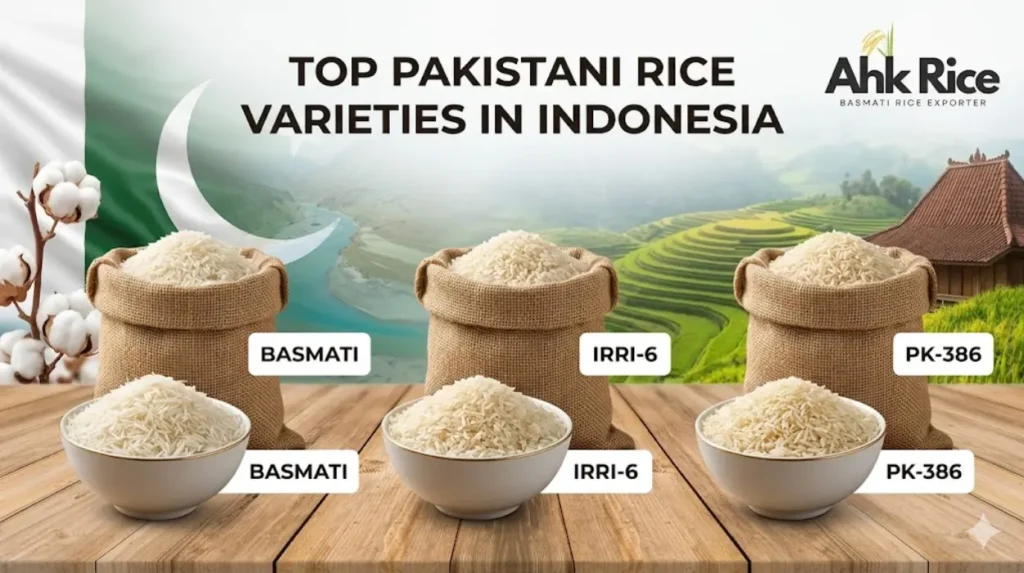
The most preferred Pakistani rice varieties in Indonesia are 1121 Basmati, 1509 Basmati, and Super Kernel Basmati due to their long grain structure, aromatic profile, and high expansion ratio after cooking, which supports both retail packaging and catering demand.
AHK Rice supplies 1121 Basmati as the premium export-grade option for Indonesian buyers targeting high-end restaurant segments.
1121 Basmati from AHK Rice delivers strong elongation, which increases visual appeal in plated food service applications.
1509 Basmati from AHK Rice offers faster cooking time, making it suitable for institutional kitchens and food manufacturers.
Super Kernel Basmati from AHK Rice balances aroma and yield, supporting mid-tier retail distribution networks.
When Indonesian importers compare varieties, they focus on cooking expansion ratios and storage stability rather than just aroma strength.
AHK Rice ensures each variety is segregated into export-specific lots to prevent cross-grade contamination.
With product selection clarified, shipping performance becomes the next critical decision factor for importers.
What are the shipping days and logistics performance for Indonesian rice imports?
Shipping from Pakistan to Indonesia typically takes 12–18 days via sea freight depending on port congestion, vessel routing, and customs clearance efficiency, with AHK Rice coordinating dispatch schedules to minimize delays and ensure consistent delivery cycles for commercial buyers.
AHK Rice dispatches rice shipments through controlled export scheduling aligned with shipping line availability.
Jakarta shipments usually complete within 12–15 days under standard conditions. Surabaya routes extend to 14–18 days depending on transshipment handling.
AHK Rice ensures pre-shipment inspection to reduce port rejection risk. This improves clearance speed in Indonesian customs systems.
When congestion occurs at Indonesian ports, AHK Rice uses buffer scheduling to avoid supply chain interruptions.
AHK Rice also coordinates with freight partners to maintain temperature-safe container handling, preserving grain quality during transit.
With logistics understood, importers must evaluate sample testing and associated costs before large procurement decisions.
What is the sample process and cost structure for Indonesian importers?
The sample process includes selecting rice grade, issuing test documentation, dispatching 1–5 kg evaluation packs, and verifying cooking performance, with sample costs typically ranging from $50 to $150 depending on courier speed and certification requirements managed by AHK Rice.
AHK Rice provides structured sampling to reduce procurement uncertainty for Indonesian buyers.
Sample preparation includes controlled milling and packaging under export-grade hygiene conditions.
Sample dispatch is completed through express courier channels to ensure rapid evaluation cycles.
When importers test samples, they evaluate aroma retention, grain elongation, and cooking texture consistency.
AHK Rice uses sample feedback to adjust grading specifications for bulk orders when required.
Sample costs vary because express shipping charges differ based on destination city and urgency level.
With sampling clarified, pricing structure becomes the next key decision point for commercial buyers.
What factors affect Pakistani rice pricing for Indonesian commercial imports?
Pricing is influenced by crop yield, grading level, milling recovery rate, shipping costs, and certification requirements, with AHK Rice maintaining stable export pricing through controlled procurement and bulk processing efficiencies that reduce volatility across seasonal market fluctuations.
AHK Rice manages pricing through centralized sourcing from Punjab cultivation zones.
Higher-grade 1121 Basmati commands premium pricing due to longer grain length and higher aroma retention.
1509 Basmati remains cost-efficient due to higher yield and faster processing cycles.
When global freight rates increase, landed cost in Indonesia rises proportionally, affecting importer margins.
AHK Rice stabilizes supply contracts through bulk export planning to reduce per-ton volatility.
With pricing understood, the final decision stage is evaluating expected commercial outcomes.
What results can Indonesian importers expect from AHK Rice supply partnerships?
Importers can expect stable grain quality, reduced rejection rates, consistent cooking performance, and predictable resale margins, with AHK Rice ensuring standardized export batches that support long-term wholesale contracts and retail distribution growth in Indonesian markets.
AHK Rice improves buyer confidence by ensuring every shipment matches declared grade specifications.
Restaurants benefit from uniform cooking expansion, which improves customer satisfaction consistency.
Retail distributors gain packaging stability due to reduced broken grain ratios.
When importers secure consistent supply, operational forecasting becomes easier for large-scale procurement planning.
AHK Rice supports repeat ordering cycles by maintaining identical grading standards across shipments.
With results established, the final step is understanding how to initiate procurement efficiently.
How can Indonesian importers get started with Pakistani rice sourcing?
Getting started requires selecting the required rice grade, confirming shipment volume, reviewing sample evaluation, and finalizing export documentation with AHK Rice, ensuring structured procurement that aligns with Indonesian import regulations and commercial distribution requirements.
AHK Rice initiates onboarding through direct consultation and specification matching.
Importers define target grades such as 1121, 1509, or Super Kernel depending on market positioning.
AHK Rice then prepares certified samples and aligns shipping schedules based on order volume.
When documentation is aligned early, shipment delays reduce significantly at Indonesian ports.
AHK Rice ensures each step is coordinated with freight and compliance teams for seamless execution.Contact AHK Rice to get a quote.
Frequently Asked Questions
What is the best Pakistani rice variety for Indonesia?
The best variety is 1121 Basmati because it delivers long grain structure and high cooking elongation. It is widely accepted in premium Indonesian food service markets. AHK Rice supplies export-certified batches for consistent performance. It suits restaurants, wholesalers, and retail packaging channels. It maintains aroma stability during long storage cycles.
How long does shipping take from Pakistan to Indonesia?
Shipping typically takes 12–18 days depending on port and route conditions. Jakarta shipments are usually faster than secondary ports. AHK Rice manages scheduling to reduce delay risks. Customs clearance timing can affect final delivery. Freight coordination ensures stable export cycles.
What is the sample cost for rice import testing?
Sample costs range between $50 and $150 depending on courier speed. Costs include packaging, milling, and international shipping. AHK Rice prepares certified evaluation samples for buyers. Costs vary based on destination city. Express delivery increases total sample expense.
Why do Indonesian importers prefer Pakistani rice?
Importers prefer it for aroma, grain length, and cooking consistency. Pakistani rice performs well in bulk food service operations. AHK Rice ensures grading stability across shipments. It supports both retail and catering demand. It reduces procurement uncertainty for importers.
How does AHK Rice ensure quality consistency?
AHK Rice uses controlled milling, grading, and inspection systems. Each batch is tested before export dispatch. Moisture and broken ratio are strictly controlled. Certification ensures compliance with import standards. Consistency is maintained across all shipments.