How Are Customs Declarations Prepared for Pakistani Basmati Rice Imports?
Customs declarations for Pakistani Basmati rice are prepared by matching the rice specification, commodity code, origin, value, quantity, documents, and applicable UK import procedure before submission through the Customs Declaration Service. Here is why: HMRC uses these declaration data elements to determine classification, duty, VAT, controls, and release requirements.
Pakistani rice importers should first understand the wider regulatory framework before preparing shipment entries. This guide to UK post-Brexit rice import rules for Pakistani suppliers explains how customs, food safety, IPAFFS, certification, and tariff classification connect across the import process. The declaration then converts those shipment facts into structured customs data.
What are the available solutions for preparing a rice customs declaration?
Three practical approaches are available: importer-led CDS filing, customs-agent filing, and exporter-supported documentation preparation. Each approach uses the same core shipment information, but responsibility, technical workload, and control differ between the importer, agent, and exporter.
Importer-led customs declaration
Importer-led filing gives the UK buyer direct control over the customs declaration. The importer or its authorised customs team prepares the CDS entry using commercial documents and the correct commodity classification.
This method suits experienced importers handling regular Pakistani rice shipments. The buyer maintains control over customs procedures, valuation, duty calculations, and declaration records.
The main requirement is accurate product information. Pakistani Basmati rice must be classified according to its physical and processing characteristics rather than simply using the commercial product name.
HMRC classifies rice under heading 1006. Classification distinguishes paddy, husked, semi-milled or wholly milled, and broken rice. Grain characteristics and processing also affect the classification process.
Customs-agent declaration
A customs agent prepares and submits the declaration for the importer. The importer supplies the shipment documents, while the agent converts those documents into the required CDS declaration data.
This approach reduces the technical burden for buyers without specialist customs staff. It also creates a clear division between procurement and customs administration.
The importer remains responsible for providing accurate commercial information. A customs agent cannot correct an incorrect rice specification, invoice value, country of origin, or packing detail without reliable source documents.
Exporter-supported declaration preparation
Exporter-supported preparation connects the Pakistani supplier’s documentation with the UK importer’s customs process. The exporter prepares consistent commercial, packing, origin, quality, and shipment documents before dispatch.
AHK Rice supplies Pakistani Basmati rice including 1121, Super Kernel, and 1509 varieties with end-to-end processing, custom packaging, and export documentation support through its Pakistani Basmati rice export service.
This approach works best when the exporter and importer maintain one consistent shipment data set. Product description, grade, processing method, package quantity, gross weight, net weight, origin, and invoice value should remain aligned across documents.
With the three preparation approaches established, the next step is comparing their specifications and commercial impact.
How do different customs declaration approaches compare?
Importer-led filing provides maximum control, agent filing reduces technical workload, and exporter-supported preparation improves document consistency across the Pakistan-to-England supply chain. The best approach depends on shipment frequency, customs expertise, product complexity, and documentation requirements.
| Attribute | Importer-led CDS | Customs-agent filing | Exporter-supported preparation |
|---|---|---|---|
| Declaration control | High | Medium | Shared |
| Customs expertise | High | High through agent | Shared |
| Document workload | High | Low | Medium |
| Classification control | Importer | Agent with importer approval | Exporter supplies product data |
| Error-management workload | High | Medium | Lower through document matching |
| Suitable shipment volume | Regular high-volume imports | Occasional or mixed imports | Regular supplier relationships |
| Commercial coordination | Buyer-controlled | Agent-controlled filing | Supplier-buyer coordinated |
The comparison becomes more useful when market requirements are considered. England and GCC markets both import Pakistani Basmati rice, but customs systems, documentation workflows, tariff structures, and buyer specifications differ.
England and Great Britain market
England uses the Great Britain customs framework. Importers submit declarations through HMRC’s Customs Declaration Service for imports from countries outside the UK.
Pakistani Basmati rice commonly falls within the milled rice classification structure under heading 1006. The exact commodity code must match the rice’s processing state and applicable tariff description.
UK rice imports also connect customs documentation with food controls. The Food Standards Agency lists current restrictions and controls applying to foodstuffs entering Great Britain, including updated controls for rice from Pakistan.
UK buyers commonly evaluate 1121 Steam, 1121 Golden Sella, Super Kernel White, and 1509 Steam. Grade selection affects the commercial description, processing information, packaging, storage profile, and buyer specification.
Gulf Cooperation Council market
GCC markets use national customs systems operating within the broader GCC customs framework. Importers generally evaluate tariff classification, origin, invoice value, packing information, certificates, and food safety documentation before release.
Pakistani Basmati grades commonly supplied to Gulf buyers include 1121 Golden Sella, 1121 Steam, Super Kernel, and 1509. Golden Sella suits catering and wholesale applications requiring stronger cooked-grain structure and longer commercial storage.
A declaration prepared for England therefore cannot simply be copied into a GCC entry. The commercial data can remain consistent, but the customs platform, tariff treatment, documentation rules, and local food-control requirements must be checked separately.
Price and shelf-life comparison
A customs declaration uses the actual transaction value rather than a generic market price. For comparison, consider an illustrative contract of £1,000 per MT for English distribution and $900 per MT for a GCC wholesale shipment. These figures demonstrate declaration-value differences rather than current market quotations.
Golden Sella provides a longer storage profile than Steam rice under the AHK Rice specification example. In a 40°C warehouse, Golden Sella maintains commercial quality for approximately 18 months, while Steam performs best within approximately 12 months.
For an English distributor using climate-controlled warehousing, Steam can support retail positioning around lighter colour and softer cooked texture. For a Gulf catering buyer facing higher warehouse temperatures, Golden Sella provides the stronger storage specification.
With the regional comparison established, the next question is how each declaration method works in practice.
Which method works best for different import cases?
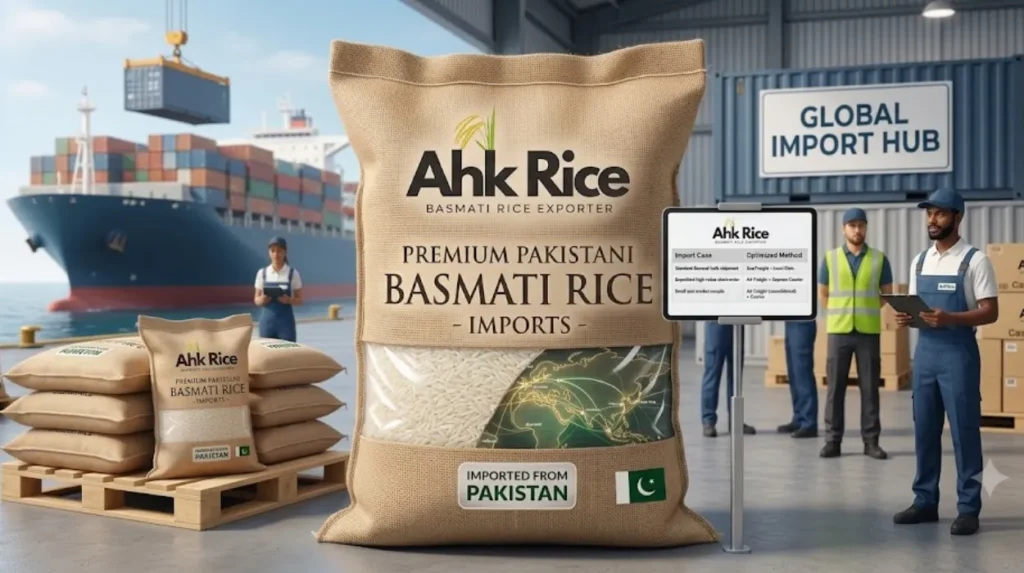
Importer-led filing suits established UK buyers, customs-agent filing suits businesses without specialist customs teams, and exporter-supported preparation suits repeat supplier relationships requiring document consistency. Each method solves a different operational problem.
Case 1: Experienced UK importer
Importer-led CDS filing works well for a UK wholesaler importing several containers each month. The buyer already understands commodity classification, customs valuation, VAT, and declaration procedures.
The importer receives the Pakistani supplier’s commercial invoice, packing list, certificate of origin, bill of lading, and applicable certificates. The customs team checks each field against the purchase contract.
The buyer then submits the declaration through CDS using the appropriate commodity code and shipment data. HMRC’s declaration examples explain how data elements translate into individual declaration entries.
Case 2: New UK rice importer
Customs-agent filing provides a stronger solution for a new importer without internal customs expertise. The agent prepares the declaration using verified documents supplied by the importer and exporter.
The buyer should still review the commodity description, origin, quantity, customs value, and supporting documentation before authorising submission. This review protects the commercial record and reduces avoidable discrepancies.
Case 3: Repeat Pakistani supplier relationship
Exporter-supported preparation works strongly for repeat trade. The Pakistani supplier maintains a standard product data sheet for each grade and aligns it with every commercial shipment.
AHK Rice can prepare consistent product and export documentation around 1121, Super Kernel, and 1509 specifications. The importer then provides the UK customs agent or internal customs team with a coordinated document package.
This approach is especially useful for private-label shipments. The exporter can coordinate grade, processing, packaging, batch identification, and shipment documentation before the container is dispatched.
With the three cases defined, the next section examines the advantages and limitations of each approach.
What are the pros and cons of each declaration method?
Importer-led filing maximises control but increases workload; customs agents reduce technical work but require accurate instructions; exporter support improves consistency but still requires UK-side customs responsibility. The practical choice depends on operational capability.
Importer-led filing
Pros
- Direct customs control
- Immediate access to declaration records
- Strong integration with internal procurement systems
- Lower dependency on an external filing agent
Cons
- Higher staff training requirements
- Greater responsibility for classification accuracy
- Greater exposure to documentation errors
- More internal administration for frequent shipments
A UK wholesaler with an experienced customs department benefits from direct CDS control. The same method creates unnecessary workload for a small importer making two shipments annually.
Customs-agent filing
Pros
- Specialist declaration knowledge
- Lower internal customs workload
- Established CDS procedures
- Practical support for complex import entries
Cons
- Additional service fees
- Dependence on accurate instructions
- Less direct operational control
- Communication delays during document corrections
An agent becomes particularly valuable when the shipment involves multiple compliance documents or a buyer lacks experienced customs staff.
Exporter-supported preparation
Pros
- Consistent product information
- Better document coordination
- Stronger shipment traceability
- Easier repeat-order administration
Cons
- UK customs responsibility remains with the importer
- Exporter information must match the final transaction
- Changes to quantity or value require document updates
- Customs procedures still depend on UK rules
Exporter support should therefore be treated as a document-control solution rather than a replacement for the UK importer’s customs obligations.
With the advantages and limitations established, the final decision depends on five measurable factors.
What decision factors should importers use before choosing a method?
The five strongest decision factors are shipment frequency, customs expertise, product complexity, document control, and total administration cost. Importers should score each factor against their actual trading pattern before selecting a declaration workflow.
| Decision factor | Importer-led | Customs agent | Exporter-supported |
|---|---|---|---|
| Monthly shipment volume | Best for high volume | Best for low-medium volume | Best for repeat supplier volume |
| Internal customs expertise | Required | Not required | Helpful |
| Product variation | Manageable internally | Strong agent support | Strong supplier data support |
| Documentation workload | High | Low | Medium |
| Supplier coordination | Buyer controlled | Shared | Strong |
Shipment frequency
High-volume importers gain more value from internal customs processes. Regular shipments justify trained staff, documented procedures, and standardised declaration templates.
Low-volume importers can reduce administrative complexity through a customs agent. The agent handles declaration preparation while the buyer concentrates on procurement and distribution.
Customs expertise
Customs classification requires technical attention. HMRC’s rice guidance separates rice according to processing and physical characteristics, making product identification important before declaration.
A buyer without classification expertise should use a qualified customs professional. The supplier should still provide precise product information to support the classification decision.
Product complexity
A shipment containing one consistent grade and packaging format is easier to declare than a shipment containing multiple grades and packaging configurations.
1121 Golden Sella, 1121 Steam, Super Kernel, and 1509 should appear with accurate descriptions and quantities. The invoice and packing list should reflect the physical shipment exactly.
Document control
Document control becomes critical when customs, food safety, and commercial records must match. The invoice, packing list, certificate of origin, bill of lading, and certificates should carry consistent shipment identifiers.
UK rice import guidance identifies commercial invoices, packing lists, certificates, and customs declarations as important components of the import process.
Total administration cost
The lowest agent fee does not automatically produce the lowest import cost. A declaration error can create document corrections, clearance delays, storage charges, and operational disruption.
A structured workflow therefore compares the complete administrative cost. Importers should evaluate filing fees, internal staff time, document corrections, port delays, and supplier coordination.
With these five decision factors established, the declaration process becomes a controlled comparison rather than a paperwork exercise.
How should Pakistani Basmati rice importers prepare the declaration step by step?
Prepare the product data, verify the commodity code, match commercial documents, confirm origin and value, check food controls, and submit the declaration through the authorised UK customs process. Each stage should use the same shipment information.
- Define the rice specification. Record variety, processing type, broken percentage, moisture, packaging, quantity, and crop year.
- Verify the commodity classification. Match the rice processing state with the appropriate UK tariff classification under heading 1006.
- Confirm the country of origin. Record Pakistan as the origin where the shipment qualifies as Pakistani-origin rice.
- Match the commercial value. Use the transaction value shown in the commercial documentation and maintain consistency across the declaration and invoice.
- Match shipment quantities. Verify net weight, gross weight, number of bags, pallets, and containers against the packing list.
- Prepare supporting documents. Maintain the commercial invoice, packing list, certificate of origin, bill of lading, phytosanitary documentation, and other certificates required for the shipment.
- Check food controls. Review current Great Britain restrictions and food safety requirements for rice originating from Pakistan.
- Submit through CDS. Enter the required customs data through the Customs Declaration Service or use an authorised customs representative.
- Review declaration consistency. Compare the submitted entry against the final shipment documents before cargo release.
- Retain customs records. Maintain the declaration and supporting documents for future audits, commercial disputes, and traceability requirements.
The declaration workflow connects product specification with customs classification, commercial value, origin, food controls, and shipment documentation. This makes accurate supplier documentation an important part of successful UK import execution.
What is the final comparison for Pakistani Basmati rice importers?
Exporter-supported documentation combined with an experienced UK customs agent provides the strongest practical model for repeat Pakistani Basmati rice imports. The exporter controls product accuracy, while the UK customs professional controls declaration submission.
This model separates responsibilities clearly. The Pakistani exporter supplies accurate product, origin, packing, quality, and shipment information. The UK importer confirms commercial terms and customs obligations. The customs agent converts the verified information into the appropriate CDS declaration.
Importer-led filing remains the strongest choice for established wholesalers with trained customs teams and frequent container imports. Customs-agent filing remains efficient for smaller buyers with limited internal expertise.
The most important principle is consistency. A 1121 Golden Sella shipment should not carry conflicting descriptions across its invoice, packing list, certificate, shipping documents, and customs declaration.
Accurate declarations also protect commercial planning. Correct classification supports duty assessment, accurate quantities support inventory planning, and consistent origin information supports customs and traceability requirements.
Pakistani Basmati rice importers should therefore select the declaration method that matches their internal expertise and shipment volume. The correct method reduces administrative friction while preserving control over customs compliance.
Frequently Asked Questions
What documents are needed for Pakistani Basmati rice imports into England?
Common documents include the commercial invoice, packing list, bill of lading, certificate of origin, phytosanitary documentation, and customs declaration. Additional certificates depend on the shipment and applicable UK controls.
What commodity code applies to Pakistani Basmati rice?
Rice is classified under heading 1006, with the precise subheading depending on whether the rice is paddy, husked, semi-milled, wholly milled, parboiled, or broken.
How are UK rice customs declarations submitted?
Import declarations for Great Britain are submitted through HMRC’s Customs Declaration Service (CDS), either by the importer or an authorised customs representative.
Does Pakistani origin affect the rice customs declaration?
Yes. The declaration must accurately state the country of origin, and applicable tariff or quota treatment depends on the commodity classification, origin, and current UK arrangements. Current RPA notices specifically identify Pakistan within rice import quota arrangements.
Which Pakistani Basmati grades can UK buyers import?
Common commercial grades include 1121 Steam, 1121 Golden Sella, Super Kernel White, and 1509 Steam. The selected grade should be accurately reflected across commercial and customs documentation.