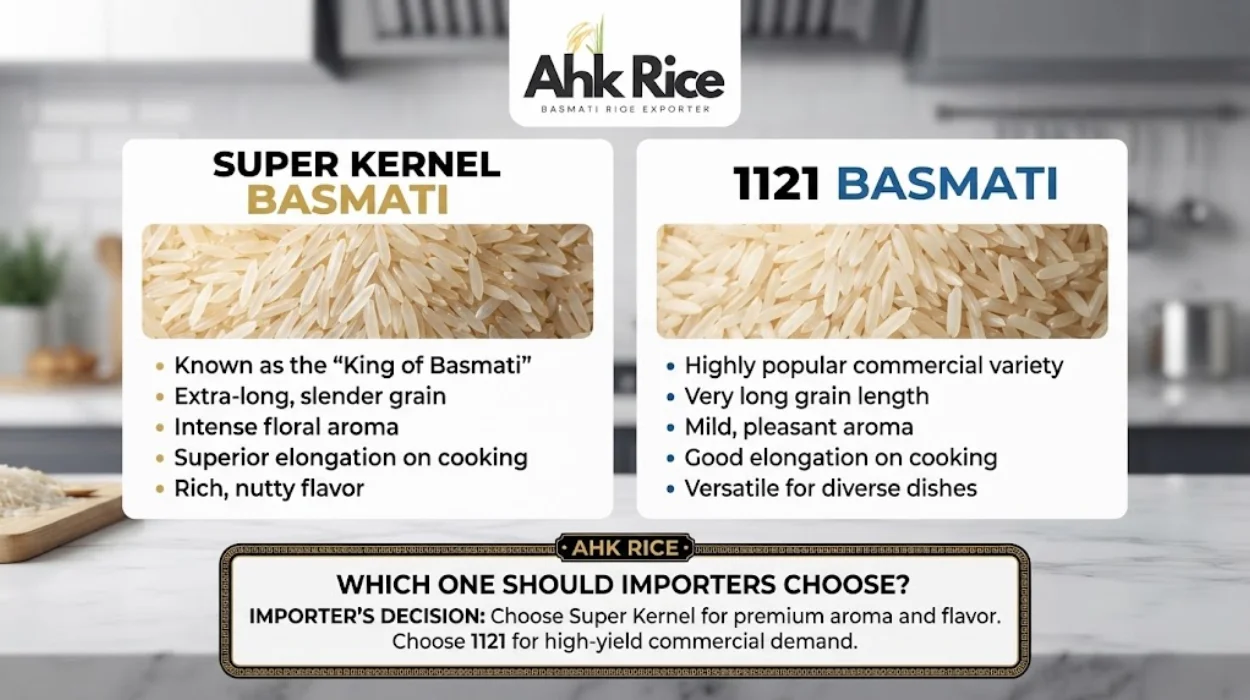
Super Kernel vs 1121 Basmati: Which One Should Importers Choose?
Super Kernel suits importers prioritising traditional aroma and balanced grain performance, while 1121 suits buyers prioritising maximum grain length and visual presentation. Here is why: Super Kernel averages around 7.0–7.5 mm raw grain length, while 1121 commonly reaches 8.20–8.50 mm. Both originate from Pakistan’s Punjab rice belt and serve premium export markets.
Pakistani Basmati includes several varieties with different grain structures, aroma profiles, cooking characteristics, and processing options. Importers therefore need to compare the complete product specification rather than selecting rice only by variety name. For foundational information about cultivation, processing, grades, and export markets, see What Is Pakistani Basmati Rice?.
AHK Rice supplies 1121, Super Kernel, and 1509 Basmati from Punjab. Its integrated processing model covers paddy sourcing, milling, grading, sorting, packaging, documentation, and container loading. This structure allows buyers to match a rice specification with their target market and commercial positioning.
What are the available solutions for importers?
Importers can choose 1121 White, Steam, or Sella, or Super Kernel White and other agreed processing specifications, depending on grain appearance, aroma, cooking performance, storage, and market demand. The variety determines the basic grain profile, while processing determines important commercial characteristics.
What is Super Kernel Basmati?
Super Kernel Basmati is a traditional Pakistani aromatic variety cultivated primarily in Punjab. It is recognised for its fragrance, slender grain, traditional cooking profile, and strong suitability for retail and foodservice applications.
Super Kernel generally measures around 7.0–7.5 mm before cooking in current commercial references. Its cooked grain expands significantly while maintaining a separate texture. The variety therefore appeals to buyers who value aroma alongside visual grain quality.
What is 1121 Basmati?
1121 Basmati is an extra-long-grain Pakistani Basmati variety recognised for exceptional elongation after cooking. Commercial specifications commonly place its raw grain length around 8.20–8.50 mm.
1121 creates a stronger visual premium because cooked grains become substantially longer. This characteristic makes it suitable for premium biryani, pulao, retail, catering, and foodservice applications where grain appearance affects customer perception.
How do the specifications compare?
| Attribute | Super Kernel Basmati | 1121 Basmati |
|---|---|---|
| Raw grain length | 7.0–7.5 mm | 8.20–8.50 mm |
| Cooked elongation | Approximately 16 mm+ | 18–22 mm+ |
| Aroma profile | Strong, traditional | Strong, refined |
| Main processing | White, with other specifications available | White, Steam, Sella |
| Visual positioning | Premium traditional Basmati | Extra-long premium Basmati |
| Typical commercial use | Retail, restaurants, wholesale | Premium retail, HORECA, catering |
| Indicative FOB reference | About $1,165–$1,205/MT | About $1,135–$1,205/MT |
Current published trade references show overlapping FOB ranges. Super Kernel is listed around $1,165–$1,205/MT, while 1121 varies around $1,135–$1,205/MT depending on processing and specification. These figures are indicative rather than contractual quotations.
With the two core solutions defined, the next question is how their specifications affect procurement decisions.
How do Super Kernel and 1121 compare in commercial terms?
1121 creates stronger visual differentiation through longer grains, while Super Kernel creates stronger traditional positioning through aroma and balanced cooking performance. The commercial difference becomes important when importers calculate retail positioning, restaurant yield, inventory turnover, and customer expectations.
How does grain length affect buyer value?
Grain length directly affects visual presentation after cooking. 1121 provides a longer cooked kernel and creates a distinctive appearance on retail shelves and restaurant plates.
Super Kernel provides a shorter grain than 1121 but retains the slender structure associated with Basmati. Its commercial value comes from the combination of fragrance, texture, and traditional Basmati identity.
A retailer selling premium biryani rice can use 1121 to emphasise cooked grain length. A distributor supplying traditional Basmati consumers can use Super Kernel to emphasise aroma and eating characteristics.
How does aroma affect the comparison?
Aroma remains an important quality attribute for both varieties. Pakistani Basmati develops its characteristic fragrance through genetic traits, cultivation conditions, harvesting, post-harvest handling, and processing.
Super Kernel has strong traditional aroma characteristics and is positioned around fragrance and authentic Basmati cooking. 1121 combines aroma with exceptional elongation, giving buyers two different premium attributes to communicate.
The correct comparison therefore depends on the product promise. Grain length supports visual positioning. Aroma supports sensory positioning.
How does processing change the commercial outcome?
Processing determines how the rice behaves during cooking, handling, storage, and distribution. White rice follows conventional milling and polishing. Steam and Sella processing apply controlled heat treatment before final milling.
1121 offers broader processing choices in commercial export, including White, Steam, and Sella. Super Kernel specifications vary by supplier and market, with White, Steam, Sella, and other formats available through export programs.
Processing choice should therefore follow the buyer’s cooking requirement. A premium retail buyer can prioritise White rice. A high-volume catering distributor can prioritise a heat-treated grade with stronger grain stability.
With specification differences established, market requirements determine which variety fits the commercial model.
Which variety works best for different market regions?
Gulf markets commonly prioritise long, separate grains and strong Basmati cooking performance, while European markets combine grain quality with aroma, packaging, compliance, and retail positioning. The appropriate variety depends on customer segment, processing grade, storage duration, and target selling price.
Which variety suits Gulf markets?
Gulf markets include the UAE, Saudi Arabia, Qatar, Oman, Kuwait, and Iraq. Pakistan’s Basmati exports already have an established presence across the region. Pakistan’s FY2024 trade data recorded major Basmati shipments to the UAE, Saudi Arabia, Oman, and other destinations.
1121 suits Gulf buyers requiring maximum cooked grain length. Sella and Steam specifications add grain strength and cooking consistency for restaurants and catering operations.
Super Kernel suits Gulf distributors targeting traditional Basmati aroma. Its grain remains premium while offering a different commercial profile from extra-long 1121.
Gulf market comparison:
| Factor | Super Kernel | 1121 |
|---|---|---|
| Preferred positioning | Traditional premium | Extra-long premium |
| Common use | Retail and foodservice | Retail, biryani and HORECA |
| Indicative FOB range | $1,165–$1,205/MT | $1,135–$1,205/MT |
| Storage planning | 18–24 months under suitable conditions | Up to about 24 months for suitable Sella grades |
| Main selling point | Aroma and traditional profile | Grain length and elongation |
The price ranges are indicative published market references. Actual quotations change with crop year, broken percentage, processing, packaging, volume, freight, and contract terms.
Which variety suits European markets?
European buyers evaluate product characteristics alongside food safety, traceability, packaging, documentation, and retail requirements. Pakistan’s Basmati exports reach established European destinations, including Italy and the United Kingdom.
Super Kernel works well for traditional Basmati retail positioning. Its aroma supports ethnic grocery, restaurant, and private-label channels.
1121 works well for premium retail packs where long cooked grains create strong visual differentiation. Retailers can also use different processing grades to target different consumer segments.
European buyers should therefore define the complete specification before comparing quotations. Grain length alone does not establish commercial quality.
With regional requirements identified, the next step is evaluating the advantages and limitations of each variety.
What are the pros and cons of Super Kernel and 1121?
Super Kernel offers strong aroma and traditional Basmati positioning, while 1121 offers exceptional grain length and premium visual appeal; each creates different procurement advantages. The limitations also differ because buyers face different price, cooking, packaging, and market-positioning requirements.
What are the advantages of Super Kernel?
Super Kernel provides a strong traditional aroma profile. This characteristic supports consumers who associate Basmati primarily with fragrance and authentic cooking.
Super Kernel also provides a premium grain without relying entirely on maximum length. This can support product lines where sensory characteristics carry more importance than visual elongation.
Super Kernel suits restaurants and wholesalers serving traditional South Asian cuisine. Biryani and pulao applications benefit from aromatic, separate grains.
What are the limitations of Super Kernel?
Super Kernel does not provide the same raw grain length as 1121. Buyers competing through extra-long cooked grain presentation therefore need to assess 1121 alongside it.
Super Kernel pricing can also enter the same premium range as 1121. Buyers should compare complete specifications instead of assuming the shorter grain always produces a lower procurement cost.
What are the advantages of 1121?
1121 provides exceptional raw and cooked grain length. This creates strong visual differentiation in premium retail and foodservice applications.
1121 also provides multiple processing options. White, Steam, and Sella formats allow importers to align grain behaviour with different cooking and storage requirements.
What are the limitations of 1121?
1121 procurement can place greater emphasis on grain-length specifications. Buyers must verify average length, broken percentage, moisture, sorting, and cooking performance through the agreed specification.
1121 also competes in premium market segments where packaging and presentation influence the final selling price. Importers need a distribution strategy that supports the premium positioning.
With the strengths and limitations clear, importers can apply a structured decision framework.
How should importers decide between Super Kernel and 1121?
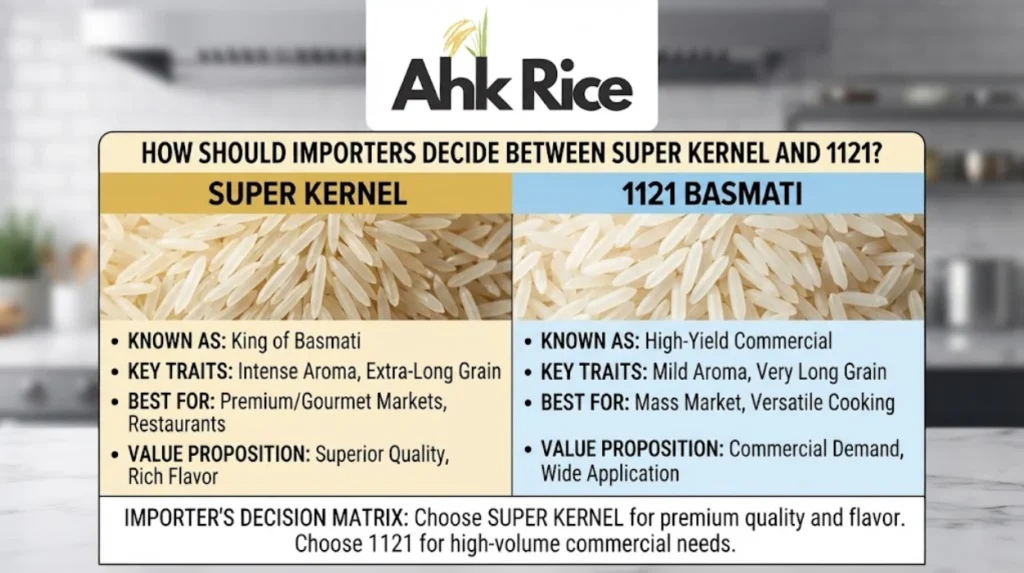
Importers should select Super Kernel for aroma-led positioning and 1121 for length-led positioning, then confirm processing, price, storage, packaging, and destination requirements before contracting. A five-factor framework turns the comparison into a practical procurement decision.
| Decision factor | Super Kernel fits when | 1121 fits when |
|---|---|---|
| Customer preference | Aroma-focused | Length-focused |
| Product positioning | Traditional premium | Extra-long premium |
| Foodservice requirement | Aromatic biryani and pulao | Long-grain presentation |
| Retail strategy | Authentic Basmati profile | Visual premium packaging |
| Procurement priority | Balanced quality and aroma | Maximum elongation and appearance |
How should buyers evaluate a sample?
Sample evaluation should test more than appearance. Importers should inspect raw grain length, broken percentage, colour, moisture, foreign matter, aroma, cooking expansion, texture, and packaging performance.
A controlled cooking test creates a more useful comparison. Cook equal quantities of both samples using the same water ratio and cooking time. Record grain separation, elongation, aroma, texture, and breakage.
The result should then be compared with the contractual specification. This prevents a visually attractive sample from becoming an inconsistent bulk shipment.
How should buyers compare quotations?
Importers should compare quotations on the same Incoterm and specification. FOB prices are not directly equivalent to CIF prices because freight and insurance create additional landed costs.
A useful procurement calculation includes product price, packaging, inspection, documentation, freight, insurance, duties, port charges, inland transport, and expected wastage.
AHK Rice supplies 1121, Super Kernel, and 1509 from Punjab and manages processing, packaging, export documentation, and logistics as part of its export operation. Its stated export network covers more than 15 countries.
What should the final specification include?
A purchase specification should identify variety, processing type, grain length, broken percentage, moisture, colour, foreign matter, packaging, quantity, inspection method, documentation, Incoterm, and destination port.
This specification creates a measurable procurement standard. It also gives the buyer a basis for sample approval and pre-shipment inspection.
The comparison therefore ends with a specification decision rather than a simple variety preference.
What should importers choose for their specific business model?
Retailers focused on visual premium presentation generally align with 1121, while aroma-focused distributors and traditional foodservice buyers often align with Super Kernel. The final choice should follow the market’s measurable requirements rather than the variety name alone.
A premium supermarket can prioritise 1121 when cooked grain length drives shelf appeal. The product can then use premium retail packaging and a specification that protects grain uniformity.
A traditional foodservice distributor can prioritise Super Kernel when aroma and familiar Basmati characteristics drive customer acceptance. The distributor can then match packaging size to restaurant and wholesale demand.
A mixed portfolio can also separate the two varieties by channel. 1121 can serve premium retail and presentation-led foodservice. Super Kernel can serve aroma-led retail and traditional restaurant demand.
AHK Rice provides both varieties, allowing importers to compare specifications within one Pakistani supply relationship. Buyers can also define custom packaging and processing requirements around their destination market.
For importers moving from comparison into supplier evaluation, the next useful step is reviewing the dedicated Super Kernel Basmati export supply and supplier process before requesting commercial specifications.
Frequently Asked Questions
Is Super Kernel better than 1121 Basmati?
Super Kernel and 1121 serve different procurement priorities. Super Kernel emphasises traditional aroma and Basmati character, while 1121 emphasises exceptional grain length and cooked elongation.
Which is more expensive, Super Kernel or 1121?
Published FOB references show overlapping price ranges. Super Kernel is listed around $1,165–$1,205/MT, while 1121 ranges around $1,135–$1,205/MT depending on processing and specification.
Which has longer grain, Super Kernel or 1121?
1121 has the longer grain. Current commercial references place 1121 around 8.20–8.50 mm raw, while Super Kernel commonly measures around 7.0–7.5 mm.
Which rice has stronger aroma?
Super Kernel is commonly positioned around strong traditional Basmati aroma. 1121 also provides a strong aromatic profile while adding greater grain elongation.
Which variety suits Gulf importers?
Both varieties serve Gulf markets. 1121 suits buyers prioritising long, separate cooked grains, while Super Kernel suits buyers prioritising traditional aroma and Basmati eating characteristics.
Which variety suits premium retail?
1121 suits premium retail where cooked grain length and visual presentation are major selling attributes. Super Kernel suits premium retail where traditional aroma and authentic Basmati positioning are stronger priorities.
What should importers test before ordering?
Importers should test grain length, broken percentage, moisture, colour, foreign matter, aroma, cooking expansion, texture, packaging, and compliance documentation before approving a bulk specification.
Can AHK Rice supply both varieties?
Yes. AHK Rice supplies 1121 and Super Kernel Basmati from Punjab alongside 1509. Its export operation covers processing, grading, packaging, documentation, and shipment coordination.