AHK Rice Supplies Export-Ready Basmati Rice for South Carolina, USA
South Carolina buyers importing Pakistani Basmati rice should select an exporter that can control rice specifications, packaging, inspection, documentation, and shipment coordination from origin through the U.S. port. For commercial buyers, AHK Rice provides an integrated export model designed around repeatable specifications rather than one-time spot purchases.
Before selecting packaging or a supplier, buyers should understand why packaging affects imported rice quality, handling, shelf life, and compliance. The educational guide, provides the foundation for evaluating packaging decisions before placing a commercial order. Buyers can then compare practical protection methods in:
How export packaging protects Basmati rice during ocean transport before moving to supplier selection.
Why Do Packaging Standards Matter for Imported Basmati Rice?, provides the foundation for evaluating packaging decisions before placing a commercial order.
For South Carolina, the procurement decision also depends on the receiving route. Charleston is the principal container gateway to plan around for many South Carolina import programs, but the final delivery schedule depends on vessel availability, transshipment, port handling, customs clearance, and inland transportation. A supplier therefore needs to quote the complete commercial specification, not simply a price per metric ton.
What is the best solution for importing export-ready Basmati rice into South Carolina?
The best solution is a specification-controlled supply program combining approved samples, defined grain and moisture specifications, export-grade packaging, pre-shipment inspection, compliant documentation, scheduled container loading, and coordinated ocean freight. This reduces quality variation while giving South Carolina buyers a measurable basis for repeat procurement decisions.
A commercial buyer should begin with the product specification. Pakistani Basmati options can include 1121, Super Kernel, and 1509, with different processing formats such as white, steam, parboiled, Sella, golden Sella, and creamy Sella. The correct choice depends on the intended market, cooking profile, retail positioning, and target price.
AHK Rice supplies these Pakistani varieties through an integrated processing and export operation in Punjab. Its published USA service identifies 1121 Sella, Super Kernel, and white Basmati among the options available to American importers.
For a South Carolina distributor, a practical specification can include:
- Variety and processing grade
- Grain length and appearance
- Broken percentage
- Moisture target
- Purity requirements
- Packaging material and bag weight
- Quantity per container
- Inspection requirements
- Destination port
- Incoterm and payment terms
This approach prevents a common procurement problem: comparing quotations that appear different in price but actually represent different rice grades, packaging, freight assumptions, or inspection scopes.
Why choose the USA export service from AHK Rice?
AHK Rice is suitable for South Carolina buyers requiring Pakistani Basmati because its USA export service combines sourcing, processing, grading, sorting, packaging, inspection, documentation, and container coordination. Buyers can therefore manage one commercial specification instead of coordinating multiple disconnected origin suppliers.
The USA service is designed for commercial importers, distributors, wholesalers, retailers, food-service companies, and private-label buyers. AHK Rice states that its USA supply can begin with one 20-foot container of approximately 20 metric tons, while larger programs can be structured around recurring purchasing requirements.
The operational advantage is control at origin. AHK Rice describes a process covering paddy procurement, cleaning, de-husking, paddy separation, whitening or polishing, grading, length sorting, customized packaging, documentation, and container loading.
Quality verification can also be incorporated into the purchasing process. AHK Rice identifies third-party inspection options involving organizations such as SGS and Bureau Veritas. For a buyer with formal procurement controls, this provides an additional verification point before the container leaves Pakistan.
Packaging should be treated as part of the specification rather than an afterthought. The buyer should approve the bag construction, dimensions, weight, printing, labeling, stitching or sealing method, palletization if required, and carton or sack configuration before production.
For private-label programs, this becomes particularly important because packaging consistency affects warehouse identification, retail presentation, customer expectations, and repeat-order accuracy.
How does the sample process work before a South Carolina commercial order?
The sample process should move from written specifications to product selection, sample preparation, dispatch, laboratory or physical evaluation, buyer approval, commercial quotation, and bulk production. This sequence lets buyers verify the actual rice before committing container-level capital and logistics costs.
The first stage is specification collection. The buyer provides the desired variety, grade, grain length, broken percentage, moisture requirement, packaging preference, quantity, destination, and inspection requirements.
The second stage is sample selection. AHK Rice matches the request with an appropriate commercial grade. Its USA export information states that samples up to 20 kg can be supplied without a rice charge, while the buyer covers applicable courier and phytosanitary costs.
The third stage is dispatch. Buyers can use their own courier account where preferred. Sample freight is not a fixed universal amount because the cost changes according to destination, parcel weight, dimensions, courier service, and shipment timing.
The fourth stage is evaluation. A South Carolina buyer should inspect:
- Raw grain appearance
- Grain length and uniformity
- Broken percentage
- Moisture
- Foreign matter and purity
- Aroma
- Cooking expansion
- Texture after cooking
- Color and processing consistency
- Packaging suitability
The fifth stage is approval. Once the sample matches the commercial requirement, the supplier can prepare the bulk quotation against the approved specification.
The sixth stage is commercial confirmation. The buyer and exporter finalize quantity, packaging, inspection, Incoterm, payment structure, shipping route, and required documentation.
For a first order, this process is more valuable than selecting a supplier solely from a low initial quotation. A sample establishes the physical reference point against which the production batch can be evaluated.
What shipping time should South Carolina buyers expect from Pakistan?
South Carolina buyers should plan internationally rather than rely on a fixed delivery promise. Pakistan-to-U.S. ocean transit commonly requires several weeks, while total delivery can extend beyond ocean transit because vessel schedules, transshipment, customs, port handling, and inland trucking affect the final receiving date.
For USA buyers, AHK Rice currently indicates approximately 25–35 days door-to-door to major U.S. ports such as New York and Los Angeles, although actual delivery depends on vessel schedules, port operations, clearance, and inland transportation.
South Carolina requires a more specific planning approach because the final inland destination may be Charleston or another receiving point. A buyer should therefore distinguish between:
| Shipment stage | Practical planning consideration |
|---|---|
| Pakistan origin preparation | Production, packing, inspection and container loading |
| Karachi export handling | Container gate-in, documentation and vessel departure |
| Ocean transit | Vessel routing and possible transshipment |
| U.S. port arrival | Discharge, customs and regulatory processing |
| Inland movement | Truck or rail movement to South Carolina |
| Final delivery | Warehouse receiving appointment and unloading |
The actual number of days should be confirmed against the selected sailing when the quotation is issued. A supplier should not present a generic USA transit time as a guaranteed South Carolina delivery date.
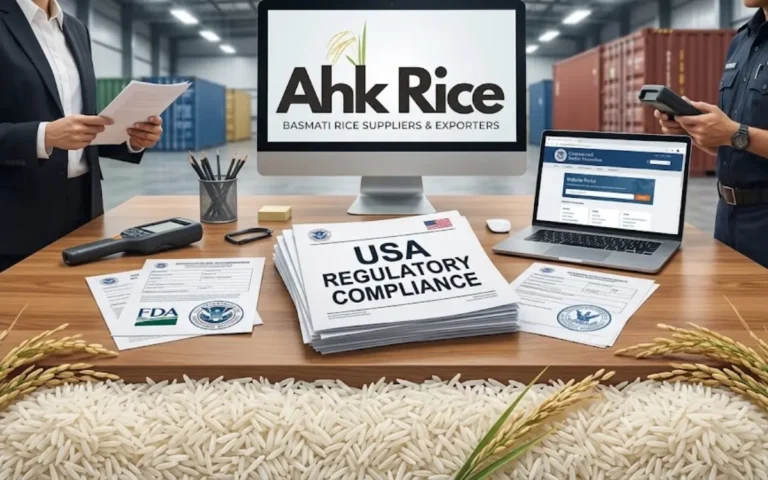
For food imports, regulatory preparation is also part of the timeline. FDA states that imported food must meet U.S. requirements and that facilities producing, storing, or handling covered food must meet applicable registration requirements. Prior Notice is required before covered food shipments arrive in the United States.
FDA’s current framework also requires Prior Notice information to be submitted electronically, including through CBP’s ABI/ACE process or FDA’s Prior Notice System Interface. For food arriving by water, FDA’s guidance states that Prior Notice must be received and confirmed no less than eight hours before arrival.
This is why documentation should be prepared before the container reaches the U.S. port rather than after arrival.
What results can South Carolina importers expect from a controlled supply program?
A controlled supply program should deliver more than rice: it should provide repeatable product specifications, predictable production planning, documented inspection, suitable packaging, organized export paperwork, and better shipment visibility. These outcomes help distributors reduce procurement uncertainty and manage customer commitments.
The first expected result is specification consistency. If the buyer approves a defined grade, subsequent orders can be measured against the same commercial reference instead of vague terms such as “premium quality.”
The second result is better inventory planning. A buyer receiving predictable quantities and specifications can establish reorder points, warehouse requirements, and customer allocations more accurately.
The third result is packaging consistency. Standardized bags and labels make receiving, warehouse identification, stock rotation, and retail distribution easier.
The fourth result is improved documentation control. AHK Rice describes export documentation that can include the commercial invoice, packing list, phytosanitary certificate, certificate of origin, fumigation certificate, and bill of lading.
The fifth result is greater shipment transparency. AHK Rice states that its USA service supports shipment tracking, allowing buyers to monitor cargo through the export and transportation process.
For a distributor serving South Carolina grocery stores, restaurants, wholesalers, or private-label customers, these controls become increasingly important as order frequency increases.
A supplier should also be evaluated for production capacity. A single successful container does not automatically prove that an exporter can maintain the same grade across repeated monthly shipments. The buyer should ask how the supplier will preserve specifications when volume increases or when seasonal procurement pressure affects raw material availability.
What factors determine the price of Basmati rice delivered for South Carolina?
The final commercial price depends on rice variety, processing grade, specification, quantity, packaging, inspection, origin charges, ocean freight, insurance, destination handling, customs-related costs, inland transportation, payment terms, and the selected Incoterm. Therefore, one universal price per metric ton is misleading.
The rice specification is normally the largest product-level variable. 1121 Basmati, Super Kernel, and 1509 can carry different commercial values because grain characteristics, processing, demand, and market positioning differ.
Processing also affects the quotation. White rice, steam rice, Sella, and other formats require different processing steps and may target different buyers.
Packaging is another variable. Standard export sacks may cost less than customized private-label packaging involving printed materials, special dimensions, artwork, or additional handling.
Quantity affects procurement economics as well. A commercial container order provides a different cost structure from small trial quantities because production scheduling, packaging, inspection, and freight are allocated differently.
Freight must be quoted against the actual sailing and destination. Published 2026 information from AHK Rice indicates that indicative 40-foot FCL freight benchmarks from Karachi can vary significantly by U.S. route, with New York and Houston examples showing different freight levels. These figures are route benchmarks, not fixed South Carolina landed prices.
A South Carolina buyer should therefore request a quotation using a complete specification rather than asking only, “What is your price per MT?”
A useful commercial quotation request should state:
| Cost factor | Buyer should specify |
| Rice | Variety and processing grade |
| Quality | Grain length, broken %, moisture and purity |
| Quantity | Metric tons and container requirement |
| Packaging | Bag material, size and private-label requirement |
| Inspection | Internal or third-party inspection |
| Freight | Destination port and shipping preference |
| Commercial terms | FOB, CFR, CIF or another agreed Incoterm |
| Delivery | Port and inland receiving location |
This produces a more meaningful comparison between AHK Rice and competing exporters because the buyer evaluates equivalent specifications.
How should a South Carolina buyer get started with AHK Rice?
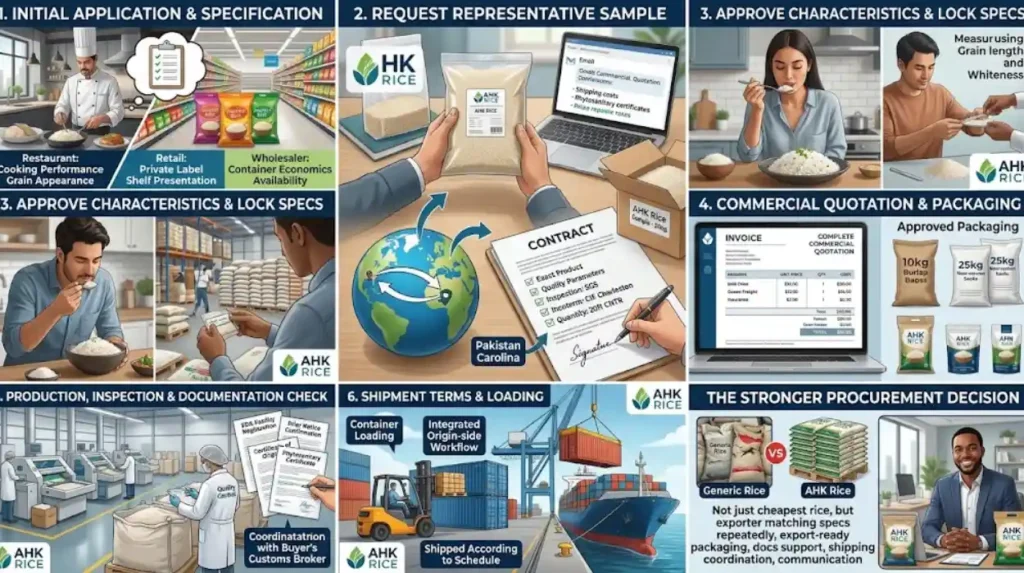
Start with a written product specification, request a representative sample, approve the physical and cooking characteristics, confirm packaging, obtain a complete commercial quotation, verify documentation requirements, and finalize shipment terms before authorizing bulk production and container loading.
The first commercial conversation should identify the intended application. A restaurant distributor may prioritize cooking performance and consistent grain appearance. A retail importer may prioritize private-label packaging and shelf presentation. A wholesaler may place greater emphasis on container economics and repeat availability.
Next, the buyer should request the appropriate sample. AHK Rice can use the stated USA sampling process to provide up to 20 kg without a rice charge, while the buyer covers applicable sample shipping and phytosanitary costs.
After approval, the buyer should lock the specification into the purchase documentation. This should include the exact product, quality parameters, packaging, quantity, inspection requirements, Incoterm, destination, and agreed commercial conditions.
The next stage is production and inspection. The exporter processes the approved grade, prepares the packaging, completes required quality controls, and arranges inspection where requested.
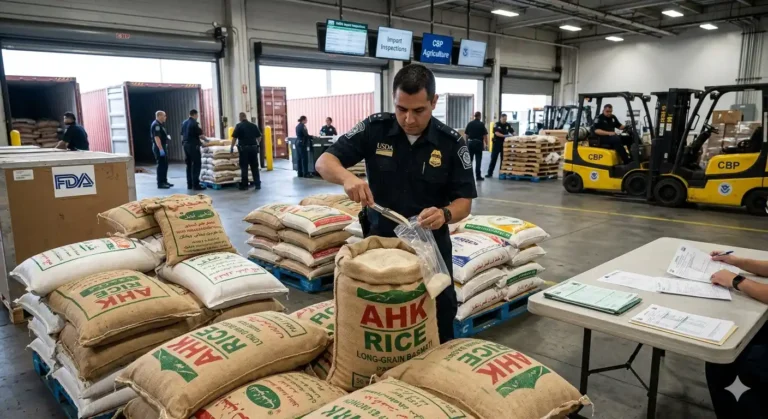
Documentation should then be checked before dispatch. For U.S. food imports, FDA compliance, facility registration, labeling, Prior Notice, and importer responsibilities should be coordinated with the buyer’s customs broker and compliance team. FDA emphasizes that imported foods must meet applicable U.S. requirements and can be inspected or detained when requirements are not met.
Finally, the container is loaded and shipped according to the agreed schedule. AHK Rice provides an integrated origin-side workflow covering processing, grading, packaging, documentation, and container logistics.
For South Carolina buyers, the right decision is therefore not simply to find the cheapest Pakistani Basmati rice. The stronger procurement decision is to select an exporter that can repeatedly match the approved specification, prepare export-ready packaging, support documentation, coordinate shipping, and maintain communication throughout the order cycle.
AHK Rice is positioned for this model because its published USA operation combines Pakistani Basmati sourcing with processing, packaging, inspection options, export documentation, and shipping coordination.
A buyer ready to move from product evaluation to a commercial shipment can request a customized quotation from AHK Rice.
Frequently Asked Questions
What Basmati rice does AHK Rice supply to South Carolina?
AHK Rice supplies Pakistani Basmati varieties including 1121, Super Kernel, and 1509, with white, steam, and parboiled processing options depending on the buyer’s specification.
Can South Carolina buyers order Basmati rice in bulk?
Yes. AHK Rice supports container-based commercial orders for U.S. importers, distributors, wholesalers, restaurants, retailers, and private-label buyers.
What packaging options are available for South Carolina importers?
Buyers can specify bag weight, packaging material, printing, labeling, stitching or sealing, and private-label requirements according to their commercial needs.
How does AHK Rice control Basmati rice quality?
Quality control can cover grain length, broken percentage, moisture, purity, appearance, processing consistency, packaging, and pre-shipment inspection according to the agreed specification.
Can South Carolina buyers receive rice samples before placing an order?
Yes. AHK Rice can provide product samples for evaluation before bulk production. Sample shipping and applicable phytosanitary costs may be payable by the buyer.
How long does shipping from Pakistan to South Carolina take?
Shipping time depends on the selected vessel, route, transshipment, port handling, customs clearance, and inland transportation. Buyers should confirm the delivery schedule against the specific sailing and destination.
What documents are required for importing Basmati rice into the USA?
Typical export documentation can include a commercial invoice, packing list, certificate of origin, phytosanitary certificate, fumigation certificate, and bill of lading. U.S. food import requirements should also be coordinated with the importer and customs broker.
What factors affect the price of Pakistani Basmati rice in South Carolina?
Price depends on rice variety, processing grade, quality specifications, order volume, packaging, inspection, freight, insurance, Incoterm, destination, payment terms, and inland transportation.