Buy Super Kernel Basmati Rice Direct from Supplier Pakistan
Buy Super Kernel Basmati Rice directly from a Pakistani supplier to control grain specifications, packaging, inspection, pricing, and export documentation from one procurement point. Here is why: direct sourcing reduces intermediary layers and lets the buyer verify the rice specification before commercial dispatch. AHK Rice supplies Pakistani Basmati rice for international buyers and can structure orders around grade, packing, destination, and shipment terms.
Pakistan remains a major Basmati exporting country. REAP recorded 808,643 MT of Basmati exports worth US$830.57 million in 2024–25, with an average Basmati export value of US$1,027.11 per MT.
For buyers evaluating cooking performance before procurement, the [Super Kernel cooking and texture guide] provides the product context needed before commercial specification. The next step is matching that specification with supplier capability.
What is the best solution for buying Super Kernel Basmati Rice?
Direct Pakistani sourcing with a verified specification, pre-shipment inspection, agreed packaging, and destination-based quotation provides the clearest procurement route. The buyer controls the product definition before the supplier loads the container.
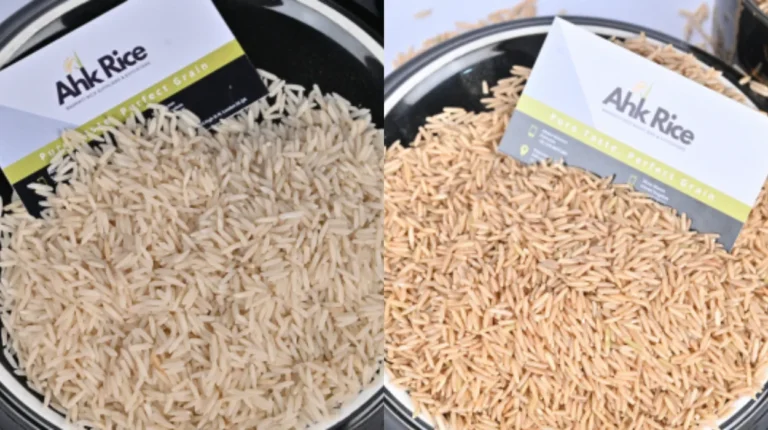
Super Kernel Basmati Rice is positioned around long, slender aromatic kernels and consistent cooking performance. Pakistan’s official Basmati specification defines minimum milled grain length at 6.50 mm, average breadth at ≤1.9 mm, and a minimum length-to-breadth ratio of 3.50.
Super Kernel procurement should therefore begin with measurable requirements. Define grain length, broken percentage, moisture, foreign matter, crop year, processing condition, packing format, and required quantity.
AHK Rice can structure the supply specification around the buyer’s intended channel. Retail distributors need appearance and packaging consistency. Restaurants need cooking performance and repeatability. Wholesale buyers usually prioritize landed cost, shipment reliability, and specification consistency.
A direct supplier relationship also simplifies commercial communication. The buyer can confirm the grade, quantity, packing, Incoterm, destination port, inspection requirements, and documentation before payment and dispatch.
The product specification establishes the procurement requirement. Supplier capability determines whether that specification can be maintained across the shipment.
Why choose AHK Rice as your Pakistan supplier?
AHK Rice combines Pakistani Basmati sourcing with milling, grading, sorting, packaging, inspection coordination, and export logistics for international procurement. This creates one commercial workflow from specification approval to shipment.
AHK Rice focuses on Pakistani Basmati supply from Punjab. The procurement process can begin with the buyer’s required grade and destination rather than an unspecified generic rice quotation.
AHK Rice can coordinate the specification around the intended market. Packaging can be defined by bag size, material, branding, and labeling requirements. The commercial quotation can then reflect the selected specification and delivery basis.
What should the Super Kernel specification include?
A commercial Super Kernel specification should define the product before the price becomes the main discussion.
| Specification | Buyer requirement |
|---|---|
| Rice type | Super Kernel Basmati |
| Grain form | Long, slender aromatic kernel |
| Processing | Milled, polished and sorted |
| Moisture | Contract specification |
| Broken percentage | Contract specification |
| Foreign matter | Contract specification |
| Packaging | Retail or bulk format |
| Origin | Pakistan |
| Shipment basis | FOB, CFR/CNF or CIF |
Pakistan’s official Basmati specification also identifies typical Basmati aroma, soft gel consistency, non-sticky cooked texture, and amylose content of 19–26% as relevant product characteristics.
These parameters matter because price alone does not identify the rice. Two quotations carrying the same product name can represent different quality tolerances, packaging, crop conditions, and delivery terms.
For buyers comparing varieties before purchasing, the [Super Kernel vs Jasmine Rice global market comparison] helps establish the commercial differences between the two rice categories.
With the product specification defined, the next procurement question is how the supplier demonstrates that specification.
What results can be expected from direct Super Kernel sourcing?
A properly specified order should deliver consistent grain appearance, defined cooking characteristics, controlled packaging, documented shipment terms, and a clearer landed-cost calculation. The result depends on the approved specification and contract.
Super Kernel quality begins at the paddy stage. The rice is cultivated, harvested, dried, milled, dehusked, polished, graded, and sorted before export preparation.
Colour sorting removes discoloured kernels from the finished rice stream. Length grading separates kernels according to the agreed specification. Mechanical sorting improves uniformity within the commercial lot.
Quality inspection then verifies the agreed parameters. Buyers can request testing for moisture, broken kernels, foreign matter, grain dimensions, and other contractual requirements.
AHK Rice can use the approved sample as the commercial reference. This gives the buyer a physical benchmark before a larger shipment is dispatched.
Sample approval is especially important for distributors introducing a new Pakistani rice supplier. The buyer can cook the sample, assess appearance, measure grain expansion, evaluate texture, and compare the result with its existing product.
The sample should also represent the intended commercial grade. A premium retail sample should not be treated as proof for a different bulk specification.
What does the sample process look like?
The sample process should follow a defined procurement sequence:
- Define the requirement. State Super Kernel grade, quantity, packing, destination, and shipment basis.
- Confirm the specification. Agree grain, broken, moisture, foreign matter, and packaging requirements.
- Request the sample. Ask for a representative commercial sample matching the proposed specification.
- Inspect the sample. Check visual uniformity, aroma, cleanliness, grain form, and cooking performance.
- Approve the sample. Record the accepted specification as the commercial reference.
- Confirm the quotation. Compare product value, packaging, freight, insurance, and destination charges.
- Confirm the order. Approve quantity, payment terms, documents, and shipment schedule.
- Inspect the shipment. Verify the finished consignment before container loading.
- Load the container. Pack and load the approved rice for export dispatch.
- Ship the order. Provide shipping and commercial documentation for destination clearance.
An illustrative sample budget can include US$25–60 for sample preparation and handling, plus courier charges that commonly vary by destination and weight. These figures are planning examples, not an AHK Rice tariff.
A commercial shipment should never be priced from the sample alone. The final quotation depends on the approved specification, quantity, packing, destination, freight market, and Incoterm.
The sample confirms product suitability. The quotation confirms commercial feasibility.
How much does Super Kernel Basmati Rice cost?
Super Kernel pricing depends on rice specification, crop condition, order quantity, packaging, freight, insurance, inspection, and delivery basis rather than one fixed global price. Buyers should compare complete quotations.
Pakistan’s REAP data reports an average Basmati export value of US$1,027.11 per MT for 2024–25. This is an aggregate export figure, not a fixed Super Kernel supplier price.
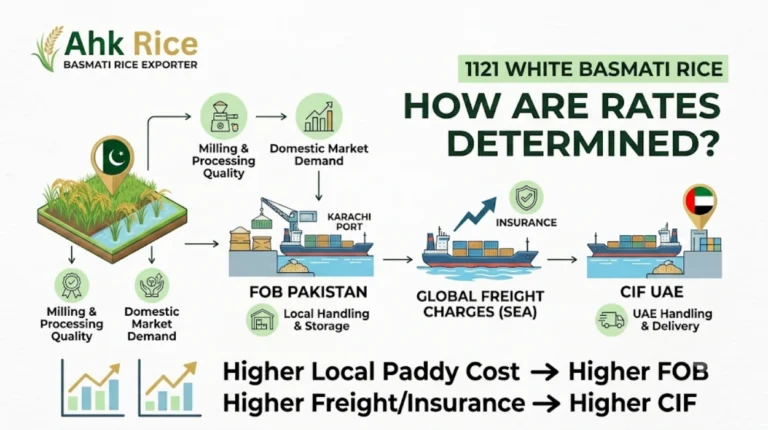
A buyer requesting an actual quotation should provide the destination port. FOB pricing covers the supplier-side export shipment up to the named loading point. CFR or CNF pricing adds ocean freight to the destination port. CIF pricing adds marine insurance as well.
Packaging also changes the commercial calculation. A bulk PP bag and a printed retail bag do not carry identical preparation costs. Private-label packaging adds artwork, printing, material, and production requirements.
Order volume affects the calculation as well. A full-container order normally creates a different cost structure from a small trial shipment. Freight allocation also changes according to container utilization.
A useful quotation comparison should therefore show:
| Cost factor | Procurement impact |
|---|---|
| Rice specification | Determines product value |
| Quantity | Changes unit economics |
| Packaging | Changes packing cost |
| Origin handling | Affects export preparation |
| Freight | Changes landed cost |
| Insurance | Applies under CIF |
| Inspection | Adds verification cost |
| Destination | Changes logistics expense |
This approach prevents a low FOB number from appearing cheaper than a higher quotation that includes more services.
Price becomes meaningful only after the product and delivery basis are identical.
How many days does shipping from Pakistan take?
Typical ocean planning windows can range from about 10–25 days port-to-port across nearby Asian and Gulf destinations, while longer routes can require 25–45 days. Actual schedules depend on sailing and transshipment conditions.
Shipping to the UAE and Gulf commonly requires a shorter planning window than European or African routes. Buyers should allow additional time for booking, container loading, port handling, customs clearance, and destination delivery.
Shipping to Malaysia and Indonesia requires a longer planning window than Gulf routes. A procurement schedule should allow approximately 18–30 days for ocean movement, plus origin and destination handling.
Shipping to Saudi Arabia should be planned around the selected destination port. Buyers should allow approximately 12–25 days for ocean movement, excluding clearance and inland delivery.
Shipping to Europe commonly requires a broader planning range. Buyers can use approximately 25–40 days as an initial planning window for ocean movement, then confirm the actual sailing schedule before purchase.
Shipping to East Africa can require approximately 25–45 days, depending on the destination port and transshipment route.
These ranges are planning estimates rather than guaranteed transit times. Vessel schedules, transshipment, port congestion, customs processing, and seasonal conditions can change the final delivery date.
The correct shipping plan therefore begins with the destination port. Once the route is defined, the buyer can compare FOB, CFR/CNF, and CIF pricing on the same commercial basis.
What documents should a buyer request before shipment?
A commercial rice export order should identify the product, quantity, origin, packing, price basis, shipping terms, and quality documentation before container dispatch. Document requirements also depend on the importing country’s rules.
Typical export documentation includes:
- Commercial invoice
- Packing list
- Certificate of origin
- Bill of lading
- Phytosanitary documentation where required
- Inspection or quality certificate where agreed
- Fumigation documentation where required
- Insurance certificate for CIF shipments
Pakistan’s official Basmati specification states that export packaging and labeling must follow applicable requirements of the importing country.
Buyers should therefore specify destination-market labeling before packaging begins. This reduces the risk of correcting labels after production.
Documentation also supports customs clearance. The commercial invoice, packing list, origin documentation, and transport documents should correspond with the shipment details.
With documentation defined, the remaining decision is how to move from sample approval to the commercial order.
How do you start buying Super Kernel Basmati Rice directly?

Start with a written specification, request a representative sample, approve the product, compare the complete export quotation, and confirm shipment terms before placing the commercial order. This sequence keeps procurement measurable.
Start by stating the required quantity. Include the destination port and preferred delivery basis.
Define the Super Kernel specification next. Include broken percentage, moisture, foreign matter, packing, crop preference, and inspection requirements.
Request the sample after specification confirmation. Test the sample through both visual inspection and cooking evaluation.
Approve the sample before commercial production. Record the accepted specification in the purchase documentation.
Request the quotation using the same specification. Compare FOB, CFR/CNF, or CIF values according to the required procurement model.
Confirm the shipment schedule after quotation approval. The supplier can then arrange milling, grading, sorting, packing, inspection, loading, and dispatch.
AHK Rice provides the commercial route for buyers seeking Pakistani Basmati supply with a defined product specification. A direct supplier relationship gives the importer one point for product, packaging, logistics, and export coordination.
The decision should ultimately rest on specification compliance, sample performance, complete landed cost, documentation, and shipment planning.
Frequently Asked Questions
Is Super Kernel Basmati Rice available directly from Pakistan?
Yes. Pakistani suppliers export Basmati rice to international markets. REAP records substantial annual Basmati export volumes from Pakistan.
Buyers can request Super Kernel according to an agreed specification. The specification should define quality tolerances before ordering.
Sample approval provides a physical product reference. Commercial orders should follow the approved specification.
Can I order a Super Kernel sample before buying?
Yes. A sample can be used to evaluate appearance, aroma, grain uniformity, and cooking performance.
Sample cost depends on preparation, packing, and destination courier charges. A planning allowance of US$25–60 can cover sample handling before courier charges.
The commercial shipment should match the approved sample specification. Buyers should document the accepted parameters.
What affects Super Kernel Basmati Rice pricing?
Product grade, broken percentage, moisture, packaging, quantity, crop condition, freight, inspection, and Incoterm all affect pricing.
FOB excludes international ocean freight and destination costs. CFR or CNF includes ocean freight to the named destination port.
CIF also includes marine insurance. Buyers should compare quotations using the same delivery basis.
How long does Pakistani rice take to reach overseas buyers?
Transit depends on the destination port and shipping route. Gulf routes can require roughly 12–25 days of ocean movement.
Southeast Asian routes can require roughly 18–30 days. European and African routes can require roughly 25–45 days.
Port handling and customs clearance add time. Buyers should confirm the carrier schedule before fixing a retail delivery date.
Why buy Super Kernel Basmati Rice directly from AHK Rice?
Direct sourcing allows the buyer to define the specification before production and shipment.
AHK Rice can coordinate product preparation, packaging, inspection, and export logistics around the agreed order.
The buyer can also evaluate a sample before committing to a larger quantity. This creates a clearer procurement process from product selection through shipment.
Direct supplier communication also simplifies quotation comparison. The buyer can discuss specification, destination, quantity, and delivery terms with one export su