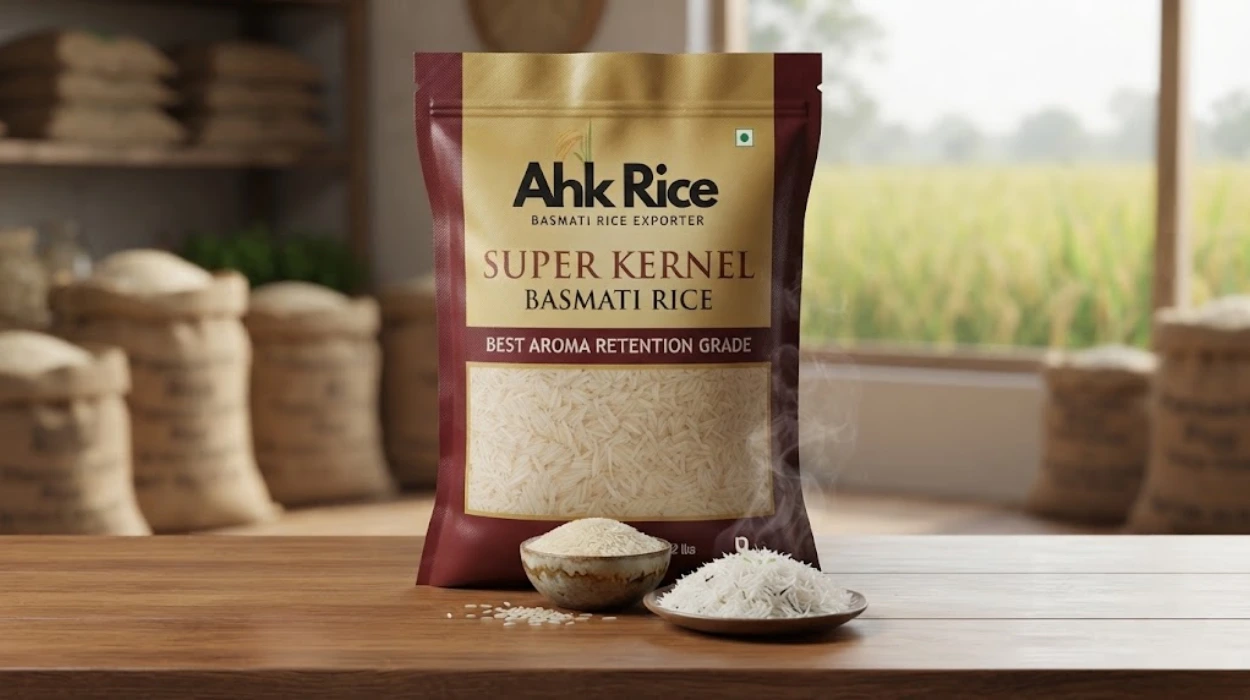
Which Super Kernel Grade Has Best Aroma Retention?
Super Kernel White retains the strongest natural aroma, while Super Kernel Steam offers the best balance between aroma retention and grain stability. Here is why: White rice uses direct milling, while Steam receives controlled heat treatment. Sella receives parboiling, which strengthens the grain but changes its aroma profile.
Super Kernel Basmati is valued for its traditional Pakistani Basmati fragrance, slender grain, and cooked elongation. Current export specifications commonly place raw grain length around 7.2–8.4 mm. Premium specifications also control moisture near 12–13% and broken grains around 1–2%.
For a deeper foundation on aroma chemistry, processing, and the characteristics that make this variety aromatic, see the guide to Super Kernel Basmati aroma and grain quality.
What are the available Super Kernel aroma-retention solutions?
Super Kernel White, Steam, and Sella provide three main processing solutions, with White prioritising natural aroma, Steam balancing aroma with structure, and Sella prioritising firmness and storage stability.
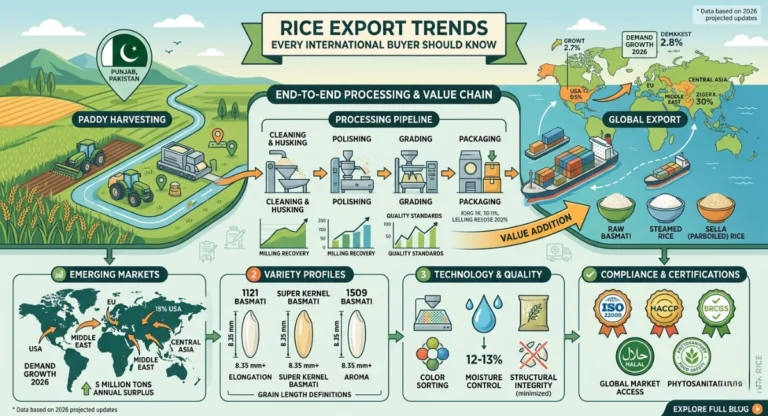
Super Kernel White is the raw or traditionally milled form. The paddy is cleaned, dehusked, polished, graded, and sorted without parboiling. This preserves the traditional sensory character of the grain.
Super Kernel Steam receives controlled steam treatment before final milling. The process stabilises the kernel and supports firmer cooking performance. AHK Rice material describes Steam processing as a controlled method for retaining aromatic compounds while improving grain structure.
Super Kernel Sella is parboiled before milling. Parboiling strengthens the kernel and improves resistance to breakage. The process also produces a firmer, less sticky cooked texture. Current exporter specifications identify Sella as a major Super Kernel processing grade.
Aroma retention also depends on crop age. Controlled aging allows moisture to stabilise and supports stronger fragrance and cooking performance. Export specifications from Pakistani suppliers commonly describe aged Super Kernel as a premium aromatic product.
The available grades solve different procurement problems, so aroma alone should not determine the purchase specification.
How do Super Kernel White, Steam, and Sella compare?
Super Kernel White delivers the most direct natural aroma, Steam provides stronger aroma retention with improved structural stability, and Sella provides the strongest grain stability for demanding foodservice storage.
| Attribute | Super Kernel White | Super Kernel Steam | Super Kernel Sella |
|---|---|---|---|
| Processing | Direct milling | Controlled steaming | Parboiling |
| Aroma profile | Strongest natural aroma | Strong, stable aroma | Moderate to strong aroma |
| Grain structure | Soft to medium | Firm | Very firm |
| Typical moisture | ≤12–13% | ≤12–13% | ≤12% |
| Broken target | ≤2% | ≤1–2% | ≤1–2% |
| Shelf-life position | 12–18 months | 12–18 months | 18–24 months |
| Main application | Premium retail and aromatic dishes | Retail and foodservice | Catering and long-storage distribution |
Published Pakistani specifications show variation between exporters. One Super Kernel specification lists 8.1–8.4 mm, 12% maximum moisture, 2% maximum broken, and 12–24 months aging. Another lists 7.2 mm average grain, 13.5% maximum moisture, and strong aroma. Buyers should therefore contract against a lot-specific specification rather than rely only on the grade name.
White rice has the most immediate aromatic expression because it does not undergo the thermal treatment used for Steam or Sella. Steam retains strong aroma while producing more stable kernels. Sella prioritises structural stability and longer storage performance.
This comparison shows why aroma retention and overall commercial performance are separate procurement criteria.
Which processing method works best for different buyers?
White suits aroma-led retail and restaurant products, Steam suits buyers needing aroma with cooking stability, and Sella suits high-volume foodservice buyers needing firmness and longer storage.
Super Kernel White for aroma-led products
Super Kernel White works well for restaurants where cooked fragrance forms part of the customer experience. Traditional biryani, pulao, and plain rice dishes benefit from a pronounced aromatic profile.
Retail buyers also use White when packaging communicates traditional Pakistani Basmati characteristics. The product supports a premium sensory proposition without changing the grain through parboiling.
The limitation is storage sensitivity. Warehouse conditions, moisture, packaging, and crop age become more important when buyers hold stock for extended periods.
Super Kernel Steam for balanced performance
Super Kernel Steam works well for buyers who want strong aroma and firmer cooking behaviour. Controlled steam treatment stabilises the grain while maintaining a recognisable Basmati fragrance. AHK Rice’s published guide specifically associates Steam processing with aroma preservation and controlled heat exposure.
Steam also fits modern retail requirements. The white appearance resembles conventional milled rice while the grain retains stronger structural integrity after cooking.
This makes Steam useful for importers supplying both retail and foodservice channels.
Super Kernel Sella for storage-intensive supply
Super Kernel Sella works well for catering companies and distributors that prioritise firm grains and storage stability. Parboiling strengthens the kernel and produces a firm, non-sticky cooking result.
Sella also fits Middle Eastern foodservice applications. Current exporter information identifies Sella as particularly popular across Saudi Arabia, the UAE, and Qatar.
The trade-off is sensory character. Parboiling changes the grain’s appearance, texture, and aroma expression compared with traditionally milled White rice.
The correct grade therefore depends on how the buyer values aroma, cooking behaviour, and inventory stability.
What are the aroma and shelf-life differences across two major markets?
Gulf buyers commonly prioritise Sella for storage and high-volume catering, while European buyers place greater emphasis on White and Steam for aroma, appearance, and premium retail positioning.
Gulf market: UAE and Saudi Arabia
Gulf distributors commonly require rice that performs consistently in restaurants and catering kitchens. Sella is widely positioned for Middle Eastern dishes because its firm grain handles high-temperature cooking and bulk preparation.
Super Kernel Steam also fits premium foodservice applications. It provides a white appearance with firmer cooking performance than traditional White rice.
Indicative Super Kernel pricing varies by processing grade, supplier, crop, packing, and Incoterm. A current Pakistani market listing places Super Kernel around USD 1,135–1,205 per MT FOB Karachi, while another exporter lists Super Kernel grades around USD 900–1,150 per MT FOB. These figures are market examples rather than fixed contract prices.
For Gulf inventory planning, Sella provides the longer stated shelf-life position. Typical commercial material places Sella around 18–24 months, while White and Steam commonly fall around 12–18 months under suitable storage conditions.
European market: UK and Germany
European buyers commonly evaluate Super Kernel through aroma, grain appearance, cooking quality, packaging, and specification consistency. Premium retail channels can favour White and Steam because both provide a lighter visual presentation than Golden Sella.
Indicative FOB pricing remains specification-dependent. Current Pakistani listings place Super Kernel within a broad range around USD 1,135–1,205 per MT. Steam and White specifications can command different prices depending on processing, broken percentage, grain length, and packaging.
European distributors holding moderate inventory can use Steam where aroma and structural stability must coexist. White suits premium aromatic positioning where warehouse turnover remains controlled.
Regional requirements therefore change the commercial meaning of “best aroma retention.”
What are the pros and cons of each aroma-retention approach?
White maximises natural aroma but requires tighter storage control; Steam balances aroma and stability; Sella maximises structural and storage performance while changing the traditional aroma profile.
| Grade | Main advantage | Main limitation | Example use |
|---|---|---|---|
| White | Strong natural aroma | Greater storage sensitivity | Premium restaurant |
| Steam | Aroma plus firm texture | Higher processing cost | Retail and foodservice |
| Sella | Long storage stability | Different aroma expression | Gulf catering |
White provides the strongest sensory expression. A restaurant serving aromatic rice immediately after cooking can benefit from this characteristic.
Steam provides a more balanced solution. The grain remains aromatic while the heat treatment improves structural stability. This makes Steam useful for importers supplying multiple channels.
Sella provides the strongest operational advantage for long distribution cycles. Its parboiled structure reduces cooking breakage and supports longer inventory planning.
The choice becomes clearer when procurement criteria are weighted rather than considered separately.
What decision factors should importers use before choosing a grade?
Importers should compare aroma intensity, processing, crop age, moisture, storage period, end use, price, and cooking performance before approving a Super Kernel grade.
| Decision factor | White | Steam | Sella |
|---|---|---|---|
| Aroma priority | Very high | High | Medium-high |
| Cooking firmness | Medium | High | Very high |
| Storage duration | Medium | High | Very high |
| Premium retail | Strong fit | Strong fit | Moderate fit |
| Large-scale catering | Moderate | Strong fit | Strong fit |
Aroma intensity should be tested using both dry-grain fragrance and cooked aroma. A strong dry smell alone does not prove strong cooked performance.
Crop age should be recorded before purchasing. Controlled aging supports moisture equilibrium and aromatic development. Published Super Kernel specifications commonly identify aging periods from 6–12 months and longer.
Moisture control should remain within the agreed specification. Current commercial Super Kernel specifications commonly use approximately 12–13.5% maximum moisture, depending on supplier and grade.
Storage conditions influence aroma retention after shipment. Heat, moisture exposure, packaging quality, and warehouse duration can reduce sensory quality even when the original rice grade is strong.
Sample approval provides the most reliable commercial benchmark. Buyers should inspect aroma, grain appearance, moisture, broken percentage, cooking expansion, texture, and fragrance after cooking.
A specification-led sample process turns an aroma preference into measurable procurement criteria.
What is the practical solution for buyers choosing Super Kernel?

Choose White for maximum natural aroma, Steam for balanced aroma and stability, and Sella for storage-intensive foodservice where grain firmness and shelf life carry greater commercial weight.
Super Kernel White is the clearest choice for aroma-first applications. The product preserves the traditional sensory character of Pakistani Basmati and suits premium dishes where fragrance matters most.
Super Kernel Steam is the balanced option for buyers serving mixed channels. It combines strong aroma with firmer grain structure and reliable cooking performance.
Super Kernel Sella is the practical option for long distribution cycles. Its parboiled structure supports firm cooking, lower breakage, and extended storage planning.
AHK Rice supplies Super Kernel alongside 1121 and 1509 Basmati varieties. Its export workflow covers processing, grading, sorting, custom packaging, inspection, and shipment coordination.
For buyers comparing aroma against price, the specification should identify processing grade, grain length, moisture, broken percentage, crop year, packaging, quantity, destination, and Incoterm.
The final decision should therefore come from the intended market and use case, not from aroma claims alone.
What should buyers check in a Super Kernel sample?
A representative sample should verify aroma, grain length, moisture, broken percentage, purity, cooking texture, cooked aroma, packaging requirements, and consistency against the agreed commercial specification.
Start with dry-grain inspection. Check colour, uniformity, broken kernels, foreign material, and natural fragrance.
Continue with cooking inspection. Use a fixed rice-to-water ratio and cooking method. Record grain separation, elongation, texture, and aroma after cooking.
Measure moisture through an appropriate testing method. Commercial Super Kernel specifications commonly place the target near 12–13%.
Record the approved sample as the commercial reference. The production lot should match the agreed grade and measurable tolerances.
This sample-led process reduces disputes between the original aroma expectation and the delivered bulk shipment.
Frequently Asked Questions
What moisture level is suitable for Super Kernel Basmati?
Commercial specifications commonly target approximately 12–13% maximum moisture, although exact limits vary by supplier and grade. The buyer should contract against the agreed certificate of analysis.
Which Super Kernel grade suits Gulf buyers?
Super Kernel Sella suits Gulf buyers requiring firm cooking, bulk foodservice performance, and longer inventory stability. Steam suits premium buyers seeking a white appearance with strong aroma.
Which grade suits premium European retail?
Super Kernel White and Steam both suit premium retail. White emphasises natural aroma, while Steam adds greater structural stability and consistent cooking performance.
What is the typical Super Kernel price per MT?
Current public Pakistani listings show broad indicative ranges around USD 1,135–1,205 per MT FOB Karachi, while individual exporter listings show lower or wider ranges. Final pricing depends on grade, crop, quantity, packing, inspection, and Incoterm.
Should buyers approve a sample before bulk ordering?
Yes. Buyers should approve a representative sample against measurable specifications before bulk production. The sample should cover aroma, moisture, grain length, broken percentage, purity, cooking texture, and cooked aroma.