Premium Purity Pakistan Basmati Rice for Saudi Arabian Private Label Brands
Saudi Arabian private label rice brands compete on consistency, appearance, cooking performance, and consumer trust. Premium purity has become one of the strongest purchasing criteria because modern retail chains, food distributors, and regulatory authorities expect imported Basmati rice to meet strict quality specifications before reaching supermarket shelves. Before selecting a supplier, buyers should understand why premium Saudi brands increasingly focus on high-purity Pakistan Basmati rice through this guide:
Why Premium Saudi Arabian Rice Brands Prioritize Purity in Pakistan Basmati Rice? They should also compare available varieties by reviewing:
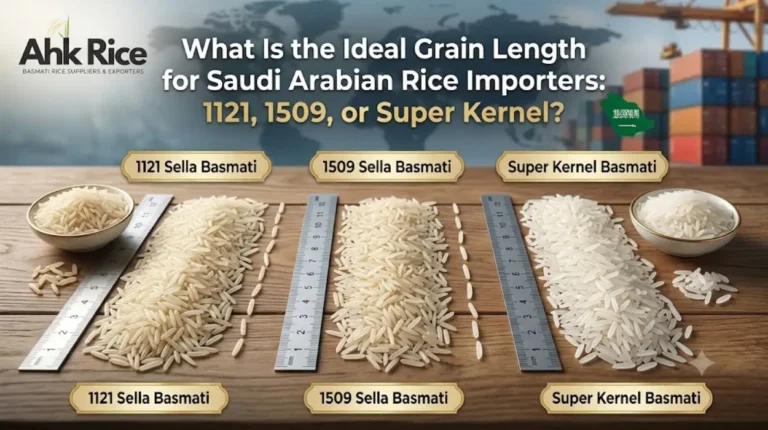
Purity Comparison Between Pakistan 1121, 1509, and Super Kernel Rice for Saudi Arabia to identify the most suitable option for their product range.
For buyers planning long-term supply contracts, AHK Rice delivers export-grade Pakistani Basmati rice to Saudi Arabia with controlled processing, strict purity standards, customized private labeling, and documentation designed for commercial importers. Learn more about our export services for Saudi Arabia through our dedicated service page before requesting samples or quotations.
What is the best solution for sourcing premium purity Pakistan Basmati rice for Saudi Arabian private label brands?
The best solution is selecting an exporter that controls procurement, grading, polishing, sorting, laboratory testing, packaging, and export documentation under one quality management system. This minimizes admixture, maintains grain consistency, supports Saudi import requirements, and protects your private label reputation across wholesale and retail markets.
Private label brands are judged differently than commodity rice traders. Consumers purchasing branded Basmati rice expect every package to contain grains with the same appearance, aroma, cooking expansion, and texture. Even small variations can reduce repeat purchases and damage brand credibility.
AHK Rice addresses this challenge through controlled sourcing from Pakistan’s major Basmati-producing regions. Every production lot passes through multiple processing stages before export. These include:
- Paddy procurement from approved suppliers
- Pre-cleaning
- Dehusking
- Whitening or steaming depending on specification
- Length grading
- Color sorting
- Stone removal
- Metal detection
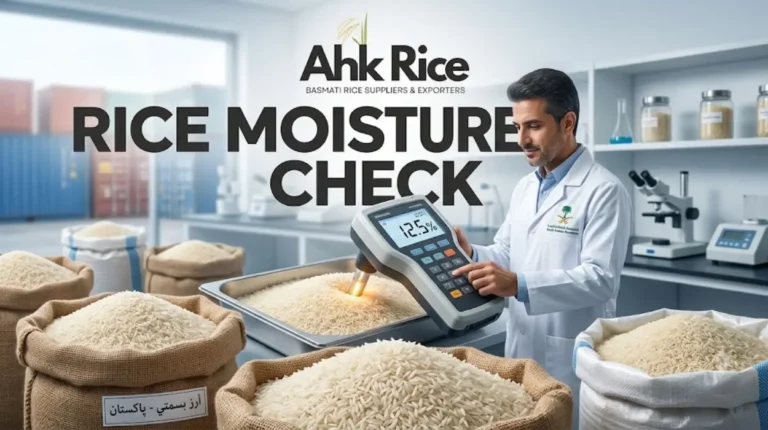
- Moisture testing
- Purity inspection
- Packaging
- Final export inspection
This integrated process helps maintain premium purity while reducing broken grains, foreign matter, immature kernels, and unwanted varieties.
For Saudi private label customers, consistency is often more valuable than simply obtaining the lowest purchase price because repeat retail orders depend on consumer satisfaction.
AHK Rice supplies multiple specifications including 1121 Basmati, 1509 Basmati, and Super Kernel Basmati according to customer requirements.
Why should Saudi Arabian private label brands choose AHK Rice?
AHK Rice combines modern processing technology, export experience, customized packaging, documented quality assurance, and reliable logistics to provide Saudi private label buyers with dependable Basmati rice that supports long-term brand growth, customer satisfaction, and stable commercial supply throughout the year.
Selecting an exporter is not simply choosing a rice supplier. It is choosing a manufacturing partner responsible for protecting your brand.
AHK Rice offers several commercial advantages.
Consistent purity standards
Multiple sorting stages help maintain high varietal purity suitable for premium retail packaging.
Private label packaging
Packaging can be customized for:
- 1 kg
- 2 kg
- 5 kg
- 10 kg
- 20 kg
- 40 kg
- 50 kg
Packaging materials include PP woven bags, BOPP laminated bags, non-woven bags, paper bags, and retail-ready printed packaging.
International certifications
Depending on buyer requirements, production may include documentation such as:
- ISO quality management
- HACCP
- FSSC 22000 where applicable
- Phytosanitary Certificate
- Certificate of Origin
- Fumigation Certificate
- SGS or third-party inspection upon request
Flexible container loading
Buyers can select:
- 20-foot containers
- 40-foot containers
- Mixed product containers
- Customized loading plans
Long-term supply planning
AHK Rice supports scheduled shipments throughout the year, allowing private label brands to maintain continuous retail inventory.
What results can Saudi private label brands expect?
Working with an experienced exporter produces measurable business outcomes including improved retail consistency, fewer customer complaints, better shelf presentation, predictable cooking performance, smoother customs clearance, and stronger long-term relationships with wholesalers, supermarkets, distributors, and food service buyers throughout Saudi Arabia.
Premium purity influences several commercial outcomes.
Better retail presentation
Uniform grain appearance creates stronger visual appeal on store shelves.
Improved customer satisfaction
Consumers expect every package to cook consistently. High purity improves cooking uniformity and reduces variation.
Reduced product complaints
Foreign grains, broken rice, and impurities frequently generate customer complaints. Controlled processing minimizes these issues.
Stronger brand positioning
Premium private labels can justify higher retail pricing when quality remains consistent.
Easier quality verification
Laboratory reports simplify buyer inspections before shipment.
AHK Rice works with buyers to establish specifications before production begins, reducing misunderstandings during export.
How long does shipping take from Pakistan to Saudi Arabia?
Most commercial shipments require approximately 18–30 days from production scheduling to arrival at major Saudi Arabian ports, although exact transit depends on packaging requirements, inspection schedules, vessel availability, destination port, and customs processing during the 2026 shipping season.
The export process generally follows these stages.
| Export Stage | Typical Time |
|---|---|
| Production scheduling | 2–3 days |
| Processing and grading | 3–5 days |
| Packaging | 2–3 days |
| Quality inspection | 1–2 days |
| Container loading | 1–2 days |
| Export documentation | 1–2 days |
| Ocean transit to Jeddah | 10–14 days |
| Ocean transit to Dammam | 12–16 days |
| Customs clearance | 2–5 days |
Total lead time commonly ranges between 18 and 30 days, depending on order size and shipping schedules.
AHK Rice coordinates production planning with vessel bookings to reduce unnecessary delays.
What is the sample process before placing a commercial order?
A structured sampling process allows buyers to evaluate grain quality, purity, aroma, cooking performance, packaging options, and laboratory specifications before committing to container quantities, reducing procurement risk while supporting informed purchasing decisions for Saudi private label operations.
Commercial buyers typically follow a structured approval process.
Step 1
The buyer shares required specifications.
These may include:
- Variety
- Grain length
- Purity
- Broken percentage
- Moisture
- Packaging
- Brand requirements
Step 2
AHK Rice prepares representative production samples.
Step 3
Samples undergo laboratory verification if requested.
Step 4
Samples are shipped internationally.
Courier services generally deliver samples to Saudi Arabia within 3–7 business days.
Step 5
The buyer performs cooking tests and internal quality evaluation.
Step 6
Commercial production begins after written approval.
Sample costs
Typical 2026 sample-related costs include:
| Item | Estimated Cost |
|---|---|
| Product sample | Often complimentary for qualified buyers |
| Courier charges | Approximately USD 40–120 depending on weight and destination |
| Third-party laboratory testing (optional) | Approximately USD 80–250 |
| SGS inspection (optional) | Quoted separately based on scope |
Many commercial buyers consider sampling a low-cost investment compared with the value of annual container contracts.
AHK Rice helps coordinate the complete sampling process for qualified importers.
What factors affect pricing for premium purity Pakistan Basmati rice?
Pricing depends on rice variety, crop season, purity specification, grain length, broken percentage, moisture level, packaging material, branding requirements, inspection services, container quantity, freight conditions, and international market demand rather than a single fixed export price.
Several commercial variables influence pricing.
Rice variety
1121 generally commands higher prices than many standard varieties because of its exceptional grain length and cooking expansion.
Purity level
Higher purity requires more advanced sorting and additional processing stages.
Packaging
Retail-ready printed bags increase production costs compared with standard export sacks.
Order volume
Container-scale purchasing generally provides better pricing efficiency.
Certifications
Additional laboratory testing and inspection services may increase total project costs.
Ocean freight
Shipping rates fluctuate depending on seasonal logistics and carrier capacity.
AHK Rice prepares customized quotations after reviewing each buyer’s commercial specifications.
How can Saudi private label brands get started with AHK Rice?
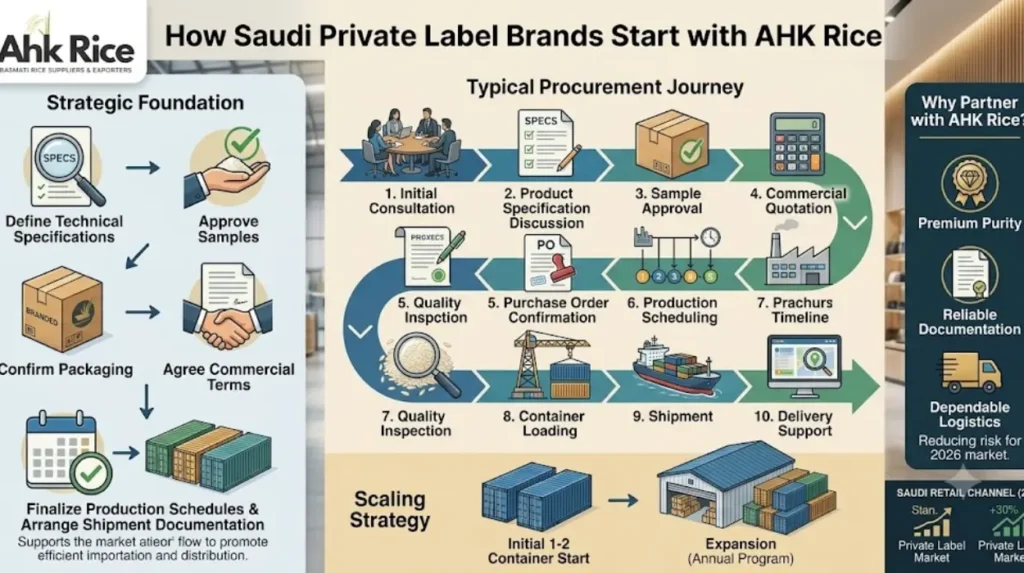
The purchasing process begins by defining technical specifications, approving samples, confirming packaging, agreeing commercial terms, finalizing production schedules, and arranging shipment documentation so every stage supports efficient importation and successful retail distribution within Saudi Arabia.
A typical procurement process includes:
- Initial consultation
- Product specification discussion
- Sample approval
- Commercial quotation
- Purchase order confirmation
- Production scheduling
- Quality inspection
- Container loading
- Shipment
- Delivery support
Throughout this process, AHK Rice maintains communication regarding production progress, documentation, and shipping schedules.
Many Saudi private label businesses initially begin with one or two containers before expanding into larger annual purchasing programs after successful market performance.
Because consumer expectations continue rising across Saudi retail channels in 2026, partnering with an experienced exporter that consistently delivers premium purity, reliable documentation, and dependable logistics helps reduce procurement risk while strengthening long-term brand reputation. AHK Rice focuses on providing export-quality Pakistani Basmati rice tailored to commercial buyers seeking dependable supply, customized packaging, and repeatable product performance. If you are ready to discuss specifications, request samples, or receive a tailored commercial quotation, visit request a quote to begin your procurement process with AHK Rice.
Frequently Asked Questions
What purity level is recommended for premium Saudi Arabian private label Basmati rice?
Premium Saudi Arabian private label brands generally prefer high-purity Basmati rice with minimal admixture, low broken grain percentages, and consistent grain size to ensure uniform cooking performance and customer satisfaction.
Which Pakistan Basmati variety is best for Saudi private label brands?
The best variety depends on your target market. Pakistan 1121 Basmati is preferred for premium retail products, while 1509 and Super Kernel are suitable for brands seeking a balance between quality and pricing.
How does AHK Rice ensure consistent rice purity?
AHK Rice uses multiple cleaning, grading, color sorting, laboratory testing, and quality inspection processes to reduce impurities and maintain consistent export specifications for every shipment.
How long does it take to ship Basmati rice from Pakistan to Saudi Arabia?
Most shipments require approximately 18 to 30 days, including production, packaging, documentation, ocean freight, and customs clearance, depending on the destination port and shipping schedule.
What sample process is available before placing a bulk order?
AHK Rice provides representative product samples based on buyer specifications. After quality approval and optional laboratory testing, commercial production begins according to the agreed specifications.
What documents are provided with export shipments?
Typical export documentation includes the Commercial Invoice, Packing List, Certificate of Origin, Phytosanitary Certificate, Fumigation Certificate, Bill of Lading, and any requested third-party inspection reports.
What factors affect the price of premium Pakistan Basmati rice?
Pricing depends on the rice variety, purity level, grain length, packaging type, order quantity, inspection requirements, seasonal availability, and international freight costs.
Can AHK Rice provide customized private label packaging?
Yes. AHK Rice offers customized private label packaging in multiple bag sizes, materials, and printed designs that meet the branding requirements of Saudi Arabian importers and retailers.
What is the minimum order quantity for export?
The minimum commercial order typically starts from one full container load (FCL), although specific requirements can vary depending on the product and packaging specifications.
Why should Saudi Arabian brands choose AHK Rice as their export partner?
AHK Rice provides consistent product quality, customized packaging, export documentation, quality assurance, and reliable logistics support, helping Saudi private label brands build long-term customer confidence and stable supply chains.