Why 1509 Basmati Rice Is Popular in Food Service Industry
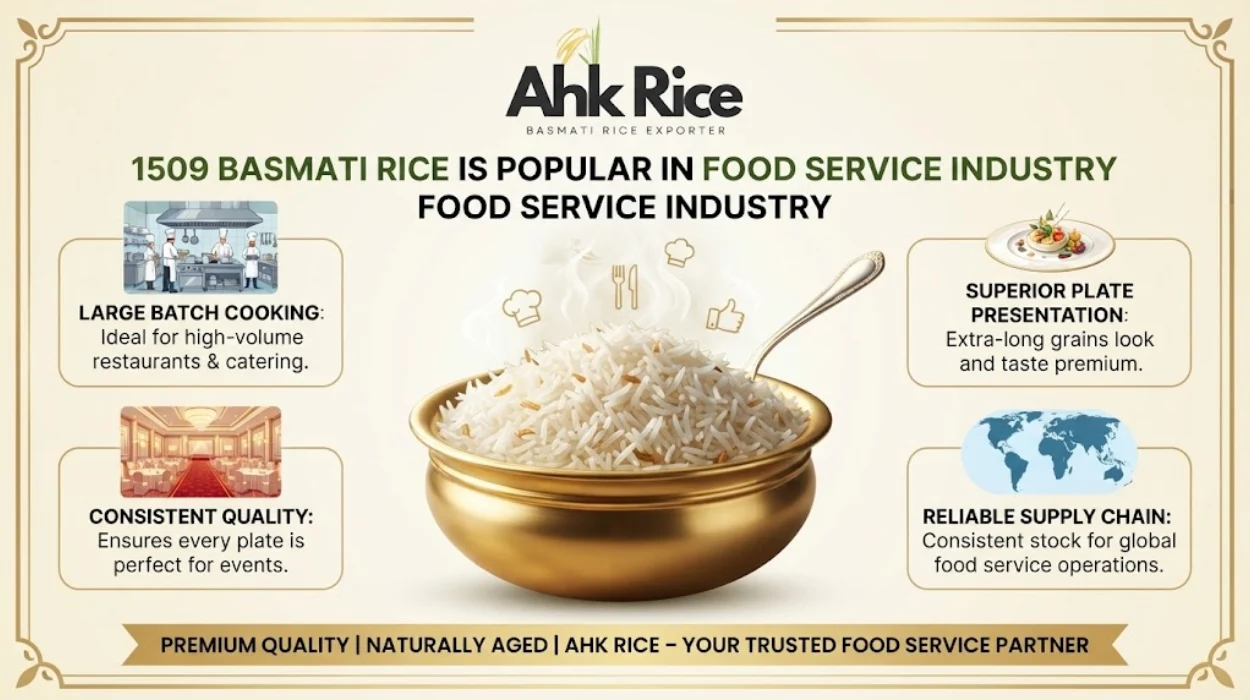
1509 Basmati Rice is popular in food service because it combines extra-long grains, fast cooking, grain separation, aroma, and commercial cooking efficiency. Here is why: 1509 provides a long-grain presentation with consistent cooking characteristics for restaurants, hotels, caterers, and institutional kitchens.
1509 Basmati Rice is a modern aromatic rice variety cultivated in the Punjab region of Pakistan and India. Pakistani 1509 is widely processed in Punjab for domestic and export markets. Commercial specifications commonly place its raw grain length around 8.1–8.5 mm, although contract specifications vary by mill and buyer.
Pakistan’s official Basmati specification defines Basmati through characteristics including a minimum pre-cooked milled grain length of 6.50 mm, typical Basmati aroma, soft gel consistency, and non-sticky cooked texture.
What Is 1509 Basmati Rice?
1509 Basmati Rice is an extra-long aromatic Basmati variety with approximately 8.1–8.5 mm raw grain length, fast cooking characteristics, and separate cooked grains. Its combination of appearance, aroma, texture, and processing options suits high-volume food service.
1509 belongs to the Basmati rice category. Basmati describes aromatic rice with distinctive grain and cooking characteristics. The 1509 designation identifies a specific variety rather than a processing method.
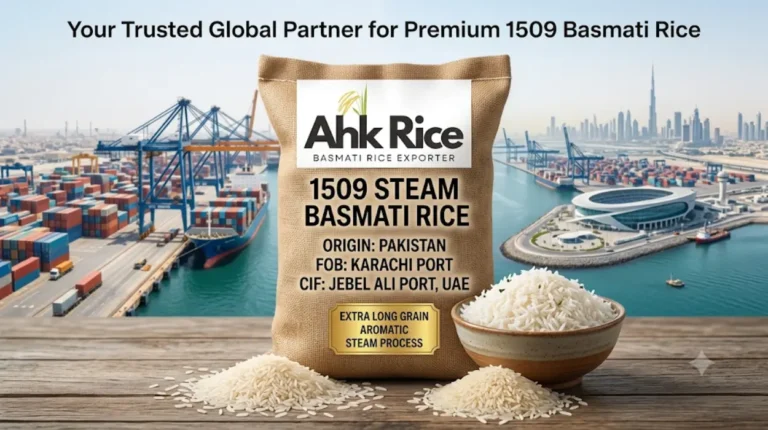
Food service buyers encounter 1509 in several processing forms. These include White 1509, Steam 1509, and Sella or parboiled 1509. Each form uses the same variety but receives different processing treatment.
The variety is also associated with relatively fast cooking. Commercial food businesses value this characteristic because kitchens often prepare large batches within fixed service periods. 1509 can therefore fit restaurants, catering companies, hotels, institutional kitchens, and prepared-food operations.
Grain appearance also matters. Long, slender grains create a recognizable presentation in biryani, pulao, rice bowls, fried rice, and buffet dishes. Commercial suppliers commonly specify grain length, broken percentage, moisture, purity, and milling finish for procurement.
With the variety defined, its agricultural origin explains why 1509 developed its distinctive commercial profile.
Where Is 1509 Basmati Rice Grown?
1509 Basmati Rice is cultivated in the Punjab rice-growing region of Pakistan and India, with Pakistani export production concentrated in Punjab. The region provides the agricultural conditions required for aromatic rice cultivation and commercial milling.
Punjab provides an established rice production ecosystem. Farmers cultivate Basmati varieties across suitable agricultural districts, while mills process harvested paddy into export specifications.
The growing cycle influences the commercial identity of 1509. The variety is recognized as an early-maturing Basmati type. Faster maturity supports earlier harvesting compared with longer-cycle varieties. Commercial sources also associate 1509 with higher yield and competitive pricing.
Pakistan’s Basmati specification also identifies geographic and natural factors as contributors to Basmati characteristics. These factors include cultivation, harvesting, and processing conditions.
Agriculture establishes the raw grain characteristics, while milling determines the final food-service specification.
How Is 1509 Basmati Rice Processed?
1509 Basmati Rice passes through cleaning, dehusking, polishing, grading, sorting, and packing stages, while Steam and Sella versions receive additional hydrothermal processing. Each stage controls cleanliness, appearance, grain integrity, and cooking consistency.
What Are the Main Processing Steps?
Clean the paddy to remove stones, dust, straw, and other field materials before milling.
De-husk the grain to remove the outer husk and produce brown rice.
Polish the grain to remove bran layers and create the required white appearance.
Grade the grain according to length and physical specifications.
Sort the grain using mechanical and optical systems to remove contrasting grains and defects.
Process the grain through steaming or parboiling for Steam and Sella specifications.
Dry the grain under controlled conditions after hydrothermal processing.
Pack the rice into food-service or retail formats according to the buyer’s requirements.
Commercial 1509 specifications differ between suppliers. One Pakistani supplier lists an average grain length of 8.35 mm, maximum moisture of 13%, and milling options including White, Steam, and Golden Sella 1509.
Matco Foods also identifies White, Brown, Steam, and Parboiled forms of 1509, showing how processing creates distinct commercial products from the same variety.
Processing therefore determines whether 1509 enters a kitchen as white rice, steam rice, or parboiled rice.
Which Characteristics Make 1509 Basmati Useful for Food Service?
The main food-service characteristics are long grain, grain separation, aromatic profile, cooking speed, volume yield, and specification consistency. These attributes support repeated batch preparation across restaurants, hotels, caterers, and institutional kitchens.
Grain Length
Grain length provides visual appeal after cooking. Commercial 1509 specifications commonly report raw lengths around 8.1–8.5 mm.
Cooking Performance
Cooking performance determines how the grain behaves after hydration and heating. 1509 is described commercially as producing long, separate, soft, and fluffy cooked grains.
Aroma
Aroma gives Basmati its distinctive sensory identity. 1509 has a recognizable Basmati aroma, while commercial descriptions often characterize it as milder than some premium Basmati varieties.
Processing Flexibility
Processing flexibility allows food businesses to select White, Steam, or Sella forms. Steam processing improves grain strength and uniform cooking, while parboiling produces a firmer grain structure.
These characteristics explain the variety’s relevance to professional kitchens, but the practical use cases show how each attribute functions during service.
Which Food Service Applications Use 1509 Basmati Rice?
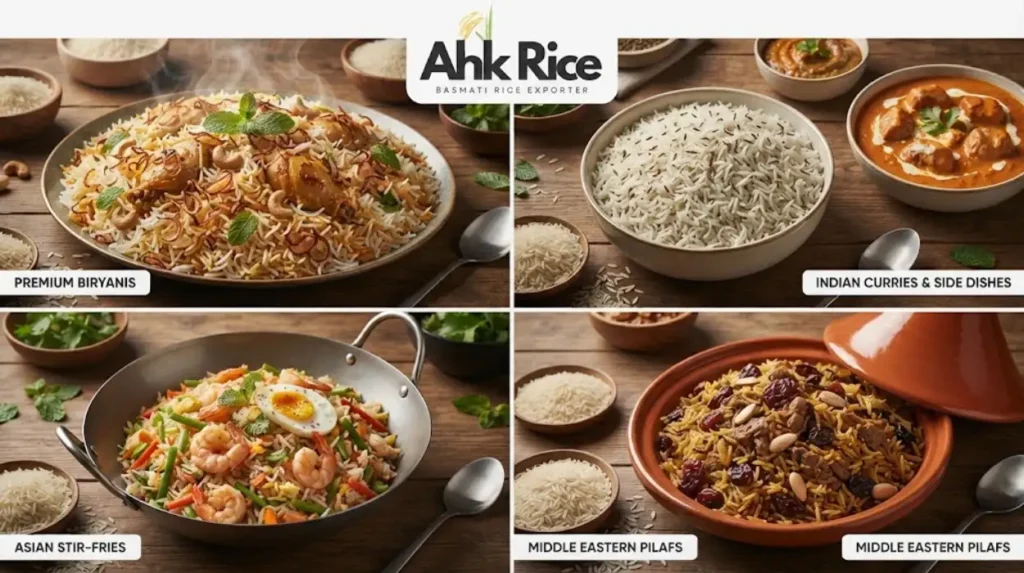
1509 Basmati Rice suits restaurants, hotels, catering operations, institutional kitchens, and large-volume prepared-food businesses that need long grains and repeatable cooking results. Common dishes include biryani, pulao, fried rice, rice bowls, and buffet rice.
Restaurants
Restaurants use 1509 for biryani, pulao, fried rice, and rice-based combination meals. Long separate grains create a clear visual presentation on individual plates and shared serving dishes.
Hotels
Hotels use Basmati rice for buffet service and banquet meals. Large kitchens need rice that maintains its structure during preparation, holding, and serving.
Catering
Catering companies prepare rice in larger batches. 1509 supports bulk cooking because its grain structure provides a recognizable long-grain result across high-volume meal production.
Institutional Kitchens
Hospitals, colleges, universities, staff cafeterias, and other institutions require standardized food production. Rice specifications help procurement teams maintain consistent raw material characteristics across repeated orders.
Food Manufacturers
Prepared-food manufacturers can use 1509 in packaged meals and ready-to-eat dishes. Processing form becomes important because Steam and parboiled rice provide different grain-strength characteristics.
Food service applications therefore depend on both the variety and the selected processing grade.
Which 1509 Basmati Grades Are Used in Food Service?
Food-service buyers commonly encounter White 1509, Steam 1509, and Sella or Parboiled 1509. White emphasizes appearance and conventional cooking, while Steam and Sella emphasize stronger grain structure and processing durability.
White 1509
White 1509 is milled and polished into a bright grain. It suits conventional rice dishes where clean appearance, aroma, and separate cooked grains are required.
Steam 1509
Steam 1509 receives controlled steaming before final milling. This process strengthens the grain and supports uniform cooking. Commercial specifications list Steam 1509 among standard export forms.
Sella or Parboiled 1509
Sella refers to parboiled rice rather than a separate rice variety. Hydrothermal processing changes the grain structure and produces a firmer cooked result. Parboiling also reduces susceptibility to breakage during handling and cooking.
Food-service procurement therefore requires more than the name “1509.” Buyers need the variety, processing form, grain length, moisture, broken percentage, and packaging specification.
What Are the Key Quality Specifications for 1509 Basmati?
Key specifications include grain length, moisture, broken grains, purity, foreign matter, chalky grains, milling finish, and processing type. These measurable attributes create a common procurement language between food-service buyers, mills, exporters, and inspection agencies.
| Specification | Typical commercial reference |
|---|---|
| Grain length | 8.1–8.5 mm |
| Moisture | Up to 13% |
| Broken grains | 1–5%, contract dependent |
| Processing forms | White, Steam, Sella/Parboiled |
| Aroma | Typical Basmati aroma |
| Cooked texture | Separate and non-sticky |
| Milling | Polished / export-grade |
Specifications vary by supplier and contract. For example, published commercial specifications list 8.35 mm average grain length and 13% maximum moisture, while other suppliers list 8.2–8.4 mm ranges.
Buyers should therefore evaluate the exact certificate of analysis rather than relying only on the variety name.
Which Markets Import 1509 Basmati Rice?
1509 Basmati Rice enters food and retail markets across the Middle East, Europe, Southeast Asia, and other international destinations where long-grain aromatic rice has commercial demand. Market suitability depends on destination specifications, consumer preferences, and import requirements.
Commercial sources identify GCC and European markets among destinations for 1509 Basmati. AHK Rice also publishes specifications for Pakistan 1509 White Rice in relation to Indonesian retail and food-service demand.
The Middle East uses Basmati extensively in biryani, mandi, kabsa, pulao, and catering. Europe includes retail, restaurant, wholesale, and ethnic-food channels. Southeast Asian markets include food-service and retail applications with specific requirements for grain appearance and cooking performance.
The market determines the required specification. A buyer supplying restaurants can require different packaging and broken percentages from a supermarket distributor.
This market variation leads naturally to comparisons between 1509 and other Basmati varieties, especially Super Kernel.
What Certifications and Export Documents Apply to 1509 Basmati?
Export documentation depends on the destination, while phytosanitary certification verifies compliance with plant-health requirements. Common export documents include commercial invoices, packing lists, certificates of analysis, and phytosanitary certificates when required.
Pakistan’s Department of Plant Protection states that exporters must fulfill the importing country’s phytosanitary requirements. The procedure includes inspection, sampling, treatment when required, and phytosanitary certification under ISPM-12.
The required export documents include a commercial invoice, packing list, container information, and other destination-specific documents. Traceability and treatment certificates apply where required.
Food-service buyers can also request laboratory test reports and certificates of analysis for parameters such as moisture, broken grains, purity, and other agreed specifications.
With compliance requirements established, the final consideration is understanding why food-service procurement often compares 1509 with other Basmati varieties.
What Are Common Misconceptions About 1509 Basmati Rice?
The main misconception is that every 1509 shipment has identical specifications. Grain length, broken percentage, moisture, milling finish, processing method, packaging, and inspection terms differ between contracts and suppliers.
Another misconception is that Sella represents a separate variety. Sella describes a parboiling process. 1509 Sella therefore means 1509 processed through parboiling.
A third misconception is that grain length alone determines food-service performance. Cooking method, soaking, water ratio, processing type, storage, and kitchen equipment also affect the final cooked result.
A fourth misconception is that all 1509 rice has the same aroma intensity. Aroma varies with variety, crop, processing, aging, storage, and specification.
For buyers comparing aroma, market positioning, and cooking characteristics, the next logical topic is 1509 vs Super Kernel Basmati: Market and Aroma Comparison.