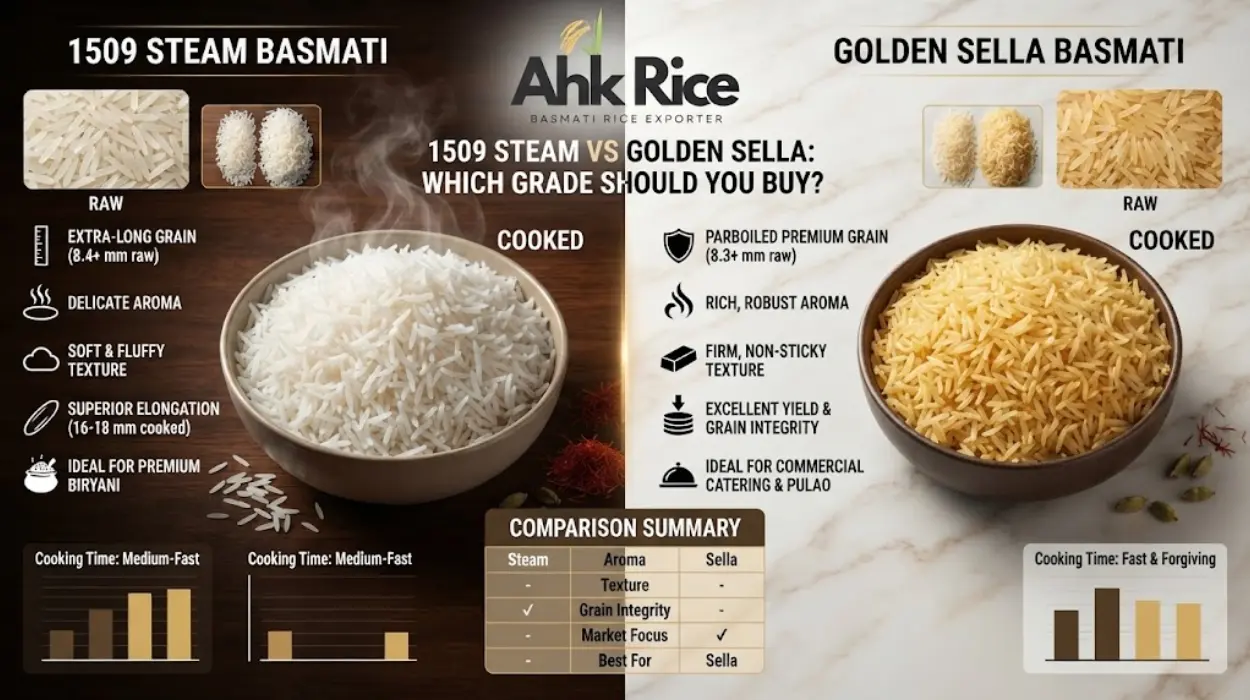
1509 Steam vs Golden Sella: Which Grade Should You Buy?
1509 Steam suits buyers prioritizing bright appearance, familiar Basmati cooking performance, and competitive procurement cost, while 1509 Golden Sella suits buyers prioritizing firmer grains, longer storage, and catering stability. Here is why: both grades use the 1509 variety, but their processing methods create different commercial specifications.
1509 identifies the rice variety, while Steam and Golden Sella identify processing forms. Buyers should therefore compare processing, grain characteristics, moisture, broken percentage, cooking performance, shelf life, and price before purchasing. The complete guide to Basmati rice quality grades explains how variety and processing grade work together.
What are the available solutions for 1509 Basmati buyers?
The main solutions are 1509 Steam, 1509 Golden Sella, 1509 White, 1509 Creamy Sella, 1509 Parboiled, 1509 Brown, and 1509 Sella. Each option combines the 1509 variety with a specific processing method and commercial use.
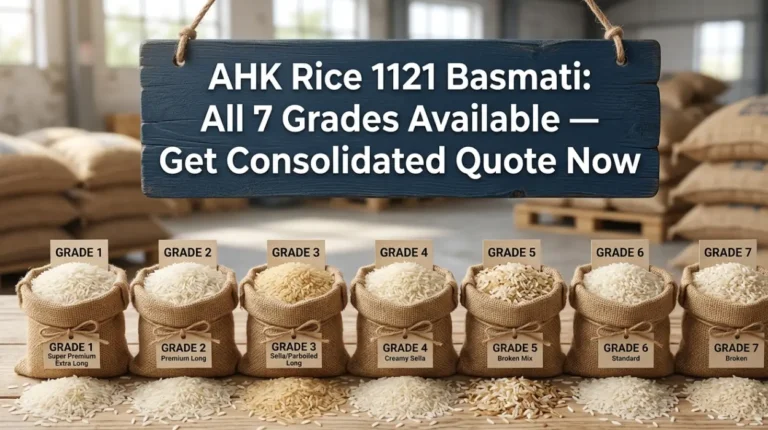
1509 Basmati is a long-grain Pakistani variety cultivated extensively in Punjab. AHK Rice lists seven processing grades for 1509: White, Brown, Steam, Parboiled, Golden Sella, Creamy Sella, and Sella. These grades allow importers to match processing characteristics with retail, foodservice, catering, and wholesale requirements.
What is 1509 Steam Basmati?
1509 Steam uses controlled heat treatment before drying and milling, producing firm grains, a light appearance, and a cooking profile suited to retail and foodservice applications. The variety commonly measures around 8.10–8.50 mm before cooking.
Steam processing changes the physical structure of the grain without creating the golden appearance associated with Golden Sella. Buyers commonly specify grain length, moisture, broken percentage, purity, polishing, and cooking performance.
AHK Rice describes 1509 Steam as an extra-long grain product processed through steaming, drying, milling, grading, and optical sorting. Commercial specifications can target approximately 8.40 mm average grain length.
What is 1509 Golden Sella?
1509 Golden Sella is parboiled and dried before milling, producing firmer grains, a golden appearance, stronger grain integrity, and extended storage characteristics. The processing method makes it particularly relevant to wholesale and catering supply.
Golden Sella is not a separate rice variety. The term combines the 1509 variety with Sella processing and the characteristic golden appearance. Parboiling changes the kernel structure and supports firm, separate cooked grains.
The processing distinction creates the main purchasing difference. Steam emphasizes a lighter finished appearance. Golden Sella emphasizes firmness, storage stability, and parboiled cooking characteristics.
With the available 1509 processing solutions established, the next question is how their specifications compare directly.
How do 1509 Steam and Golden Sella compare?
1509 Steam provides a lighter appearance and conventional steam-processed texture, while Golden Sella provides firmer grains, golden colour, stronger storage performance, and different cooking behaviour. Buyers should compare both grades using the same acceptance criteria.
| Attribute | 1509 Steam | 1509 Golden Sella |
|---|---|---|
| Processing | Controlled steaming | Parboiling and drying |
| Typical raw grain length | 8.10–8.50 mm | Around 8.20–8.50 mm |
| Appearance | White to cream | Golden to yellow |
| Moisture target | Around 12–13% by commercial specification | Around 12–13% by commercial specification |
| Broken percentage | Contract specification | Contract specification |
| Cooked texture | Firm and separate | Firmer and separate |
| Shelf-life positioning | Around 12 months in AHK comparison data | Around 18–24 months in AHK comparison data |
The supplied AHK comparison data places Steam at around 12 months and Golden Sella at 18–24 months. Storage conditions, packaging, moisture, crop year, and warehouse temperature affect actual performance.
The Pakistan Trade Portal lists one current 1509 Steam commercial offer at US$1.39 per kilogram, equivalent to about US$1,390 per MT. The listing specifies a 25,000 kg minimum order, moisture below 15%, and broken rice below 5%.
Pakistan Customs’ 2026 valuation schedule lists US$1,150/MT for 1509 Steam and US$1,100/MT for 1509 White/Sella. These are customs valuation figures, not supplier quotations or landed prices.
Price therefore should not be compared using the processing name alone. Grain length, broken percentage, crop year, packaging, inspection, quantity, freight, and Incoterm can change the commercial quotation.
A buyer comparing US$1,150 Steam against US$1,100 Sella should first confirm whether both offers carry the same grain length, moisture, purity, packaging, and shipment terms.
With the specification table established, regional procurement patterns show why the same grade can create different value.
Which grade works best for Gulf and European markets?
Gulf buyers often prioritize durable cooking performance and storage stability for catering, while European buyers place greater emphasis on appearance, documentation, packaging, and consistent retail specifications. The correct grade therefore depends on channel requirements.
Which grade suits Gulf buyers?
1509 Golden Sella fits large catering and wholesale programs requiring firm cooked grains, longer inventory stability, and consistent performance across repeated commercial batches. Steam fits retail and foodservice programs requiring a lighter appearance and steam-processed profile.
Gulf markets include UAE, Saudi Arabia, Qatar, Kuwait, Oman, and Bahrain. Basmati serves retail, restaurants, hotels, catering companies, and wholesale distributors across these markets.
UAE buyers can use 1509 Steam for retail packs and foodservice programs. Golden Sella fits distributors holding larger inventories for catering and wholesale customers.
Saudi buyers also evaluate grain appearance and cooking performance. The selected grade should match the intended dishes, packaging format, storage duration, and customer expectations.
For a warehouse exposed to higher temperatures, Golden Sella provides a stronger storage-oriented specification. The supplied AHK comparison places Golden Sella at 18–24 months versus around 12 months for Steam under its stated comparison framework.
Which grade suits European buyers?
1509 Steam suits European retail and foodservice programs requiring a light appearance, while Golden Sella suits distributors prioritizing firmer texture and extended inventory planning. Documentation and batch consistency remain essential for both grades.
European importers typically evaluate grain specification, moisture, broken percentage, purity, packaging, traceability, and food-safety documentation.
Retail programs can favor Steam because its lighter appearance aligns with conventional white Basmati presentation. Foodservice distributors can select Golden Sella when firm grains and inventory stability carry greater operational value.
The final decision should therefore connect the processing grade with the sales channel. A supermarket shelf and a high-volume catering kitchen do not create identical procurement requirements.
With regional differences established, the next step is comparing the advantages and limitations of each grade.
What are the pros and cons of 1509 Steam and Golden Sella?
1509 Steam offers lighter appearance and competitive positioning, while Golden Sella offers firmer grains and longer storage performance; each creates different advantages for commercial buyers. The decision depends on the buyer’s distribution model.
What are the advantages of 1509 Steam?
1509 Steam provides a light finished appearance, strong cooked grain presentation, and a familiar processing profile for retail and foodservice distribution. Its commercial specification also supports buyers seeking competitive pricing.
Steam processing preserves the long-grain identity of 1509 while creating a firm cooked structure. The grade works across retail packs, restaurants, catering, and wholesale channels.
Steam also creates a straightforward visual proposition. Buyers can present the product as long-grain Basmati with a light white-to-cream appearance.
The main limitation is storage planning. The supplied AHK comparison data assigns Steam a shorter shelf-life range than Golden Sella.
What are the advantages of 1509 Golden Sella?
1509 Golden Sella provides firmer grain structure, golden colour, strong cooking separation, and longer storage positioning for wholesale and catering inventory. These characteristics support buyers managing larger stock volumes.
Golden Sella suits catering distributors that need consistent cooked grain structure across large meal volumes. Its parboiled structure also supports handling and milling performance.
Golden Sella’s golden appearance creates a clear product identity. The colour differentiates it from Steam and White Basmati on retail and wholesale shelves.
The main limitation is positioning. Golden Sella does not suit every customer expecting traditional white Basmati appearance. Retailers should therefore validate consumer expectations before changing an established Steam specification.
With the strengths and limitations separated, procurement decisions become clearer through a structured framework.
Which method works best for different buying cases?
Steam fits appearance-led retail and foodservice programs, while Golden Sella fits storage-led wholesale, catering, and high-volume distribution programs requiring firmer cooked grains. The buying case should determine the processing grade.
| Buying case | Recommended specification | Main reason |
|---|---|---|
| Premium retail appearance | 1509 Steam | Light finished appearance |
| Large catering inventory | 1509 Golden Sella | Longer storage positioning |
| Fast stock rotation | 1509 Steam | Suitable for shorter inventory cycles |
| Hot warehouse conditions | 1509 Golden Sella | Stronger storage-oriented profile |
| Foodservice requiring firm grains | 1509 Golden Sella | Firm cooked texture |
A supermarket with rapid inventory turnover can select Steam. The buyer should focus on appearance, cooking performance, packaging, and agreed quality limits.
A catering distributor carrying several months of inventory can select Golden Sella. The buyer should prioritize moisture, packaging integrity, storage conditions, and shelf-life requirements.
A private-label importer should test both grades before changing the commercial specification. The approved sample should become the reference for bulk production.
A wholesaler serving different customer segments can maintain both grades. Steam can serve appearance-led retail demand, while Golden Sella can serve catering and bulk distribution.
A buyer seeking one universal specification should avoid choosing from price alone. The processing method must match the customer’s cooking and storage requirements.
With the use cases mapped, the final decision depends on measurable procurement factors rather than grade names.
What decision factors should buyers check before ordering?
Buyers should compare processing method, grain length, moisture, broken percentage, storage period, cooking performance, packaging, price, and inspection requirements before approving 1509 Steam or Golden Sella. A specification-led purchase creates a clearer commercial comparison.
| Decision factor | Buyer question | Priority |
|---|---|---|
| Processing | Is Steam or Golden Sella required? | Critical |
| Grain specification | What raw grain length is contracted? | Critical |
| Moisture | What maximum percentage is acceptable? | Critical |
| Broken percentage | What contractual limit applies? | Critical |
| Storage | How long will stock remain before sale? | High |
Processing should be confirmed first. Steam and Golden Sella produce different physical and cooking characteristics.
Grain length should then be documented. AHK Rice describes 1509 as commonly measuring around 8.2–8.5 mm raw.
Moisture should appear in the purchase specification. Commercial contracts often use tighter limits than general marketplace listings.
Broken percentage should also appear in the contract. A lower broken specification requires stronger grading and sorting control.
Storage duration should influence the final grade. Short inventory cycles can support Steam. Longer inventory cycles can support Golden Sella.
Packaging should match the distribution channel. AHK Rice offers formats ranging from small retail bags to larger bulk bags, with custom packaging available.
Inspection should verify the actual shipment. Buyers should compare the approved sample with the production batch before container loading.
Price should remain the final comparison rather than the first. A lower price becomes less valuable when the specification does not match the buyer’s intended market.
How should buyers verify the final 1509 specification?
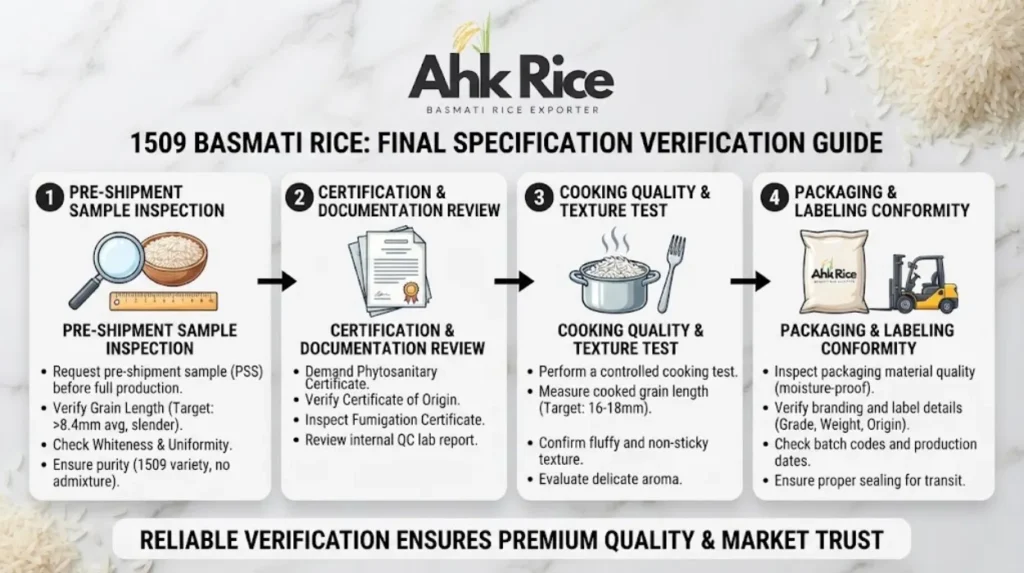
Buyers should approve a representative sample, confirm technical specifications, verify production quality, inspect finished rice, approve packaging, and review export documents before container dispatch. This sequence connects the commercial order with the actual shipment.
Start by confirming variety, processing grade, quantity, packaging, destination, and Incoterm.
Approve the physical sample before production. Inspect grain length, broken grains, colour, aroma, moisture, purity, cooking behaviour, and packaging.
Mill the production batch against the approved specification. Grade kernels by length and quality.
Sort the finished rice through appropriate sorting equipment. Remove defective, discoloured, and foreign material.
Test the finished batch against the agreed quality parameters. Record moisture, broken percentage, purity, and other contractual measurements.
Inspect the packed product before loading. Confirm bag weight, printing, batch identification, and packaging integrity.
Verify export documents before dispatch. Common documents include commercial invoice, packing list, certificate of origin, phytosanitary certificate, fumigation certificate, and bill of lading.
AHK Rice manages sourcing, processing, grading, packaging, and export logistics as an integrated supply process. Its 1509 program covers multiple processing grades and custom packaging options.
The verification process converts a grade selection into a measurable procurement specification. The final question is therefore which specification matches the buyer’s commercial objective.
What is the final buying framework for 1509 Steam vs Golden Sella?
Choose 1509 Steam for lighter appearance, rapid stock rotation, and retail-focused applications; choose Golden Sella for firm texture, longer storage, catering, and wholesale inventory. Both grades require contract-level specification control.
1509 Steam works well for buyers selling through retail and foodservice channels where visual appearance and cooking performance drive product selection.
1509 Golden Sella works well for buyers carrying larger inventories and serving catering or wholesale customers requiring firm, separate cooked grains.
Price should remain specification-based. Current Pakistan Customs valuation lists US$1,150/MT for 1509 Steam and US$1,100/MT for 1509 White/Sella. The figures provide a valuation reference rather than a fixed export quotation.
Storage should also influence the choice. The supplied AHK comparison places Steam around 12 months and Golden Sella around 18–24 months under its stated comparison framework.
The strongest procurement method is therefore specification matching. Buyers should approve the processing grade, grain length, moisture, broken percentage, packaging, storage requirement, and inspection method before placing a bulk order.
AHK Rice supplies 1509 Basmati from Punjab alongside 1121 and Super Kernel. Its export process covers processing, grading, sorting, custom packaging, inspection, and shipment coordination.
For buyers moving from comparison into procurement, the next stage is a defined bulk specification covering grade, quantity, packaging, destination, and Incoterm.
Frequently Asked Questions
Is 1509 Steam better than 1509 Golden Sella?
1509 Steam suits appearance-led retail and foodservice programs. Golden Sella suits longer inventory cycles, catering, and wholesale distribution. The correct grade depends on storage duration, cooking requirements, customer expectations, and contracted specifications.
What is the difference between 1509 Steam and Golden Sella?
1509 Steam receives controlled steaming before drying and milling. Golden Sella undergoes parboiling and drying before milling. Steam produces a lighter appearance, while Golden Sella produces a golden appearance and firmer grain structure.
Which has a longer shelf life, 1509 Steam or Golden Sella?
Golden Sella has the longer shelf-life positioning in the supplied AHK comparison data. The comparison places Golden Sella at approximately 18–24 months and Steam at approximately 12 months. Actual storage performance depends on moisture and warehouse conditions.
Which 1509 grade is suitable for catering?
1509 Golden Sella suits catering operations requiring firm, separate cooked grains and longer inventory stability. Large catering buyers should still approve a representative sample and define cooking performance, moisture, broken percentage, and packaging requirements.
What is the current 1509 Steam price per MT?
Pakistan Customs’ 2026 valuation schedule lists 1509 Steam at US$1,150 per MT. A current Pakistan Trade Portal listing shows 1509 Steam at US$1.39 per kilogram. These figures represent different commercial references, not one universal supplier quotation.