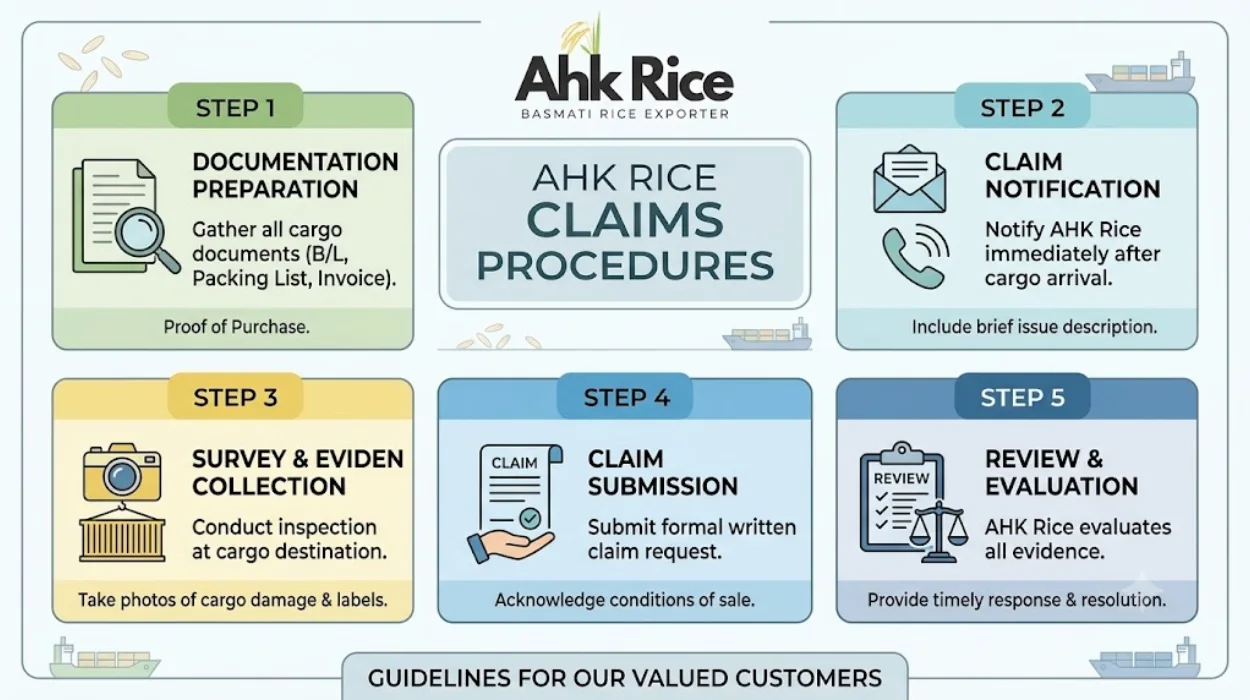
AHK Rice Claims Procedures for Quantity and Quality Disputes
Quantity and quality disputes are resolved fastest when shipment specifications, inspection reports, and documented evidence are compared against the signed sales contract. A structured claims process protects both buyers and exporters while preserving long-term trade relationships.
International rice trade depends on measurable standards. Every shipment is sold according to agreed specifications such as grain length, moisture percentage, broken grain ratio, purity level, packing weight, and container quantity. When a shipment arrives with differences between the contracted specifications and actual delivered goods, a formal claims procedure becomes necessary.
For importers evaluating risk management before placing large orders, understanding how disputes are handled is as important as understanding rice grades and export standards. Buyers who first learn the fundamentals of rice quality control and export verification can benefit from our guide on understanding rice quality assurance and export inspection systems before reviewing claims procedures. AHK Rice operates a fully integrated processing and export system in Punjab, Pakistan, with in-house grading, color sorting, quality inspections, customized packaging, and export documentation controls designed to reduce claim risks before shipment.
Rice Claims Procedure Specification Comparison
| Attribute | Quantity Claim | Quality Claim |
|---|---|---|
| Primary Issue | Weight shortage | Specification mismatch |
| Evidence Required | Weight certificates | Laboratory reports |
| Inspection Method | Weight verification | Sample testing |
| Common Causes | Loading errors, moisture loss | Grade variation, handling damage |
| Resolution Time | Usually faster | Usually longer |
| Third-Party Role | Weight surveyor | Independent inspection agency |
| Compensation Method | Quantity adjustment | Discount, replacement, or settlement |
What are the available solutions for rice quantity and quality disputes?
The most effective solutions include documentary verification, independent inspection, laboratory testing, negotiated settlements, replacement shipments, and financial compensation. The correct solution depends on whether the issue relates to quantity shortages, quality deviations, packaging damage, or specification non-compliance identified after delivery.
Rice export claims generally fall into four categories.
The first category involves quantity disputes. These occur when the received shipment weight differs from the contractual quantity. Causes may include weighing errors, loading discrepancies, documentation mistakes, or moisture-related weight variation during transit.
The second category involves quality disputes. These claims arise when grain length, broken percentage, moisture content, purity level, aroma, color, or cooking performance differs from agreed specifications.
The third category involves packaging disputes. Torn bags, damaged cartons, incorrect labeling, or moisture penetration can create losses for importers and distributors.
The fourth category involves documentation disputes. Missing certificates, incorrect invoices, packing list errors, or customs documentation problems can delay clearance and generate commercial losses.
The most common resolution methods include:
- Contract verification
- Shipment document review
- Sample analysis
- Independent inspection
- Commercial settlement
- Replacement shipments
- Credit note issuance
Exporters with documented traceability systems and pre-shipment inspections experience significantly fewer disputes because shipment specifications are verified before container loading. Independent inspections and laboratory testing provide objective evidence that reduces disagreement between trading parties.
How do different approaches compare when handling rice export claims?
Claims resolution methods differ in cost, speed, evidence quality, and commercial impact. Documentary review is fastest, independent inspections provide the strongest evidence, while negotiated settlements preserve business relationships and reduce legal expenses for both parties involved in international rice trade.
Claims Resolution Methods Comparison
| Method | Speed | Cost | Evidence Strength | Best Use Case |
|---|---|---|---|---|
| Internal Review | High | Low | Moderate | Minor discrepancies |
| Third-Party Inspection | Medium | Medium | High | Quality disputes |
| Laboratory Testing | Medium | Medium | Very High | Specification claims |
| Commercial Settlement | High | Low | Moderate | Long-term partners |
| Arbitration | Low | High | Very High | Major disputes |
Internal reviews involve comparing purchase contracts, packing lists, inspection reports, photographs, loading records, and shipment documents.
Third-party inspections provide independent assessments. Organizations such as SGS and Bureau Veritas frequently verify rice shipments before export and help establish objective findings regarding quantity and quality.
Laboratory testing becomes essential when quality specifications are disputed. Tests commonly evaluate moisture, grain length, purity, broken grains, foreign matter, and cooking performance. Accredited laboratories produce objective results that support resolution discussions.
Commercial settlements remain the most practical option for repeat buyers and exporters because they minimize disruption and maintain future business opportunities.
Which method works best for different cases?
The most suitable claims method depends entirely on the dispute category. Weight shortages require quantity verification, specification disagreements require laboratory analysis, packaging issues require inspection reports, and documentation problems require contract review and corrective administrative action.
Decision Framework for Claims Resolution
| Dispute Type | Best Method | Evidence Needed | Typical Outcome | Complexity |
|---|---|---|---|---|
| Weight Shortage | Quantity Survey | Weight Certificate | Compensation | Low |
| Broken Grain Excess | Lab Testing | Sample Analysis | Price Adjustment | Medium |
| Moisture Variation | Lab Testing | Moisture Report | Settlement | Medium |
| Packaging Damage | Inspection Report | Photos & Survey | Replacement | Medium |
| Multiple Deviations | Third-Party Investigation | Full Documentation | Negotiated Resolution | High |
Quantity disputes are typically resolved through weight verification reports from independent surveyors.
Quality disputes require representative sampling. Samples collected according to contractual procedures are tested against the original specification sheet.
Packaging disputes often rely on photographs, unloading reports, warehouse records, and insurance documentation.
Complex disputes involving multiple issues usually require coordinated investigations combining inspection reports, laboratory testing, shipping documents, and contractual analysis.
How do market requirements affect dispute resolution?
Different importing regions prioritize different rice specifications, which directly influences the type of claims most commonly reported. Buyers must understand regional preferences because quality acceptance standards vary significantly between destination markets and distribution channels.
Middle East Market Preferences
The Gulf region generally prefers extra-long grain Basmati varieties such as 1121 Steam, 1121 Sella, and Super Kernel Basmati.
Key claim factors include:
- Grain length consistency
- Aroma retention
- Cooking elongation
- Color uniformity
- Broken grain percentage
European Market Preferences
European buyers place greater emphasis on food safety compliance, traceability, packaging standards, documentation accuracy, and specification consistency.
Key claim factors include:
- Moisture compliance
- Purity standards
- Traceability records
- Certification accuracy
- Packaging conformity
These regional differences influence how quality claims are evaluated and resolved because acceptance criteria differ between retail, foodservice, wholesale, and industrial buyers.
How do rice grades influence quality claims?
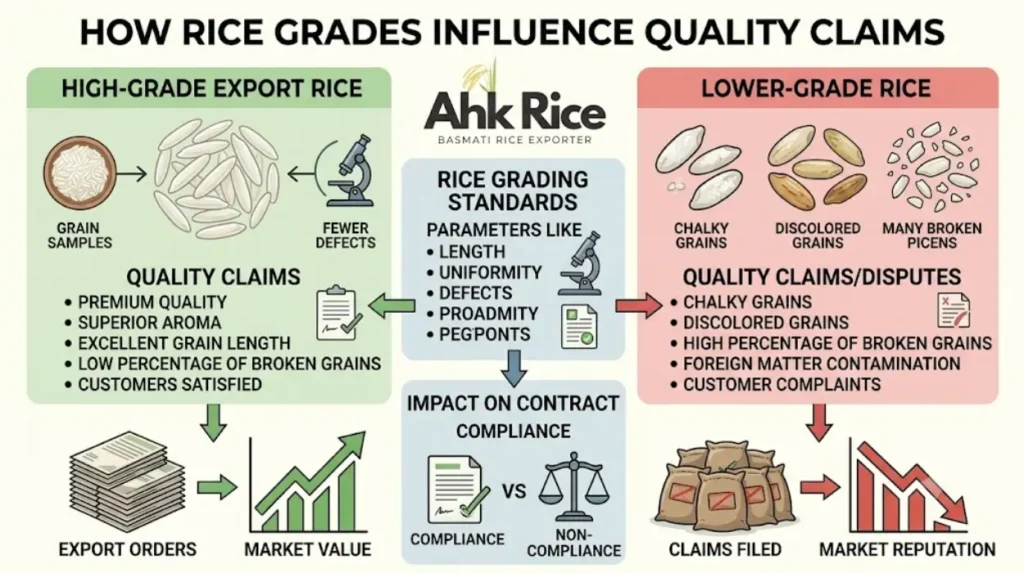
Higher-value grades generate stricter inspection requirements because specification tolerances become narrower. Premium Basmati grades face more scrutiny regarding grain length, aroma, purity, and cooking performance compared with economy-grade rice categories.
Typical Export Price Comparison
| Rice Grade | Typical Price Range (USD/MT) | Claim Sensitivity |
|---|---|---|
| 1121 Basmati | 1,000–1,500 | Very High |
| Super Kernel Basmati | 900–1,300 | High |
| 1509 Basmati | 800–1,200 | High |
| Non-Basmati Grades | 450–800 | Moderate |
Higher-value shipments justify more extensive inspections because the financial impact of specification deviations increases significantly.
Premium buyers often request pre-shipment inspections and laboratory certifications before approving bulk dispatches.
What are the pros and cons of different claims resolution strategies?
Every dispute resolution strategy involves trade-offs between speed, cost, evidence quality, and relationship preservation. The best approach balances commercial practicality with objective verification while minimizing operational disruption and financial exposure for both parties.
| Strategy | Advantages | Disadvantages |
|---|---|---|
| Internal Review | Fast and inexpensive | Limited neutrality |
| Lab Testing | Highly accurate | Additional cost |
| Third-Party Inspection | Independent evidence | Longer process |
| Commercial Settlement | Preserves relationship | May require compromise |
| Arbitration | Legally enforceable | Expensive and slow |
For repeat trading partners, negotiated settlements often create better long-term outcomes than adversarial approaches because both parties remain focused on future business opportunities.
Independent inspections become increasingly valuable when evidence is disputed or when contract values are substantial.
What decision factors should buyers evaluate before filing a claim?
Buyers should evaluate evidence quality, contractual specifications, shipment value, claim amount, commercial relationship importance, and independent inspection availability before initiating a formal dispute process. Strong documentation significantly improves the likelihood of successful claim resolution.
Critical factors include:
- Contract specification accuracy
- Inspection certificate availability
- Representative sample integrity
- Third-party verification access
- Financial impact assessment
Before filing any claim, buyers should collect:
- Purchase contracts
- Commercial invoices
- Packing lists
- Inspection certificates
- Laboratory reports
- Photographs
- Weight certificates
- Shipping documents
Comprehensive documentation creates a factual foundation for efficient dispute resolution and minimizes subjective interpretations.
Quantity and quality disputes are a normal part of international agricultural trade. The difference between a costly disagreement and a successful resolution is documentation, traceability, inspection, and objective evidence. Buyers who establish clear specifications, require pre-shipment verification, and maintain structured claims procedures reduce commercial risk significantly.
For importers comparing exporters and evaluating post-shipment support systems, the next step is understanding how transparent dispute management contributes to supplier reliability. Learn more in Choose AHK Rice for Transparent Claims Resolution and Support.
Frequently Asked Questions
How long should buyers wait before filing a rice quality claim?
Most contracts require buyers to report quality concerns immediately after unloading and inspection. Claims should be supported by documented evidence and representative samples.
What documents are required for a quantity dispute?
Weight certificates, packing lists, commercial invoices, bills of lading, and unloading reports are usually required.
Can third-party inspections prevent rice export disputes?
Yes. Independent inspections verify quantity and quality before shipment, reducing disagreements after delivery.
What is the most common cause of rice quality claims?
Specification mismatches involving moisture content, broken percentage, grain length, and purity are among the most common causes.
Are laboratory reports necessary for quality disputes?
Yes. Laboratory testing provides objective evidence and is often the most reliable method for resolving specification disagreements.