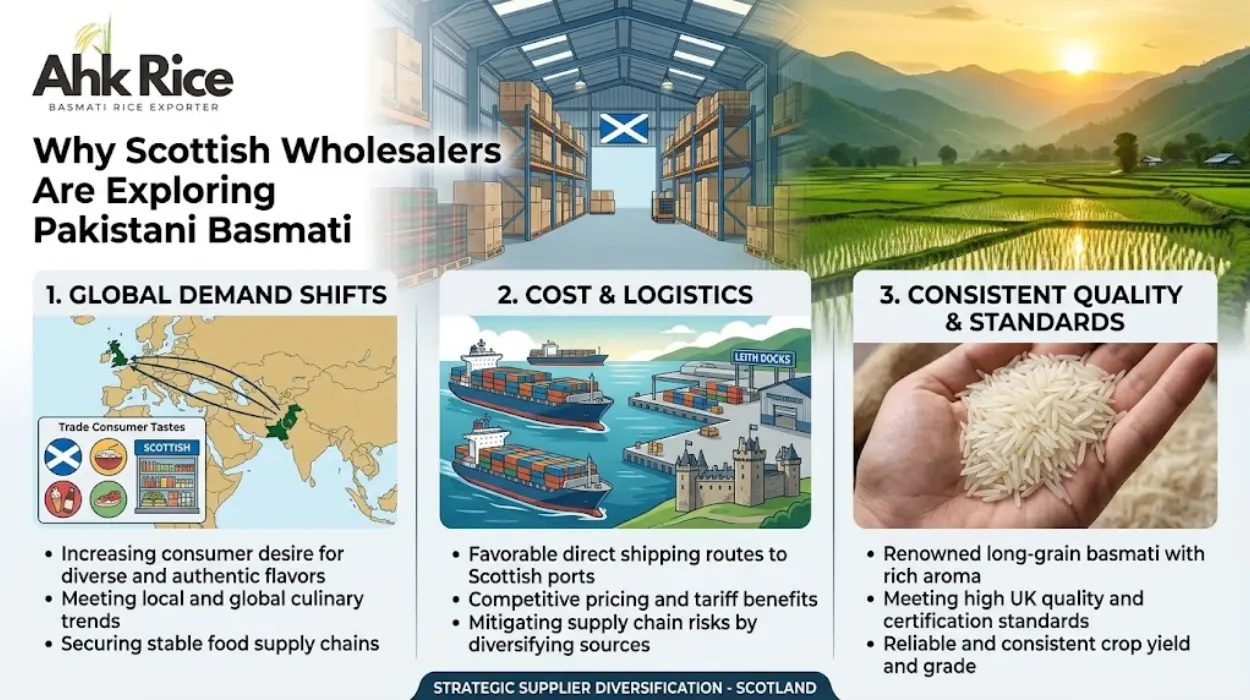
Why Are Scottish Wholesalers Exploring Pakistani Basmati Rice Sources?
Scottish wholesalers are exploring Pakistani Basmati rice sources because Pakistan provides long-grain aromatic rice in several varieties, processing formats, and commercial grades. Punjab is a major Basmati-growing region, while established export supply chains connect Pakistani mills with European and UK markets.
What Is Pakistani Basmati Rice?
Pakistani Basmati rice is a long-grain aromatic rice grown mainly in Punjab, with varieties such as 1121, Super Kernel, and 1509 supplied in white, steam, and parboiled forms for international food markets.
Basmati is defined by its distinctive aroma, slender grain structure, cooking characteristics, and ability to elongate during cooking. Pakistan’s Punjab region has established Basmati production areas. Government agricultural records classify several Basmati varieties as fine or aromatic rice grown across Punjab.
For Scottish wholesale buyers, the product is not one single specification. A shipment can differ by variety, grain length, broken percentage, moisture, processing method, packaging, and crop year. These attributes determine the appropriate use in retail packs, restaurants, catering, and foodservice distribution.
The principal export varieties discussed in this market include 1121 Basmati, Super Kernel Basmati, and 1509 Basmati. 1121 is known for extra-long grains. Super Kernel provides a slightly shorter premium grain profile. 1509 is another long-grain Basmati option used in international wholesale supply.
Where Is Pakistani Basmati Rice Grown?
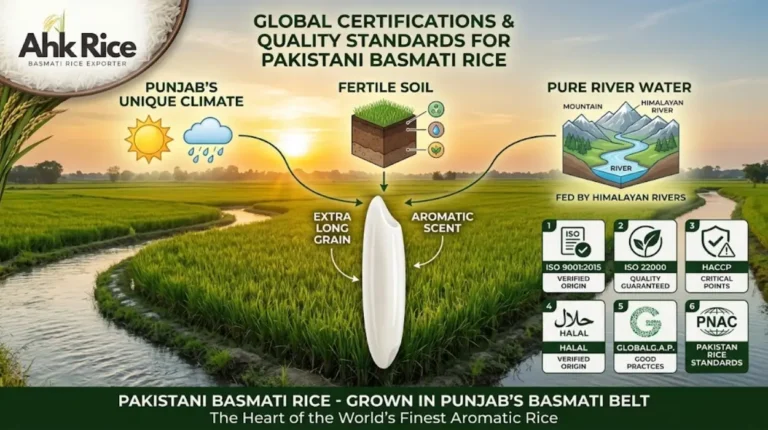
Pakistani Basmati rice is primarily associated with Punjab’s rice-growing areas, where suitable soil, climate, irrigation, and farming practices support aromatic fine-grain production for domestic and export markets.
Punjab has a long-established Basmati cultivation base. Government agricultural information lists Basmati Pak, Basmati 385, Super Basmati, Basmati 515, PK 1121 Aromatic, and other fine Basmati varieties among Punjab’s rice varieties.
The growing region matters because geographical origin influences procurement, traceability, crop planning, and quality control. Export buyers therefore examine the declared variety and origin rather than treating every Pakistani rice shipment as identical.
For example, a buyer specifying 1121 Basmati requires a different product identity from a buyer specifying Super Kernel. A buyer requiring parboiled rice also needs a different processing specification from one purchasing white rice.
How Is Pakistani Basmati Rice Processed?
Pakistani Basmati rice passes through controlled stages that normally include paddy reception, cleaning, dehusking, milling, grading, sorting, quality testing, packing, container loading, and export documentation.
1. Paddy Reception
Harvested paddy enters the processing chain after procurement. The mill checks incoming material for quality characteristics such as moisture, impurities, varietal identity, and physical condition.
2. Cleaning
Cleaning removes unwanted material from the paddy. Examples include stones, dust, straw, husk, weed seeds, and other foreign matter.
3. Dehusking
The outer husk is mechanically removed from the paddy. This produces brown rice, which then moves through further milling or processing stages depending on the required product.
4. Milling
For white rice, milling removes the bran layers and produces the characteristic polished grain. The milling process must balance appearance with grain recovery because excessive milling can increase breakage.
5. Parboiling or Steaming
Sella rice is produced through a parboiling process before drying and milling. Steam processing uses controlled steaming and drying to produce a different cooking and texture profile.
6. Grading
Rice is separated according to grain size, broken percentage, and other specification parameters. Buyers can therefore specify grades suited to premium retail, wholesale foodservice, or catering applications.
7. Colour Sorting
Optical sorting equipment identifies and removes grains with undesirable colour or visual defects. This stage improves uniformity in the finished lot.
8. Final Testing and Packing
Finished rice undergoes quality checks before packing. Export packaging can include bulk bags, sacks, retail packs, or customer-specific packaging formats.
What Pakistani Basmati Grades Can Scottish Wholesalers Source?
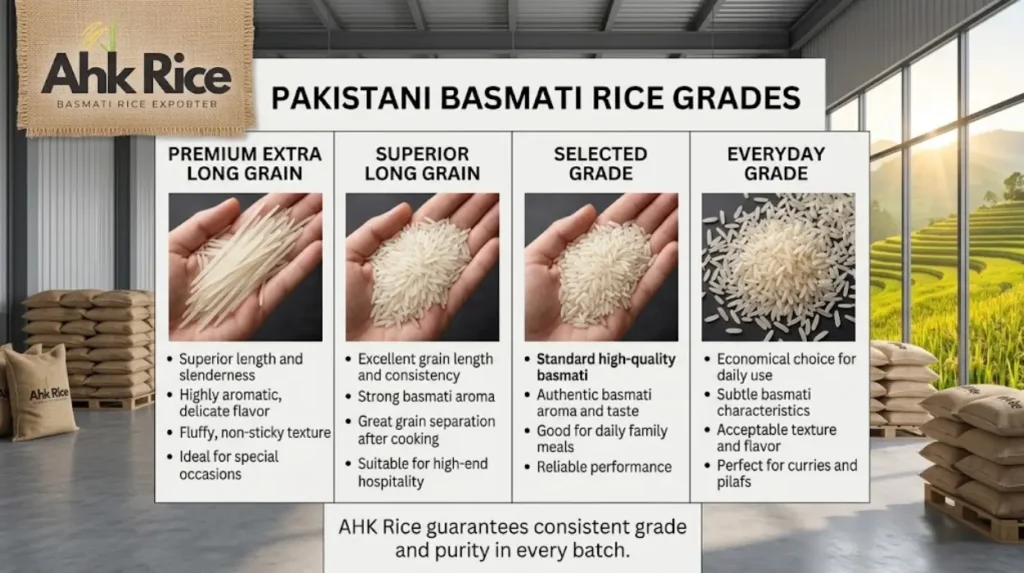
Common Pakistani Basmati export options include 1121 White, 1121 Steam, 1121 Golden Sella, 1121 Creamy Sella, 1121 Brown, Super Kernel White, Super Kernel Steam, Super Kernel Sella, and 1509 White, Steam, and Sella formats.
The exact commercial grade depends on the supplier’s specification sheet. A grade name alone does not establish the complete quality standard. Buyers need measurable specifications covering broken grains, moisture, foreign matter, grain length, packaging weight, and crop year.
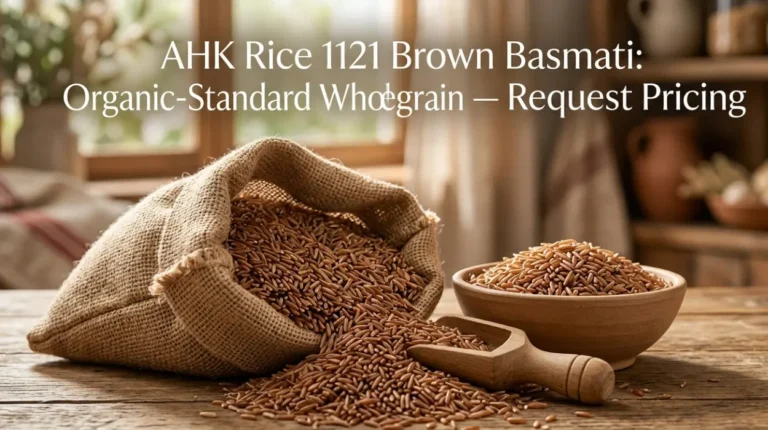
1121 Basmati is positioned as an extra-long grain variety. Its long cooked grain provides a distinctive visual appearance for premium rice dishes. It is available in white, steam, Sella, Golden Sella, Creamy Sella, and brown formats within common export product ranges.
Super Kernel Basmati is another premium Pakistani Basmati category. It is generally associated with a slightly shorter grain than 1121 while retaining aromatic cooking characteristics.
1509 Basmati provides another long-grain option. It is available in white, steam, and parboiled formats through Pakistani export supply chains. Industry product listings identify 1509 as a long-grain Basmati variety supplied to international buyers.
Why Are Scottish Wholesalers Interested in Pakistani Sources?
Pakistani Basmati gives Scottish wholesalers access to multiple varieties, processing formats, packaging configurations, and specification levels through one established origin, supporting different retail, restaurant, catering, and foodservice requirements.
The UK is an established European destination for Pakistani Basmati rice. UK market information identifies Pakistan as an important source of Basmati for British retail and food channels.
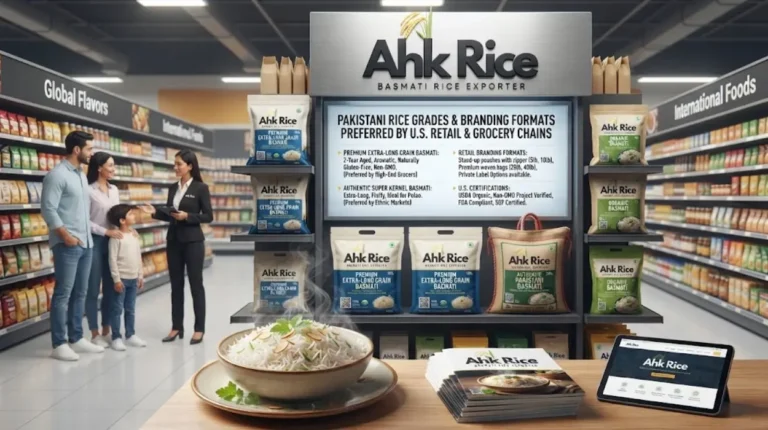
Scottish wholesalers can use different grades for different customer groups. A premium 1121 specification can serve branded retail or restaurants. A Sella specification can suit catering operations that require particular cooking characteristics. Smaller consumer packs can serve retail distribution, while larger sacks can support foodservice customers.
Supply diversification also has practical value. A wholesaler that understands several origins and specifications can compare grain length, processing, packaging, documentation, and landed cost before selecting a supply program.
Which Markets Import Pakistani Basmati Rice?
Pakistani Basmati rice is exported to markets across Europe, the Middle East, Africa, and other regions, with the UK representing an established European destination for Pakistani Basmati products.
Export destinations vary by variety and grade. Pakistani suppliers commonly serve the UAE, Saudi Arabia, Qatar, other GCC markets, the UK, North Africa, and Asian and African destinations.
The UK market has particular relevance because Basmati already has established retail and foodservice demand. UK importers purchase specifications rather than simply purchasing “rice.” They assess the product against their intended channel and customer requirements.
For example, a wholesaler supplying Indian and Pakistani restaurants can prioritize aromatic long-grain Basmati. A foodservice distributor can prioritize consistent cooking performance and bulk packaging. A retail distributor can prioritize appearance, packaging compliance, traceability, and repeatable lot specifications.
What Certifications and Documents Apply to Pakistani Rice Imports?
Rice entering the UK must satisfy applicable food safety, import, labelling, and documentary requirements, while certifications such as HACCP, ISO 22000, and BRCGS provide additional food-safety assurance rather than replacing statutory import obligations.
HACCP refers to a preventive food-safety system based on identifying and controlling hazards. ISO 22000 is a food safety management standard. BRCGS is a widely used food-safety and quality certification scheme in food supply chains.
These certifications are not identical to export documents. A shipment can also require documents such as a commercial invoice, packing list, bill of lading, certificate of origin, phytosanitary documentation where applicable, and other certificates required by the destination rules or buyer specification.
UK importers must also consider applicable maximum residue limits, food labelling requirements, contaminants, food safety controls, and customs procedures. GOV.UK specifically provides guidance for importing cereals and identifies Basmati rice and labelling as areas importers must consider.
Scottish businesses also operate within the UK food regulatory framework. Food Standards Scotland provides guidance on import controls and official controls for specific food consignments.
What Are the Main Benefits of Pakistani Basmati for Wholesale Supply?
The main benefits are product variety, established agricultural production, multiple processing formats, scalable packaging, international export experience, and the ability to match different Basmati specifications with different wholesale applications.
Product variety is important because wholesalers rarely serve one customer type. A distributor can require premium long-grain rice for restaurants and different packaging for retail customers.
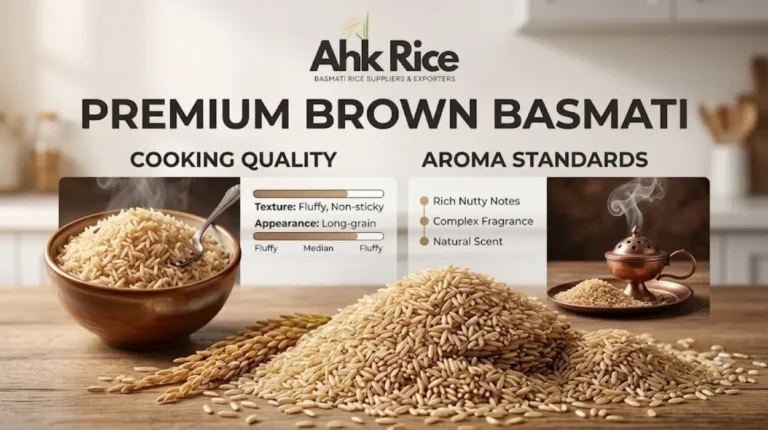
Processing choice also affects the product’s cooking characteristics. White, steam, and Sella rice provide distinct options for food businesses.
Origin consistency is another important consideration. A defined variety and specification gives buyers a reference point for repeat orders. Quality documentation then provides measurable evidence for each shipment.
AHK Rice operates from Punjab and supplies 1121, Super Kernel, and 1509 varieties to international markets. Its stated export model includes processing, custom packaging, and export handling.
What Problems and Misconceptions Should Buyers Avoid?
The main misconception is that every Pakistani Basmati shipment has the same quality; buyers must compare variety, grade, broken percentage, moisture, grain length, processing type, packaging, documentation, and crop year before treating two offers as equivalent.
The first problem is comparing price without comparing specification. A lower price does not represent better value when the grade, broken percentage, packaging, or processing format differs.
The second problem is treating a variety name as a complete specification. “1121” identifies a variety, but it does not independently define every quality parameter in a shipment.
The third problem is confusing certification with compliance. HACCP or ISO 22000 demonstrates a management system or food-safety framework. It does not automatically prove that every shipment satisfies every UK import requirement.
The fourth problem is ignoring documentation. A shipment needs accurate commercial and regulatory paperwork because customs and food controls depend on traceable information.
How Should Scottish Wholesalers Understand the Selection Process?
Scottish wholesalers should begin with the intended customer application, define the required Basmati variety and processing type, specify measurable quality parameters, verify documentation and food-safety controls, then compare suppliers using the same specification.
This approach creates an apples-to-apples comparison. The buyer first defines whether the rice is intended for retail, restaurants, catering, or wholesale redistribution.
The buyer then selects the variety. The next step is defining grain characteristics, broken percentage, moisture, foreign matter, packaging, quantity, and delivery requirements.
The final stage is supplier evaluation. Buyers should examine processing capability, traceability, food-safety systems, export documentation, inspection arrangements, and consistency between samples and shipment specifications.
For readers moving from product education to supplier evaluation, the next useful step is understanding how wholesale buyers select reliable rice categories across measurable quality and supply criteria.
Why Does This Matter for Scottish Wholesale Buyers?
Understanding Pakistani Basmati at product level prevents incorrect comparisons. A wholesaler that understands cultivation, processing, grades, certifications, and market applications can interpret supplier specifications accurately.
The result is a more structured procurement process. Buyers compare like-for-like products rather than relying on variety names, marketing descriptions, or headline prices.
Pakistan’s established Basmati production and export infrastructure provides Scottish wholesalers with several product categories to evaluate. The important step is matching each category to a defined wholesale application and documented specification.
Frequently Asked Questions
Why do Scottish wholesalers source Pakistani Basmati rice?
Scottish wholesalers source Pakistani Basmati because Pakistan offers established Basmati production, multiple varieties, different processing formats, and export supply suitable for retail, restaurant, catering, and foodservice applications.
Which Pakistani Basmati varieties are commonly available?
Common export varieties include 1121, Super Kernel, and 1509. Each has different grain characteristics and can be supplied in processing formats such as white, steam, and Sella.
Where is Pakistani Basmati rice grown?
Pakistani Basmati is strongly associated with Punjab’s rice-growing areas. Government agricultural records list multiple fine and aromatic Basmati varieties grown across Punjab.
What is the difference between white, steam, and Sella rice?
White rice is milled without parboiling. Steam rice undergoes controlled steaming during processing. Sella is parboiled rice that is processed through soaking, heating, drying, and milling stages.
What certifications should UK rice buyers examine?
Buyers should examine applicable food-safety systems such as HACCP and ISO 22000, along with any customer-specific certification such as BRCGS. These should be considered separately from statutory import and shipment documentation.
What documents are relevant to rice imports into the UK?
Depending on the shipment and applicable requirements, documents can include commercial invoices, packing lists, bills of lading, certificates of origin, phytosanitary certificates, health documentation, and inspection records. UK import requirements must be checked for the specific product and origin.
Why should wholesalers compare rice specifications instead of prices alone?
Price alone does not show whether two shipments have the same variety, broken percentage, moisture, grain length, processing type, packaging, or documentation. A specification-based comparison produces a more accurate wholesale evaluation.