Buy 1509 Basmati Rice Bulk from Pakistan Exporter
Buy export-grade 1509 Basmati in bulk with an approved specification, representative sample, controlled processing, inspection, and shipment planning. Here is why: AHK Rice supplies Pakistani 1509 Basmati with defined grain, moisture, broken-grain, purity, packaging, and export requirements. Its documented specification includes 8.20–8.40 mm average grain length, maximum 13% moisture, Pakistan origin, and 5 kg to 50 kg packaging options.
1509 Basmati suits importers seeking long cooked grains and commercial pricing. The variety works across retail, foodservice, catering, restaurants, and private-label distribution. AHK Rice manages sourcing, milling, grading, sorting, inspection, packaging, and export coordination. The buyer can therefore define the commercial specification before production begins.
Before placing a bulk order, review the 1509 Basmati cooking time and texture guide to understand how grain structure affects cooking results. The final purchase should connect cooking performance with measurable procurement specifications.
What is the best solution for buying 1509 Basmati rice in bulk?
A sample-approved, specification-based purchase is the safest bulk solution, with grain length, moisture, broken percentage, purity, packaging, quantity, destination, and Incoterm confirmed before production.
Bulk buyers face three common procurement risks. The first is inconsistent grain quality between shipments. The second is unclear landed cost. The third is approving a sample that does not match the final container.
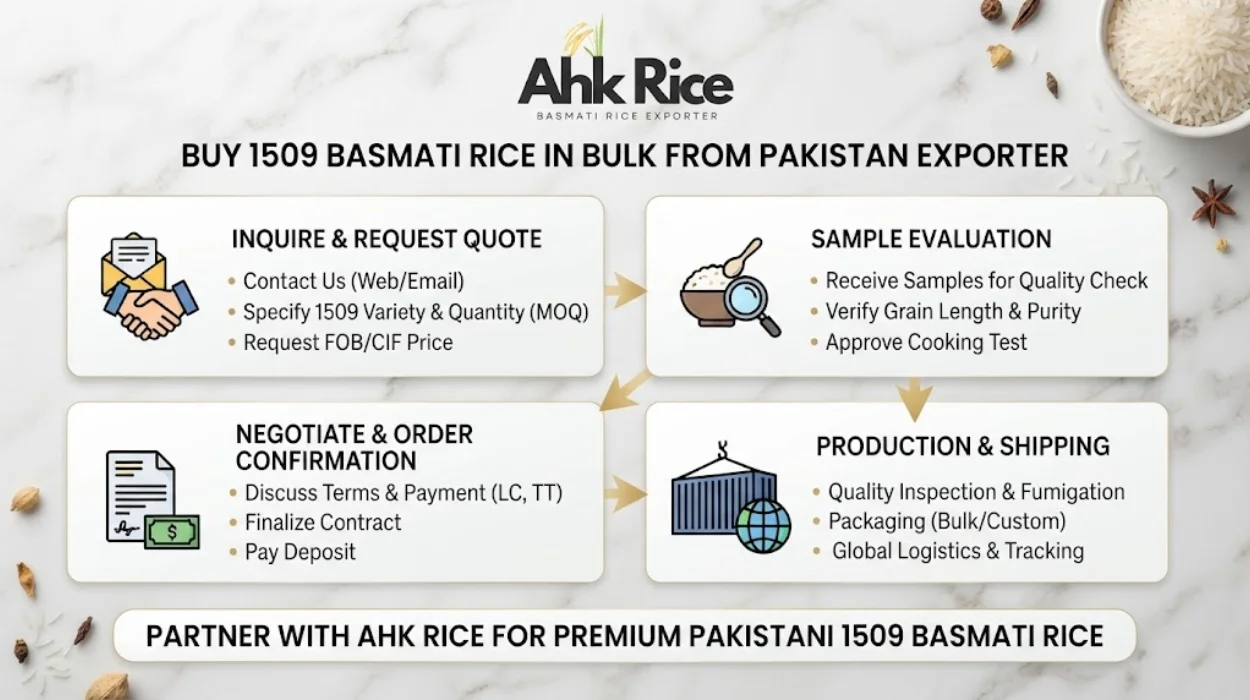
AHK Rice addresses these risks through a defined export workflow. The buyer first states the required specification. A representative sample follows. Production then proceeds against the approved specification.
1509 Basmati offers a useful commercial balance. Its long grain supports attractive cooked presentation. Its processing specification can also support price-sensitive distribution compared with higher-premium grades.
Buyers comparing processing options should also review the 1509 Steam vs Golden Sella comparison before approving the final grade. This comparison helps connect processing choice with cooking, distribution, and customer requirements.
With the purchasing specification established, the next decision is supplier execution.
Why choose AHK Rice for 1509 Basmati bulk supply?
AHK Rice combines Pakistani sourcing, milling, grading, colour sorting, inspection, packaging, documentation, and shipment coordination within one export workflow.
AHK Rice supplies 1509 Basmati from Pakistan and structures orders around the buyer’s technical and commercial requirements. The process can cover grain length, moisture, broken percentage, purity, packaging, quantity, destination, and Incoterm.
AHK Rice uses a defined processing sequence. The workflow includes cleaning harvested paddy, drying, dehusking, polishing, grading, length sorting, foreign-material removal, inspection, and export packing. This sequence supports consistent physical quality across the contracted lot.
Quality control includes moisture testing, length grading, colour sorting, foreign-matter inspection, packaging verification, fumigation compliance, and shipment documentation. AHK Rice can also support export documentation such as commercial invoices, packing lists, certificates of origin, phytosanitary certificates, fumigation certificates, bills of lading, and quality inspection reports.
AHK Rice also supports customized packaging. Bulk buyers can select standard commercial bags or develop private-label packaging according to their distribution strategy.
The result is one procurement workflow rather than separate sourcing, processing, packing, and export arrangements. The next question is what the buyer should expect after approval.
What results can be expected from importing 1509 Basmati from Pakistan?
Importers can expect long-grain presentation, consistent cooking potential, specification control, customized packing, and a structured route from sample approval to container dispatch.
1509 Basmati produces long cooked grains and supports attractive plate presentation. These characteristics make it suitable for restaurants, catering operations, retail products, wholesalers, and foodservice distribution.
Retail buyers can use 1509 Basmati for premium-looking long-grain products. Foodservice operators can use the variety for standardized dishes where cooked grain appearance matters.
AHK Rice supports repeat procurement by connecting the approved sample with the commercial specification. This reduces the risk of purchasing a different grade under the same variety name.
The commercial result depends on execution. A low quoted price does not compensate for excessive broken grains, inconsistent moisture, incorrect packaging, or shipment delays.
For this reason, AHK Rice treats specification approval as a central part of the order process. The next decision is the actual cost.
What factors affect the bulk price of 1509 Basmati rice?
Grade, grain specifications, broken percentage, quantity, processing, packaging, freight, inspection, destination, and Incoterm determine the final bulk purchase cost.
1509 Basmati does not have one universal export price. The final quotation changes according to the specification and logistics requirements.
Grade affects processing and sorting requirements. A tighter broken-grain limit can require additional sorting. Higher purity requirements can also increase processing requirements.
Quantity affects procurement economics. Full-container orders generally provide a clearer cost structure than small commercial quantities. Recurring orders can also support production planning.
Packaging changes the commercial cost. Standard PP bags have different production requirements from BOPP printed bags or private-label packaging.
Freight changes the landed price. FOB Karachi covers a different cost structure from CFR, CNF, or CIF. Destination charges, insurance, port handling, and inland transportation must also be considered.
Inspection and laboratory testing add costs when the buyer requests independent verification. AHK Rice therefore prepares quotations against the actual order requirements rather than relying on a generic price.
With the cost structure clear, shipping time becomes the next procurement consideration.
How many days does 1509 Basmati take to ship from Pakistan?
Indicative sea transit varies by destination, with current route data showing about 5–7 days to Jebel Ali, 4–8 days to Jeddah, and roughly 25–40 days to New York.
UAE shipments can move quickly from Karachi to Jebel Ali. Current tracked schedules show a typical port-to-port median near 7 days, although carrier services range from shorter direct services to longer transshipment routes.
Saudi shipments also offer relatively short sea transit. Current route guidance places Karachi-to-Jeddah sea transit around 4–8 days. Actual arrival depends on booking, sailing schedules, transshipment, customs, and port conditions.
US East Coast shipments require a longer planning window. Current shipping data shows Karachi-to-New York FCL transit around 25–40 days, depending on the carrier and service.
Indonesia requires shipment-specific confirmation. AHK Rice’s supplied Indonesia workflow describes 14–21 days of sea transit, alongside production and documentation time. The complete purchase window can therefore extend to approximately 4–6 weeks from order confirmation to delivery.
These figures are planning benchmarks, not guaranteed delivery dates. The buyer should confirm the sailing, port, carrier, cut-off, and destination requirements before contract approval.
Shipping time establishes the delivery window. The next step is controlling quality before dispatch.
How does the 1509 Basmati sample-to-shipment process work?
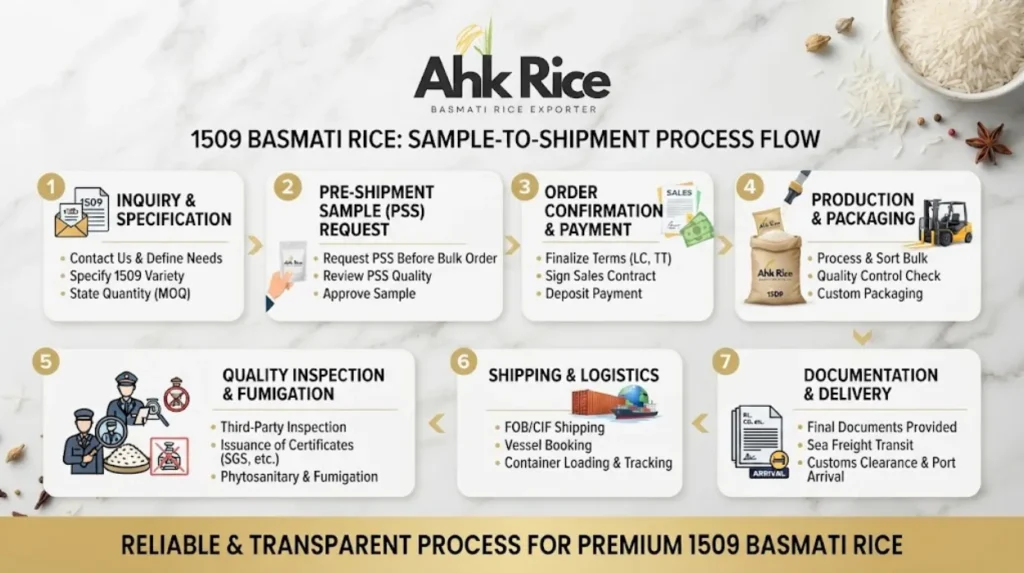
The process starts with specification definition, moves through representative sampling and approval, then continues through production, testing, packing, documentation, loading, and dispatch.
Start by defining the variety, grade, grain length, moisture, broken percentage, purity, packaging, quantity, destination, and Incoterm.
Request a representative sample from AHK Rice. The supplied AHK Rice process allows buyers to evaluate the product before bulk approval. Samples can be provided with the buyer covering courier and applicable phytosanitary expenses.
Inspect the sample for grain length, colour, aroma, moisture, broken grains, purity, cooking performance, and packaging condition.
Approve the sample only after the commercial specification is clear. The approved sample should become the reference for the bulk shipment.
Confirm the commercial quotation after sample approval. Review the price basis, quantity, packing, freight, documentation, payment terms, and delivery window.
Process the contracted rice against the agreed specification. AHK Rice then mills, grades, sorts, inspects, and packs the rice for export.
Test the finished lot against the agreed parameters. Independent inspection can also be arranged where required by the buyer or destination market.
Verify export documentation before container loading. This stage reduces avoidable documentation delays.
Load the approved rice into the container. Dispatch then follows the confirmed vessel booking and port schedule.
The sample is therefore not merely a product demonstration. It becomes a quality-control reference for the commercial order.
How much does a 1509 Basmati sample cost?
AHK Rice states that the rice sample can be provided for sampling, while the buyer covers courier shipping and applicable phytosanitary charges.
Sample cost should be separated from logistics cost. The rice itself can be treated according to the supplier’s sampling arrangement. Courier cost depends on destination, weight, dimensions, carrier, and service level.
Phytosanitary charges depend on the shipment requirement and destination. Laboratory testing can also add cost when the buyer requests additional verification.
A practical sample budget should therefore include:
- Sample quantity: Confirm the approved sample weight.
- Courier: Obtain the actual international carrier quotation.
- Phytosanitary documents: Confirm whether the destination requires them.
- Packaging: Confirm the sample packing format.
- Laboratory testing: Specify moisture, purity, or other required tests.
- Commercial order: Confirm how approved sample costs are treated.
AHK Rice’s broader sampling guidance states that samples up to 20 kg can be provided, with the buyer covering shipping-related expenses.
With sampling costs understood, the final step is converting approval into a commercial order.
How can buyers get started with AHK Rice?
Start with a defined 1509 Basmati specification, request a representative sample, approve the quality, confirm the quotation, and schedule production against the required delivery window.
Define the target specification first. Include grain length, moisture, broken percentage, purity, processing grade, packaging, quantity, destination port, and Incoterm.
Request the sample and inspect cooking performance. Use the same preparation method for every comparison. This creates a practical basis for evaluating texture and grain separation.
Approve the commercial specification after inspection. AHK Rice can then structure the quotation around the confirmed requirements.
Confirm documentation before production. Commercial invoices, packing lists, certificates, inspection documents, and destination-specific requirements should be agreed before loading.
Schedule the container after production and inspection requirements are complete. Confirm the vessel, cut-off, estimated transit, and destination clearance responsibilities.
AHK Rice gives bulk buyers a direct path from Pakistani sourcing to export dispatch. The key purchasing principle remains simple: approve the exact specification that will appear on the commercial contract. To move from sample approval to a specification-based commercial quotation, use the AHK Rice bulk export quote request.
Frequently Asked Questions
Is 1509 Basmati suitable for bulk import?
Yes, 1509 Basmati suits commercial bulk procurement.
The variety provides long cooked grains and attractive presentation.
It supports retail, restaurants, catering, and foodservice applications.
Export specifications can define grain, moisture, broken percentage, and packing.
Sample approval should precede a large commercial commitment.
What is the grain length of export-grade 1509 Basmati?
The supplied AHK Rice specification gives 8.20–8.40 mm average grain length.
Moisture is specified at maximum 13%.
Broken grains remain subject to the contracted grade.
Purity follows the agreed export specification.
Buyers should confirm the final specification through the quotation and sample.
Can AHK Rice provide a 1509 Basmati sample?
Yes, AHK Rice supports sample-led bulk procurement.
The supplied sampling process allows samples up to 20 kg.
The buyer covers international courier shipping.
Applicable phytosanitary charges are also paid by the buyer.
The approved sample should match the final commercial specification.
How long does 1509 Basmati take to reach international markets?
UAE sea transit can take about 5–7 days on suitable Karachi-Jebel Ali services.
Jeddah planning can use roughly 4–8 days for sea transit.
US East Coast services can require roughly 25–40 days.
Indonesia planning can involve 14–21 days of sea transit.
Production and documentation time must be added to ocean transit.
What affects the final 1509 Basmati export price?
Grade and quality specifications directly affect processing requirements.
Quantity influences the commercial price per metric ton.
Packaging affects material and production costs.
Freight changes according to destination and shipping conditions.
Incoterm determines which logistics costs remain with the buyer or seller.