How Is Cooking Yield Evaluated Before Importing Premium Basmati Rice?
Cooking yield is best evaluated by combining standardized laboratory cooking tests, grain elongation measurements, water absorption analysis, cooked volume expansion, texture stability, and batch consistency rather than relying on grain length alone. In 2026, professional importers use multiple measurable parameters to predict foodservice performance, serving capacity, and long-term purchasing value before selecting premium Pakistani Basmati rice suppliers.
Restaurant distributors, wholesalers, retail chains, and foodservice operators increasingly evaluate cooking yield because it directly influences serving costs and customer satisfaction. Premium Basmati rice may appear identical before cooking, yet produce significantly different cooked volume. Buyers therefore assess yield before placing container-sized orders instead of discovering performance differences after import.
If you are unfamiliar with why cooked grain expansion has become a major purchasing criterion, first read our guide explaining how grain elongation influences commercial kitchens and restaurant profitability:
Why premium grain expansion has become essential for American foodservice buyers
Cooking yield represents the relationship between the quantity of dry rice and the amount of cooked rice produced under standardized cooking conditions. Importers use this metric to estimate food cost, menu consistency, inventory planning, and overall purchasing efficiency. The higher the consistent cooking yield, the more servings each kilogram provides without compromising texture or aroma.
Pakistani Basmati rice achieves high cooking yield because of its naturally long grain structure, controlled moisture, proper milling, ageing, and uniform processing. Exporters such as AHK Rice, based in Punjab, follow standardized processing procedures that help maintain these characteristics across export shipments.
What is cooking yield and why do importers evaluate it before purchasing?
Cooking yield measures how efficiently dry Basmati rice transforms into cooked rice through water absorption, grain elongation, volume expansion, and texture retention. Importers evaluate these measurable characteristics before purchasing because they determine serving capacity, food cost, menu consistency, storage efficiency, and long-term commercial profitability across wholesale and foodservice operations.
Cooking yield is not simply the weight increase after cooking. Modern laboratories evaluate several physical characteristics simultaneously.
The primary measurement begins with standardized sample preparation. Equal quantities of rice are selected from representative production batches. Broken grains, foreign matter, and damaged kernels are excluded because they influence cooking performance.
The samples are then cooked under controlled laboratory conditions using standardized rice-to-water ratios. Every variable remains constant including cooking time, soaking period when applicable, water quality, and resting time.
After cooking, specialists record multiple measurable values including:
- Water absorption percentage
- Grain elongation ratio
- Cooked volume increase
- Texture consistency
- Grain separation
- Stickiness level
- Uniformity across repeated cooking cycles
Professional buyers compare these values because restaurants require predictable performance every day rather than occasional excellent results.
What are the available solutions for evaluating cooking yield before importing?
Importers evaluate cooking yield using independent laboratory testing, exporter quality reports, commercial cooking trials, third-party inspection agencies, pilot production samples, foodservice kitchen validation, and long-term supplier performance analysis. Combining several evaluation methods produces the most reliable purchasing decisions for premium Basmati rice imports.
Several evaluation methods are available in 2026. Each serves different purchasing objectives depending on shipment size and commercial requirements.
Laboratory cooking analysis
Accredited quality laboratories perform standardized cooking tests using internationally recognized methods.
Measurements remain repeatable because environmental conditions are controlled.
Large importers frequently request these reports before approving annual supply contracts.
Exporter quality evaluation
Professional exporters maintain internal quality laboratories throughout processing.
Each production batch is evaluated for moisture, purity, broken percentage, grain length, and cooking performance before packaging.
Consistent documentation allows buyers to compare production lots objectively.
Third-party inspection
Independent inspection organizations verify production quality before shipment.
This approach increases confidence because testing remains separate from both buyer and exporter.
Third-party verification is commonly requested for high-value container shipments.
Commercial kitchen validation
Restaurant groups often cook production samples inside their own kitchens.
This allows chefs to observe actual menu performance rather than relying exclusively on laboratory data.
Cooking methods closely resemble commercial operations.
Pilot production testing
Large distributors occasionally test imported samples in small-scale commercial distribution before committing to full container orders.
This reduces purchasing risk while generating operational feedback.
Historical supplier consistency
Experienced importers also evaluate historical supplier performance.
Consistent cooking yield across multiple shipments often predicts future reliability better than isolated laboratory reports.
How do different cooking yield evaluation approaches compare?
Every evaluation approach measures different aspects of cooking performance. Laboratory analysis offers precision, commercial cooking demonstrates real-world usability, and independent inspection increases confidence. Combining objective testing with operational validation produces the most dependable purchasing decisions for premium Pakistani Basmati rice imports.
Cooking Yield Evaluation Comparison
| Attribute | Laboratory Testing | Commercial Kitchen Trial | Third-Party Inspection |
|---|---|---|---|
| Standardization | Very High | Moderate | High |
| Repeatability | Excellent | Good | Excellent |
| Operational realism | Moderate | Excellent | Moderate |
| Cost | Moderate | Low | Higher |
| Time required | Short | Moderate | Moderate |
| Documentation quality | Excellent | Internal only | Excellent |
| Suitable for container purchases | Yes | Yes | Yes |
No single approach answers every commercial question.
Laboratory testing provides precise numerical measurements.
Kitchen trials demonstrate operational practicality.
Third-party inspection strengthens contractual confidence.
Professional buyers generally combine all three whenever annual procurement volumes justify the investment.
Which Basmati grades produce different cooking yields in major import markets?
Different export markets prioritize different Basmati grades because cooking yield expectations vary according to restaurant preferences, retail demand, pricing strategies, and menu applications. Matching rice grade with market requirements improves customer satisfaction, operational efficiency, and long-term commercial competitiveness.
Pakistani exporters supply multiple premium Basmati grades.
Each grade performs differently depending on cooking objectives.
Market Preference Comparison (2026)
| Market Region | Preferred Grades | Typical Commercial Application | Approximate Export Price (USD/MT)* | Typical Shelf Life |
|---|---|---|---|---|
| USA | 1121 Steam, 1121 Sella, Super Kernel Premium | Restaurants, catering, retail | 1,150–1,450 | Up to 24 months under recommended storage |
| GCC (Saudi Arabia & UAE) | 1121 Steam, 1509 Steam, Super Kernel | Hospitality, wholesale distribution | 980–1,320 | Up to 24 months under recommended storage |
*Prices vary according to crop quality, packaging specifications, contract size, Incoterms, freight conditions, and seasonal market fluctuations throughout 2026.
American restaurant buyers frequently prioritize maximum grain elongation because presentation strongly influences customer perception.
Gulf markets often balance elongation with cooking speed, aroma consistency, and competitive procurement costs for large hospitality operations.
What factors influence cooking yield the most?
Cooking yield depends primarily on grain genetics, ageing duration, moisture control, milling precision, storage conditions, cooking procedures, and batch uniformity. Managing these variables consistently enables exporters and buyers to predict commercial kitchen performance with significantly greater accuracy before international shipment.
Several measurable factors influence final cooking performance.
Rice variety
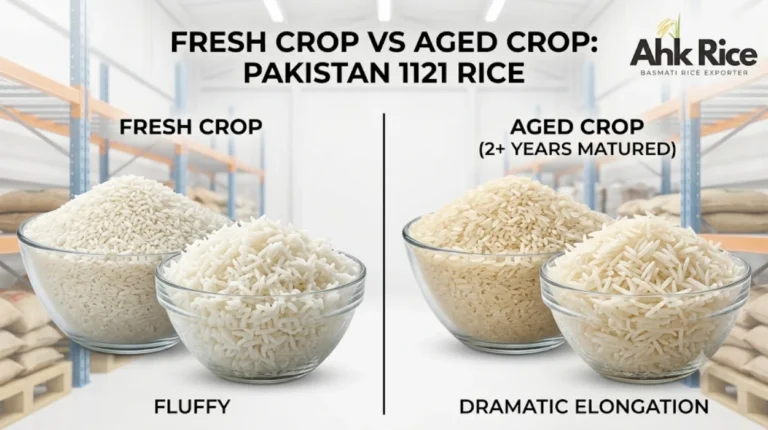
1121 Basmati naturally produces exceptional elongation because of its genetic characteristics.
Super Kernel offers balanced elongation with excellent aroma.
1509 provides shorter cooking times while maintaining attractive expansion.
Ageing
Proper ageing improves cooking stability.
Freshly harvested rice generally performs differently than properly matured rice because internal moisture gradually stabilizes.
Moisture content
Controlled moisture contributes to predictable water absorption.
Excess moisture reduces storage stability.
Insufficient moisture can influence cooking behaviour.
Milling quality
Uniform milling preserves grain integrity.
Damaged kernels reduce overall cooking consistency.
Storage
Temperature and humidity directly influence grain quality before export.
Proper warehouse management preserves cooking characteristics throughout storage.
What are the advantages and limitations of each evaluation strategy?
Every evaluation strategy offers measurable strengths and limitations. Importers achieve the most reliable purchasing outcomes by combining objective laboratory measurements with operational cooking validation and verified supplier consistency instead of relying on a single quality indicator.
Laboratory testing
Advantages
- Highly repeatable
- Numerical comparisons
- Objective documentation
- Suitable for contract specifications
Limitations
- Does not perfectly replicate every restaurant kitchen
- Controlled environments differ from commercial operations
Commercial cooking trials
Advantages
- Real menu evaluation
- Chef feedback
- Customer-focused assessment
Limitations
- Less standardized
- Results vary with cooking technique
Third-party inspection
Advantages
- Independent verification
- Increased contractual confidence
- Widely accepted internationally
Limitations
- Additional inspection cost
- Scheduling requirements before shipment
For example, a restaurant distributor importing several containers annually benefits from laboratory testing combined with commercial kitchen trials. Conversely, a retailer introducing a new product line may prioritize pilot cooking evaluations before expanding nationwide distribution.
Which evaluation method works best for different purchasing situations?
The most effective evaluation method depends on purchasing objectives, shipment size, customer expectations, quality requirements, and commercial risk. Matching evaluation strategy with procurement goals improves buying confidence while reducing quality variation across future imports of premium Basmati rice.
Decision Framework
| Purchasing Situation | Primary Objective | Recommended Evaluation Method | Expected Confidence | Best Choice |
|---|---|---|---|---|
| First supplier selection | Reduce uncertainty | Laboratory + Third-party testing | Very High | Excellent |
| Restaurant supply | Menu consistency | Commercial kitchen trial + Laboratory testing | Very High | Excellent |
| Retail distribution | Consumer satisfaction | Pilot production + Laboratory report | High | Excellent |
| Annual procurement contracts | Long-term consistency | Historical supplier analysis + Laboratory verification | Very High | Excellent |
| Private label programs | Brand protection | Full multi-stage quality evaluation | Maximum | Best Practice |
This structured approach minimizes purchasing uncertainty while improving operational predictability.
Importers increasingly evaluate suppliers based on repeatable quality systems rather than isolated product samples.
Consistent documentation supports stronger procurement decisions and more stable long-term supply relationships.
How should buyers compare suppliers when evaluating cooking yield?
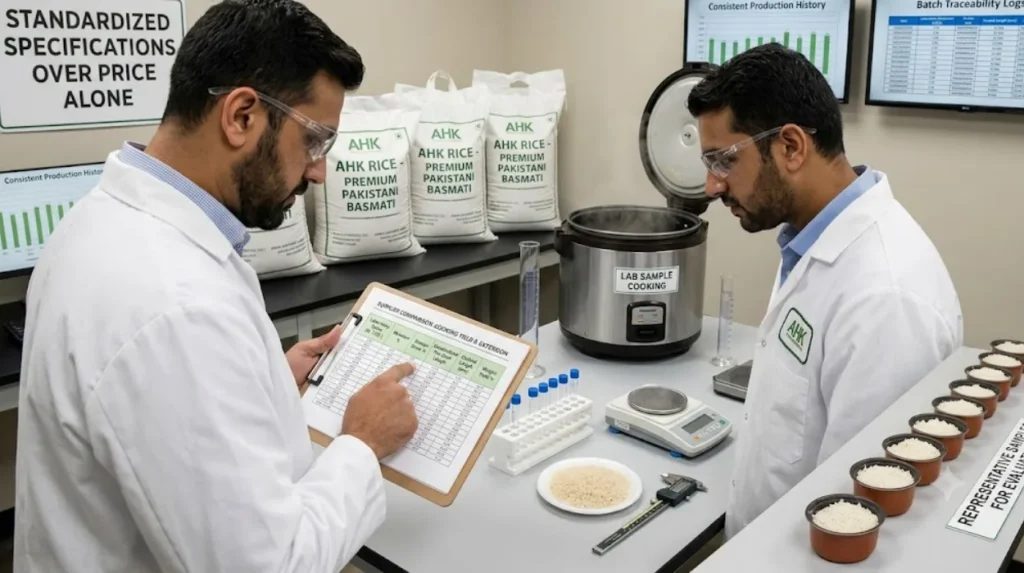
Buyers should compare suppliers using standardized specifications, documented laboratory results, consistent production history, transparent processing controls, representative samples, and repeatable cooking performance rather than evaluating appearance or price alone. This comprehensive comparison produces stronger purchasing decisions and more predictable commercial outcomes.
Supplier comparison should extend beyond grain length.
Professional procurement teams review production systems from paddy selection through final packaging.
Important comparison criteria include laboratory documentation, batch traceability, moisture control, milling consistency, ageing practices, packaging quality, export documentation, and historical shipment performance.
Exporters such as AHK Rice maintain end-to-end processing systems that enable buyers to compare batches using standardized specifications instead of subjective visual inspection alone. This structured evaluation supports wholesalers, retailers, and foodservice businesses seeking consistent cooking performance from premium Pakistani Basmati rice.
Understanding cooking yield provides a stronger foundation for evaluating suppliers, but procurement decisions also depend on selecting exporters capable of delivering consistently high elongation across commercial shipments. For buyers moving toward supplier selection, a natural next step:
How to supply USA restaurants with consistently high-elongation Pakistani Basmati rice
Frequently Asked Questions
How is cooking yield measured in premium Basmati rice?
Cooking yield is measured by evaluating water absorption, cooked volume, grain elongation, texture stability, and weight increase under standardized laboratory cooking conditions. Importers use these results to compare the performance of different Basmati rice grades before purchasing.
Why is cooking yield important for foodservice buyers?
Cooking yield determines how many servings can be prepared from each kilogram of rice. Higher and more consistent yield helps restaurants reduce food costs, maintain portion consistency, and improve operational efficiency.
Which Pakistani Basmati rice variety offers the highest cooking yield?
Premium 1121 Basmati rice generally delivers the highest cooking yield because of its extra-long grain, excellent elongation, and superior water absorption. Super Kernel and 1509 Basmati also provide strong performance for different commercial applications.
What factors affect the cooking yield of Basmati rice?
Cooking yield is influenced by rice variety, grain maturity, ageing period, moisture content, milling quality, storage conditions, and cooking method. Proper processing and storage help preserve consistent cooking performance.
How do importers compare cooking yield before placing bulk orders?
Importers compare cooking yield using laboratory reports, commercial kitchen trials, third-party inspection certificates, representative samples, and historical supplier performance to verify consistency before confirming container orders.
Does grain elongation indicate better cooking yield?
Grain elongation is one important indicator, but it is not the only measurement. Buyers also evaluate water absorption, cooked volume, grain separation, texture, and overall consistency to determine actual cooking yield.
Which export markets prioritize high cooking yield?
The United States, Canada, the United Kingdom, Saudi Arabia, the UAE, and other GCC countries prioritize high cooking yield because restaurants, wholesalers, and retail brands value consistent serving performance and customer satisfaction.
How does ageing improve cooking yield?
Proper ageing stabilizes grain moisture and strengthens the rice structure, allowing grains to absorb water more evenly, elongate better during cooking, and maintain a firmer texture with less breakage.