Is 1509 Basmati Rice Good for Restaurants and Catering?
Yes, 1509 Basmati rice suits restaurants and catering because it provides long grains, strong cooking performance, commercial yield, and consistent presentation. Here is why: 1509 averages about 8.20–8.40 mm before cooking and supports bulk dishes such as biryani, pulao, and steamed rice.
1509 Basmati is an aromatic rice variety cultivated in Punjab, Pakistan and India. Pakistan production is concentrated in Punjab. The variety has an early maturity cycle and supports high-volume commercial food preparation. Its grain structure produces long, separate cooked grains when correctly processed and cooked.
Restaurants evaluate rice differently from household buyers. Kitchen operators need predictable cooking, uniform grain size, controlled breakage, suitable cooking yield, and stable supply. Catering kitchens also need rice that performs consistently across large cooking vessels and repeated service periods.
What is 1509 Basmati rice?
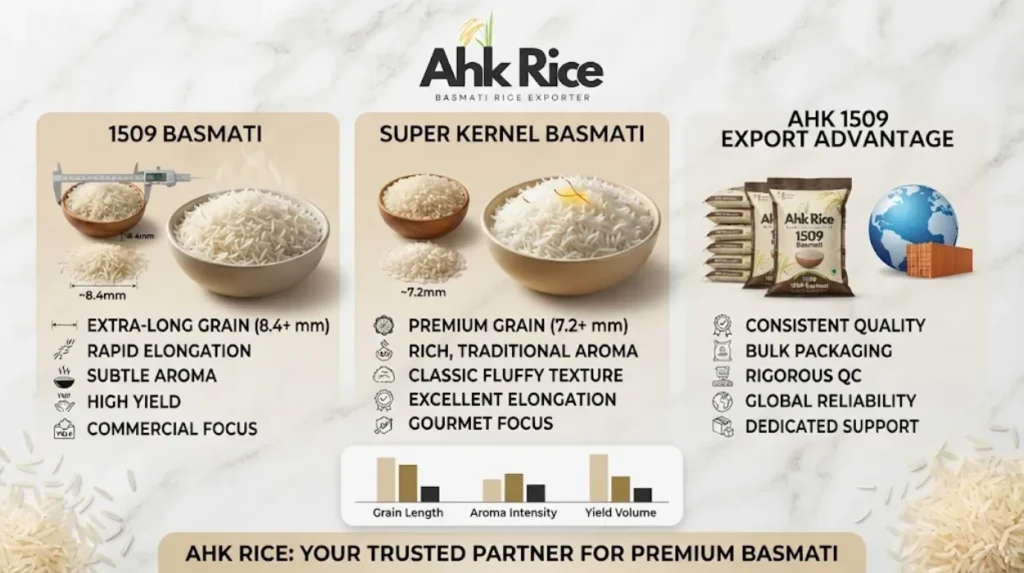
1509 Basmati rice is an extra-long aromatic Basmati variety with an average raw grain length around 8.20–8.40 mm, cultivated mainly in Punjab and processed into white, steam, and Sella forms.
1509 Basmati belongs to the modern Basmati varieties used in commercial rice production. Farmers cultivate it for its grain length, cooking expansion, aromatic character, and relatively efficient crop cycle.
The variety is especially relevant to foodservice because cooked rice needs visual consistency. Long grains create a larger plate appearance. Proper grading also reduces variation between kernels during cooking.
1509 Basmati differs from 1121 Basmati in grain profile and commercial positioning. 1121 generally commands a stronger premium for extreme grain length. 1509 provides a balance between long-grain presentation and commercial foodservice economics.
The distinction becomes clearer by examining where 1509 Basmati is cultivated and how the harvested paddy becomes finished rice.
Where is 1509 Basmati rice grown?
1509 Basmati rice is cultivated primarily in the Punjab rice-growing regions of Pakistan and India, where soil, temperature, irrigation, and seasonal conditions support aromatic long-grain production.
Pakistan’s 1509 production is associated with Punjab’s Basmati-growing belt. Farmers cultivate the crop under irrigated agricultural conditions and harvest mature paddy before delivering it to rice mills.
Punjab’s rice-processing infrastructure connects cultivation with drying, milling, grading, sorting, packaging, and export. This supply chain supports commercial buyers that require repeat shipments.
The origin also matters for procurement. Importers should record the country of origin, crop year, processing form, grain specification, moisture, broken percentage, and inspection requirements in the purchase specification.
Understanding cultivation establishes the raw material. The next stage is the processing sequence that determines restaurant cooking performance.
How is 1509 Basmati rice processed?
1509 Basmati rice passes through cleaning, drying, dehusking, polishing, grading, length sorting, quality inspection, and packaging, while Steam and Sella grades receive additional heat-based processing.
Commercial processing begins after harvested paddy reaches the rice mill. Each stage controls a different physical or quality characteristic.
- Clean the paddy to remove stones, dust, straw, and field material.
- Dry the paddy to establish controlled moisture before milling.
- De-husk the grain to remove the outer husk while protecting the kernel.
- Polish the rice to achieve the required surface appearance.
- Grade the kernels according to size and physical quality.
- Sort by length to create a more uniform commercial lot.
- Remove discolored grains through optical or mechanical sorting.
- Test moisture levels against the agreed specification.
- Inspect finished rice for foreign matter, appearance, and contracted quality.
- Pack the rice into retail, foodservice, or bulk export formats.
Steam processing adds controlled steaming before drying and final milling. Sella processing uses parboiling and drying to create a firmer kernel structure. These processes change cooking texture, appearance, grain strength, and handling characteristics.
With processing defined, the next question is which 1509 grade fits restaurant and catering kitchens.
What are the main 1509 Basmati rice grades?
The main commercial forms include 1509 White, 1509 Steam, 1509 Creamy Sella, and 1509 Golden Sella, with each grade providing different cooking, appearance, and handling characteristics.
1509 White Basmati rice
1509 White is conventionally milled and polished rice. The finished kernel has a clean white appearance and retains the characteristic Basmati grain structure.
White 1509 suits restaurants serving steamed rice, pulao, biryani, and curry-based meals. Kitchen teams can select the grade according to grain length, moisture, broken percentage, and cooking specification.
1509 Steam Basmati rice
1509 Steam receives controlled steaming during processing. The treatment strengthens the grain and supports uniform cooking.
Steam 1509 is relevant to commercial kitchens because stronger kernels help maintain grain integrity during large-batch preparation. Current commercial specifications commonly show approximately 8.4–8.45 mm average grain length for Steam grades.
1509 Creamy Sella
Creamy Sella is a parboiled form with a lighter appearance than Golden Sella. Parboiling changes the kernel structure and creates a firmer cooked texture.
This grade fits foodservice applications requiring grain separation and strong handling characteristics. The exact specification depends on the mill and contracted grade.
1509 Golden Sella
Golden Sella receives parboiling and drying that create its characteristic golden appearance. The process produces a firm grain suitable for dishes requiring strong separation.
Golden Sella is commonly associated with biryani, pulao, and high-volume foodservice applications. Commercial sources also identify Sella forms as suitable for catering and bulk kitchens.
The available grades show why the term “1509” alone does not define the finished product. The processing form determines important cooking characteristics.
Why do restaurants use 1509 Basmati rice?
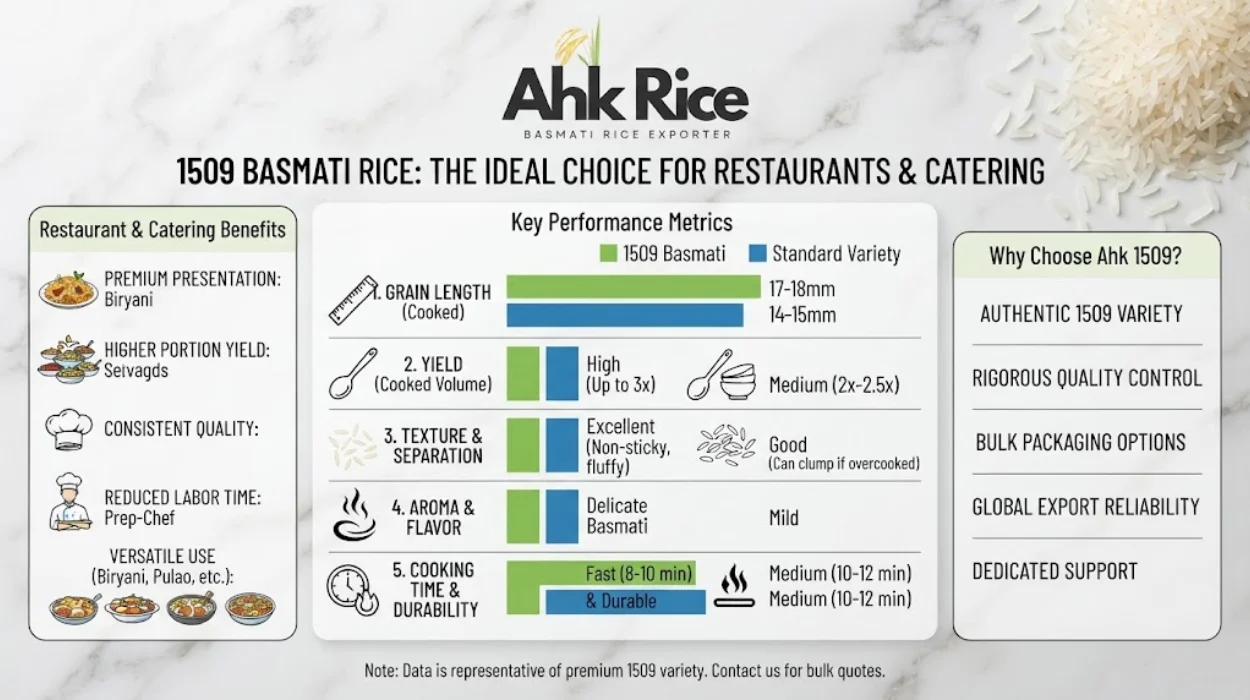
Restaurants use 1509 Basmati for long grain presentation, cooking consistency, bulk preparation, aromatic character, and commercial efficiency across biryani, pulao, steamed rice, and catering menus.
Long grain presentation
Long grains create a distinctive appearance on the plate. A raw grain length around 8.20–8.40 mm provides a visible long-grain profile before cooking.
Cooking expansion
1509 expands during cooking and produces elongated grains. The exact cooked length depends on processing, soaking, water ratio, cooking method, and rice age.
Grain separation
Properly processed 1509 produces separate cooked grains. Steam and Sella forms provide additional grain strength through controlled heat processing.
Bulk kitchen performance
Commercial kitchens prepare large quantities at once. Uniform grading helps the rice cook more evenly across a large batch.
Menu flexibility
Restaurants use 1509 for biryani, pulao, steamed rice, fried rice, banquet meals, and curry accompaniments. Catering companies also use it for institutional and event food production.
These characteristics explain the use cases. The next consideration is how restaurants should match the rice form to the dish.
Which restaurant and catering dishes use 1509 Basmati rice?
1509 Basmati fits biryani, pulao, steamed rice, banquet meals, catering trays, institutional foodservice, and high-volume kitchen production where long, separated grains support presentation.
Biryani
Biryani requires grain separation, length, aroma, and resistance to breakage during mixing. Steam and Sella forms provide firm grain structures for large-batch preparation.
Pulao
Pulao benefits from separated grains and consistent water absorption. 1509 provides the long-grain appearance expected in commercial pulao service.
Steamed rice
White and Steam 1509 can serve as plain rice alongside curries, grilled meats, vegetables, and sauces.
Catering trays
Catering operations need uniform rice across many portions. Consistent grain grading helps maintain similar appearance from the first tray to the final serving.
Institutional kitchens
Hospitals, schools, hotels, cafeterias, and large foodservice operations need repeatable cooking results. Commercial suppliers therefore specify moisture, broken percentage, grain length, purity, and processing form.
The variety supports many dishes, but correct procurement still requires a defined specification.
What specifications should restaurants check before buying 1509 Basmati rice?
Restaurants should check grain length, moisture, broken percentage, processing form, purity, crop origin, packaging, and cooking performance before approving a 1509 Basmati specification.
| Specification | Typical commercial consideration |
|---|---|
| Variety | 1509 Basmati |
| Raw grain length | 8.20–8.40 mm |
| Moisture | Maximum 13% |
| Broken grains | Contract-specific |
| Processing | White, Steam, Creamy Sella, Golden Sella |
| Origin | Pakistan |
| Packaging | 5 kg–50 kg or bulk formats |
| Purity | Contract-specific export specification |
The final contract should define every measurable parameter. Different mills publish different specifications. Buyers should therefore approve a sample and certificate of analysis against the agreed lot specification.
Restaurants should also test cooking performance in their own kitchen. Water ratio, soaking time, cooking equipment, batch size, and holding period affect the final result.
The specification framework also prevents a common misunderstanding about what “good rice” means.
What are the common problems and misconceptions about 1509 Basmati rice?
The main misconceptions concern grain length, processing grades, cooking performance, and the assumption that every 1509 lot has identical specifications. Different mills and contracts define measurable parameters differently.
1509 always has the same grain length
1509 is associated with long grains, but published specifications differ by supplier and processing form. Buyers should approve a fixed average grain length rather than rely only on the variety name.
Steam and Sella are identical
Steam and Sella use different processing treatments. Steam involves controlled steaming. Sella involves parboiling and drying. The resulting texture and appearance differ.
Longer grain automatically means better restaurant performance
Grain length affects presentation, but restaurant performance also depends on broken percentage, moisture, cooking method, and batch consistency.
Every 1509 grade cooks the same way
White, Steam, Creamy Sella, and Golden Sella have different processing histories. Kitchen teams should test the selected grade before changing their regular specification.
Price alone identifies the correct grade
A lower purchase price does not define cooking performance. Restaurants should compare the complete specification, cooking yield, breakage, and consistency.
The main conclusion is clear: 1509 Basmati is a commercially relevant restaurant and catering rice when its processing grade and specifications match the kitchen’s cooking method
Frequently Asked Questions
Is 1509 Basmati rice good for restaurants?
Yes. 1509 Basmati provides long grains, cooking expansion, aromatic character, and commercial suitability for restaurant dishes such as biryani, pulao, and steamed rice.
Is 1509 Basmati good for catering?
Yes. Its long-grain profile and available Steam and Sella processing forms suit large-batch catering and institutional foodservice.
What is the average grain length of 1509 Basmati rice?
Commercial specifications commonly place 1509 around 8.20–8.40 mm, although the contracted specification should determine the final accepted range.
Which 1509 Basmati grades are available
Restaurants should check grain length, moisture, broken percentage, processing type, purity, origin, packaging, and cooking performance before approving a shipment.