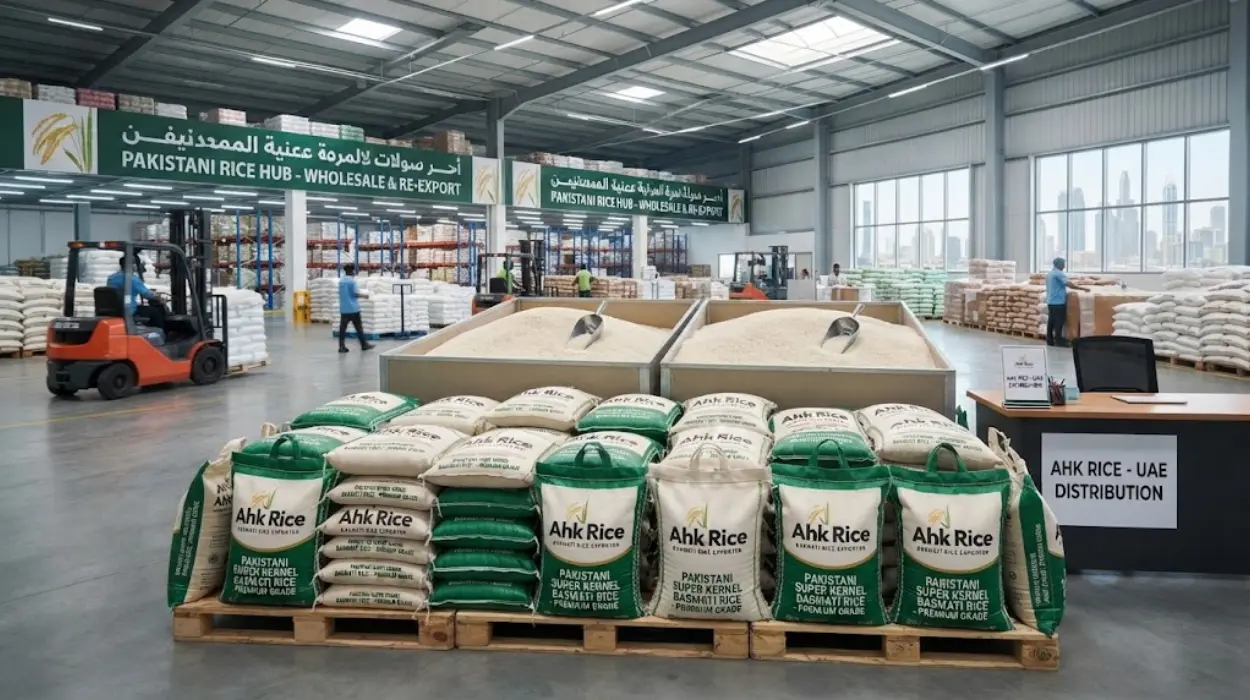
Which Pakistani Rice Grades Dominate UAE Wholesale and Re-export Markets in 2026?
1121 Basmati and Super Kernel dominate premium UAE wholesale demand, while 1509 serves price-sensitive and parboiled distribution. Here is why: December 2025 trade data recorded 74,897 tonnes of Pakistani rice entering the UAE, including 16,850 tonnes of Basmati. (source: Pakistan rice trade data reported by Dawn, January 2026)
UAE wholesale buyers need grades that combine grain appearance, aroma, cooking performance, price control, and reliable replenishment. Dubai also functions as a regional distribution hub for Gulf and African markets.
For the broader sourcing process, buyers can review how UAE rice importers and retailers source from Pakistan in 2026. The procurement decision then depends on grade, processing type, packaging, quantity, and delivery terms.
What Pakistani rice grades are best for UAE wholesale and re-export?
1121 Basmati and Super Kernel are the leading premium choices, while 1509 provides a commercial option for parboiled and value-focused distribution. Here is why: UAE buyers require consistent grain specifications across retail, foodservice, wholesale, and re-export channels.
1121 Basmati
1121 Basmati provides long grain presentation and premium positioning. White, Steam, Golden Sella, and Creamy Sella grades address different wholesale requirements.
1121 White suits premium retail packs and foodservice. 1121 Steam suits buyers seeking a clean white appearance and firm cooked grain. Golden Sella suits longer holding and bulk catering applications.
Super Kernel Basmati
Super Kernel provides traditional Pakistani Basmati aroma with strong recognition among South Asian consumers. Its commercial position combines aromatic quality with a premium wholesale specification.
Super Kernel works particularly well for ethnic retail, restaurant supply, and distributors targeting authentic Pakistani Basmati demand.
1509 Basmati
1509 provides a long-grain commercial option with strong relevance for parboiled supply. 1509 Steam and Golden Sella can serve wholesale buyers requiring consistent bulk cooking performance.
UAE trade records also show Pakistani 1509 parboiled shipments entering the market. A May 2025 shipment recorded 81,900 kg of Pakistani 1509 parboiled rice packed in 50 kg bags. (source: Volza UAE import records)
With the main grades established, the next decision is matching each specification with the correct UAE sales channel.
Which grade should UAE wholesalers choose for re-export?
Choose 1121 for premium retail, Super Kernel for aromatic ethnic demand, and 1509 for cost-sensitive bulk or parboiled distribution. Here is why: each grade creates a different balance between grain appearance, aroma, processing, cooking performance, and procurement cost.
| Buyer requirement | Suitable grade | Commercial use |
|---|---|---|
| Premium retail | 1121 White | Supermarkets and private label |
| Premium parboiled | 1121 Golden Sella | Retail and catering |
| Long-grain presentation | 1121 Steam | Restaurants and foodservice |
| Traditional aroma | Super Kernel | Ethnic retail and distributors |
| Bulk parboiled supply | 1509 Golden Sella | Wholesale and catering |
| White bulk rice | 1509 White | Value-focused distribution |
The UAE’s re-export structure makes consistency especially important. A distributor purchasing for Oman, Saudi Arabia, or African destinations needs the same approved specification across repeated shipments.
Dubai’s wholesale network connects imported rice with supermarkets, catering companies, and regional destinations.
Buyers comparing market positioning can also review the UAE Basmati market and export-destination comparison before selecting a grade.
With the grade-to-channel relationship clear, supplier execution becomes the next procurement issue.
Why choose AHK Rice for UAE wholesale supply?
AHK Rice integrates sourcing, milling, grading, packaging, quality control, documentation, and export coordination for UAE buyers. Here is why: wholesale procurement requires more than a competitive rice price.
AHK Rice supplies Pakistani Basmati from Punjab and works with specifications covering variety, processing, grain length, broken percentage, moisture, packaging, quantity, and destination.
AHK Rice manages the commercial workflow from specification approval through shipment preparation. The export process covers specification, quotation, sample, approval, milling, inspection, packaging, and dispatch.
AHK Rice also supports custom packaging for wholesale and private-label requirements. Buyers can select suitable bag sizes and packaging formats according to their distribution model.
AHK Rice provides a direct supplier relationship. This reduces the need to coordinate separate milling, packaging, inspection, and logistics providers.
AHK Rice’s export portfolio includes 1121, Super Kernel, and 1509. These varieties address premium retail, foodservice, wholesale, and distribution requirements.
The UAE export service also supports Jebel Ali shipments and UAE buyer requirements.
With supplier capabilities established, the next question is what delivery and procurement results buyers should plan for.
What shipping time should UAE rice importers expect?
UAE shipments from Karachi typically require 7–14 days of ocean transit, plus approximately 7–10 days for production and export preparation. Here is why: vessel schedules, container availability, documentation, port handling, and production requirements affect the complete procurement timeline.
For Jebel Ali, current planning guidance places sea transit around 8–12 days after vessel departure. Production and export preparation normally require another 7–10 days.
| Market | Typical sea transit | Planning point |
|---|---|---|
| UAE / Jebel Ali | 8–12 days | Primary Gulf route |
| Saudi Arabia | 10–15 days | Port and inland planning |
| Oman | 10–15 days | Vessel schedule matters |
| Qatar | 12–16 days | Direct or connecting service |
| Bahrain | 12–17 days | Gulf routing |
| Kuwait | 14–18 days | Longer Gulf transit |
AHK Rice coordinates production, inspection, documentation, container loading, customs preparation, and vessel booking within the export workflow. A buyer should therefore calculate the total lead time rather than using ocean transit alone.
UAE law also regulates agricultural imports and re-exports. Agricultural consignments require inspection and authenticated phytosanitary documentation.
Dubai’s public-health framework separately regulates imported and re-exported food, including documentation, inspection, food safety, and conformity requirements.
With shipping requirements defined, price becomes the next commercial decision.
What affects Pakistani rice prices for UAE buyers?
Rice grade, processing type, grain specification, broken percentage, moisture, packaging, order volume, freight, and Incoterm determine the final quotation. Here is why: FOB Karachi and CIF Dubai represent different cost structures.
Indicative September 2026 market data places 1121 White around US$1,165–US$1,205 per MT FOB Karachi. 1121 Sella is listed around US$1,135–US$1,175 per MT, while Super Kernel is around US$1,165–US$1,205 per MT. These figures are market indicators, not fixed AHK Rice quotations.
Packaging changes the landed cost. Standard 25 kg and 50 kg wholesale bags support bulk distribution, while smaller private-label packs require additional packaging and handling.
Quantity also affects unit economics. Full-container orders generally produce more efficient freight allocation than small mixed consignments.
AHK Rice calculates the commercial offer around the buyer’s exact specification. A comparable quote should therefore define grade, processing, packing, quantity, destination, and Incoterm before price approval.
With cost factors established, the final step is sample approval and order execution.
How can a UAE buyer start a Pakistani rice order?

Start with the exact grade, request a representative sample, approve the specification, confirm the commercial quotation, and then schedule production and shipment. Here is why: sample approval prevents buyers from committing to bulk volume without verifying the actual product.
Sample process
- Submit the specification. State the variety, processing type, grain length, broken percentage, moisture target, packing, quantity, and UAE destination.
- Review the quotation. Compare the FOB or CIF basis, packaging cost, freight, inspection requirements, and shipment schedule.
- Request the sample. AHK Rice can provide up to 20 kg of Super Kernel Basmati for sampling. The buyer covers courier shipping and applicable phytosanitary charges.
- Inspect the sample. Check grain length, aroma, appearance, cooking performance, broken percentage, moisture, and packaging suitability.
- Approve the specification. Confirm the commercial grade and quality parameters before bulk production.
- Schedule production. AHK Rice coordinates milling, grading, sorting, polishing, packaging, and inspection.
- Complete documentation. Prepare the commercial invoice, packing list, certificate of origin, phytosanitary documentation, and other destination requirements.
- Load the container. Dispatch the approved rice through Karachi after export clearance and vessel booking.
- Track delivery. Monitor vessel departure, Jebel Ali arrival, customs clearance, and warehouse delivery.
AHK Rice can therefore support the complete sequence from sample evaluation to container dispatch. This approach gives UAE wholesalers a defined decision path instead of relying on price alone.
What results can UAE wholesale buyers expect?
Buyers can expect clearer specifications, controlled processing, documented quality checks, planned shipment timing, and packaging aligned with wholesale distribution. Here is why: specification control connects product quality with commercial execution.
A premium retail importer can use 1121 for long-grain positioning. An ethnic distributor can use Super Kernel for aroma-led demand. A bulk caterer can evaluate 1509 Golden Sella for parboiled supply.
AHK Rice supports these decisions through product specifications and coordinated export preparation. A buyer can therefore compare grades before committing container volume.
The practical decision is straightforward. Match 1121 with premium presentation, Super Kernel with traditional aromatic demand, and 1509 with value-focused or parboiled distribution.
AHK Rice then converts that selected specification into sampling, production, inspection, packaging, and shipment planning. AHK Rice can then coordinate the export order through a specification-based rice export quotation.
Frequently Asked Questions
Which Pakistani rice grade dominates UAE wholesale markets?
1121 Basmati leads premium positioning.
Super Kernel serves traditional aromatic demand.
1509 supports value-focused and parboiled supply.
Grade selection depends on the buyer’s channel.
Retail, catering, and re-export needs require different specifications.
Is Super Kernel Basmati suitable for UAE re-export?
Yes, Super Kernel suits aromatic Basmati distribution.
It targets traditional South Asian consumer demand.
The grade provides strong aroma and premium positioning.
UAE distributors can use it for ethnic retail.
Final selection should follow the approved buyer specification.
How long does rice take from Pakistan to UAE?
Typical Jebel Ali sea transit is about 8–12 days.
Production normally requires another 7–10 days.
Documentation and inspection affect the complete timeline.
Vessel schedules can change the arrival date.
Buyers should plan total lead time, not sea transit alone.
What documents are needed for UAE rice imports?
Phytosanitary documentation is required for regulated agricultural consignments.
Commercial documents must match the shipment specification.
UAE authorities can inspect imported agricultural consignments.
Food imports also face safety and conformity controls.
Re-export shipments require compliance with applicable UAE requirements.
How can UAE buyers request a Pakistani rice sample?
Start by submitting the required rice specification to the exporter.
AHK Rice can provide up to 20 kg of Super Kernel for sampling.
The buyer covers courier and applicable phytosanitary charges.
The buyer evaluates the sample before bulk production.
Approved specifications then guide milling, packing, inspection, and dispatch.