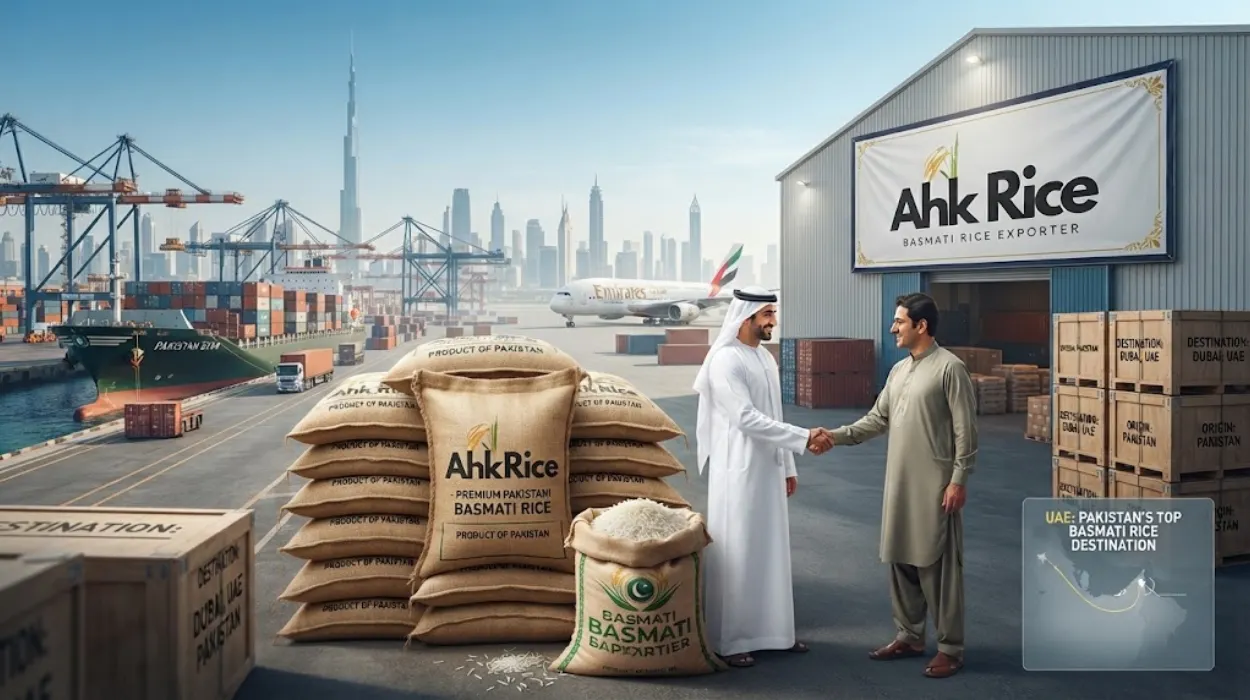
UAE as Pakistan’s Top Basmati Rice Export Destination in 2026
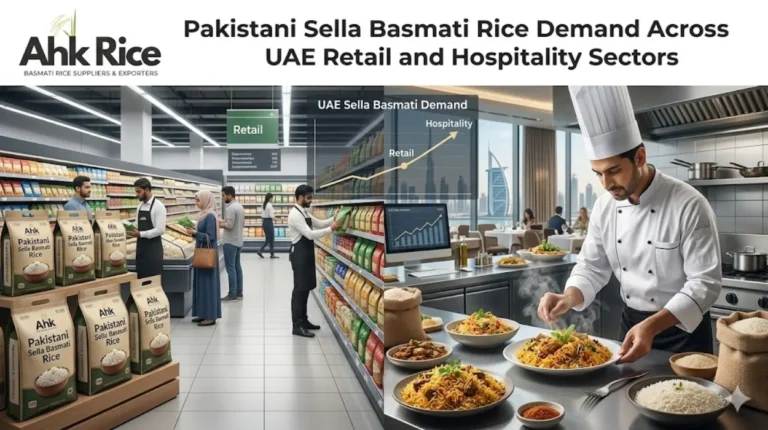
The UAE is Pakistan’s leading rice destination in the current 2026 trade cycle, with Basmati serving retail, wholesale, foodservice, and re-export demand. Here is why: December 2025 trade data placed the UAE first among Pakistani rice destinations, with 74,897 tonnes imported, including 16,850 tonnes of Basmati.
The UAE market combines domestic consumption with regional redistribution. Dubai connects Pakistani rice suppliers with supermarkets, catering companies, restaurants, wholesalers, and re-export traders. Pakistan’s overall Basmati exports reached 808,643 MT worth US$830.57 million in FY2024-25, with an average value of US$1,027.11 per MT. (source: REAP export history)
Buyers evaluating this market should first understand how the UAE rice import market works and why Pakistani Basmati is demanded. The comparison then moves from market structure to grade selection, processing method, pricing, shelf life, packaging, and re-export requirements.
What are the available Pakistani Basmati solutions for UAE buyers?
The main solutions are 1121 Basmati, Super Kernel Basmati, and 1509 Basmati, offered as White, Steam, or Sella grades for retail, wholesale, catering, and re-export channels. Each solution serves a different balance of grain length, aroma, cooking performance, storage stability, and procurement cost.
1121 Basmati
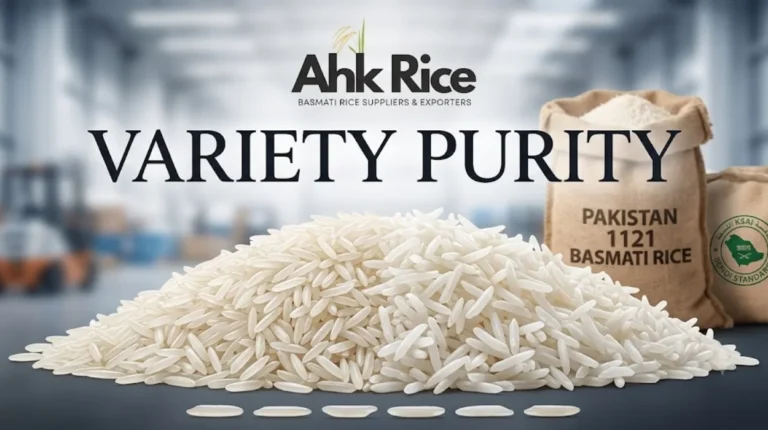
1121 Basmati represents the long-grain premium segment. Commercial specifications commonly place its raw grain around 8.2–8.5 mm, depending on the selected grade. Its long grain and cooking elongation support premium retail, hotels, restaurants, and catering.
1121 Steam suits buyers seeking a long white grain with strong cooking performance. 1121 Sella suits buyers requiring greater structural stability for bulk cooking and longer storage cycles.
UAE trade records also show 1121 Sella moving in commercial shipments. One February 2025 shipment listed 52,011 kg of 1121 Sella from Pakistan to the UAE. (source: Volza shipment data)
Super Kernel Basmati
Super Kernel Basmati provides an aromatic Pakistani Basmati option between premium long-grain positioning and commercial wholesale economics. The variety is associated with Punjab production and strong natural aroma.
Super Kernel White suits aroma-focused retail and foodservice applications. Super Kernel Steam improves grain resilience for cooked-food operations. Super Kernel therefore works across ethnic retail, restaurant supply, and distribution channels.
1509 Basmati
1509 Basmati provides a commercial alternative for buyers prioritizing volume efficiency and controlled procurement cost. AHK Rice documents 1509 with an average raw grain length of approximately 8.20–8.40 mm.
1509 Steam supports fresh restaurant and catering service. 1509 Sella supports longer storage and bulk distribution. UAE shipment records also document 1509 parboiled rice moving in commercial quantities, including an 183,600 kg shipment recorded in February 2025. (source: Volza shipment data)
AHK Rice manages sourcing, milling, grading, sorting, packaging, and export coordination through its Pakistan rice export service, allowing buyers to align product specifications with the intended UAE channel.
These three varieties establish the available product solutions; the next question is how their specifications translate into commercial differences.
How do Pakistani Basmati approaches compare for the UAE market?
1121 provides premium grain positioning, Super Kernel balances aroma and commercial value, while 1509 emphasizes volume efficiency; processing further separates Steam, Sella, and White applications. The correct comparison therefore uses specification, market use, price, storage, and logistics rather than variety name alone.
| Attribute | 1121 Basmati | Super Kernel Basmati | 1509 Basmati |
|---|---|---|---|
| Commercial position | Premium | Mid-premium | Commercial/value |
| Grain profile | Extra-long | Medium-long aromatic | Long-grain |
| Aroma | Strong | Strong | Moderate to strong |
| Processing options | White, Steam, Sella | White, Steam, Sella | White, Steam, Sella |
| Main UAE users | Retail, hotels, catering | Retail, restaurants, wholesale | Catering, wholesale, foodservice |
| Price position | Higher | Mid-range | Lower than premium 1121 |
| Storage strategy | Grade dependent | Grade dependent | Strong for Sella |
1121 remains the strongest fit for premium presentation. Super Kernel serves buyers who need aroma without selecting the highest-priced long-grain specification. 1509 provides a commercial route for large-volume buyers managing selling price and procurement cost.
Processing creates another major distinction. Steam rice retains a white appearance and strong cooking profile. Sella rice undergoes parboiling before drying and milling, creating firmer kernels and greater storage resilience.
The distinction becomes important in UAE warehouses. The UAE combines high ambient temperatures with long distribution chains. Sella therefore suits inventory programs requiring greater storage stability. Steam suits faster-moving retail and foodservice programs.
A 2026 AHK Rice market comparison places UAE export pricing broadly around US$940–US$1,280 per MT and Saudi Arabia around US$960–US$1,320 per MT. These are indicative export ranges rather than universal contract prices. Actual pricing changes with grade, milling quality, packing, Incoterm, freight, and order quantity.
The specification comparison shows why the UAE requires segmentation; the next question is how regional buyers apply these grades.
Which method works best for different UAE and Gulf market cases?
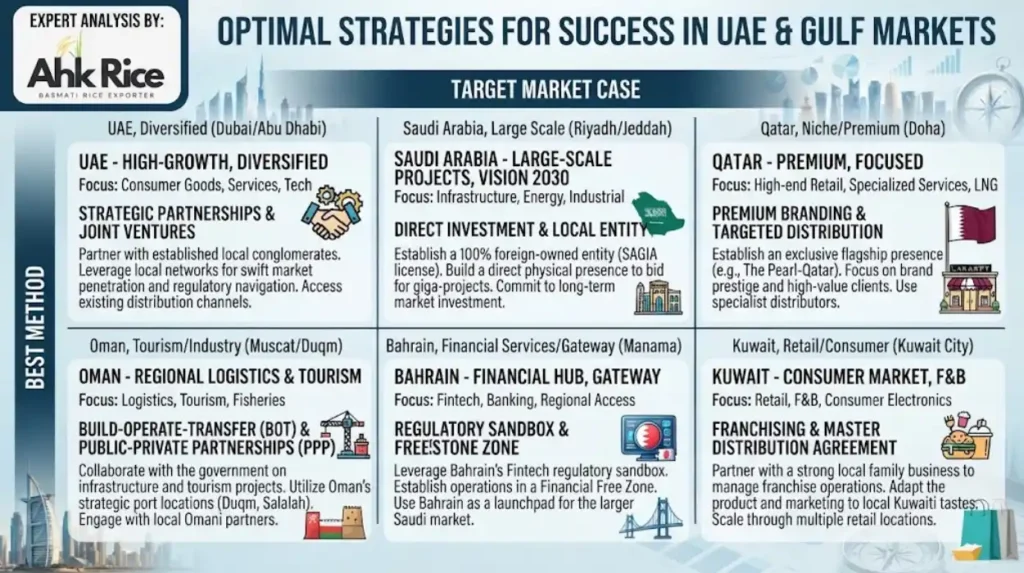
1121 Sella fits durability-focused catering and re-export programs, 1121 Steam fits premium retail, Super Kernel fits aroma-led wholesale, and 1509 fits cost-controlled volume distribution. Market channel, inventory cycle, packaging, and cooking application determine the appropriate specification.
UAE domestic retail
UAE retail buyers commonly require attractive grain appearance and consistent cooking results. 1121 Steam fits premium supermarket positioning. Super Kernel supports aromatic ethnic retail products. Smaller retail packs commonly range from 1 kg to 10 kg.
UAE catering and hospitality
Catering operations prioritize cooking consistency, holding performance, and cost per served portion. 1121 Sella supports large-volume biryani and rice preparation. 1509 Sella provides a commercial option for high-volume kitchens.
UAE re-export
Re-export traders require specifications that remain stable during warehousing and redistribution. 1121 Sella supports premium GCC redistribution. 1509 Sella supports cost-sensitive regional distribution.
Dubai’s role as a distribution centre strengthens this model. Imported rice can enter through UAE ports, move through wholesale channels, and reach GCC or African destinations. UAE regulations also cover bulk imports, retail packaging, private-label products, and re-export operations.
Saudi comparison
Saudi Arabia and the UAE both purchase Pakistani Basmati, but their commercial patterns differ. UAE trade combines domestic consumption with re-export, while Saudi demand places greater emphasis on hospitality, catering, restaurants, wholesalers, and household consumption.
The 2026 comparison data identifies 1121 Steam, 1121 Sella, Super Kernel, and 1509 among UAE procurement patterns. Saudi demand commonly includes 1121 Steam, 1121 Golden Sella, Super Kernel, and premium long-grain grades. UAE packaging can range from 1–40 kg, while Saudi commercial packaging commonly ranges from 5–40 kg.
| Market | Common grades | Indicative 2026 price/MT | Shelf-life planning | Main use |
|---|---|---|---|---|
| UAE | 1121 Steam, 1121 Sella, Super Kernel, 1509 | US$940–1,280 | 18–24 months | Retail, wholesale, catering, re-export |
| Saudi Arabia | 1121 Steam, Golden Sella, Super Kernel | US$960–1,320 | 18–24 months | Hospitality, catering, retail, wholesale |
The price range demonstrates why buyers should compare complete specifications rather than headline prices. A lower FOB price can lose its advantage through weaker grade performance, unsuitable packaging, higher breakage, or different freight terms.
The regional comparison establishes market fit; the next issue is the practical advantages and limitations of each procurement approach.
What are the pros and cons of each Pakistani Basmati solution?
1121 offers premium presentation, Super Kernel offers aroma-value balance, and 1509 offers commercial efficiency; each solution carries different storage, pricing, and positioning trade-offs. Buyers should connect these trade-offs directly to their sales channel before approving a specification.
1121 Basmati
Advantages: Long grain, premium appearance, strong cooking elongation, broad retail recognition, and suitability for premium foodservice.
Limitations: Higher procurement cost and greater sensitivity to grade specifications. Premium grades also require stronger control over broken percentage and grain uniformity.
A premium supermarket brand can justify 1121 Steam through appearance and cooking performance. A price-led catering contract can require 1121 Sella or 1509 instead.
Super Kernel Basmati
Advantages: Strong aroma, established Pakistani Basmati identity, balanced commercial positioning, and suitability for ethnic retail and foodservice.
Limitations: It does not provide the same premium long-grain positioning as top 1121 specifications. Buyers must therefore define grain length, broken percentage, moisture, and processing grade before comparing quotations.
A Dubai distributor serving South Asian consumers can use Super Kernel to maintain aromatic positioning without moving entirely into the highest premium segment.
1509 Basmati
Advantages: Commercial pricing, long-grain appearance, strong catering suitability, and useful Sella performance for storage-oriented distribution.
Limitations: Premium retail buyers can prefer 1121 because of its longer grain profile and stronger premium positioning.
A high-volume caterer can therefore prioritize 1509 Sella, while a premium retail importer can prioritize 1121 Steam.
These trade-offs show that product selection should follow the buyer’s operating model rather than a generic grade ranking.
What decision factors should UAE rice importers evaluate?
UAE buyers should evaluate grain length, processing method, broken percentage, moisture, packaging, price per MT, shelf life, documentation, and delivery terms before approving a rice specification. These factors determine whether the cargo performs commercially after import, storage, distribution, and resale.
| Decision factor | What to check | Commercial impact |
|---|---|---|
| Grain specification | Length, purity, appearance | Determines market positioning |
| Processing | White, Steam, Sella | Controls cooking and storage behavior |
| Broken percentage | Contracted maximum | Influences yield and presentation |
| Moisture | Contracted maximum | Supports storage stability |
| Packaging | PP, BOPP, retail, private label | Changes handling and branding cost |
| Price | FOB or CIF per MT | Defines procurement baseline |
| Shelf life | Remaining life at shipment | Protects inventory planning |
| Documentation | Phytosanitary, origin, invoice, packing list | Supports customs clearance |
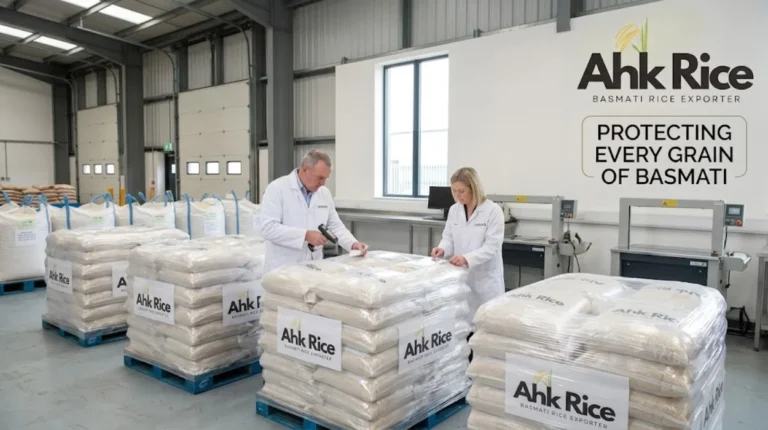
| Inspection | Pre-shipment testing | Reduces specification disputes |
UAE importers should also evaluate the delivery route. Pakistan-to-UAE shipments commonly move through Karachi toward Jebel Ali. A 2026 AHK Rice logistics guide gives a typical Pakistan-UAE shipping range of 7–14 days, depending on vessel schedules and logistics conditions.
Quality documentation remains equally important. Common export documents include the phytosanitary certificate, certificate of origin, fumigation certificate, packing list, commercial invoice, bill of lading, and inspection certificate. UAE requirements also include food safety, labeling, customs, and traceability controls.
The decision framework converts grade comparison into procurement criteria; the final step is matching those criteria with the intended UAE business model.
What is the practical decision framework for UAE buyers?
Choose the specification by sales channel, storage cycle, price target, packaging model, and redistribution route rather than selecting one grade for every UAE order. This framework gives importers a repeatable method for evaluating quotations from Pakistani suppliers.
| Buyer requirement | Specification direction | Reason |
|---|---|---|
| Premium retail | 1121 Steam | Long grain and presentation |
| Large catering | 1121 Sella or 1509 Sella | Bulk cooking and storage |
| Aroma-led wholesale | Super Kernel | Strong aromatic positioning |
| Cost-controlled distribution | 1509 | Commercial volume economics |
| Regional re-export | 1121 Sella or 1509 Sella | Storage-oriented distribution |
A UAE importer should therefore request quotations against a fixed specification. The quotation should state variety, processing grade, grain length, broken percentage, moisture, purity, packing, quantity, origin, Incoterm, destination, and inspection terms.
AHK Rice supplies 1121, Super Kernel, and 1509 Basmati rice varieties from Punjab to international markets. Its export model covers sourcing, processing, grading, custom packaging, documentation, and shipment coordination.
The UAE’s position as a major Pakistani rice destination makes specification discipline more important than selecting rice by variety name alone. The market combines premium retail, catering, wholesale, and re-export demand. Buyers gain stronger procurement control by matching each channel with the appropriate grain and processing specification.
For the next decision stage, readers can compare the specific Pakistani grades used across UAE wholesale and re-export channels in Which Pakistani Rice Grades Dominate UAE Wholesale and Re-export Markets in 2026.
FAQs About Pakistan’s Basmati Rice Exports to the UAE
Why is the UAE a major destination for Pakistani Basmati rice?
The UAE combines domestic consumption, wholesale distribution, foodservice demand, and regional re-export activity. Dubai provides access to supermarkets, restaurants, catering companies, wholesalers, and GCC markets, creating multiple channels for Pakistani Basmati rice.
Which Pakistani Basmati grades are commonly used in the UAE?
1121, Super Kernel, and 1509 Basmati serve the main commercial requirements. 1121 suits premium retail and foodservice. Super Kernel supports aroma-focused wholesale. 1509 suits catering, wholesale, and cost-controlled distribution.
Is 1121 Basmati suitable for UAE wholesale buyers?
Yes, 1121 Basmati suits premium wholesale, retail, hotels, restaurants, and catering applications. 1121 Steam provides long white grains and strong presentation. 1121 Sella provides greater grain resilience for bulk cooking and storage.
Is Super Kernel Basmati suitable for the UAE market?
Super Kernel suits aroma-focused retail, ethnic distribution, restaurants, and wholesale channels. Its strong natural aroma gives distributors a Pakistani Basmati option with a commercial positioning between premium 1121 and cost-focused 1509.
Is 1509 Basmati suitable for UAE catering?
Yes, 1509 Basmati suits high-volume catering because it combines long-grain presentation with commercial procurement economics. 1509 Steam supports fresh cooking and service. 1509 Sella suits bulk cooking and longer inventory cycles.
Which Basmati grade suits UAE re-export markets?
1121 Sella and 1509 Sella suit storage-oriented re-export programs. Sella processing improves kernel firmness and supports longer inventory planning. 1121 Sella serves premium regional redistribution, while 1509 Sella supports cost-controlled volume distribution.
What is the difference between Steam and Sella Basmati rice?
Steam rice provides a white appearance and strong cooking performance, while Sella rice provides firmer kernels and greater storage resilience. Steam commonly suits faster-moving retail and foodservice. Sella suits catering, wholesale inventory, and re-export operations.
What factors determine Pakistani Basmati rice prices in the UAE?
Grade, grain length, broken percentage, moisture, processing, packaging, quantity, freight, destination, and Incoterm determine the final quotation. Buyers should compare complete specifications rather than evaluating suppliers only by price per metric ton.
What documents do UAE rice importers require?
Common export documents include the commercial invoice, packing list, certificate of origin, phytosanitary certificate, fumigation certificate, bill of lading, and applicable inspection documents. UAE food safety, labeling, customs, and traceability requirements also apply.
How should UAE buyers compare Pakistani rice suppliers?
Buyers should compare specifications, processing consistency, quality testing, packaging, documentation, shipment planning, and commercial terms. A fixed specification makes quotations easier to compare and reduces disputes over grain length, broken percentage, moisture, and packing.
What packaging options can Pakistani rice exporters provide for UAE buyers?
UAE rice can be supplied in retail, wholesale, and custom private-label packaging formats. Packaging selection depends on the sales channel, order quantity, handling requirements, brand positioning, and destination market.