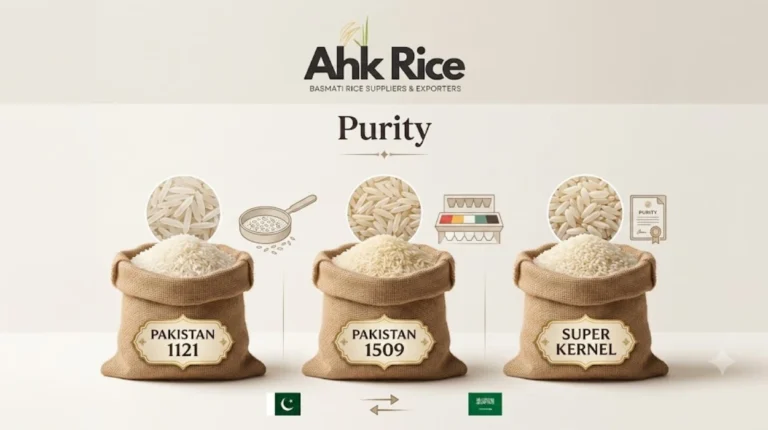
Buy DNA-Verified Pure Pakistani Basmati Rice for UAE Private Label Brands
UAE private label brands need Pakistani Basmati rice that meets defined purity, grain quality, cooking performance and packaging requirements. DNA testing helps verify varietal identity, while physical inspection and laboratory analysis address additional quality risks. Buyers should approve the specification, test a representative sample and confirm shipment controls before placing a commercial order. Understanding how Basmati rice purity is measured and adulteration detected provides the foundation for making this purchasing decision.
What Is the Best Solution for Buying DNA-Verified Pure Pakistani Basmati Rice?
The best solution combines DNA-based varietal verification, documented product specifications, representative sample approval and pre-shipment quality checks. UAE importers should confirm that testing covers the intended rice variety and that the commercial shipment matches the approved sample, specification and packaging requirements.
DNA testing examines genetic markers to assess whether a rice sample matches the declared variety or reference profile. This is particularly useful for private label brands selling premium 1121, Super Kernel or 1509 Basmati rice, where authenticity affects product positioning and buyer confidence.
However, DNA testing does not independently establish every aspect of rice quality. It does not automatically confirm moisture, broken-grain percentage, pesticide residues, cooking performance or freedom from foreign matter. These require appropriate physical inspections, laboratory tests and cooking evaluations.
For a reliable procurement process, UAE buyers should establish the following controls:
- Varietal identity: Specify 1121, Super Kernel or 1509 and request suitable DNA verification.
- Physical specifications: Agree on grain length, broken percentage, moisture, foreign matter and processing type.
- Laboratory evidence: Review the report, sample identification, test method and laboratory details.
- Cooking performance: Evaluate aroma, elongation, texture, water absorption and grain separation.
- Shipment consistency: Establish how the final lot will be inspected and compared with the approved specification.
AHK Rice supplies Pakistani Basmati varieties through its rice sourcing, processing and export service, supporting buyers who need defined specifications and coordinated export preparation. The purchasing decision should depend on documented evidence and agreed acceptance criteria, not simply on a supplier’s purity claim.
Why Should UAE Importers Choose AHK Rice?
AHK Rice is a Pakistani Basmati rice exporter based in Punjab, supplying 1121, Super Kernel and 1509 varieties to international markets. UAE private label buyers should evaluate its product specifications, available testing documentation, sample consistency, packaging options and ability to meet the agreed shipment requirements.
Private label procurement involves more than selecting a rice variety. Importers must coordinate product positioning, packaging artwork, bag sizes, labeling information, shipping arrangements and destination documentation. Unclear specifications can create disputes when the delivered rice differs from the sample or the retail product requirements.
AHK Rice supports the sourcing and export workflow, including processing coordination, grading, sorting, custom packaging and shipment preparation. Buyers should confirm which DNA tests and laboratory certificates are available for the specific lot before treating genetic verification as a confirmed service deliverable.
The three principal varieties serve different commercial purposes:
| Variety | Commercial positioning | Purchasing consideration |
|---|---|---|
| 1121 Basmati | Premium retail, biryani and foodservice | Long grain and cooked elongation |
| Super Kernel Basmati | Aromatic ethnic retail and wholesale | Aroma, grain consistency and price positioning |
| 1509 Basmati | Value-focused retail and bulk supply | Yield efficiency, cooking performance and cost |
AHK Rice can help buyers define the relevant grade and packing requirements before an order is finalized. For a private label project, the importer should request a written specification sheet, confirm available test reports and agree on the inspection procedure.
Buyers who need additional technical guidance should also review what UAE importers should ask exporters about DNA testing for Basmati rice purity. This comparison-stage resource should support the decision about which evidence is appropriate for the intended product.
What Results Can UAE Private Label Brands Expect?
A properly controlled sourcing process gives importers stronger evidence of varietal identity, clearer quality acceptance criteria and better consistency between the approved sample and commercial shipment. Results depend on representative sampling, suitable testing, accurate documentation and effective production controls.
DNA verification can reduce uncertainty about whether a rice sample matches its declared varietal identity. Combining it with physical grading and cooking tests helps buyers assess whether the product meets their brand’s requirements.
Consider a Dubai distributor launching a premium 1121 Basmati label. The importer specifies grain characteristics, maximum moisture, broken percentage, aroma and packaging. A representative sample undergoes DNA verification and cooking evaluation before the buyer approves the specification.
Before dispatch, the importer requests the agreed inspection records and verifies that the shipment documentation identifies the correct lot. This process creates a traceable purchasing record and reduces the risk of accepting a product based solely on a sales sample.
Expected benefits include:
- Better evidence supporting variety-related product claims.
- Clearer acceptance criteria for supplier and buyer.
- More consistent retail positioning across repeat orders.
- Reduced ambiguity during quality disputes.
- Improved coordination between testing, packing and shipment preparation.
These controls do not guarantee zero adulteration or identical cooking results in every batch. The outcome depends on the scope of testing and the quality controls used throughout procurement and processing.
How Much Does DNA-Verified Basmati Rice Cost?
The final cost depends on the rice variety, grade, testing scope, order volume, packaging, inspection requirements and delivery terms. Buyers should obtain separate quotations for rice, testing, samples, packaging and freight rather than assuming DNA verification is included in the base price.
A practical quotation should distinguish the following cost components:
| Cost component | What determines the price |
|---|---|
| Rice supply | Variety, crop, grade, processing and order quantity |
| DNA testing | Laboratory, method, sample count and report scope |
| Physical laboratory tests | Moisture, broken grains, residues or other requested parameters |
| Commercial samples | Sample preparation, packaging and courier charges |
| Private label packaging | Bag material, weight, printing, artwork and order quantity |
| Inspection | Sampling plan, inspection provider and testing requirements |
| Freight and destination charges | Shipment size, route, Incoterm and destination handling |
DNA testing costs vary by laboratory and method. Request a written laboratory quotation before budgeting, and confirm whether the charge covers one sample, multiple samples or a complete commercial lot.
For sample shipments, the buyer should confirm the courier fee, collection arrangements and any applicable import permits, phytosanitary requirements or clearance charges. These costs depend on the shipment and destination requirements; they should not be assumed to be fixed.
For bulk orders, compare quotations using the same specification and Incoterm. FOB pricing generally covers delivery to the agreed loading point under the applicable contract, while CIF includes cost, insurance and freight to the named destination port. Neither quotation automatically includes every destination import charge.
A lower price per metric tonne is not necessarily the better commercial option if the rice fails the required specifications or generates additional testing and rejection costs.
How Long Does Shipping Take From Pakistan to the UAE?
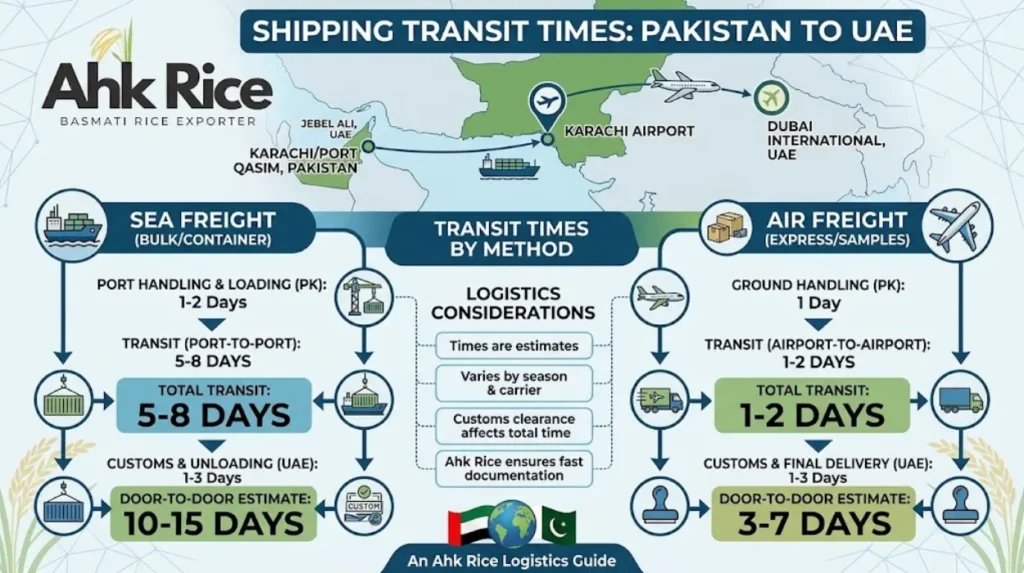
Sea freight from Karachi to UAE ports commonly takes several days to around two weeks of ocean transit, depending on the destination and sailing schedule. Allow additional time for production, testing, customs clearance, port handling and delivery to the buyer’s warehouse.
Planning estimates should be confirmed with the shipping line or freight forwarder for the actual booking.
| Destination | Indicative sea transit planning range |
|---|---|
| Jebel Ali, Dubai | Approximately 3–10 days |
| Khalifa Port, Abu Dhabi | Approximately 4–12 days |
| Sharjah or other UAE destinations | Approximately 4–14 days, depending on routing |
These are indicative planning ranges, not guaranteed schedules. Transshipment, vessel availability, port congestion and the selected service can change transit times. Door-to-door delivery takes longer than ocean transit alone.
Importers should separate the production and approval timeline from the sailing timeline. A first private label order requires time for sample evaluation, DNA testing, packaging approval and production scheduling. Repeat orders can be planned more efficiently when specifications and artwork are already approved.
How Does the Sample and DNA Verification Process Work?
Start with a defined product specification, request a representative commercial sample, agree on the testing scope and approve the results before confirming bulk production. The buyer should establish sample costs, laboratory responsibilities, acceptance criteria and shipment controls in writing.
The recommended workflow is:
- Define the product. Select 1121, Super Kernel or 1509 and specify processing type, grain requirements, moisture, broken percentage and packaging.
- Request the sample. Ask AHK Rice to confirm sample availability, quantity, preparation time and dispatch arrangements. A cooking sample and a DNA-testing sample may require different quantities and handling.
- Confirm sample costs. Obtain the sample charge, courier quotation and any applicable documentation or clearance costs. If the supplier offers a complimentary sample, confirm the conditions in writing.
- Arrange DNA testing. Agree whether the supplier or buyer will arrange testing. Confirm the laboratory, reference variety, sample identification, method and report format. A buyer may prefer independent testing for greater control.
- Evaluate the rice. Review the DNA report alongside physical grading, visual inspection and cooking performance. Request additional laboratory testing when required by the destination market or the buyer’s food-safety program.
- Approve the specification. Record the accepted variety, test results, tolerances, packaging design and inspection procedure. A sample approval should identify the sample and applicable production lot.
- Inspect and dispatch the order. Confirm the production batch, packing details, required certificates and shipping documents before shipment. Where agreed, arrange representative pre-shipment sampling and inspection.
A commercial sample is evidence for evaluation, not automatic proof that the entire shipment is identical. Buyers should establish lot-specific sampling and inspection requirements before production begins.
How Should Buyers Finalize a Private Label Rice Order?
Finalize the purchase only after the supplier has confirmed the product specification, testing arrangements, packaging requirements, delivery terms and acceptance procedure. A written purchase order should define responsibilities clearly and identify the documents required before dispatch.
Before approving an order with AHK Rice, UAE importers should confirm:
- The declared variety and agreed DNA verification scope.
- The required grain, moisture and broken-grain specifications.
- The laboratory report and any additional food-safety tests.
- Retail bag weights, printing, labeling and packaging materials.
- Quantity, price, Incoterm, shipment schedule and destination port.
- Sample approval, pre-shipment inspection and dispute procedures.
The importer should also confirm current UAE import and labeling requirements with its customs broker or relevant authority. Requirements depend on the product, shipment and applicable regulations.
For new brands, a smaller initial order can help validate consumer response and operational consistency before scaling distribution. Established distributors may prefer a repeatable specification and testing protocol that can be applied to subsequent consignments.
The strongest purchasing decision is based on verified evidence, agreed tolerances and a transparent commercial process. DNA testing supports varietal authenticity, while laboratory analysis, physical inspection and documented shipment controls address the other requirements of private label procurement.
Contact AHK Rice today and submit your requirements through the quotation request form to receive a tailored export proposal.
Frequently Asked Questions
Does DNA testing prove that Pakistani Basmati rice is completely pure?
DNA testing helps assess varietal identity against an appropriate reference.
Its reliability depends on the test method and sample quality.
It does not independently measure every form of adulteration.
Physical inspection and additional laboratory tests may be necessary.
Buyers should review the report’s scope before approving a shipment.
Which Pakistani Basmati variety is best for UAE private labels?
1121 suits premium brands seeking long grains and cooked elongation.
Super Kernel suits aromatic retail and wholesale positioning.
1509 can suit value-focused products and bulk distribution.
The best option depends on the target consumer and budget.
Approve a representative sample before selecting the commercial grade.
Can UAE importers request DNA testing before bulk orders?
Yes, buyers can request testing arrangements before confirming a bulk order.
The supplier and buyer should agree on the laboratory and method.
Sample identification and chain of custody should be documented.
Testing costs and turnaround times should be confirmed in advance.
Bulk production should follow written sample and specification approval.
What does a DNA-verified Basmati rice sample cost?
Costs depend on sample quantity, laboratory charges and courier arrangements.
Some suppliers may offer complimentary rice samples under specific conditions.
Courier fees and applicable clearance charges may remain payable.
Independent laboratory testing may incur a separate fee.
Request an itemized quotation before dispatch.
How can buyers reduce the risk of receiving inconsistent rice?
Set written limits for moisture, broken grains and other quality parameters.
Approve the variety and cooking performance using a representative sample.
Require relevant test reports and lot identification.
Agree on pre-shipment inspection and document requirements.
Apply the same acceptance criteria to repeat orders.